
The Enemy: Ninja Dropouts
Naruto, Sakura and Lee escort captured rogue ninja Gantetsu by riverboat, but Captain Todoroki’s private revenge makes the prisoner’s own guard detail another threat.
Naruto is assigned to protect a criminal from the criminal's former gang.
That would already be a difficult escort mission.
Then the captain of the escort decides he may want the prisoner dead too.
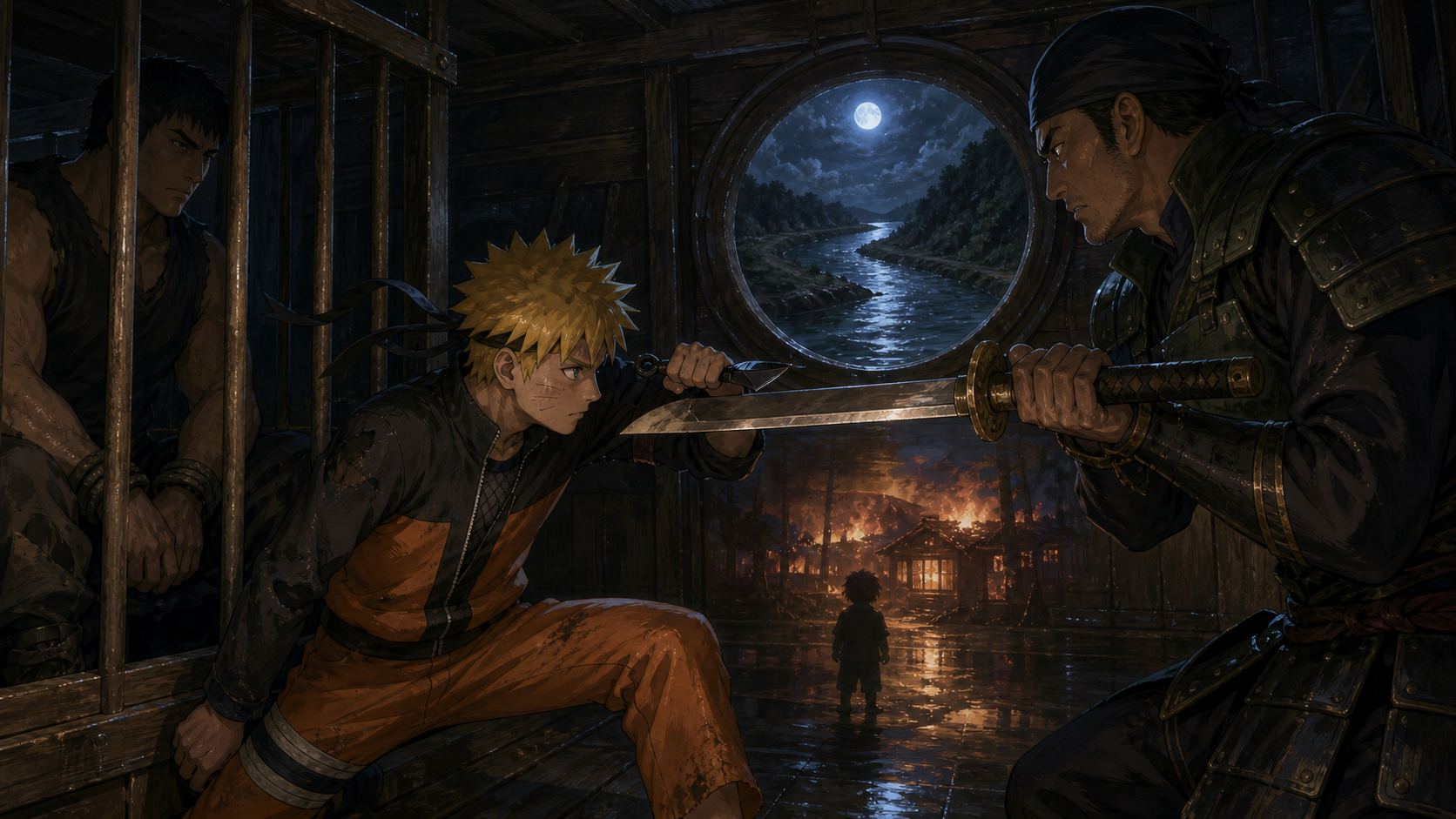
`The Enemy: Ninja Dropouts` begins a new four-episode mission with a cage, a riverboat, and a guard detail carrying more anger than discipline. Gantetsu once belonged to a gang of rogue ninja called the Shinobazu. He has been captured and must reach the Land of Forests capital alive for interrogation and trial.
Naruto, Sakura, and Lee are there to make sure he does.
Captain Todoroki is less certain about the alive part.
The Shinobazu Burn the Evidence
The order to burn everything establishes how the gang protects itself. It does not merely steal and flee. It destroys witnesses, records, shelter, and any physical trail that could support a later investigation. Violence is part of its cleanup procedure.
Monju's discovery of the child creates a private test for Gantetsu, but the camera withholds the result. That choice prevents the opening from becoming proof for either side. Todoroki's hatred will soon make Gantetsu look unquestionably guilty. The missing action reminds us that certainty and complete evidence are not the same thing.
It also tells us why a live transfer matters. If the Shinobazu routinely erases evidence, a captured insider may be the only surviving route to names, methods, victims, and crimes that never reached an official record.
The episode opens during a raid.
The Shinobazu move through a home as thieves who have done this before. Monju discovers a child. Gantetsu is told to handle the problem, and the gang prepares to burn the place so no evidence remains.
We do not see enough to know exactly what Gantetsu does.
That missing piece matters.
The scene establishes the gang's cruelty without giving us a clean answer about the man who will spend the episode inside a cage. Gantetsu was present. He followed the group. A child was left in his hands. The episode wants us to remember all three facts while refusing to arrange them into a verdict yet.
It is a stronger opening because it leaves room for suspicion.
Gantetsu does not need to twirl a villain mustache. The burning building does enough talking.
Naruto and Lee Discover Professional Training
Back in Konoha, Naruto and Lee are conducting what they consider valuable combat training.
Naruto creates a crowd of shadow clones. Lee punches through them. Both boys congratulate themselves on the efficiency of the arrangement.
Sakura observes that they are slugging it out for fun.
Both descriptions are correct.
The sparring also gives us the right team energy before the mission begins. Naruto brings instinct and refusal to stay quiet. Lee brings commitment so intense that standing guard will become a sacred duty. Sakura brings the practical judgment required whenever the other two start congratulating each other.
Tsunade interrupts the recreation with an actual assignment.
A Rogue Ninja Gang Without a Village
The name `Ninja Dropouts` can make the group sound like a collection of failures who wandered away from training. That is misleading. These are trained operatives who rejected the limits and accountability attached to service while keeping every technique that makes organized crime more dangerous.
Their border-spanning activity creates an information problem. One jurisdiction may know about a robbery, another about a burned house, and another only about a wanted notice. Bringing Gantetsu to the capital could connect those fragments. Killing him on the boat would protect the gang's secrecy as effectively as one of its fires.
That is why due process is not an abstract kindness offered to a criminal. Interrogation and trial serve victims too. A quick execution may satisfy rage while destroying the testimony needed to identify everyone else responsible.
Tsunade explains that the Ninja Dropouts are rogue ninja who voluntarily abandoned their villages and joined together.
Leaving a village is not their defining offense. What they do afterward is.
The Shinobazu use shinobi training for organized theft, intimidation, and murder. They are known across national borders for brutal methods. Gantetsu is the only member whose wanted notice has circulated widely, and authorities found him wandering near Ogi Pass in the Land of Forests.
He now needs transport to the capital.
The distinction between capture and conviction becomes important almost immediately. Gantetsu is restrained. He is dangerous. He is also a prisoner who must be questioned and tried, not a target placed inside a convenient box.
Naruto understands that before the professional guards do.
His legal education appears to consist of common sense and yelling, but the common sense is sound.
Captain Todoroki Does Not Want Children on His Ship
Todoroki's age objection is not entirely ridiculous. Naruto and Lee greet a tense international detail by insulting his sword, and Sakura immediately has to repair the conversation. Nothing about that entrance advertises disciplined reinforcement.
The problem is that Todoroki uses their immaturity as a reason to exclude oversight. He controls the guards, the ship, the cage, and access to Gantetsu. Independent shinobi complicate a plan that depends on everyone accepting his decisions without seeing the motive behind them.
His promise to guard the prisoner `on his sword` carries two meanings. To the group, it sounds like a pledge of competence. To Todoroki, the sword may be the instrument through which he settles the mission before it reaches the capital.
The Leaf team meets the Land of Forests guard detail and receives a chilly welcome.
Todoroki looks at Naruto, Sakura, and Lee and sees children. He says his own people can protect the prisoner and objects to Konoha joining the transfer.
Naruto and Lee respond by mocking Todoroki's sword.
Sakura apologizes because she would like the international mission to survive its first conversation.
Todoroki promises on that sword that his squad will guard Gantetsu. The promise sounds honorable until we understand that Todoroki and Gantetsu share a history. He is not merely offended by young reinforcements. He wants control over the prisoner and does not want witnesses close enough to interfere.
The cage is lowered into the belly of a riverboat. Todoroki's guards keep the Leaf shinobi at a distance.
Naruto hates being treated like extra luggage.
For once, his inability to sit quietly is exactly what the mission needs.
The Escort Captain Enters the Prisoner's Hold
The river trip is calm enough to bore Naruto.
Sakura reminds him that boredom is the best possible outcome. Their job is to deliver Gantetsu safely, not hope for an ambush so they can demonstrate how impressive they are.
Naruto agrees for almost several seconds.
Then he decides to perform his own guard duty near the cage. He sees Todoroki enter the hold alone and follows.
Todoroki looks at Gantetsu and remembers fire.
He remembers his father and mother. He remembers calling for his younger brother, Akio, while the family home burned. In Todoroki's mind, Gantetsu is not an abstract prisoner or a name on a wanted notice. He is part of the gang that destroyed everyone Todoroki loved.
The captain draws his sword.
This is why he did not want help.
Naruto Stops an Execution
Naruto's position is stronger because he does not claim Gantetsu deserves trust. He claims the prisoner deserves to arrive. That limited principle survives every uncertainty the episode creates. Gantetsu may be guilty of terrible crimes, but Todoroki cannot appoint himself witness, judge, and executioner inside a locked hold.
The attempted killing would also betray Todoroki's own guard squad. His subordinates believe they are carrying out a lawful transfer under his command. He uses their labor and reputations to place himself within reach of revenge. If Naruto had not followed, every guard aboard could have become associated with a prisoner's unexplained death.
Respecting Todoroki's grief means taking its force seriously, not pretending it authorizes anything. The memory of Akio and his parents explains why he draws the blade. It cannot make the blade lawful or wise.
Naruto interrupts before Todoroki can strike.
Todoroki first pretends Naruto misunderstood the scene. Why would the captain assigned to guard Gantetsu try to kill him?
The answer is standing in Todoroki's hand.
Naruto refuses to accept the denial. A criminal still cannot be killed before interrogation. The mission requires custody, and custody is not revenge with paperwork.
Todoroki finally drops the performance. He says Gantetsu and the Shinobazu slaughtered people without mercy, including innocent children. From his perspective, no investigation could uncover anything that changes the result.
His grief is real.
His conclusion is still dangerous.
Todoroki has converted personal certainty into a private death sentence. He leads the people responsible for keeping Gantetsu alive, which gives him access, authority, and an excuse to be alone with the prisoner. The mission has safeguards against the Shinobazu attacking from outside. It has none against its captain becoming the threat.
Except Naruto.
That may be the first time anyone has described Naruto's refusal to mind his own business as a safeguard, but here we are.
Gantetsu Says Almost Nothing
Silence makes Gantetsu difficult to read because it can serve opposite meanings. A guilty man may see no advantage in speaking. A frightened witness may know that naming the truth will put other people at risk. A person carrying shame may accept punishment for actions that are not the whole story.
Episode 209 refuses to choose among those readings. Even his physical stillness inside the cage provides no reliable verdict. Resignation can look like indifference when the audience lacks the history behind it.
Naruto's intervention therefore protects narrative uncertainty as well as legal process. Gantetsu remains available to answer questions later, and Todoroki remains capable of learning that his memory does not contain every fact.
The prisoner does not defend himself while Todoroki raises the sword.
Gantetsu does not explain the burning home, ask Naruto for sympathy, or offer a convenient confession. He remains quiet enough to make every possibility uncomfortable.
Maybe he is guilty and resigned.
Maybe he knows something Todoroki does not.
Maybe the cold open showed an act the episode has deliberately hidden from us.
Naruto does not need to settle any of those questions before intervening. That is the point. Preventing an execution is not the same as declaring Gantetsu innocent. It preserves the chance to learn what happened through something other than Todoroki's blade.
An escort mission protects more than a body. It protects the possibility of truth.
Sakura Notices a River That Should Not Exist
Sakura's observation is the first successful piece of guard work after the transfer begins. Todoroki focuses on the prisoner. Naruto focuses on Todoroki. Sakura checks the route itself. Her broader attention catches the attack before a visible enemy gives it away.
The false tributary shows that the Shinobazu planned around the ship rather than merely chasing it. They control where the guards will be separated, where support becomes difficult, and where the current prevents an easy correction. The technique turns navigation into capture.
Monju's cutting lines then exploit a vessel already committed to the wrong waterway. The two steps reveal organization behind the gang's brutality. These are not random bandits with stolen jutsu. They study movement, create the terrain they need, and strike after the target loses its escape route.
While Naruto and Todoroki argue below deck, Sakura notices something wrong with the route.
A tributary has appeared where there should not be one.
The boat is being pulled away from its intended course, and the current is too strong to dismiss as a navigation mistake. The Shinobazu have shaped the river approach into a trap.
This is a good Sakura moment precisely because it is not flashy. She pays attention to the terrain, recognizes the contradiction, and warns the others before the attack becomes visible. A guard who only searches for masked enemies can miss the landscape moving beneath her feet.
The gang does not charge the boat from shore.
Monju uses a technique called Link and Slay. Lines stretch across the vessel and cut through it with enough force to split the ship in two.
The calm escort ends instantly.
The Ship Splits the Team
The attack divides more than wood.
Sakura and Lee remain with part of the guard detail. Naruto, Todoroki, and Gantetsu are separated with the other section. The prisoner is now stranded beside the man who tried to kill him and the genin who stopped it.
That is an excellent disaster arrangement.
Naruto cannot simply focus on the attackers. He must also watch Todoroki. Todoroki cannot pursue revenge without getting past Naruto. Gantetsu cannot be treated as passive cargo because both sides want control of what happens to him.
Then Shura arrives and identifies himself as the head of the Ninja Dropouts.
He announces that the gang will take Gantetsu back.
The wording raises another question. Are they rescuing a comrade, silencing a liability, or recovering something Gantetsu possesses? Episode 209 does not answer. It closes at the moment the outside enemy finally steps into view.
The Enemy Is Not Singular
The title sounds straightforward until the episode finishes.
The Ninja Dropouts are the enemy. They burned homes, killed civilians, manipulated the river, and sliced apart a transport ship.
Todoroki's grief can also become an enemy when it makes him betray the duty he swore to perform.
Gantetsu may be an enemy, but the episode has not shown us enough to define what kind.
Naruto's job is not to choose the most satisfying answer and punch toward it. He must keep a hated man alive while facts, loyalties, and old memories remain incomplete.
That makes this more than another prisoner escort.
The gang attacking the boat is dangerous.
The person holding the key to the cage may be just as dangerous.
Burning evidence makes a living prisoner unusually valuable
The Shinobazu do not merely rob homes and flee. They erase scenes, witnesses, records, and shelter through fire. That habit means authorities may possess scattered crimes without enough surviving material to connect them across borders.
Gantetsu can identify members, methods, victims, routes, and offenses that never entered a complete file. Delivering him alive serves harmed families as much as it protects the accused. Todoroki’s private execution could destroy the best route to holding the rest of the gang accountable.
“Ninja Dropouts” understates an organized criminal force
These are not students who failed training. They retained shinobi skills while rejecting the command structure and accountability attached to village service. Their border-spanning organization converts specialized technique into robbery, intimidation, murder, and evidence destruction.
The distinction matters because leaving a village is not the offense the episode is prosecuting. The harm comes from what they build with the training afterward. A label that sounds unserious can make the threat appear less coordinated than the manipulated river and ship attack prove it is.
Todoroki’s objection to young reinforcements hides a control problem
Naruto and Lee do behave like children during the introduction, so skepticism about their discipline is not invented. Todoroki uses that reasonable concern to argue for complete control over the prisoner, cage, guards, and route.
Independent Leaf shinobi create witnesses capable of interrupting him. The same oversight he calls unnecessary becomes the only safeguard when the escort captain draws a sword inside the hold.
The captain compromises his own squad through secrecy
Todoroki’s subordinates believe they are conducting lawful transport. He uses their labor, uniforms, and reputation to place himself close enough for revenge without telling them the mission has changed.
If Gantetsu died alone with him, every guard aboard could be tied to a prisoner’s unexplained death. Personal vengeance would not remain personal. It would damage the credibility of the entire unit and any later prosecution of the Shinobazu.
Naruto protects process without declaring innocence
He never claims Gantetsu is a good man. He insists the prisoner must reach interrogation and trial. That limited principle survives every uncertainty the cold open creates.
Due process is useful precisely when evidence is incomplete and emotions are justified. Preventing Todoroki’s strike preserves the possibility that guilt, mitigation, hidden victims, and additional perpetrators can be established through something more reliable than one survivor’s blade.
Gantetsu’s silence does not choose a single interpretation
Resignation can resemble indifference. Fear of retaliation can resemble refusal to cooperate. Shame can silence a person who committed crimes without explaining the full relationship to them. The episode withholds enough of the opening to keep all three possibilities alive.
Naruto does not need to read the prisoner correctly before acting. Custody protects the chance for later truth because silence in one locked room is not a final verdict.
Sakura guards the route while everyone else watches people
Todoroki watches Gantetsu. Naruto watches Todoroki. Sakura notices a tributary where the route should contain none. Her attention catches the attack before an enemy body appears.
This is practical field intelligence. A guard searching only for weapons and masks can miss the terrain carrying the protected group into position. Sakura treats navigation as evidence and recognizes that the landscape has become part of the ambush.
The Shinobazu control placement before they attack
The false tributary commits the vessel to water where support and correction become difficult. Monju’s cutting lines strike only after the ship has entered the route the gang selected.
That sequence proves organization behind the brutality. The gang does not improvise a chase. It shapes movement, separates the escort, and attacks when current, terrain, and distance already work in its favor.
The split ship places three incompatible duties together
Naruto must fight the gang, keep Gantetsu alive, and watch the captain assigned to help him. Todoroki must survive beside the prisoner he tried to kill. Gantetsu can no longer remain passive cargo because both his former gang and his current guards contest control of his body.
The disaster creates the correct pressure for the arc. The external enemy is obvious. The internal threat carries lawful authority and personal grief. Naruto has to protect a hated person from both without pretending either danger is simple.
RaeRae’s full take
Episode 209 understands that grief can explain an execution attempt without authorizing it. Todoroki’s family burned. His younger brother vanished. I believe his rage. I still need him nowhere near an unmonitored cage while holding the only sword in the room.
Naruto’s best move is unusually restrained. He does not forgive Gantetsu or make a speech about hidden goodness. He blocks the blade because the prisoner must arrive alive for the facts to remain possible.
Sakura earns the other essential moment by noticing the river is wrong. Everybody is busy deciding who looks dangerous while the gang changes where the entire ship is going. The enemy is not only the person holding a weapon. Sometimes it is the route everybody accepted without checking.
RaeRae checkpoint: Protecting a prisoner is not approval. It protects evidence, victims, lawful judgment, and the possibility that one furious survivor does not possess the whole story.
Receipts and official routes
- Episode number, licensed title, Gantetsu’s transfer, Todoroki’s opposition, and the Shinobazu river attack: Naruto Official Site.
- Japanese title, November 9, 2006 broadcast record, and TV Tokyo episode synopsis: TV Tokyo.