
Genjutsu or Reality?
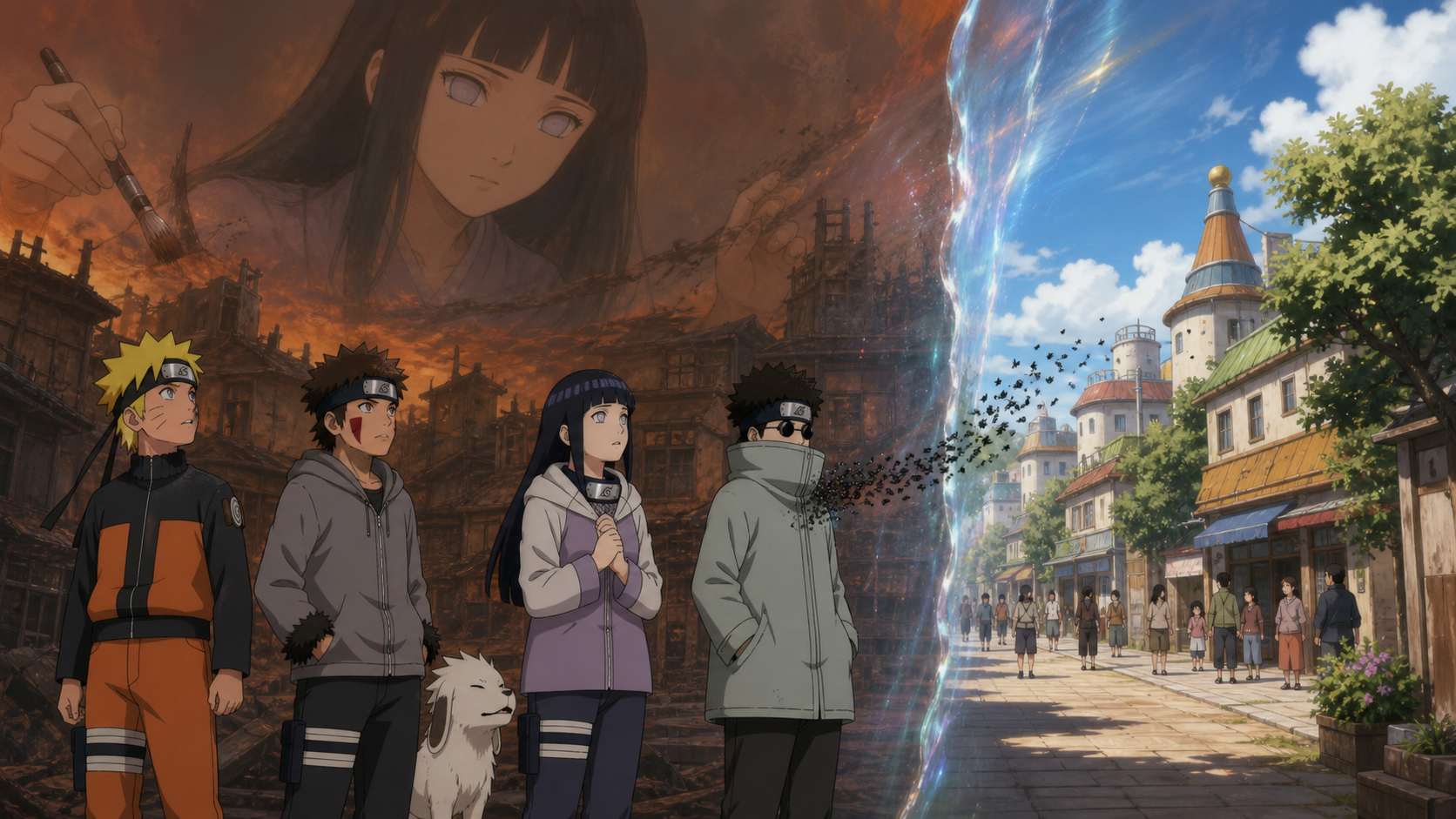
Yakumo traps the rescue group inside a shared sensory world where Konoha is ruined and imaginary lava can still burn, leaving Shino’s insects as their only outside reference.
Konoha is gone.
The streets are empty. Buildings lie broken. The village looks as if a war happened while Naruto carried Yakumo home.
None of it happened.
That does not make it safe.
Naruto Episode 206, `Genjutsu or Reality?`, gives Yakumo control over the entire sensory world. Her illusion can fool the Byakugan, feed Kiba a false smell, produce lava that burns a real body, and turn a painted injury into death.
The village is imaginary.
The consequences are not.
The Group Returns to a Dead Village
The timing is the first clue. Naruto, Sakura, Kiba, Hinata, and the others did not hear an attack while they were carrying Yakumo. There is no smoke moving across the horizon, no retreating enemy, and no surviving patrol racing toward them with news. They simply cross an invisible threshold and find a finished catastrophe waiting on the other side.
The group initially treats the scene as physical evidence. They examine streets, buildings, and the apparent absence of villagers. That response is reasonable because every available sense agrees. Stone looks broken. Dust feels present. The village smells abandoned. Even trained shinobi have little reason to reject a world that supplies sight, sound, touch, smell, and pain at once.
Episode 206 uses that certainty against them. The question is not whether one person can spot a visual trick. It is whether a team can recognize a lie after the lie has replaced every tool they normally use to test reality.
Naruto carries Yakumo toward Konoha while the accusation against the Third Hokage runs through his head.
He refuses to believe Hiruzen ordered Yakumo eliminated. Then he remembers Kurenai's confession, her strange resignation, and the seal she placed on the girl. For the first time, Naruto cannot dismiss the accusation without confronting evidence that seems to support it.
The group reaches Konoha and finds devastation.
Hinata searches with the Byakugan but sees no villagers. Kiba and Akamaru do not smell an obvious ambush or hidden crowd. The damage appears complete through every method Team 8 normally trusts.
They move Kurenai and Yakumo into the hospital. Sakura treats Kurenai and searches for medicine to stabilize Yakumo. Kurenai sends Kiba, Shino, and Hinata to survey the village and orders them back within thirty minutes.
Naruto worries about leaving Yakumo beside the woman who may have received an order to kill her.
That suspicion is exactly where Yakumo's world wants him.
Unkai Says the Ruins Are Inside Their Heads
Unkai arrives with an answer the group does not want to accept: Konoha has not been destroyed. Yakumo has placed them inside a genjutsu that governs all five senses.
His warning changes the scale of her ability. Ordinary deception might disguise one attacker or alter the shape of a room. Yakumo supplies an entire environment and keeps several experienced ninja synchronized inside it. Each person sees the same devastation and reacts to the same threats. The illusion does not merely hide reality. It coordinates a substitute reality around everyone caught within its reach.
Unkai's knowledge also exposes the cost of the Kurama clan's silence. He understands what Yakumo can do, yet the group has received almost none of that context before entering her range. The adults who classified the danger hoped secrecy would contain it. Instead, secrecy sends Naruto and his friends into the illusion without a vocabulary for recognizing it.
Naruto encounters Unkai in the hospital and attacks before listening.
Unkai restrains him and warns that everyone will die if Naruto keeps treating the wrong thing as the enemy. The ruined Konoha is not the aftermath of a battle.
It is Yakumo's genjutsu.
Her latent ability has awakened on a scale large enough to envelop the village in a shared sensory environment. Every broken wall, empty street, smell, wound, and sound arrives through a mind she can manipulate.
Naruto objects because the illusion looks too complete.
That completeness is the ability.
Ordinary genjutsu can insert a false image or trap a target in a repeated experience. Yakumo controls all five senses deeply enough that the brain stops receiving a reliable outside reference.
You cannot notice the fake door by touching the wall when touch belongs to the same illusion.
The Byakugan Can See a Lie Perfectly
Hinata's Byakugan should be the group's strongest verification tool. Kiba's nose should provide a separate line of evidence. Both fail because Yakumo is not placing a painted surface in front of their eyes. She is controlling the sensory information their minds receive.
That distinction matters. Hinata can inspect the false village in extraordinary detail and still reach the wrong conclusion because the illusion supplies details for her to inspect. Kiba can smell what appears to be present because his sense of smell has been given the same false report. Greater sensitivity does not help when the source feeding the sense has been compromised.
Shino's insects create the contradiction that the human senses cannot. Their behavior does not match the ruined world the team perceives. The insects are useful precisely because Yakumo's control is centered on the people trapped in her technique. Their response gives the group an external reference point, a small piece of evidence that does not belong to the shared hallucination.
Team 8's strongest senses become vulnerabilities.
Hinata normally cuts through concealment with the Byakugan. Kiba and Akamaru locate hidden people through scent. Yakumo does not need to defeat those senses at their source. She only needs the brain to interpret their signals inside the world she built.
Hinata can see farther and still see the lie.
Kiba can smell more accurately and still smell what Yakumo supplies.
Superior perception increases confidence in the false conclusion.
Shino notices the break because his insects behave differently. They respond through instinct rather than constructing the same human interpretation of the environment. Their movement does not match the devastation around him.
The insects do not prove the correct landscape by seeing through Yakumo. They expose a disagreement. Human senses report ruin while the colony behaves as though ordinary structures and conditions remain. Shino trusts the contradiction enough to question the world in front of him. That is real intelligence: not possessing an infallible detector, but noticing when independent evidence refuses to support the obvious answer.
The quietest member of Team 8 finds reality by watching creatures nobody else considered witnesses.
Kurenai trained a reconnaissance team to gather more information than one mind could hold. Episode 206 shows why that variety matters. No single perfect sense is enough when perception itself has been compromised.
Imaginary Lava Still Burns
The lava makes the danger impossible to dismiss as a dream. A victim who believes the heat is real develops real burns. Yakumo's genjutsu can turn sensory conviction into bodily injury.
That is why telling someone to ignore the illusion is not enough. Pain reinforces belief, and belief strengthens the body's response. Once the cycle begins, every injury appears to prove that the false environment must be physical. The technique traps its victims through evidence manufactured from their own nervous systems.
The medical consequences raise the stakes beyond the immediate fight. Unkai suffers badly while helping the others escape, and his wounds remain meaningful even after the false landscape breaks. The group cannot treat survival as a simple matter of waking up. They have to interrupt the sensory control before their bodies finish obeying a danger that was never materially present.
Yakumo's genjutsu turns the hospital environment into a lethal chamber.
The air grows hot. A room fills with lava. The brain accepts the heat, danger, and contact as real.
That acceptance can burn the body.
The distinction between illusion and reality now sounds like a philosophy question asked while the floor is melting. The lava does not exist as molten rock in physical Konoha. A victim who falls into it can still die because the body obeys the brain's verdict.
This explains the painting Naruto found at the cottage. Kurenai was not physically stabbed when the image showed a blade through her chest. Naruto still experienced the wound. Yakumo's art gives shape to a sensory command, and her power makes the target live inside it.
She can injure someone without changing the material in front of them.
That is more frightening than ordinary destruction because evidence cannot settle the dispute. The victim's own nerves testify for the attacker.
Unkai Explains What Kurenai Tried to Seal
Unkai confirms that Kurenai did not seal Yakumo's talent because she resented it. She was trying to contain a destructive presence tied to that talent. His explanation corrects a central part of Yakumo's accusation, but it does not make the Kurama elders blameless.
They chose intervention without honest preparation. Yakumo lost access to the future she had built her identity around, then received fragments, evasions, and surveillance instead of a complete explanation. From her perspective, authority figures acted together and refused to say why. The resulting suspicion was not irrational, even though the conclusion it produced was wrong.
Episode 206 stops before naming the whole truth behind the presence or the fire that killed Yakumo's parents. That restraint preserves the next episode's discovery. Here, the important change is narrower: Naruto learns that Kurenai's seal was an emergency measure, not proof of a murder plot.
Unkai finally names the threat behind Hiruzen's order.
Once every several generations, the Kurama clan produces a child with an extreme physical and mental relationship to genjutsu. Yakumo inherited power far beyond her ability to control it.
She often uses it unconsciously.
That power formed a growing monster within her. If left alone, the entity could absorb Yakumo's consciousness and become one with her.
The Third Hokage and Kurenai did not plan to eliminate Yakumo.
They meant to eliminate the thing consuming her from inside the ability.
The language Yakumo overheard was still terrible. Adults discussed a part of her mind as a village-level threat and decided what must be sealed without giving her the knowledge to separate herself from it.
She heard them plan to destroy `it` and reasonably believed that `it` meant her.
The misunderstanding is not stupidity.
It is the predictable result of secrecy applied to a child already taught that her power was her entire value.
Escaping Requires Losing Every Sense at Once
Unkai's solution is brutal because partial resistance cannot work. As long as Naruto trusts even one controlled sense, Yakumo can use it to rebuild the false world. Sight alone is enough to restore the ruins. Pain alone is enough to make the lava convincing. The escape must break the entire sensory loop at once.
He forces Naruto through an experience that overwhelms the system and creates a moment outside Yakumo's control. It is not a clean counter-technique or a triumphant demonstration of superior skill. Unkai accepts severe injury to create an opening for someone else.
That choice shows both his courage and the failure that preceded it. The clan waited until the crisis spread across Konoha before giving Naruto the information required to act. Unkai can diagnose the trap, but the only tool left to him is dangerous enough to burn his own body. Correct knowledge arrives late and therefore costs more than it should.
Naruto cannot solve the illusion with Shadow Clones or a louder attack.
Any technique performed inside Yakumo's sensory world remains subject to the same false feedback. Unkai decides they need to shut out all five senses long enough for the brain to stop accepting the constructed reality.
He takes Naruto into the apparent lava.
The move looks suicidal because every nerve insists that it is. The overwhelming shock breaks their connection to the illusion, but Unkai does not emerge untouched. He suffers severe burns and injuries while forcing the escape.
Sakura later treats him.
Unkai's sacrifice does not erase the abduction attempt. He still led clan members into a guarded cottage and tried to take Yakumo by force. It proves his fear was never invented. He understood what an uncontrolled awakening could do and chose another harmful form of control.
Kurenai sealed the power.
Unkai tried to seize the person.
Neither gave Yakumo a way to understand herself.
Yakumo Keeps Kurenai in the Innermost Room
Yakumo drives the others away and isolates Kurenai.
She shows her teacher the paintings and says she has removed the intruders. Konoha will receive her revenge later. First, she wants an answer from the woman who sealed her future.
Yakumo repeats the accusation. Hiruzen ordered her parents killed and planned to eliminate the Kurama clan. Kurenai denies it.
Yakumo threatens to erase her through the painting if she continues to lie.
Kurenai offers her life.
If killing her will end Yakumo's suffering and hatred, she says, Yakumo should do it.
The tears make Kurenai's love visible.
The offer is still wrong.
It also places an impossible burden on Yakumo. Kurenai asks a grieving teenager in the middle of a psychological collapse to decide whether another person deserves to live. The gesture sounds selfless, but it makes Yakumo responsible for resolving an adult's guilt. If Yakumo refuses, the underlying deception remains. If she accepts, she adds another death to the loss she is already unable to process.
Dying would not teach Yakumo the truth. It would confirm that pain can only end when a person disappears. Kurenai is trying to pay for secrecy with her body because sacrifice feels easier than asking Yakumo to trust her again.
Reality Is the Story Everyone Refused to Tell Yakumo
Episode 206 reveals that the central illusion started before Konoha appeared ruined.
Yakumo has lived for a year inside a story assembled from real grief and missing facts. Her parents died. The reports vanished behind classification. Hiruzen feared her power. Kurenai sealed it.
The false conclusion feels complete because adults removed every competing explanation.
Unkai can break the village-wide genjutsu by forcing Naruto beyond the five senses.
Breaking Yakumo's private illusion will require something harder.
Someone has to tell her what actually happened and convince her that the monster inside her is not the whole person she is.
Agreement across compromised senses is not corroboration
Hinata sees destruction, Kiba smells emptiness, skin feels heat, and ears receive the same dead village. Normally, several matching channels would strengthen a conclusion. Yakumo controls the point where those channels become conscious experience, so their agreement comes from one corrupted source.
The episode turns a basic investigative rule inside out. Independent evidence matters only when it is actually independent. Five senses inside one genjutsu are not five witnesses. They are five versions of the same report.
Greater perception can create greater confidence in a lie
The Byakugan gives Hinata more detail to inspect, and Kiba’s nose provides more sensitivity than ordinary smell. Neither helps if the mind receives fabricated input that includes convincing detail. Their specialties make the false world feel better verified.
That is not a weakness in their abilities. It is a reminder that every instrument has a failure mode. Expertise becomes dangerous when someone assumes a powerful tool cannot be deceived and stops asking whether the tool’s input path remains trustworthy.
Shino’s insects provide disagreement, not magical truth
The colony behaves in ways that do not match the ruined environment. Shino does not instantly receive a perfect image of physical Konoha from them. He gets a contradiction strong enough to reopen the question everybody thought had closed.
That is excellent intelligence work. An external reference does not need to explain the whole world. It needs to refuse the story decisively enough that investigators stop treating consensus as certainty.
Imaginary injury remains medically real
The lava is not molten rock, but a nervous system convinced of burning can produce injury capable of killing. Calling the environment unreal therefore offers no useful safety. Victims need the sensory loop interrupted before their bodies complete the damage their minds accept.
Sakura’s role after escape matters because release from genjutsu does not erase every consequence. Pain, shock, burns, exhaustion, and trauma continue beyond the perception that produced them. Medical care has to treat the body that experienced the event, not debate whether the material cause existed.
Unkai supplies necessary truth after helping create the silence
He explains the periodic Kurama ability, the destructive presence growing inside Yakumo, and the intended target of Kurenai’s seal. That information gives Naruto the vocabulary adults withheld before he entered the crisis.
His courage in breaking the illusion is real. So is his responsibility for leading a forced extraction and participating in a clan culture that treated Yakumo’s power as collective property. Late truth can save lives without cleaning the choices that made it arrive late.
Separating Yakumo from the entity requires careful language
Hiruzen and Kurenai meant to eliminate the destructive presence, not the girl. Yakumo had been taught that her rare ability was her identity and value, so the distinction was never obvious from the sentence she overheard.
Calling part of her mind a monster may describe its violence while increasing fear that she herself is contaminated. Any responsible explanation must distinguish person, symptom, ability, and harmful action without pretending they have no connection.
Unkai’s escape method proves how expensive delayed disclosure becomes
By the time he explains the five-sense trap, no gentle countermeasure remains available. He forces Naruto through apparent lava and accepts severe injury to create a moment outside the constructed world.
Earlier knowledge might have supported entry precautions, external anchors, paired observers, or a planned release method. Secrecy does not remove operational cost. It postpones preparation until the only surviving option is brutal.
Kurenai’s offer to die hands Yakumo another impossible burden
The gesture looks like total responsibility, but it asks a grieving teenager in crisis to decide whether killing her teacher will end pain. If Yakumo refuses, the truth remains hidden. If she accepts, she inherits another death.
Kurenai’s life is not a substitute for explanation. Sacrifice feels cleaner than rebuilding trust because it ends the conversation at once. Protection requires staying alive long enough to face anger, provide evidence, and help Yakumo understand what happened.
RaeRae’s full take
Episode 206 understands that “it was only genjutsu” is nonsense once perception can burn flesh. The village may remain physically intact, but everyone trapped inside Yakumo’s world is in real danger because bodies do not wait for a philosophy seminar before obeying pain.
Shino gets the best detective beat. He does not defeat the illusion by seeing more. He notices that something outside the shared human story disagrees. One stubborn contradiction is worth more than five matching senses when the same person controls all five.
Kurenai still chooses disappearance as payment. Offering her life is not the brave answer Yakumo needs. The brave answer is to remain, tell the complete truth, open the sealed evidence, and survive the student’s judgment without making that student responsible for another body.
RaeRae checkpoint: Reality is not whatever hurts least. In this episode, the illusion hurts physically, and the truth hurts because adults withheld it until trust collapsed.
Receipts and official routes
- Episode number, licensed title, shared five-sense illusion, Kurama power explanation, and Kurenai’s confrontation with Yakumo: Naruto Official Site.
- Japanese title, October 19, 2006 broadcast record, and TV Tokyo episode synopsis: TV Tokyo.