
The Top 5 Ninja Battles!
Naruto and Sakura host a four-year anniversary countdown whose studio comedy and survivor interviews keep returning to the unresolved loss of Sasuke.
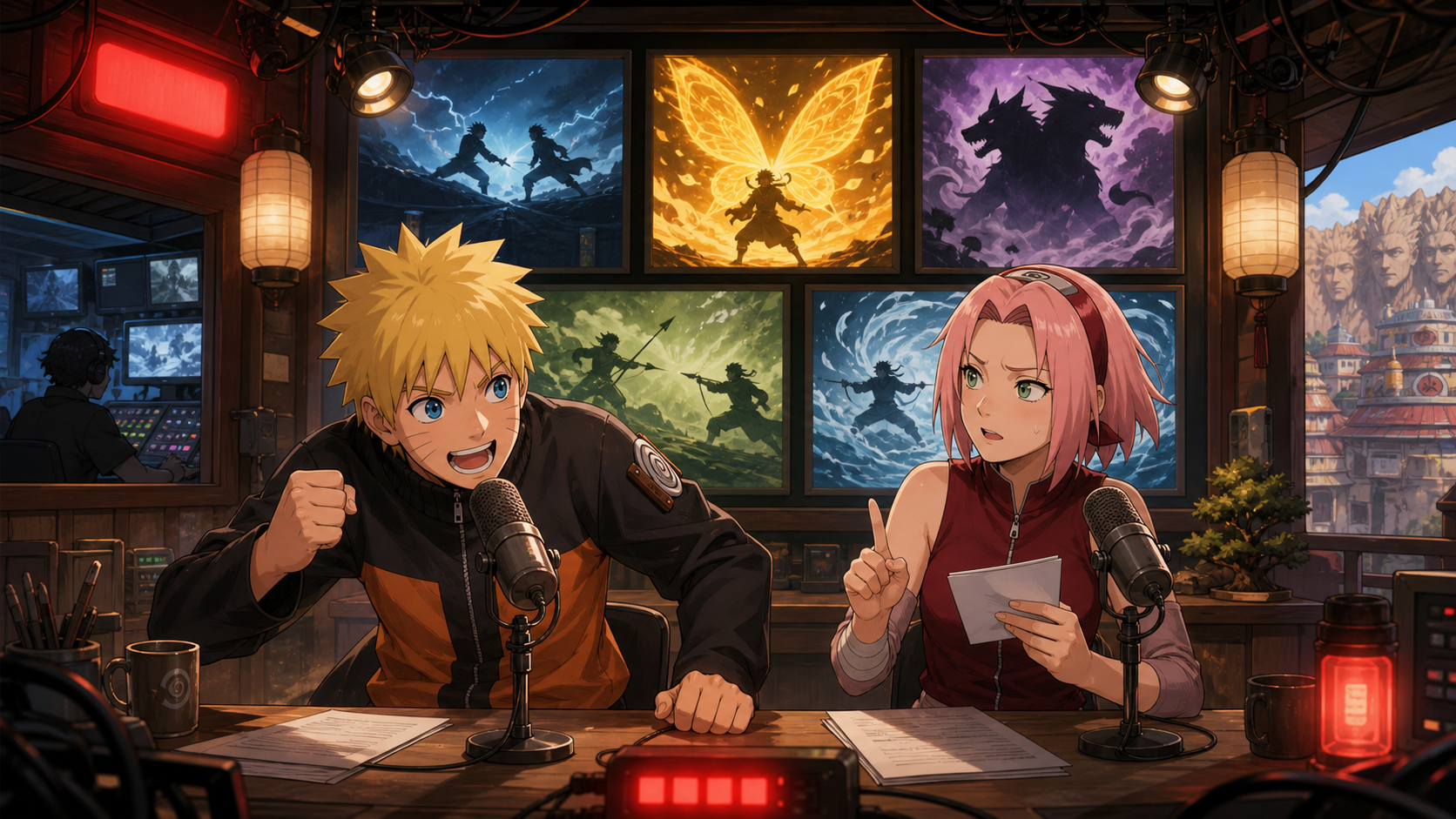
Naruto Episode 202 puts Naruto behind a microphone.
This is dangerous for everyone in the studio.
Naruto and Sakura host a four-year anniversary special from a Konoha studio, counting down five battles selected from the anime so far. Sakura understands timing and transitions. Naruto understands that a microphone lets him say anything at broadcast volume.
`The Top 5 Ninja Battles!` is a recap episode, but it is not trying to disguise itself as a new mission. It builds a television show around reused fights, guest interviews, running jokes, and one uncomfortable call to the place where Sasuke now lives.
The countdown celebrates four years of Naruto.
It also reveals which wound the series still cannot leave alone.
Episode 202 Facts
Episode: 202 of the original Naruto anime
Licensed title: The Top 5 Ninja Battles!
Japanese broadcast: September 27, 2006
Format: Four-year anniversary recap special
Hosts: Naruto Uzumaki and Sakura Haruno
Classification: Recap special with new studio framing
This is not a mission or an arc opener. Most battle footage is reused, while the Konoha studio presentation, guest reactions, comedy, and Jiraiya remote segment provide the new material. Episode 203 begins Kurenai's separate Team 8 story.
The program presents the countdown as a voted ranking, not an objective critical verdict. Its selections tell viewers what the anniversary production chose to foreground after four broadcast years, not which five fights every fan must consider best.
Number Five: Naruto vs. Sasuke on the Hospital Roof
The fifth-place battle is Naruto and Sasuke's clash on the hospital roof.
It is the smallest fight on the list by physical scale and the most important warning. Naruto arrives determined to prove that he has caught up. Sasuke sees Naruto's progress as evidence that he is falling behind. The water tanks damaged by Chidori and Rasengan expose the difference between what each boy can see and what each attack actually did.
Kakashi stops the collision before either technique lands on a person.
The roof fight has no clean victor because victory was never the real question. Sasuke is measuring his worth against Naruto while Itachi's return and his own helplessness poison every comparison. Naruto thinks he is finally being treated as a rival. Sasuke feels replaced by someone he once dismissed.
Putting this at number five gives the special a proper opening statement.
The countdown is about famous action, but its spine is Sasuke leaving.
The hospital roof technically occurs before the Sasuke Recovery Mission, which keeps the ranking from being five entries taken directly from one arc. Emotionally, it functions as the mission's ignition. Sasuke's jealousy, Naruto's need for recognition, and Kakashi's emergency intervention establish why the later departure feels possible.
Starting here lets the countdown trace rupture rather than chronology. The program is not moving from weaker animation toward stronger animation. It is moving from a warning between two teammates toward the valley where that warning becomes separation.
Sakura responds to the replay by hitting Naruto. The studio framing refuses to preserve the battle as untouchable tragedy. Naruto is both the fighter in the footage and the loud host who can still earn immediate consequences.
Number Four: Chōji vs. Jirōbō
Chōji's stand against Jirōbō takes fourth place.
The fight begins with the recovery team trapped and losing chakra. Chōji stays behind because his strength offers the others a path forward. Jirōbō treats his size and appetite as proof that he is weak, repeating the insult Chōji has heard from people who never bothered to know him.
Chōji answers with the Akimichi clan's Three Colored Pills.
Each pill buys more power at a harsher cost. By the time the red pill opens his butterfly wings, the victory and the apparent sacrifice have become inseparable. Chōji does not risk death because an insult makes him angry. He does it because Shikamaru trusted him with a place on the team.
The studio follows the segment with an interview.
Naruto remarks that the battle made Chōji sweat. Chōji answers with Human Bullet Tank and runs him down. Naruto learns the rule of live commentary: if the subject is nearby, choose the adjective carefully.
The joke works because the original fight gave Chōji something the early series often denied him. He was not a punch line. He was the friend who stayed.
His studio retaliation protects that change. Replaying the butterfly-wing sacrifice could turn Chōji back into a frozen symbol of loyalty. Letting him roll over the host returns comic agency to the person who survived. Naruto's careless remark becomes the joke, not Chōji's body.
The interview format does similar work for every recovery-team guest. The special can reuse frightening footage without pretending those characters remain trapped inside it.
The Honorable Mentions Cannot Agree on What a Fight Is
The special pauses the ranking for battles that missed the top five.
Kakashi's confrontation with Zabuza represents the serious end of the category. It was Team 7's first look at combat between elite shinobi, a fight built from deception, silent killing, copied techniques, and the possibility that their teacher could die in front of them.
Then Kakashi and Guy appear.
Their great contest is rock-paper-scissors.
That pairing explains the special's sense of humor better than any studio speech could. Naruto can honor a formative Land of Waves fight and immediately count a hand game between rivals as shinobi combat. The category stretches because the anniversary is celebrating personalities as much as choreography.
It also invites an obvious argument. A list covering four years has no Lee vs. Gaara in its top five. Naruto vs. Neji, the Third Hokage vs. Orochimaru, and Naruto vs. Gaara are absent too.
The omissions are not an error in the episode.
They tell us how narrow its chosen memory is.
Lee versus Gaara is the most obvious absence because it had become one of the anime's defining early spectacles. Its omission makes the countdown less useful as a general beginner's guide and more revealing as a 2006 editorial choice. The show wants the Sasuke rupture available in viewers' immediate memory while late original-anime material continues.
Kakashi versus Zabuza supplies just enough Land of Waves history to acknowledge the series before that rupture. Kakashi versus Guy then punctures any claim that the honorable mentions follow consistent competitive standards.
Number Three: Kiba and Akamaru vs. Sakon and Ukon
Third place belongs to Kiba and Akamaru against Sakon and Ukon.
This is the list's ugliest survival fight. Kiba's strongest combination becomes the two-headed wolf, but Sakon and Ukon's shared body technique makes ordinary close combat terrifying. Ukon can invade another person's body at the cellular level, turning physical contact into an attack from inside.
Kiba responds by stabbing himself.
The choice is desperate and clever. Hurting his own body forces Ukon to share the damage and separate. Kiba then escapes with Akamaru while both are badly injured, knowing the enemy can still track them.
When Kiba enters the studio portion, Naruto insults him and receives another beating.
The repetition is simple, but the placement matters. Chōji, Kiba, and later Neji are allowed to speak after their old battles play. The recap does not leave them frozen at the moment of apparent death. They are alive, present, and fully capable of objecting to Naruto's version of events.
For an arc built around friends falling behind one at a time, the interviews become a quiet roll call of survivors.
That roll call also changes the emotional meaning of the ranking. During the original chase, Naruto never sees what Chōji, Kiba, and Neji endure after the team separates. Episode 202 places him in a room where each survivor can answer his narration physically and immediately. The host cannot own the story merely because his name is on the series.
Number Two: Neji vs. Kidōmaru
Neji's fight with Kidōmaru takes second place.
Kidōmaru is the worst possible opponent for the Gentle Fist. He studies the Byakugan from a distance, tests Neji's defense, and finds the small blind spot behind the upper back. His webs restrict movement. His hardened weapons keep him beyond the range where Neji can close chakra points.
Neji wins by accepting the hit that should kill him.
He lets Kidōmaru's arrow connect, sends chakra back through the attached thread, and uses that link to strike the enemy's internal system. It is a victory built from analysis, pain, and faith that Naruto will keep moving toward Sasuke.
The boy who once declared that people cannot escape fate risks his life for a mission whose outcome he cannot control.
After the replay, Neji joins the studio exchange and uses Gentle Fist on Naruto.
Naruto has now been corrected by mass, teeth, and precision chakra control. Sakura should probably revoke his interview privileges. She does not, because watching the host create his own danger is half the program.
Number One: Naruto vs. Sasuke at the Valley of the End
The final Valley of the End battle is the obvious winner.
It is also the only possible ending for the list Episode 202 has constructed.
Naruto catches Sasuke after every other member of the recovery team pays for his progress. Sasuke insists that leaving is his choice. Naruto refuses to accept a future where strength requires severing every bond.
The fight moves through their entire relationship. Taunts become memories. Ordinary techniques give way to the Nine-Tails' chakra and Sasuke's cursed seal. Rasengan meets Chidori beneath the stone figures of Hashirama and Madara, turning a private rupture into an image the series will carry for years.
Sasuke wins and leaves Naruto alive.
That contradiction matters. He claims he will obtain power by cutting away his closest bond, but refuses to kill Naruto by the method Itachi prescribed. His departure is real. His separation is incomplete.
Episode 202 can laugh through four rankings, but first place restores the failure underneath the celebration.
Konoha's young shinobi survived their individual battles.
They did not bring Sasuke home.
The ranking therefore counts sacrifice without converting sacrifice into success. Chōji, Kiba, and Neji win their individual battles. Naruto loses the outcome those victories were meant to support. First place refuses the comforting version where courage automatically delivers the mission objective.
Jiraiya Calls From the Unresolved Story
The closing remote segment turns the recap into a cruel little surprise.
Jiraiya appears as a correspondent and introduces Orochimaru as his guest. Through the connection, Naruto and Sakura briefly see Sasuke at the hideout.
The sighting changes nothing. Naruto cannot reach through the screen. Sakura cannot ask the conversation she actually wants to have. Sasuke remains beside the man whose ambition pushed the recovery mission into motion.
The segment also turns access into a taunt. Jiraiya can reach Orochimaru long enough to produce a broadcast surprise, yet the connection offers no extraction route, verified location, or useful negotiation. Naruto and Sakura receive proof that Sasuke remains there without gaining any power to change it.
That is harsher than a simple nostalgic cameo. Every earlier guest can enter the studio and reclaim an old scene. Sasuke appears only through the enemy controlling the distance.
That is why the call belongs after the number-one fight.
The anniversary special spends most of its time making old footage social again. Chōji, Kiba, and Neji can walk into the studio and argue with the host. Sakura can hit Naruto for an old disaster. Kakashi and Guy can reduce rivalry to a hand game.
Sasuke is the one person who cannot rejoin the room.
He appears only at a distance, through Orochimaru.
This Is a Time Capsule, Not a Definitive Ranking
Episode 202 is easy to skip if the only question is whether the plot advances.
It does not.
As a piece of broadcast history, though, it has a clear purpose. Naruto had completed four years on television and was entering its fifth. The production paused to let its characters host their own highlight reel, tease one another, and remind viewers of the emotional conflict still waiting beyond the anime-original missions.
The list is wildly concentrated. Four entries come directly from the Sasuke recovery pursuit, and the fifth is the rooftop confrontation that helped send Sasuke toward the exit. This is less a ranking of every great Naruto fight than a compressed retelling of one collapse.
Chōji stayed behind.
Kiba nearly bled out.
Neji accepted an arrow through his body.
Naruto reached the valley.
Sasuke still left.
The ranking keeps the franchise's most important absence visible.
As a watch-order decision, viewers can skip Episode 202 without losing a new plot event. Anyone interested in how the anime framed itself at the four-year mark gets something more specific: a studio-era time capsule, a selective memory map, and proof that even the filler stretch understood which unresolved relationship still organized the series.
Naruto begins Episode 202 delighted to have a microphone.
He ends it looking at the friend no amount of talking has brought home yet.
The ranking remembers one mission much more than four years
Four of the five selected battles come from the Sasuke Recovery Mission, and the remaining hospital-roof clash supplies its emotional ignition. That concentration makes the special a poor claim about the objectively greatest action in the whole anime and a revealing document about what the production wanted viewers remembering in September 2006.
The countdown compresses one failure into stages: Sasuke and Naruto rupture, Chōji stays behind, Kiba survives, Neji nearly dies, and Naruto reaches the valley too late to change Sasuke’s choice. The ranking celebrates individual courage while keeping the mission result unresolved.
Leaving out Lee versus Gaara tells its own story
A four-year list without that Chūnin Exam fight is impossible to treat as universal fandom consensus. Naruto versus Neji, the Third Hokage versus Orochimaru, and Naruto versus Gaara also remain outside the top five. The omissions expose selection priorities rather than proving those battles mattered less.
Episode 202 is preserving the relationship the ongoing story still needs, not building a beginner’s history of every landmark episode. Sasuke’s absence organizes the list because the anime-original period keeps orbiting a promise the main plot has not yet resolved.
The studio interviews return ownership to the survivors
Naruto never witnessed the full cost of Chōji, Kiba, and Neji’s separate fights after the pursuit team split. As host, he can narrate their footage and accidentally reduce pain to a careless joke. The guests then walk into the studio and answer him themselves.
The repeated beat of Naruto being flattened is broad comedy, but it prevents his name on the franchise from making him sole owner of the mission’s memory. Chōji’s body, Kiba’s wounds, and Neji’s decision belong first to the people who survived them.
Chōji’s segment refuses to make his body the joke
The original battle turned insults about weight and appetite into an attack on his worth. He used the Three Colored Pills because Shikamaru trusted him, not because Jirōbō successfully shamed him into proving strength.
In the studio, Naruto’s sloppy comment becomes the target and Chōji controls the punch line through Human Bullet Tank. The anniversary can laugh without undoing the dignity the recovery mission finally gave him.
Kiba and Neji form a roll call of people Naruto left behind
Kiba survives an enemy who enters his body. Neji survives an arrow aimed through the Byakugan’s blind spot. Both wins require using an apparent weakness as a route back to the opponent, and both happen beyond Naruto’s view while he continues chasing Sasuke.
Bringing them into the studio changes the recap from memorial footage into testimony. The recovery team did not become a collection of noble sacrifices frozen in old episodes. They are present, difficult, funny, and entitled to correct the host.
The number-one battle remains a loss even when Naruto survives
Valley of the End earns the top position because every earlier sacrifice points there. Naruto reaches Sasuke, fights with everything available, and still fails to return him to Konoha. The story does not convert effort into automatic mission success.
Sasuke also refuses the murder Itachi prescribed. He wins, leaves, and preserves the bond he claims he must sever. That contradiction keeps the relationship active. The separation is physical and chosen, but not emotionally complete.
The remote call turns access into cruelty
Jiraiya can place Orochimaru and Sasuke on a broadcast connection long enough for Naruto and Sakura to see them. He cannot provide a verified location, extraction route, or conversation capable of changing the situation. The image supplies proof without agency.
Every other guest can enter the room and reclaim old footage. Sasuke appears only through distance controlled by the enemy. The studio has turned four years of danger into jokes and interviews, but it cannot make the missing teammate socially present again.
A recap special still creates new meaning
Most action footage is reused, so viewers following plot mechanics can skip the episode without losing a mission event. That does not make the framing meaningless. Hosts, guest responses, selection order, omissions, and broadcast context show how the anime understood its own recent past.
The useful question is not whether this list is correct. It is why this production selected these five fights at this moment. The answer is a time capsule built around survival, failed recovery, and a friend still visible but unreachable.
RaeRae’s full take
Episode 202 is shameless television, and I mean that affectionately. Naruto gets a microphone, Sakura tries to keep a broadcast alive, and three teammates arrive to correct any fantasy that the host owns their trauma because he can introduce the clip.
The list itself would start a fandom argument before number four. No Lee versus Gaara? Be serious. That frustration is part of reading it honestly. This is not a neutral archive of Naruto’s finest animation. It is a four-year anniversary choosing the Sasuke wound as the story everybody still needs fresh.
The final call makes that purpose plain. Chōji, Kiba, and Neji survived long enough to walk into the studio. Sasuke remains trapped behind a screen beside Orochimaru. The special celebrates how far the anime has come, then points straight at the person its heroes still cannot bring into the room.
RaeRae checkpoint: Treat the countdown as a 2006 memory map, not fandom law. Its biggest statement is not who ranks first. It is why every road on the list keeps leading back to Sasuke.
Receipts and official routes
- Episode number, licensed title, anniversary format, hosts, selected countdown, and Sasuke remote segment: Naruto Official Site.
- Full Japanese special title, September 27, 2006 broadcast record, and studio synopsis: TV Tokyo.