
The Powerful Helper
Homura and Koharu recognize that Gennō’s bomb network follows a thirty-year-old Konoha, while Naruto traces their former ramen meetings back to the trapper himself.
Konoha's newest buildings are sitting on its oldest war.
The paper bombs do not follow the village Naruto knows. They crowd empty ground and avoid busy residential blocks. Their jutsu script looks ordinary to the Konoha 11.
Homura and Koharu take one look and recognize the past.
That empty ground was supposed to become a shopping district. That script was standard when they were young. Gennō did not install thousands of bombs during three months of recent carpentry.
He planted them thirty years ago.
Episode 200 gives the investigation its most useful resource: two old people with long memories, sharp eyes, and absolutely no patience for Tsunade's mouth.
Episode 200 Facts
Episode: 200 of the original Naruto anime
Licensed title: The Powerful Helper
Japanese title: 現役バリバリ 最強の助っ人 (Gen'eki Baribari, Saikyō no Suketto)
Japanese broadcast: September 13, 2006
Arc: Konoha Plans Recapture Mission
Classification: Anime-original filler
Homura and Koharu are the “powerful helpers” in the title. Their contribution is historical recognition, not a surprise combat technique. Kagerō Village is also rendered as Heat Devil Village in the Crunchyroll subtitles, while Kagerō remains the common proper name.
Gennō states a motive here, professional pride and fear that his greatest traps will disappear unused, but Episode 201 complicates his intention. His claim belongs in the investigation as testimony, not yet as the final truth. Episode 200 ends before Shikamaru identifies the exact final target.
The Village Cannot Know It Is Being Saved
Tenten disables the Academy target mechanism.
The students are safe from one accidental bullseye, but Shikamaru refuses to let the team celebrate. If Gennō notices that his trigger has stopped working, he may use another method to ignite the network.
The team restores the practice area and tells the children to keep throwing kunai while deliberately missing the center.
That instruction is harder than it sounds. One student insists he hit the bullseye the previous day. Everyone else decides he must have been slightly off because the alternative is admitting the school should already be rubble.
Tsunade faces the same problem at village scale. An evacuation would save people from hidden charges, but sudden panic would tell Gennō his trap has been discovered. He could detonate the remaining bombs while roads are packed and civilians are confused.
Konoha has to remove the threat without changing the rhythm of daily life.
Every calm street becomes part of the cover operation.
That choice asks civilians to remain beside a danger they cannot consent to because informing them might activate it. Tsunade is balancing two forms of risk: hidden exposure during quiet removal and concentrated exposure during evacuation. There is no clean option once the network exists.
The Academy students continue throwing at a target the team has disabled because their ordinary behavior helps convince any observer that discovery has not occurred. The children do not know they are participating in counter-surveillance. Protecting them and using their routine happen at the same time, which should remain uncomfortable even when the tactic works.
Bomb Disposal Looks Ridiculous in Public
The Konoha 11 spreads through the village.
Kiba and Akamaru locate charges by scent. Tenten handles mechanisms. Neji and Hinata trace hidden placements. Naruto crawls into openings and invents excuses whenever a civilian asks why a teenager is halfway inside their property.
At Ichiraku, he claims money fell into a gap.
Teuchi offers to retrieve it later. Naruto immediately warns that would be dangerous, realizes how suspicious that sounds, and changes the subject to ramen.
This is covert bomb disposal conducted by children who did not receive covert bomb-disposal training.
It still works.
The comedy hides an enormous coordination burden. Charges sit near businesses, homes, roads, and public structures. Each removal must avoid damaging the property, alarming witnesses, or leaving enough visible change to reveal the operation. A team member needs a plausible reason to occupy every awkward space.
Naruto's Ichiraku excuse becomes personally sharp. He lies to Teuchi to remove a bomb near one of the few places that accepted him before the village did. Gennō used the same shop as intelligence access, and now Naruto has to keep its owner ignorant while making it safe.
The operation moves too slowly, though. Most trained shinobi remain outside Konoha after the Hidden Waterfall deployment. The group needs people who can search without drawing attention and understand what they are touching.
Tsunade knows exactly who has time.
Homura and Koharu Report for Active Duty
Homura Mitokado and Koharu Utatane arrive already insulting Tsunade.
She calls them idle elders who tell old stories and complain about young people. They remind her that advising the young is literally their job. Within seconds, “powerful helper” feels less like a title and more like three relatives arguing at a holiday table.
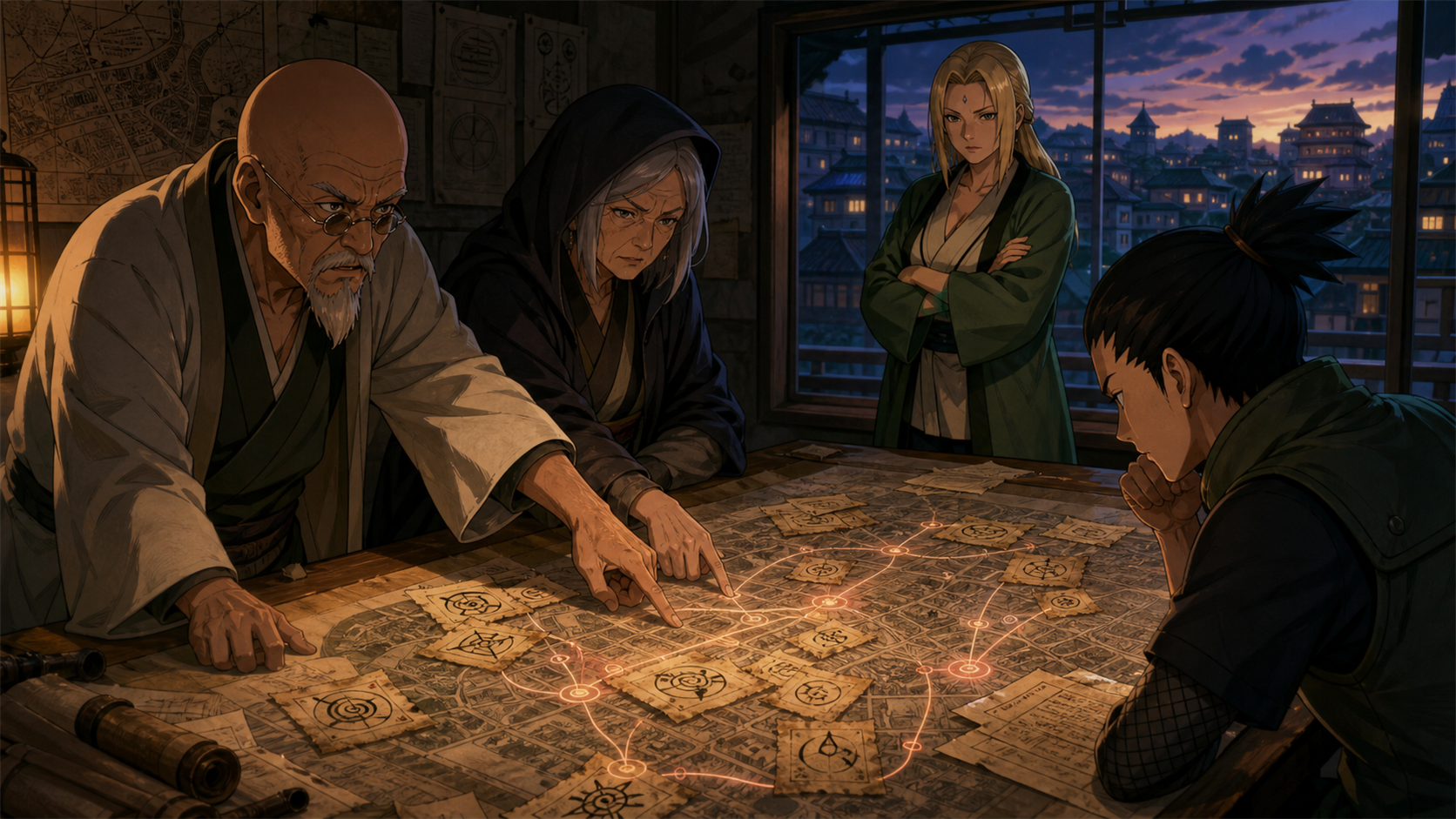
Then Tsunade sends the pair to an apparently useless site at the edge of town.
Very few people live there, yet the ground contains a heavy concentration of bombs. Homura remembers that Konoha once planned a major shopping district for the area. Koharu recognizes the writing on the explosive tags as an obsolete jutsu form.
The younger ninja can see where the bombs are.
The elders can see when the map made sense.
Institutional memory does not always live in a searchable archive. Development proposals fail, districts move, vocabulary changes, and old technical conventions stop appearing in training manuals. Homura and Koharu remember the argument around the shopping plan and the visual grammar of tags written by their contemporaries.
Their knowledge becomes testable rather than ceremonial. The bomb clusters align with the abandoned commercial map. Sparse charges in modern residential areas confirm those neighborhoods did not yet exist. Memory generates a hypothesis; current observation proves it.
That difference matters because technology never arrives without a date. A sealing formula can look like meaningless variation to someone trained on the modern version. An abandoned development proposal can look like irrelevant paperwork to anyone who never saw the debate. Homura and Koharu carry both references in memory.
The episode lets them be irritating and essential at the same time. Their experience does not make them automatically right about every policy. It makes them the only people present who can recognize a weapon written in their generation's language.
Current residential blocks contain surprisingly few charges because many did not exist when the network was built. Empty land holds clusters because old planners expected commerce and crowds there.
The trap follows a future Konoha that never happened.
That failed future explains what looked like poor targeting. Gennō did not waste bombs on empty outskirts. He expected shops, traffic, and crowds to occupy the ground by the time Kagerō attacked. Urban planning changed while the charges stayed fixed.
The present village inherited both the structures built and the dangers designed for structures that never arrived. A modern risk map looks irrational until overlaid on the abandoned plan.
Thirty Years Is the Best Camouflage
Paper bombs sealed inside walls remain invisible unless someone uses the Byakugan or knows exactly where to search.
Nobody expects thousands of enemy charges to survive beneath a friendly village for three decades. That assumption protects them better than any genjutsu.
Shikamaru finally understands why Gennō's recent construction record never explained the scale. The old man did not create the network this season. He returned to a weapon already waiting for him.
The discovery also changes the meaning of the missing recommendation letter.
Gennō supplied a crude forgery during his recent employment, one that would fail if compared against the older document. After the master carpenter reported the mismatch, the older letter disappeared.
Shikamaru suspects both letters came from Gennō.
The first was good enough to survive thirty years. The second was designed to expose him. Removing the old one hid the fact that the same carpenter had worked in Konoha during another construction boom.
Gennō did not merely repeat his old cover.
He used the repetition to erase it.
The Carpenter's Diary Records a War Nobody Remembers
The master carpenter finds his father's diary.
One entry describes hiring a middle-aged outsider carrying a recommendation from the Hidden Sand. His work was average, but labor was scarce. The date falls one week after Konoha attacked Kagerō Village in the Land of Mountains.
The subtitles call it Heat Devil Village. The place vanished so completely that modern records preserve little beyond Gennō's country of origin.
Thirty years earlier, Konoha and Kagerō fought to a deadlock. Konoha struck while Kagerō's main force was away and seized the advantage.
Kagerō sent Gennō into the Leaf as a carpenter. He spent roughly two and a half months placing paper bombs at construction sites. His village planned to invade while he detonated the network, crushing Konoha from inside and outside at once.
The attack never came.
Kagerō's hardline leader died in an accident. His successor accepted a ceasefire with the Leaf. Gennō left the bombs buried and disappeared.
Two weeks later, the Hidden Vale attacked the exhausted Kagerō Village and destroyed it.
The mission survived the country that ordered it.
Konoha's old strike forms part of that history. The Leaf exploited Kagerō's absent main force and gained the military advantage. A ceasefire stopped Gennō's planned counterattack, but it did not restore Kagerō's security. Hidden Vale destroyed the weakened village two weeks later.
That sequence gives Gennō a real grievance without making present civilians responsible for becoming his delayed battlefield. The people walking over the bombs did not choose the old campaign. Historical explanation identifies the wound and the institutions involved; it does not authorize an elderly operative to make children pay it.
That history does not excuse Gennō's return. It does explain why the network feels less like a current military strike than unfinished business given physical form. Kagerō stopped existing, its orders expired, and the original battle moved into archives. The bombs remained ready because nobody knew they had inherited them.
Naruto Finds Gennō Through Their First Meeting
While delivering removed bombs, Naruto passes Ichiraku.
He remembers where Gennō stood before their first meal and asks what the old man was looking at. The line of sight points away from the restaurant and toward the mountains.
Naruto follows it.
He finds Gennō waiting.
The old man does not deny his identity or the old mission. He says nobody hired him and no surviving commander ordered the attack. He returned because age was catching him. If he died quietly, his greatest work would remain buried and unknown.
He calls that a waste.
Naruto hears an old man admitting that an entire village became a portfolio piece.
Gennō also confirms that the ramen meetings helped him gather information about modern Konoha. Naruto's anger stops being abstract. Their bowls, conversations, and easy affection were useful to the operation.
Useful does not automatically mean false. Gennō can collect intelligence and still enjoy Naruto's company. Naruto can recognize manipulation and still remember genuine warmth. The episode refuses to settle that tension because Gennō speaks like a trapper even when discussing himself.
Naruto's refusal to accept the “you will understand when older” defense matters. Age can explain why Gennō fears disappearing. It cannot transform involuntary casualties into professional recognition. Naruto understands legacy well enough to know that being remembered is not worth any price.
Gennō tells him he will understand when he is older.
Naruto refuses.
Good.
Some explanations do not become acceptable with age.
Gennō Says the Bombs Do Not Need to Explode
Naruto tells Gennō that his friends are removing the paper bombs.
The old man is not worried.
He never says he must detonate them. He says he intends to put them to use, and a trap can serve its purpose by controlling attention rather than causing an explosion.
Then he activates another prepared move and reminds Naruto that a shinobi reads several steps ahead.
Back in the village, Shikamaru reaches the same conclusion from the Academy target. A trapper this careful would never leave final activation to the luck of a child hitting a bullseye. Whether the bombs explode does not matter.
The network is another diversion.
Gennō wants something else.
The visible network has already succeeded without detonating. It empties the border, occupies the Konoha 11, forces secret labor across the village, and convinces defenders that removing charges equals progress toward the final objective. A trap can control time and staffing even when every explosive reaches storage safely.
Shikamaru tests the Academy mechanism against the person who designed it. Dependence on a child's lucky bullseye does not match the precision of the staged corpse and collapsing tunnel. The inconsistency becomes evidence that the obvious catastrophe was built to be found.
Shikamaru predicts he will move when Konoha's main force returns and tells Chōji to warn Tsunade not to let them enter. Hinata arrives with a second emergency.
Naruto found Gennō.
Now the old trapper has him.
Quiet bomb disposal creates an ethical problem, not a clean solution
Tsunade cannot evacuate without telling Gennō the network has been found, yet leaving civilians in place means they remain beside explosives without knowing enough to choose. The team’s secrecy reduces the immediate chance of deliberate detonation while preserving exposure to any mechanism they missed.
That is emergency command at its ugliest. There is no option that protects consent, calm, speed, and tactical surprise at once. Tsunade chooses covert removal because crowded roads and public panic could create a larger target. The choice can be defensible while still leaving a debt to the people whose ordinary day became part of a counter-operation.
Homura and Koharu supply context the Byakugan cannot see
Neji and Hinata can locate charges through matter. They cannot look through time. The bomb clusters appear badly placed on the current village map because the commercial district they targeted was never built. Homura remembers the abandoned plan; Koharu recognizes the sealing script of their generation.
Their value is not vague senior wisdom. They offer two concrete claims that current evidence can test: where crowds were expected thirty years earlier and when that style of writing was used. Once the pattern aligns with the historic proposal and avoids newer housing, memory becomes verified intelligence.
Obsolete technique is evidence with a date attached
A seal is not merely functional writing. Stroke order, symbols, materials, and conventions belong to a training period. Younger ninja read the tag for what it does. Koharu reads when a trained person would have written it.
Konoha’s archive should preserve those technical changes, because old weapons do not update themselves when curriculum changes. If every expert in an obsolete system retires without recording the grammar, the village loses the ability to date threats still buried inside its own infrastructure.
The abandoned shopping district proves risk follows imagined futures too
Gennō planted charges according to construction plans, not only completed streets. Empty ground carries a dense network because planners expected shops and crowds there. Modern residents see wasted bombs; he saw a future population center.
Security reviews usually catalogue what exists. This case shows why cancelled development matters. Utilities may have been started, access granted, and hostile preparations placed before a project died. The village inherits physical consequences from futures it never built.
Konoha’s war history explains Gennō without excusing him
The Leaf attacked while Kagerō’s main force was away and gained an advantage. A later ceasefire stopped Gennō’s counterattack, then Hidden Vale destroyed his weakened home. That sequence gives him grief, professional resentment, and a reason to believe Konoha escaped consequences.
It does not make children born decades later legitimate targets. Historical accountability should examine the institutions and decisions that created the wound. Revenge transfers the bill to whoever happens to live above the buried weapons. Explanation matters because it prevents the story from flattening Gennō into random evil. It cannot grant him ownership of innocent lives.
The bomb network succeeds before a single charge explodes
It empties Konoha’s experienced forces, occupies the young search team, consumes attention, forces secret operations near civilians, and makes defenders measure progress by the number of tags removed. Gennō calls that putting the traps to use.
Shikamaru recognizes the deeper design because the Academy bullseye is too uncertain for the man who staged a corpse and timed a collapsing tunnel. A child might never hit it at the required moment. The visible trigger was built to be discovered, so discovery itself must advance another objective.
Naruto traces a relationship instead of a military route
He returns to the place where Gennō first stood and asks what the old man could see. The sightline points toward the mountains. This is not a genius deduction delivered from nowhere. It uses a memory everyone else treated as sentimental and applies a spatial question to it.
Gennō chose that meeting point. Naruto finally studies the choice instead of only the meal that followed. The personal history supplies a route official records cannot, which is why investigators should neither worship emotional testimony nor discard it.
Professional pride is Gennō’s stated motive, not yet a closed finding
He says age frightened him because his finest work could vanish unused. That confession fits the enormous network and his identity as a trap specialist. It also comes from a man who has controlled every explanation Konoha received. Shikamaru is right to keep testing behavior against the statement.
Even if the pride is sincere, recognition cannot justify mass casualties. A craft does not become valuable because its maker forces unwilling people to witness its destructive scale. Naruto refuses the “you will understand when older” defense because maturity is not supposed to make vanity more entitled to other lives.
RaeRae’s full take
Episode 200 gives Homura and Koharu one of the best elder roles in this run. They are irritating, funny, specific, and essential. Nobody needs them to punch harder than the younger team. Konoha needs somebody who remembers when empty dirt was supposed to become a shopping district and when a sealing mark looked normal.
The buried network is also a brutal image of unresolved war. Governments sign a ceasefire, commanders die, maps change, and civilians assume the danger ended. Meanwhile, the weapon remains inside the wall waiting for a person who refuses to let history become history.
Gennō may say the bombs do not need to explode. He is right in the narrowest sense. They have already reorganized the entire village around his choices. Shikamaru’s job is to find the target hidden behind that success before everyone congratulates themselves for removing the bait.
RaeRae checkpoint: The strongest helpers are not always the people with the biggest technique. Sometimes they are the two elders who remember the map everybody else forgot existed.
Receipts and official routes
- Episode number, licensed title, thirty-year-old bomb network, Kagerō history, and Naruto locating Gennō: Naruto Official Site.
- Japanese title, September 13, 2006 broadcast record, and TV Tokyo episode synopsis: TV Tokyo.