
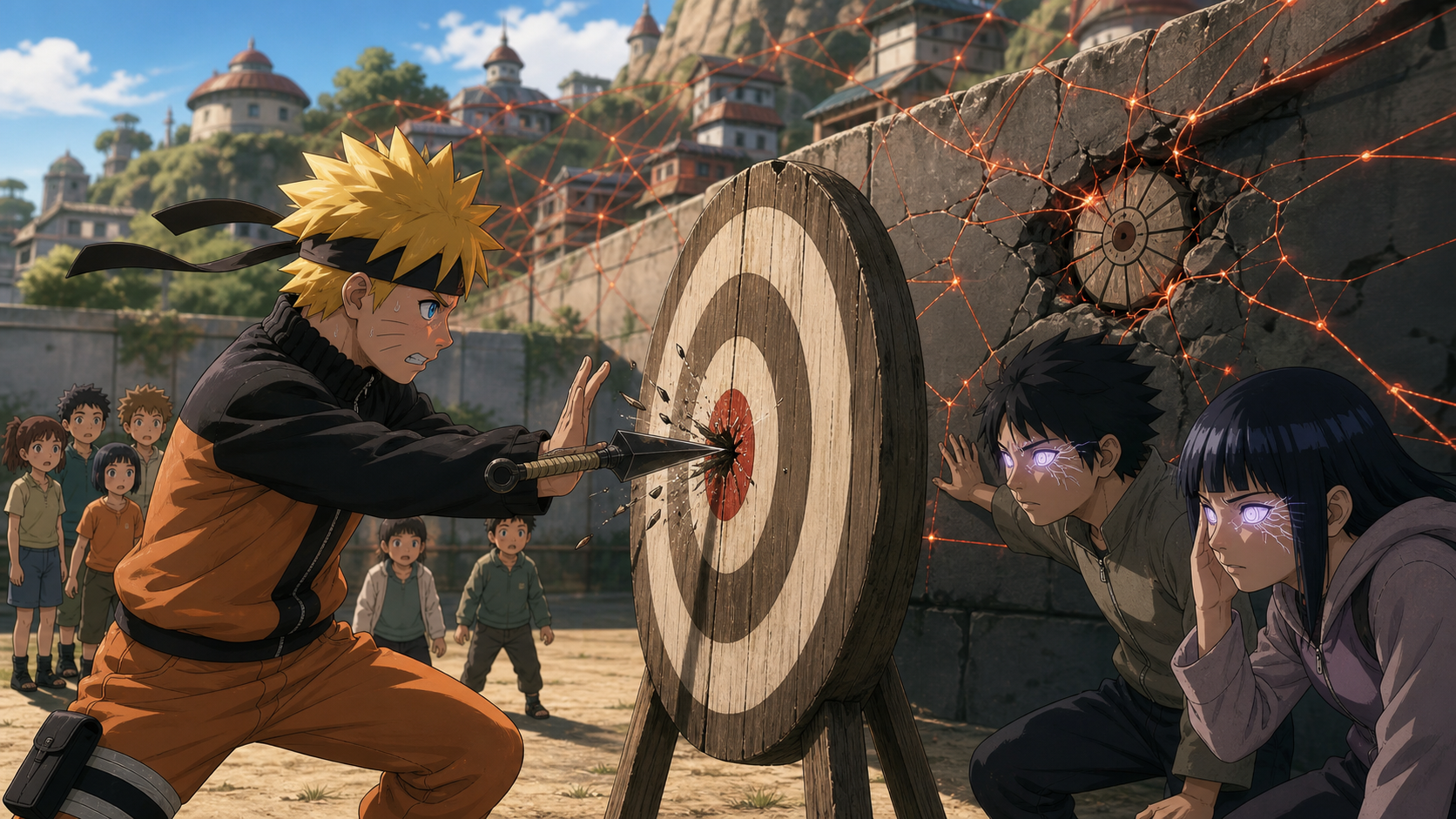
The Missed Target
The returned blueprints prove to be bait as Naruto, Neji and Hinata discover that an Academy practice target can ignite Gennō’s village-wide paper-bomb network.
The children keep missing the bullseye.
That is the only reason the Academy is still standing.
Gennō hides a paper bomb behind a repaired wall, runs an ignition thread to the center of a kunai target, and convinces students that secret practice will impress their teachers. Every lesson they learned about focus and accuracy now pushes them toward killing themselves.
The trap is vicious because nobody has to behave strangely for it to work.
One child only has to succeed.
Episode 199 takes the phrase “missed target” and uses it twice. The students survive by missing the literal target. Konoha nearly dies because its leaders spend two episodes aiming at the wrong threat.
Episode 199 Facts
Episode: 199 of the original Naruto anime
Licensed title: The Missed Target
Japanese title: 的外れ 見えてきた標的 (Matohazure, Mietekita Hyōteki)
Japanese broadcast: August 30, 2006
Arc: Konoha Plans Recapture Mission
Classification: Anime-original filler
The eagle scatters the actual stolen facility plans, not recommendation letters or decoys. The team accounts for every stolen sheet. The Academy repair plan is a separate missing work record connected to Gennō's recent construction access.
Episode 199 ends when Neji and Hinata discover the village-wide paper-bomb network. The bombs' age, installation history, ultimate target, and disarmament operation belong to Episodes 200 and 201.
The Stolen Plans Fall From the Sky
A giant eagle scatters the missing blueprints across Konoha.
Naruto floods the streets with shadow clones. Chōji expands an arm to catch sheets in the air. One bird refuses to surrender its prize, forcing Naruto to negotiate with the dignity of a shinobi who desperately needs a piece of paper released from a beak.
The team collects and checks everything.
All the stolen plans are present.
At the same time, Hidden Waterfall confirms its troop movement was only a large training exercise. It has no connection to an attack on the Leaf. Tsunade cancels the S-Level Emergency Security Alert and recalls the village's forces.
The crisis appears to have dissolved by itself.
Gennō is dead. The suspected enemy retreats. The stolen material returns.
Three problems solve themselves in minutes.
That should not make anyone feel better.
The eagle turns recovery into spectacle. Papers cross rooftops, streets, and open air while clones and enlarged hands scramble after them. Even if every sheet returns, Konoha has no way to prove Gennō made no copy or passed no information before the drop. Possession of the originals never guaranteed secrecy again.
The timing matters more than the bird's identity. Plans arrive exactly as Hidden Waterfall retreats and the alert ends. Relief encourages the village to treat three coordinated events as closure rather than ask who arranged their sequence.
The Corpse Was Another Piece of Stage Dressing
The forensics report destroys the first convenient answer.
The body recovered after the Western Forest explosion is not Gennō. It resembles him closely enough to fool observers during a violent escape, but the hands and chakra network belong to a different man.
Gennō prepared a corpse, triggered multiple explosions, and exchanged places while ANBU moved away from the blast.
Hinata's Byakugan finds the escape route behind a tree. The tunnel is camouflaged and engineered to collapse naturally as the soil settles. Wait one more day, and even the Byakugan might miss its entrance.
Kiba asks Akamaru to follow the scent.
Gennō planned for that too.
No usable trail remains.
The failed escape was never an escape. It was a performance designed for highly trained witnesses. ANBU saw exactly what Gennō needed them to report, then the evidence began erasing itself.
The self-closing tunnel shows how Gennō designs against delayed review. Loose soil does not look like a mechanical trap. Gravity completes the concealment after he leaves, and time makes later inspection less reliable. He does not need to return and erase the route personally.
Hinata finds the entrance during a narrow window before settling removes the visible difference. Akamaru's failure then confirms a second layer: the route exists, but scent cannot extend it into a pursuit. One specialist recovers the mechanism while another proves the trail was intentionally severed.
Gennō Wanted Konoha Looking Outward
Shikamaru finally states the shape of the diversion.
Gennō stole military blueprints, exposed his own forged recommendation, staged a dramatic death, and timed the entire sequence around Hidden Waterfall's exercise. Konoha responded as any responsible village would: it sent nearly every available shinobi to defend the border.
That response left the interior at its weakest.
Shikamaru questions the coincidence that started ANBU's surveillance. Why did the master carpenter happen to find an authentic old letter that made Gennō's forgery obvious? If Gennō maintained an expert cover for months, perhaps he planted the comparison himself.
Even the discovery may have been scheduled.
That possibility changes the forged recommendation from a mistake into a trigger. Gennō may have planted or exposed the authentic comparison because he needed ANBU surveillance to begin at a predictable time. A convincing cover kept him inside Konoha; a controlled flaw told the village when to start watching.
The operation depends on being investigated. Without ANBU witnesses, the corpse cannot certify his death. Without a stolen-plan alert, adult forces do not leave. Without an apparent enemy at the border, the diversion lacks direction.
The returned blueprints do not end the diversion. They consume the few people left inside Konoha, sending Naruto and Chōji chasing pages while a giant eagle draws every eye upward.
The village believes it recovered Gennō's target.
Shikamaru realizes the plans were bait.
The Missing Academy Record Matters More
One document remains wrong.
The Academy paid for repair work the previous month, and Gennō took part in that job. Its repair plan has disappeared from the carpenter's records.
Among all the places connected to his labor, only this plan is missing.
Shikamaru sends the Konoha 11 to search the Academy.
Neji and Hinata cannot scan the entire campus for “something suspicious” in one glance. The Byakugan needs a target, material, or mechanism to identify. Without that, every wall, thread, repair, and piece of furniture could matter.
That limitation keeps the Byakugan from becoming a mystery eraser. Seeing through surfaces produces enormous information, not automatic understanding. A thread looks like a thread until the team knows it should connect a concealed bomb to a target. A repaired wall looks structurally ordinary until Naruto supplies the construction timeline.
The investigation works by narrowing questions. Shikamaru identifies the Academy. Naruto recognizes the new wall. Neji confirms the hidden charge. Hinata follows the ignition line. Each answer gives the eyes a more useful target.
They take the basic route and inspect room by room.
The slow search becomes harder because the building is full of children.
Most teachers joined the emergency mobilization, but students remain in classrooms for self-study. Naruto tries to clear them without announcing that a trap specialist may have altered their school. The children refuse to leave, call him a delinquent, and question why he is still inside the village if useful ninja went to the border.
Chōji eventually solves one classroom with Expansion Jutsu.
Subtle, it is not.
The Students Are Doing Exactly What Gennō Wants
Another group slips away to practice kunai throwing.
They say someone told them teachers would praise any student who improved in secret. The idea sounds wholesome enough to repeat. Work hard when nobody is watching. Surprise your instructor. Earn recognition.
Gennō takes a good lesson and turns it into delivery instructions for a weapon.
Using children removes the need for a timer or an accomplice. Students already want praise, practice throwing, and understand the bullseye as success. Adult absence during mobilization gives them privacy. The suggestion only has to make secret practice feel like initiative.
The cruelty extends beyond immediate casualties. If a child hit the center and survived long enough to understand, that student would believe personal effort destroyed the school. Gennō converts an educational milestone into lifelong guilt.
Naruto, Chōji, and Lee initially admire the students' discipline. They remember using the same secluded area to skip lessons, read comics, nap, and eat potato chips.
Then Naruto notices a new section of wall near the practice ground.
Neji examines it with the Byakugan and finds a paper bomb sealed completely inside.
The bomb is not on a timer. A thin ignition thread runs through the structure, around a classroom, and out toward a log in the training area.
At the end of the thread sits a kunai target.
The bullseye is the trigger.
Naruto Accidentally Asks Hinata Out
Naruto needs Hinata to inspect the thread from outside the building.
He runs up and tells her to go out with him.
Hinata nearly short-circuits.
She tries to process a romantic invitation during an active security emergency, manages not to say no, and watches Naruto announce that he will ask Neji instead.
This poor girl deserves hazard pay for conversations with Naruto.
Once everyone reaches the practice area, the danger becomes immediate. Children are already throwing kunai at the target. Each miss lands a little closer to the center.
The team cannot scream that the Academy will explode. Panic could cause someone to throw, bump the log, or expose that the mechanism has been discovered.
Naruto starts sabotaging success.
His response shows unusually controlled judgment. Naruto normally announces danger at full volume and attacks the obvious mechanism. Here he understands that panic, sudden movement, or a frightened throw could finish the circuit. He lies about damaged tools, redirects attention, and accepts looking foolish because secrecy protects the children.
The accidental wording with Hinata stays funny without interrupting the work. She recovers from the misunderstanding and uses the Byakugan exactly where Naruto needs it. Her competence survives a conversation designed to short-circuit it.
Missing the Target Saves Every Student
One child finally appears to hit the bullseye.
The Academy does not explode because Naruto secretly cracked the kunai tip. He scolds the student for failing to maintain his tools and moves the group away before anyone can inspect too closely.
Then Lee steps up.
Of course Rock Lee sees a target, hears encouragement, and prepares to apply his entire soul to one throw.
Naruto tackles the attempt and pretends he dropped a ninja tool. Lee complains because he had the center perfectly lined up. Naruto finally tells him the truth: a clean hit would have detonated the building.
The students admit that an unknown person encouraged their secret training. The Konoha 11 assumes Gennō used genjutsu or planted the suggestion.
He did not need to know which child would throw the fatal kunai.
He only needed to trust that someone wanted to improve.
The Academy Is Only the Trigger
Stopping the kunai saves the school for the moment.
Hinata looks again and sees more than one thread leaving the mechanism. The lines split beyond the Academy. She and Neji follow them with the Byakugan, tracing branch after branch across Konoha.
Each path reaches another paper bomb.
There are not ten.
There are not twenty.
There are too many to count.
The Academy target is not merely attached to one hidden charge. It sits inside a network capable of carrying fire throughout the village.
A branching ignition system also complicates disarmament. Removing the Academy bomb may leave charges elsewhere, while cutting a line without understanding its direction could expose another trigger or tell Gennō the network has been found. The team has discovered scale, not yet a safe procedure.
Neji's “nest” description fits because the bombs are embedded within Konoha rather than aimed from outside. The village's own walls protect the network from casual inspection, and familiar spaces keep residents close to it.
Gennō made Konoha evacuate its defenders, returned the documents everyone thought he wanted, and left children playing beside the switch.
The stolen blueprints were never the weapon.
They were what he used to make the village miss the weapon already under its feet.
That distinction changes the whole mission. Recovering property is simple compared with finding a system built into the places people use every day. A blueprint can be locked away. A wall is trusted because it is already part of the room. A practice target becomes invisible through familiarity.
Gennō weaponizes routine at every level. Soldiers follow an emergency alert. investigators recover scattered evidence. Students train when adults are absent. Nobody acts foolishly. Everyone performs the behavior their role demands.
Shikamaru's team survives by questioning the role before obeying it.
Recovering the plans cannot recover secrecy
The giant eagle gives Konoha every stolen sheet, but nobody can prove Gennō made no copy, memorized no route, or transferred no information. The village recovers property and feels the pull of closure because paper can be counted. Knowledge cannot.
That distinction matters beyond this mission. Security documents remain compromised once an unauthorized person has controlled them, even if the originals return without a torn corner. Konoha needs to review the facilities, access routes, and defensive assumptions described on those plans. Putting the sheets back in a cabinet would preserve the exact weakness Gennō exploited.
The forged letter may be a deliberately planted mistake
Shikamaru revisits the discovery that started ANBU surveillance. A man who maintained a perfectly average cover for months should not casually leave handwriting evidence capable of exposing him. The authentic comparison letter may have appeared because Gennō needed the village to become suspicious at a specific moment.
That possibility changes investigation from something happening to him into one more tool he controls. ANBU must watch before it can witness his death. Konoha must believe a spy stole military plans before it will empty defenders toward the border. The cover gets him access; the controlled flaw starts the clock.
The Academy search works because the team narrows the question
Byakugan sight is enormous, but enormous information is not the same as understanding. Neji and Hinata cannot look through every wall and instantly know which thread, repair, nail, or seal matters. Shikamaru identifies the missing work record. Naruto recognizes the recent wall. Neji locates the charge. Hinata follows the ignition path.
Each teammate makes the next teammate’s ability more precise. The scene avoids treating a bloodline technique as an automatic mystery solution. Eyes still need a reason to focus, and evidence becomes useful only when people connect it to time, access, and purpose.
Gennō weaponizes a lesson teachers normally want children to learn
The students practice in secret because someone told them improvement would impress their instructors. Hard work without supervision sounds admirable. At the Academy, hitting the center is the measurable proof that practice succeeded. Gennō does not force a child to touch a suspicious switch. He attaches the switch to the outcome every student has been trained to pursue.
The cruelty is psychological as well as physical. A surviving child who struck the bullseye could spend a lifetime believing personal effort killed classmates and damaged the village. Gennō turns achievement into guilt, then lets the school’s own teaching deliver the hand that triggers it.
Naruto protects the children by accepting embarrassment
His usual response to danger is loud, direct, and physical. Here, shouting could cause panic and one panicked throw could close the circuit. Naruto cracks a kunai tip, invents a maintenance lecture, interrupts Lee, and allows everyone to think he is behaving strangely.
That is controlled field judgment, not accidental luck. He identifies what the civilians must not know yet, keeps their movement predictable, and solves the immediate trigger without advertising the discovery to Gennō. The delinquent who once disrupted the Academy now protects its students by understanding exactly how easily a lesson can go wrong.
Lee proves why the trigger was statistically certain
Once Lee sees a target, encouragement and training take over. He prepares to commit completely because that is the behavior adults spent years teaching him to value. Naruto must physically interrupt the throw even after diverting the children.
Gennō never needed to predict which student would succeed. He needed enough attempts and enough motivation. A bullseye eventually arrives because practice is designed to improve accuracy. The longer the trap waits, the more likely the Academy’s educational purpose completes it.
The bomb network hides inside trusted architecture
Neji calls it a nest because the charges are not attacking from beyond the walls. They live inside the walls, grounds, and structures Konoha treats as protection. Familiarity becomes camouflage. Nobody studies an ordinary repair after workers leave unless another clue points back to it.
The network also punishes impatient disarmament. One visible charge may connect to branches, alternate triggers, or distant bombs. Cutting the obvious thread without mapping direction could isolate nothing or ignite something else. Episode 199 ends at the correct point: discovery of scale is not yet a solution.
Every reasonable role advances Gennō’s plan
Soldiers answer an emergency alert. ANBU follows a suspect. investigators recover scattered plans. Students practice. Teachers trust repaired walls. None of these people acts irrationally. Gennō builds around the expected behavior attached to each role and lets Konoha supply the movement.
Shikamaru’s team begins winning only when it asks why the reasonable response is so useful to the enemy. That question does not require cynicism about every routine. It requires enough attention to notice when several routines point everyone away from the same unexamined place.
RaeRae’s full take
Episode 199 takes one of Naruto’s most familiar images, a child trying to hit a target, and makes success terrifying. The bullseye is not guarded by a villain. It is guarded by the statistical hope that every student remains bad at the lesson long enough for help to arrive.
Naruto is excellent here because he does not need recognition for the save. He makes himself look foolish, ruins a good throw, and keeps the children calm. That is a more mature use of attention than another speech about becoming Hokage.
The larger indictment belongs to Konoha. Gennō installs a network during ordinary repair work, and the village notices only after he steals documents designed to pull every eye elsewhere. The walls did not become dangerous when the plans vanished. They were dangerous while everybody trusted them.
RaeRae checkpoint: A trap becomes almost invisible when the trigger looks like success. The children live because Naruto understands that, for one afternoon, missing is the only correct answer.
Receipts and official routes
- Episode number, licensed title, returned plans, Academy target trigger, and discovery of the village-wide bomb network: Naruto Official Site.
- Japanese title, August 30, 2006 broadcast record, and TV Tokyo episode synopsis: TV Tokyo.