
Hot-Blooded Confrontation: Student vs. Sensei
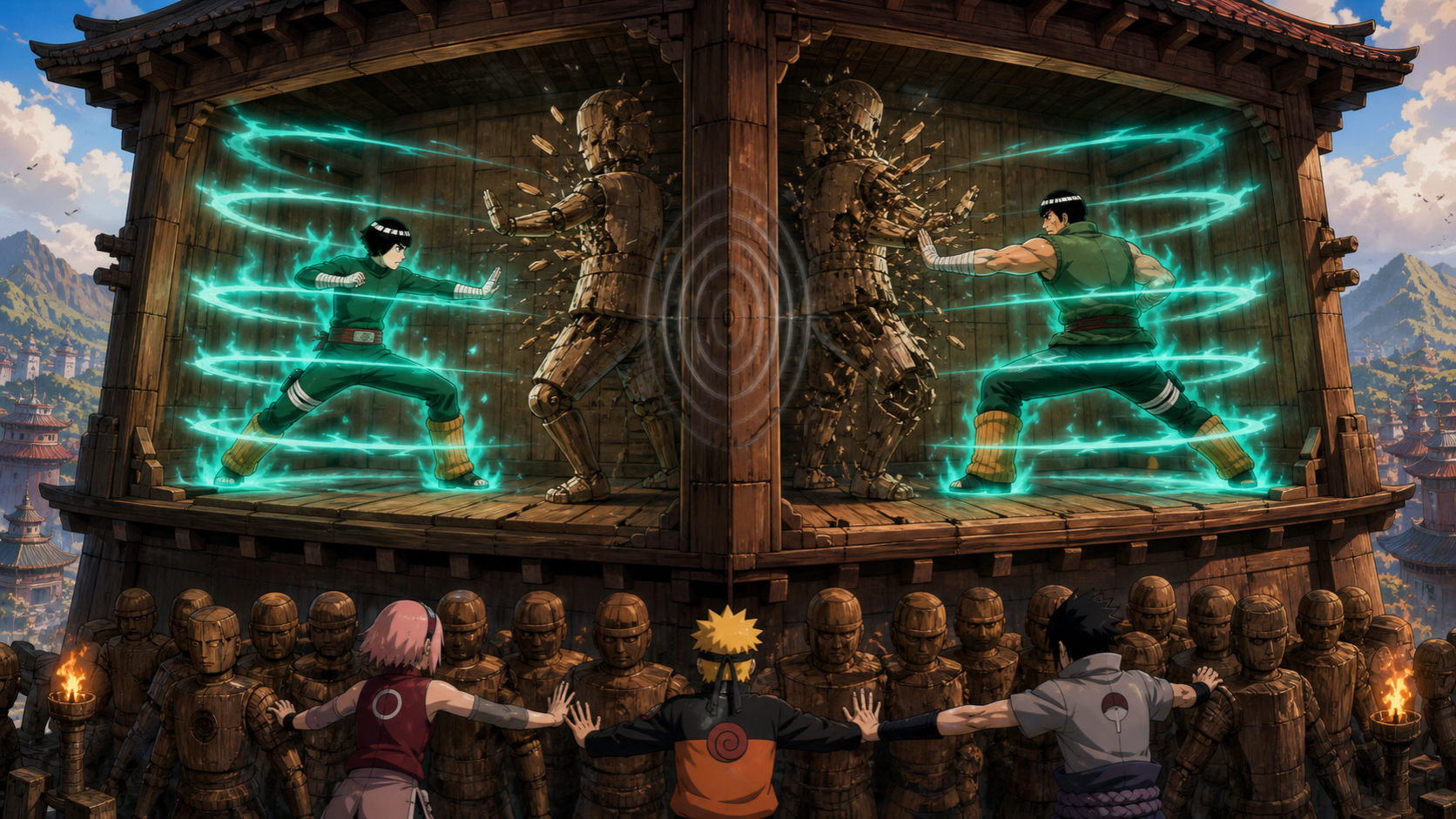
Wooden puppets redirect Lee and Guy’s attacks against each other until private communication and synchronized speed outrun the revenge machine.
The Ryūdōin brothers want Might Guy to die fighting Rock Lee.
They do not put teacher and student in the same room.
They make wooden copies reproduce each man's movements against the other.
Lee sees a puppet using Guy's power. Guy sees a puppet using Lee's Lotus. Neither can leave without defeating the enemy in front of him, which means every stronger attack pushes the person he loves closer to death.
This is not a test of who has better taijutsu.
It is a test of whether imitation can reproduce trust.
Episode 196 answers with five open gates, Morse code, and two men moving faster than a revenge machine can understand.
Episode 196 Facts
Episode: 196 of the original Naruto anime
Licensed title: Hot-Blooded Confrontation: Student vs. Sensei
Japanese title: 涙の激突! 熱血師弟対決 (Namida no Gekitotsu! Nekketsu Shitei Taiketsu)
Japanese broadcast: August 9, 2006
Arc: Third Great Beast Arc finale
Classification: Anime-original filler
Genshō is the impostor who wore Yagura's identity in Episode 195. Rokkaku and Jakō are his younger brothers, and Agira Ryūdōin is their father. Episode 197 begins a separate Konoha Plans Recapture Mission, so none of that village-infiltration plot belongs here.
The brothers' legal outcome remains unstated. The episode resolves their misunderstanding and ends the immediate violence, but it does not establish whether Konoha arrests, releases, or otherwise disciplines them for attacking Yagura, impersonating him, abducting Guy, and endangering the rescue team.
Genshō Removes Yagura's Face
Guy stands inside a field of chakra-reinforced wooden training dummies.
The false Yagura reveals himself as Genshō Ryūdōin. His younger brothers, Rokkaku and Jakō, control the trap with him.
Their father was Agira Ryūdōin.
Agira and Guy fought years earlier while serving opposing missions. Agira suffered injuries severe enough to end his fieldwork and training, then died. According to his sons, he resented Guy until the end, repeated his name on his deathbed, and told them to fight the Leaf ninja.
The brothers hear one instruction.
Avenge him.
Guy remembers a different man. Agira faced him directly, fought with honor, and earned a place in Guy's personal history of great battles. Guy denies using cowardly tactics and asks the brothers to reconsider.
The disagreement begins with memory ownership. The sons witnessed their father's disability, frustration, and decline after the battle. Guy remembers the person Agira was inside the fight. Each side possesses evidence the other lacks, but the brothers turn suffering into proof of betrayal before asking what Agira valued about combat.
His dying request is dangerously compact. “Fight Guy” can mean continue my revenge, test yourselves against the opponent I respected, or carry forward the match my body could not repeat. Grief selects the interpretation that gives the brothers a target and years of preparation give that reading weight.
Their trap does not resemble Agira's method. That contradiction should have warned them sooner.
They did not build a forest full of murderous lumber to reconsider.
The First Puppets Are Labels With Fists
Naruto, Neji, and Tenten reach the trap.
Neji sees Guy inside a wooden structure controlled by chakra. Training dummies close around the rescue team before they can approach.
At first, the system looks more sophisticated than it is. Labels attached to the backs of the heads contain simple instructions. Each dummy repeats a fixed punching or kicking pattern without reacting to an opponent.
Remove the label, stop the movement.
Naruto creates shadow clones and begins stripping them away.
Then one dummy adapts.
Genshō activates direct manipulation and hides responsive puppets among the automated figures. A fighter who assumes every body follows the same loop gets hit by the one body watching him.
The brothers layer cheap repetition around skilled control. Quantity creates noise. A few dangerous puppets use that noise as cover.
The design is more tactical than a wall of identical dummies. Basic figures consume attention at low cost. Labels make their predictable movement portable and replaceable. Directly controlled units exploit the rescuers after they learn the easy rule. The moment Naruto believes removing labels solves the system, Genshō uses that confidence against him.
Neji's Byakugan prevents the layers from remaining invisible. He can trace chakra into the structure and distinguish moving control from ordinary wood. Tenten's ranged weapons and Naruto's clones create the coverage Lee needs to reach the entrance. The supporting team does not break the central trap, but it makes the student-sensei solution possible.
It is an effective system until Lee arrives with no interest in counting anything.
Sakura Cannot Lie Well Enough to Stop Lee
Tsunade ordered Sakura to keep Lee in the village.
His ankle has not healed. His chakra network already carries cumulative damage. He is prohibited from missions and should not use the gates that support Hidden Lotus.
Sakura tries to conceal the emergency.
Lee recognizes the lie.
He reconstructs Guy's route from what she accidentally reveals and follows. By the time he reaches Naruto, Neji, and Tenten, the wooden army has nearly closed around them.
Leaf Hurricane announces him.
Naruto asks how he found them. Lee asks only where Guy is.
The dummies retreat and combine into a pagoda-like fortress around his teacher. Neji finds a weak point in the chakra at its center, but the opening is obvious enough to be bait.
Lee chooses to enter anyway.
If it is a trap, he says, they can fall into it intentionally.
This is not medically responsible reasoning.
It is very Rock Lee.
Sakura's failed concealment shows why secrecy is a poor safety plan for somebody who knows his team. Lee reads her hesitation, infers the danger, and travels without medical support because the adults denied him enough information to make a supervised choice.
Telling him the truth might not have kept him home. It could have allowed Tsunade to brace the ankle, define limits, or send someone capable of stopping him before the gates. Instead, everyone relies on deception against a person whose defining trait is refusing to remain behind when Guy needs him.
Lee still bears responsibility for violating the restriction. The rescue explains the decision. It does not make opening five gates on an injured leg safe.
The Fortress Gives Each Man the Wrong Opponent
Naruto, Neji, and Tenten cover Lee's approach.
He strikes the chakra point with Dynamic Entry and drops inside the structure.
The trap closes behind him.
A wooden fighter waits in the chamber. Genshō speaks through it using the voice Lee knew as Yagura. He promises to prove that passion and effort eventually fail.
Lee attacks.
The dummy answers with Leaf Hurricane.
Elsewhere in the fortress, Guy faces another wooden body. It moves with Lee's technique. Every action Guy takes becomes an attack against Lee through the puppet in front of him. Every action Lee takes becomes an attack against Guy.
The Wooden Men Possession Turnover Manipulation Technique does not control their minds.
It controls the meaning of their movement.
Teacher and student believe they are fighting Genshō's incarnation while the system converts each into the other's executioner.
The technique is not mind control. Guy and Lee choose every attack, but Genshō redirects the physical result through matched puppets. That distinction makes the trap crueler. He wants both survivors to know their own skill killed the other, even though neither could see the person receiving it.
The enclosure removes ordinary signals of intent. No eye contact, warning, posture change, or spoken correction can cross the chambers. Genshō assumes taijutsu becomes anonymous once wood hides the body.
Technique Reveals the Person Inside the Wood
Lee notices that the opposing puppet has grown stronger than the fake Yagura he faced at the Academy.
Its spinning kick carries a level of force only one person he knows can produce.
Guy recognizes the Lotus sequence used against him. He knows who trained to connect those particular movements and who would risk them despite an injured leg.
The brothers assume recognition changes nothing. Neither fighter can stop defending himself, and neither can escape without breaking the puppet blocking the chamber.
Guy taps a message through the structure in Morse code.
They are destroying each other.
Lee understands.
The technique can copy motion and force. It cannot copy the conversation underneath them. Genshō built a system around physical imitation and ignored the private language of people who trained together for years.
Recognition comes before Morse code. Lee knows the force carried by Guy's kick. Guy knows the sequence Lee intends to build toward Lotus. Their bodies function as signatures because repetition created consistency, not because Lee lacks originality.
The tapping then turns a prison wall into communication equipment. Genshō designed the structure to isolate them, yet the same material transmitting puppet control also transmits rhythm. Teacher and student do not need a long strategy meeting. They need confirmation that both understand the mechanism and will accelerate together.
Once Guy and Lee know the mechanism, they can choose one movement together.
Lee Asks Permission to Break the Rule
Lee's injured legs are failing.
The only solution he sees requires the power Tsunade prohibited. He asks Guy, knowing his teacher cannot answer aloud, whether using the gates to protect the person most important to him can be forgiven.
Guy remembers the promise made before Lee's surgery.
If Lee dies, Guy dies with him.
The promise has always been emotionally sincere and operationally alarming. Here it becomes a refusal to let the trap separate their survival.
They open the Third Gate of Life.
Then the Fourth Gate of Pain.
Then the Fifth Gate of Closing.
Their speed rises beyond sound and beyond the wooden bodies' ability to reproduce it. The imitation system breaks under movements it cannot transfer quickly enough.
Guy and Lee destroy the puppets without landing the copied finishing blows on each other.
The fortress collapses.
Effort defeats imitation because imitation has a ceiling.
Their trust decides how to exceed it.
Opening through the Fifth Gate answers the machine but reopens the episode's medical conflict. Lee proves that his effort can exceed imitation, yet the proof demands the exact bodily escalation Tsunade tried to prevent. Victory does not show her restriction was mistaken. Sakura's stretcher confirms the bill arrives immediately.
Guy shares that risk rather than ordering Lee to bear it alone. His old promise remains alarming, but inside the trap it becomes synchronized responsibility. Neither asks the other to produce a force he will not also attempt.
Revenge Arrived Without the Father's Values
The Ryūdōin brothers face Guy after the collapse.
He asks why they did not challenge him with their family's kung fu. If the purpose was to settle Agira's score, why hide behind an impostor, automated soldiers, and a trap that forced two other people to fight?
Guy explains the original battle.
Agira was the last man standing on his side. He refused surrender and faced Guy fairly. Guy respected him enough to answer one-on-one.
After the defeat, Agira smiled.
He wanted to fight Guy again.
His sons inherited the words but removed the context. “Fight Might Guy” became “kill the coward who ruined me.” They spent years preparing revenge for a father who remembered the same event as a worthy match.
Their grief was real.
Their interpretation was wrong.
Real grief does not grant the right to outsource revenge through stolen identities and unwilling bodies. The brothers attack Yagura before he reaches Konoha, exploit Lee's injury, and try to make Guy kill his student. Learning what Agira meant can end their motive. It does not erase the people harmed while they pursued it.
The absent disciplinary ending leaves that accountability unfinished. Guy offers the truth they needed. Konoha still owes the victims more than a corrected family story.
Agira's Lesson Belongs to Lee Too
Guy tells the brothers what he learned from their father.
Fortune does not belong only to people born with natural gifts. The truly fortunate people believe in themselves, continue striving, and keep their passion alive until the end.
That lesson answers Genshō's attack on Lee.
He called Lee a pale copy built through effort. Agira, a master the brothers claim to honor, taught Guy that sustained effort is its own form of fortune.
Genshō tried to use Guy and Lee's similar techniques as proof that Lee lacked identity.
The trap proves the opposite. Their movements resemble each other because years of teaching connect them. Lee still reads the technique, makes his own decision, communicates with his teacher, and matches the impossible speed required to save them both.
He is not a replacement Guy.
He is the student Guy trusted to move with him.
Lee Leaves on a Stretcher With His Priorities Intact
The fight ends, and the medical consequences arrive.
Sakura prepares Lee for transport to Tsunade. He insists that the real Yagura receive care first. The innocent trainee was attacked before reaching the Leaf and used as the face of a revenge plan he never knew existed.
Lee still has not learned Genshō's real name during the confusion.
Guy tells him there will be time for names after first aid.
Naruto watches them and envies the clarity of their relationship.
Guy and Lee are absurd, dangerous, and incapable of moderate emotional volume.
They also know exactly who they are to each other when a fortress tries to replace that bond with wood.
Genshō builds his revenge around copied surfaces
He steals Yagura’s face, fills the forest with replaceable bodies, and makes wooden fighters borrow the movements of living people. Every layer of the plan depends on the belief that resemblance can stand in for identity. If a stranger wears the correct face, Konoha will grant access. If a puppet repeats a technique, Lee will treat it as an ordinary opponent. If Agira’s sons repeat a dying instruction without its history, revenge will look like loyalty.
The episode keeps answering that mistake with relationships. Neji reads the chakra behind the wood. Lee reads Guy inside a kick. Guy reads Lee inside a Lotus sequence. The brothers preserve appearances while the Leaf team identifies the people and intentions underneath them.
The dummy labels reveal how the trap manufactures confidence
The first wave teaches Naruto an easy rule: find the command tag and remove it. That victory is real, but it is also training supplied by the enemy. Once he trusts the pattern, directly controlled puppets can hide among the automatic ones and punish the assumption that every body works alike.
This is the same manipulation Genshō used at the Academy. He gave Lee enough recognizable evidence to accept “Yagura,” then changed the danger after trust formed. The disguise and the dummy army are versions of one tactic. Present a readable surface, reward the target for reading it, and conceal a human decision inside the familiar pattern.
Neji, Tenten, and Naruto do not become background decoration
The emotional climax belongs to Guy and Lee, but they reach it because the rescue team keeps the outside system occupied. Naruto supplies bodies against an army built on quantity. Tenten attacks from range and prevents every opening from becoming a surround. Neji traces the chakra network, distinguishes control from repetition, and finds the fortress entry point.
None of them can solve the paired chamber from outside. That does not make their work optional. A rescue often divides into people who create access and people who survive the final mechanism. The episode gives Team Guy’s supporting members practical jobs instead of pretending one bond can magically erase every other threat on the field.
Five gates are a solution and a medical emergency
The episode wants the synchronized release to feel glorious, and it does. Teacher and student agree without seeing each other, accelerate together, and overwhelm a machine that assumes motion can be copied forever. It is also Lee using the exact system Tsunade restricted because his ankle and chakra network remain vulnerable.
Those truths can sit in the same scene. The gates save Guy. They also place Lee back on a stretcher. Heroism explains why he accepts the risk; it does not turn tissue damage into a misunderstanding. Sakura’s presence at the end prevents the story from pretending passion cancelled the bill.
Guy’s promise makes shared risk personal
When Lee asks permission through the wall, Guy remembers the vow he made before surgery: if Lee dies pursuing the path Guy encouraged, Guy will not continue untouched. That promise is too extreme to serve as a healthy everyday rule. Inside this trap, however, it tells Lee that the teacher will not demand a sacrifice from the student while remaining safely outside it.
They open the same gates and move on the same count. Genshō designed the chambers to convert one man’s effort into harm against the other. Synchronization converts that connection again, this time into mutual escape. The mechanism stays linked. Guy and Lee change what the link means.
Agira deserved better than the story his sons invented
The brothers watched injury and decline, so their anger did not appear from nowhere. What they lacked was the part of Agira’s history that Guy carried: the fair fight, the smile after defeat, and the desire to meet a respected opponent again. Grief turned a compact final request into an order for murder because murder gave their pain somewhere to go.
That discovery ends the revenge motive, but it should not erase accountability. Yagura was assaulted and impersonated. Lee’s medical weakness was exploited. Guy was abducted, and the rescue team faced lethal puppets. Understanding why the brothers were wrong is the beginning of repair, not a receipt proving nobody owes the victims anything.
Effort does not make Lee a copy
Genshō treats Lee’s resemblance to Guy as evidence that training produced imitation instead of identity. The trap proves the opposite. Lee recognizes the teacher through technique because he learned closely enough to understand the force, timing, and intention behind it. Then he makes a choice the puppet cannot make: trust the person on the other side of the wall and coordinate around information the machine does not possess.
Students are supposed to inherit tools. Identity appears in how they understand, combine, and use them. Lee’s taijutsu carries Guy’s instruction, his own damaged body, years of rejected shortcuts, and a loyalty strong enough to decode a kick as communication. Wood can reproduce the outline. It cannot reproduce the life inside it.
RaeRae’s full take
Episode 196 works because it makes the ridiculous wooden fortress emotionally precise. Genshō believes people are collections of visible moves. Guy and Lee know that years of training created a language beneath those moves, and one tapped warning is enough to bring the whole revenge machine down.
I still need the Leaf to explain what happened after the brothers learned the truth. A sad misunderstanding does not clean up impersonation, assault, abduction, or attempted murder. Guy can forgive the insult to his honor. Yagura and the injured rescue team deserve a say about the rest.
And yes, opening five gates on Lee’s injured leg is spectacular. It is also exactly why Tsunade wanted him under supervision. The stretcher is not a joke attached to the victory. It is the cost. Trust defeats imitation here, but trust also means taking the damaged body seriously once the music stops.
RaeRae checkpoint: A puppet can steal a technique, a stranger can steal a face, and grief can steal the meaning of a final request. None of those copies survives contact with people who know the whole story.
Receipts and official routes
- Episode number, licensed title, paired wooden-puppet trap, five-gate escape, and Agira’s intended meaning: Naruto Official Site.
- Japanese title and August 9, 2006 broadcast record: TV Tokyo.