
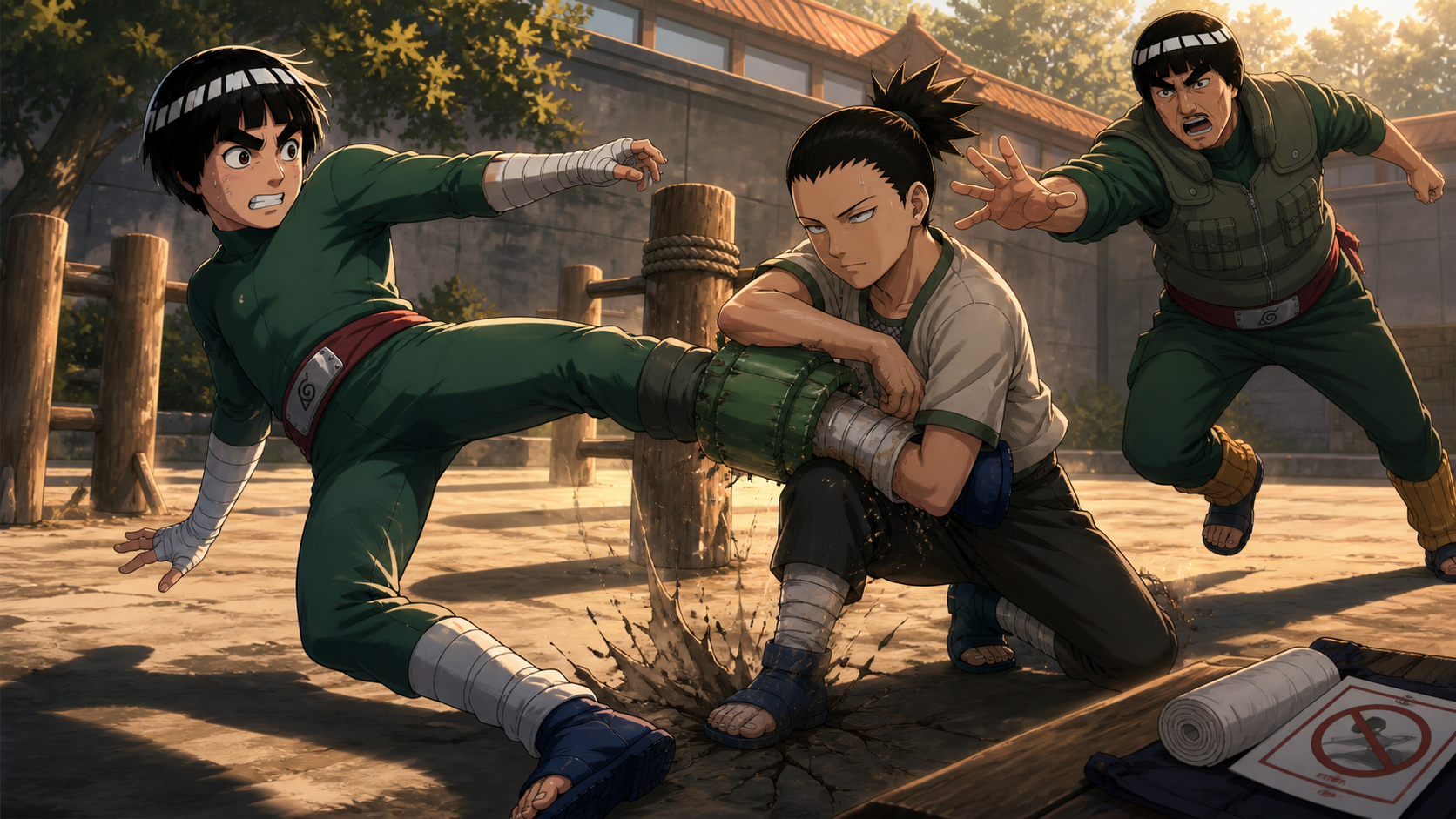
The Third Super-Beast!
Tsunade restricts Lee’s damaged body before a gifted-looking trainee attacks his ankle, his confidence, and the trust holding him to Guy.
Rock Lee survived the injury that was supposed to end his ninja career.
That does not mean his body forgot it.
Episode 195 returns to the cost of rebuilding himself after the Chuunin Exams. Tsunade finds cumulative damage in his chakra network and bans the Hidden Lotus. Then a new trainee defeats him with taijutsu, nearly crushes his ankle, and says effort has made Lee nothing but a weak copy of Guy.
The physical attack hurts.
The argument is designed to hurt more.
It reaches past one lost match and asks whether every sacrifice Lee made has only taught him to imitate somebody better.
Yagura wants Lee to believe that natural talent has replaced him in Guy's eyes. Lee nearly does.
Then he remembers who kept faith when surgery gave him almost no reason to hope.
Episode 195 Facts
Episode: 195 of the original Naruto anime
Licensed title: The Third Super-Beast!
Japanese title: 第三の超獣 最大のライバル (Daisan no Chōjū, Saidai no Raibaru)
Japanese broadcast: July 26, 2006
Arc: Third Great Beast Arc
Classification: Anime-original filler
This episode opens a two-part story. The wooden-dummy trap, the impostor's identity, and the reason Guy was targeted continue into Episode 196. They remain unresolved here. The real Yagura survives the roadside attack, but he does not participate in Lee's match or leave on Guy's mission.
That distinction matters because the episode asks viewers to judge Lee through a fight engineered by an enemy. The “gifted trainee” did not arrive for honest evaluation. He arrived to injure Lee, isolate Guy, and turn an existing insecurity into operational cover.
Naruto Is Healthy and Lee Is Not
Naruto visits Tsunade with a medical crisis.
He feels dull, makes more mistakes than usual, and can eat only five large bowls of Ichiraku ramen. He prepares himself for a terrible diagnosis.
Tsunade tells him he is healthy and stupid.
Then she notices Lee's missing checkups.
Naruto and Tenten find him training hard enough to make the concern immediately reasonable. Lee says he feels fine. His body says the definition of fine needs supervision.
The examination finds cumulative damage across his chakra network. His surgery restored the possibility of a career after Gaara's attack, but healing did not make repeated extreme strain harmless.
Tsunade's diagnosis corrects a dangerous story about recovery. Surgery succeeded, Lee returned to movement, and the village celebrated. None of those facts guarantees that damaged tissue can absorb his previous workload indefinitely. Medical clearance is not a permanent certificate that effort can never reopen an injury.
Lee also has a reason to avoid checkups. A doctor might restrict the only work that makes him feel like a ninja. Missing appointments lets him keep training until symptoms become impossible to ignore, but it also removes the person best equipped to distinguish productive discomfort from cumulative harm.
Tsunade does not dismiss his identity when she compromises. She permits controlled training and removes the technique most likely to turn ambition into another emergency. Lee hears the restriction as a verdict because moderation has never been the language through which he proved himself.
Tsunade initially orders him to stop missions and training.
Lee invokes his self-rule. He must never forget the intention that brought him this far. If he keeps trying, he can keep living as a ninja.
Tsunade compromises. She removes him from active duty and permits controlled training.
Hidden Lotus is forbidden.
Losing One Technique Feels Like Losing the Future
Lee leaves the hospital looking crushed.
The medical news is serious, but the ban carries a second meaning. Hidden Lotus represents the extreme end of the path he built through effort. His body lacks the natural access to ninjutsu and genjutsu that other shinobi use. Every gate and taijutsu technique became proof that relentless work could create another route.
Now his strongest route is closed.
Guy refuses to let one prohibited technique become the limit of Lee's identity.
He recalls the day before surgery. Lee trusted him when success was uncertain and failure could end everything. Guy promised that Lee's effort could pull the future toward him, and in the smallest chance that surgery killed Lee, Guy would die with him.
That promise was reckless, loving, and absolute.
Lee believed him.
Guy asks for that faith again. If Hidden Lotus is gone, Lee will build something greater.
He is a genius at effort.
The training resumes with a ten-second sprint to the Academy and five hundred push-ups when ten seconds proves ridiculous.
Medical moderation has lasted several minutes.
Guy's encouragement restores Lee's hope, but it also repeats the pressure Tsunade is trying to manage. “Build something greater” sounds inspiring to a student who needs rest. Lee translates every limit into another training target because Guy taught him to answer impossibility with volume.
Neither adult is entirely wrong. Tsunade protects the body that must carry Lee's future. Guy protects the identity that makes Lee willing to imagine a future at all. The danger appears when Lee treats those responsibilities as opponents and assumes respecting medicine would betray effort.
A greater technique does not have to mean a more destructive one. Better timing, defense, efficiency, or teamwork could extend his career without forcing another gate. Episode 195 leaves that possibility unspoken because Yagura interrupts before Lee can redefine progress.
Yagura Looks Like the Student Guy Ordered
At the Academy, Guy introduces Yagura.
An acquaintance sent the young trainee to the Leaf about a week earlier so Guy could judge whether he had the aptitude to become a ninja. Guy is impressed. Yagura absorbs instruction quickly and shows strong natural instincts.
Yagura recognizes Lee and asks for guidance from a senior.
Guy arranges a practice match. Lee should warm up, help the newcomer, and avoid hurting him.
The instructions become funny almost immediately.
Yagura is fast enough to follow Lee, strong enough to absorb his pressure, and knowledgeable enough to read Leaf Hurricane. He blocks the escape above, answers the low strike, and turns Lee's momentum against him.
The newcomer does not need protection.
Lee does.
Guy's praise gives Yagura exactly the comparison he wants. Natural instincts, fast absorption, and immediate performance sound like everything Lee was told he lacked. Guy means to describe a promising visitor. The impostor uses the same language to construct a replacement narrative.
Lee enters the match under conflicting instructions. He must help a junior, keep the practice light, prove he still deserves Guy's confidence, and avoid stressing a medically fragile body. Yagura only needs to create one opening and make the resulting loss feel definitive.
The Intersection Method Attacks the Joint
Yagura catches Lee's kicking leg between his knee and elbow.
The Intersection Method applies crushing force from both directions. It is a limb-breaking counter disguised as a clean interception.
Lee's ankle survives because he is still wearing his training weights. Without that reinforcement, the bones would have broken. Even so, his Achilles tendon narrowly escapes serious damage.
Guy stops the match.
Tsunade orders complete rest this time. Lee's earlier permission to train depended on restraint, and the practice session has delivered another injury before he could begin adapting.
Naruto and Tenten initially misunderstand vague reports that Lee's condition is "considerable." They imagine the worst, then learn the bone is intact.
The deeper injury is visible anyway.
A trainee defeated Lee in the only discipline Lee can call entirely his own.
The Intersection Method is not ordinary sparring pressure. It traps a committed kick and crushes the joint from opposing directions. Yagura selects a counter that exploits Lee's need to prove speed and power while leaving an injury that can be blamed on excessive effort.
The training weights saving Lee's ankle adds a bitter reversal. The burden he carries to make routine movement harder becomes protective reinforcement when the impostor tries to break him. Years of effort do not win the match, but they prevent the planned damage from becoming catastrophic.
Neji Explains Why One Loss Will Not End Lee
Naruto and Tenten worry that Lee will collapse under the setback.
Neji disagrees.
Lee heard from the Academy onward that he had no talent for ninjutsu or genjutsu. A person who surrendered when talent rejected him would never have become the fighter they know.
He reached this point through effort and persistence.
If his body heals, Neji believes Lee can surpass people who depend on natural talent alone.
That judgment matters because it comes from Neji. He once treated talent and inherited limits as fate. Lee's refusal to accept those categories helped change the way Neji sees strength.
Tenten remembers the same influence through Guy's lesson on self-rules and the infamous green training suit. Lee embraced both without embarrassment. His commitment gave the rest of the team permission to take Guy's methods seriously enough to find what worked for them.
Neji and Tenten are not merely tolerating their eccentric teammate.
They are grateful he exists.
Their gratitude expands the effort-versus-talent argument beyond Lee's private worth. His persistence changed Team Guy. Neji reconsidered the fatalism attached to inherited ability. Tenten learned to treat Guy's eccentric methods as tools she could evaluate rather than noise she had to endure. Lee's value cannot be measured only by whether he defeats the latest opponent.
Yagura's insult depends on isolating technique from influence. If Lee has not surpassed Guy, then he is supposedly a failed copy. Neji and Tenten provide the answer before the impostor speaks: Lee has already produced changes Guy could not produce alone.
Yagura Turns a Mission Into Rejection
Guy receives a C-rank mission to the Land of Mountain Streams.
He asks Yagura to accompany him for practical training while Lee recovers.
The choice is ordinary on its face. Lee cannot take missions. Yagura is present for evaluation. Field experience will show Guy what a practice hall cannot.
Yagura visits Lee and weaponizes it.
He refuses Lee's offer to train again after recovery. Lee has nothing worth stealing. A fighter built entirely through effort is only a pale imitation of the naturally gifted teacher he follows.
Then Yagura delivers the intended wound.
Guy chose him for the mission instead of Lee because effort cannot defeat talent.
Lee protests that Guy promised to make him a splendid ninja. Yagura points to the empty space beside the teacher and asks Lee to trust what he sees.
The argument works because replacement has always been Lee's fear. If he cannot perform the techniques that justify his place, why would a legendary taijutsu master keep investing in him?
Lee Chooses the History He Knows
Lee nearly accepts Yagura's story.
Then he returns to his self-rule.
If his injured leg cannot train, his upper body can. If Guy believes his training is insufficient, Lee will work harder. He chooses faith in the teacher who staked his own life on Lee's surgery rather than the stranger who arrived a week ago and seems eager to sever that bond.
It is not blind trust.
Lee has years of evidence.
Yagura has one mission invitation and a cruel interpretation.
Trust does not remove Lee's hurt. He continues conditioning because action helps him resist the story, but the repetition that he trusts Guy sounds like reassurance he still needs to hear. Faith and doubt occupy the room together.
That makes the deception sharper than a simple jealous-student plot. The impostor does not invent Lee's fear. He notices a vulnerable joint inside an existing relationship and applies pressure exactly as he did to the ankle.
The audience soon learns the cruelty was the point.
The real Yagura never reached the Leaf. Someone attacked him on the road, and he is now injured under protection.
The trainee who fought Lee and left with Guy is an impostor.
The substitution also exposes a village-screening failure. An outside recommendation brings a trainee into direct contact with an elite jōnin, Academy facilities, a recovering shinobi, and mission operations without anyone confirming that the person who arrived is the person who was sent. The real Yagura's survival provides the comparison only after Guy has already departed.
Guy's generosity makes the breach easier. He treats rapid aptitude as something to nurture and offers practical experience. The enemy counts on him behaving like a teacher.
Guy Walks Into a Forest Built to Trap Him
Tsunade sends Naruto, Neji, and Tenten after Guy.
She tells Sakura to keep the truth from Lee because his injury will not stop him from following.
The fake Yagura leads Guy through a dangerous route toward the Land of Mountain Streams, then disappears among wooden training dummies.
Guy recognizes the equipment from his youth. At first the figures seem limited: repetitive movement, fixed range, predictable attacks.
Then one jumps.
The patterns change. More dummies appear. Their reach extends beyond the circle Guy calculated, and the forest closes around him.
Neji cannot find normal footprints on the pursuit route. He sees stick-like figures moving across the ground instead.
The mission was never about training Yagura.
It was designed to isolate Guy inside somebody else's training ground.
Lee sits in the village repeating that he trusts his teacher.
Guy faces an army built by people counting on that student being unable to follow.
Recovery does not mean Lee’s body returned to zero
Surgery restored a path back to shinobi work after Gaara’s attack. It did not erase scar tissue, cumulative strain, or the cost of repeatedly forcing his chakra network past ordinary limits. Tsunade’s finding is not a betrayal of the earlier success. It is the medical reality that successful recovery still requires monitoring, boundaries, and a workload the repaired body can survive.
Missing checkups is an understandable and dangerous avoidance
Lee knows an examination may restrict the activity through which he proves his identity. Avoiding the doctor protects training time in the short term and removes the person best able to distinguish growth from renewed injury. Feeling functional is not the same as being medically safe, especially for an athlete whose entire method depends on ignoring discomfort longer than other people can.
Tsunade’s compromise needs measurable conditions
She moves from complete rest to controlled training and forbids Hidden Lotus. That respects Lee’s need for purpose while protecting the most vulnerable system. The plan should also define intensity, duration, warning symptoms, scheduled reviews, and who supervises him. “Controlled” means little to Lee unless someone translates it into limits he cannot convert into another punishment challenge.
Guy’s encouragement can inspire and escalate the same risk
Calling Lee a genius of effort restores hope after the ban, but promising something greater can sound like an order to outwork damaged tissue. A greater technique need not be harsher. Efficiency, timing, defense, recovery, and teamwork could extend Lee’s career. Guy must help redefine progress instead of making every medical boundary another wall Lee proves devotion by breaking.
The false Yagura targets the exact insecurity his praise creates
Guy calls the newcomer naturally gifted and quick to learn. The impostor turns those compliments into a replacement story: talent has arrived, effort has failed, and Guy no longer needs Lee. The argument hurts because it uses real differences rather than invented insults. Manipulation often works best when it selects accurate details and gives them the cruelest possible meaning.
The practice match was designed to look like Lee caused his own injury
Intersection Method catches the committed kick and crushes the ankle from two directions. If Lee is hurt, observers can blame intensity, medical fragility, or refusal to rest. The impostor uses a sparring frame to conceal deliberate harm. His choice attacks both the joint and Lee’s credibility as a person trusted to manage recovery.
The training weight becomes unexpected protective equipment
Lee normally carries it to make movement harder. During the trap, the added structure prevents catastrophic damage. Years of effort do not win the match, but they keep the planned injury from ending his recovery. That reversal matters because Yagura claims effort produced only imitation. The evidence on Lee’s ankle says his training already changed what his body could survive.
Neji and Tenten measure Lee through influence as well as victory
Lee’s persistence changed how Neji thinks about inherited limits and how Tenten approaches Guy’s eccentric lessons. His value to Team Guy cannot be reduced to whether he defeats the newest taijutsu opponent. The impostor isolates one loss and calls it a final ranking. His teammates supply a longer record containing years of discipline, trust, and change.
Guy’s mission invitation is ordinary evidence given a hostile meaning
Lee is injured and unavailable. Yagura is present specifically for evaluation. Taking the visitor on a C-rank mission can be a practical assessment without replacing anyone. The impostor presents the empty space beside Guy as proof of abandonment because Lee already fears it. Interpretation becomes the weapon. Years of conduct are weighed against one seating arrangement.
Trust wins because Lee has a larger evidence file
Guy stood beside him before surgery, trained him through failure, and tied his own future to Lee’s survival. Yagura arrived recently and immediately tried to sever that relationship. Lee still hurts and needs reassurance, but choosing the longer record is not blind faith. It is better evidence than the story offered by a stranger who benefits from isolation.
The substitution exposes a serious identity-verification failure
An outside recommendation gives the impostor access to Guy, Academy facilities, a recovering genin, and mission movement without confirmation that he is the person sent. The real Yagura is found only after the fake has departed with an elite jōnin. The Leaf needs verified arrival channels, description or documentation exchange, and direct confirmation with the referring contact before access expands.
The wooden-dummy forest is built around Guy’s teaching instincts
Guy sees training equipment and begins by reading predictable movement, range, and rhythm. The trap evolves because its designers expect him to engage, analyze, and demonstrate. His willingness to nurture talent made the substitution work; his identity as a teacher shapes the battlefield selected for him. The attackers are not only testing strength. They are exploiting the habits attached to care.
RaeRae’s full take
Episode 195 understands that Lee’s deepest injury is not the ankle. It is the suggestion that effort made him disposable the moment natural talent entered the room. The impostor lands that argument after using a practice match to attack the body already under medical restriction.
Tsunade and Guy are protecting different parts of the same future. She needs Lee alive and functional. Guy needs him able to imagine himself as a ninja. Their job is to make those goals cooperate instead of letting Lee prove one by destroying the other.
Lee chooses years of trust over one stranger’s cruel interpretation. Good. Meanwhile, the Leaf lets that stranger leave on a mission with Guy before confirming his identity. Less good. Belief saves Lee’s bond. Procedure still owes everybody an explanation.
RaeRae checkpoint: Lee does not become weak because his repaired body needs limits. The real test is whether effort can mature from self-destruction into a way of training that leaves him alive long enough to keep growing.
Receipts and official routes
- Episode number, licensed title, chakra-network damage, Tsunade’s rest order, and Academy training: Naruto Official Site.
- Japanese title, Lee’s medical restriction, Yagura practice defeat, Guy’s mission invitation, and July 26, 2006 broadcast record: TV Tokyo.