
The Mystery of the Targeted Merchants
The Leaf team discovers Princess Haruna used vulnerable merchants as cover, then rebuilds the false D-rank escort around informed choices and civilian safety.
The merchants are not being targeted.
One passenger is.
Princess Haruna hid inside the caravan, hired the Leaf under a false D-rank story, and planned to use elderly travelers and children as decoys if the enemy caught up.
Episode 188 turns the mystery into an argument about whose life gets counted. Haruna believes preserving her bloodline preserves the Land of Greens. Naruto believes a country is not saved by sacrificing its people without even telling them.
Both understand that Haruna must survive.
They disagree on whether everyone else becomes disposable.
Episode 188 Facts
- English title: The Mystery of the Targeted Merchants
- Japanese title: 不可解 狙われた行商人
- Original Japanese broadcast: June 7, 2006
- Story position: Second episode of the five-part Peddlers Escort Mission
- Confirmed casualty: Kikunojou, killed after facing Ruiga alone
- Mission disclosure: A hidden A-rank political escort was sold to the Leaf as D-rank bandit protection
- Civilian correction: The merchants are escorted to a nearby village
- Cliffhanger: Naruto and Yurinojou face Ruiga's water technique together
Episode 188 is not only the identity-reveal chapter. It is the point where the Leaf team reconstructs an honest mission from a dishonest contract. Protect the civilians first. Separate unwilling cover from willing combatants. Then decide whether to continue helping Haruna with the danger finally named.
Haruna Divides the Caravan
The pursuers have followed the caravan's detour.
Naruto, Hinata, and Choji need to defend travelers who move at different speeds. Haruna proposes splitting them into two groups. Young merchants can move ahead quickly with one protector. Elderly travelers and children will move more slowly with two.
She explains the strategy through bowls of ramen because Naruto refuses to follow the original persimmon example.
The comedy almost hides the cruelty.
The slow group is easier to catch. Giving it two protectors sounds responsible, but it also makes those civilians the obvious target while Haruna travels among the faster group.
One elderly merchant accepts the arrangement because younger people have spouses and children waiting at home. He consents to danger without knowing the person designing the split has a private reason to place him there.
Hinata escorts the fast group. Naruto and Choji remain with the vulnerable travelers.
Haruna has converted the caravan into a shield without disclosing what it shields.
The elderly merchant's consent cannot validate the split because he agrees to a false risk. He believes age makes him slower during a general pursuit and volunteers to protect younger families. He does not know the enemy wants one specific passenger traveling in the other group. Haruna uses his generosity as cover for information she withholds.
Naruto Finds What Secrecy Cost
Naruto leaves Choji briefly to inspect the earlier trap line and search for pursuers.
He finds Kikunojou.
The flower ninja who slipped away under the cover name Kikusuke is dead. His body bears the injuries left by Ruiga's water technique.
Naruto still does not know Kikunojou's identity, but he knows the disappearance was not a bathroom break and the caravan has been lying.
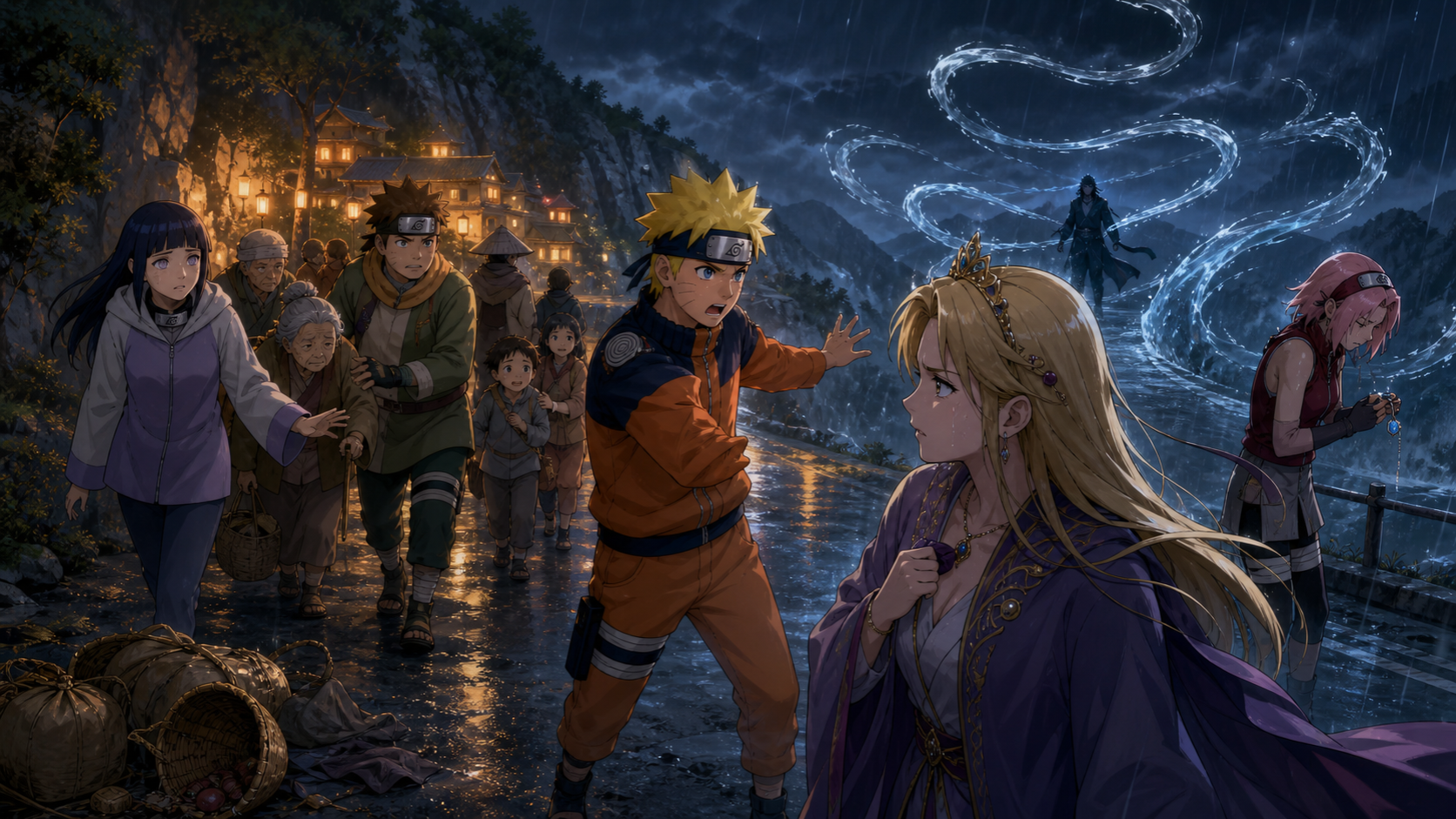
At the slow group, strange rain begins falling. It erases the enemy's presence and gathers into an attack around Choji and the civilians.
Ruiga is not simply pursuing whatever group happens to share the route. He searches each group for a specific person.
Naruto returns with shadow clones and paper bombs, forcing Ruiga to withdraw. The retreat provides the missing clue. The attacker leaves because the slow group does not contain what he wants.
That means Hinata's group does.
The merchants abandon much of their merchandise so everyone can reunite quickly.
The people hired as cover discard their livelihoods before learning why anyone is chasing them.
Those abandoned goods make the deception materially costly even before another person dies. Peddlers carry their income in the caravan. Dropping merchandise to outrun an undisclosed political threat means the merchants pay for Haruna's escape with property as well as danger.
The False Names Finally Fall Away
Naruto confronts Shun and Yurinoshin.
Someone among the travelers has hidden information directly connected to the attacks. Kikusuke is dead. Continuing the lie means the Leaf team cannot protect even the people it might still save.
Yurinojou tells the truth.
Kikusuke was Kikunojou. Yurinoshin is Yurinojou. Shun is Princess Haruna, only daughter of the Land of Greens' feudal lord.
Naruto's first stunned reaction includes discovering that Shun is a woman, because Naruto remains Naruto even during a political crisis.
The larger revelation follows.
Haruna's father learned that a coup was coming. More than half the country's officials had already been bought. He hid his daughter among traveling peddlers and assigned Kikunojou and Yurinojou to get her out.
Two guards did not seem sufficient, so they hired the Leaf.
They called it protection from mountain bandits.
That false description also prevents Tsunade from making an informed staffing decision. A political heir, specialized enemy shinobi, and coup intelligence would justify senior leadership, contingency support, and diplomatic preparation. Haruna's protectors did not merely underestimate Naruto's team. They removed the mechanism by which the Leaf could send a stronger one.
A D-Rank Contract Hid an A-Rank Mission
The distinction is not paperwork.
The Leaf team accepted a D-rank mission to protect ordinary merchants from common bandits. Guarding a national leader from three criminal ninja during a coup is an A-rank assignment.
Mission rank determines the experience, staffing, intelligence, and compensation required for the danger. Naruto, Hinata, and Choji were sent without a formal leader because Tsunade believed the work was routine.
Haruna says she could not reveal the escape. It was secret, and the young Leaf ninja might have panicked and run.
Naruto answers with the consequence.
Kikunojou might still be alive if the team had understood the situation and coordinated from the start.
Haruna replies that one of the Leaf genin might have died instead.
She treats ignorance as protection because trust has only shown her ways people can fail.
The result is not safety.
It is an ally fighting alone while trained reinforcements carry boxes nearby.
The deception also steals the Leaf team's ability to judge acceptable risk. A ninja may choose an A-rank assignment knowing death is possible. These three accepted ordinary escort work and planned around bandits. Haruna did not merely hide her name. She replaced the mission they agreed to perform with one they never had the chance to assess.
Payment cannot repair that retroactively. Mission rank exists because danger, secrecy, and political consequence change what competence looks like. Three genin succeeding under false terms would not make the deception safe or fair. It would make them lucky.
Haruna Admits the Merchants Were Decoys
Naruto recognizes what the split caravan really accomplished.
Haruna placed elderly travelers and children in the group most likely to be attacked so she could escape with the faster merchants.
She confirms it.
As the feudal lord's only surviving blood relative, Haruna believes her life contains the country's future. If she survives, the Land of Greens can someday be restored even if the land itself is destroyed now.
Naruto asks what she thinks people's lives are worth.
Haruna's logic is not nonsense. A surviving legitimate heir could rally allies, challenge the Janin, and rebuild a government. Her death could end that possibility.
The problem is the price she assigns without consent.
Haruna does not ask the merchants to risk themselves for restoration. She hides among them and directs danger toward the most vulnerable people while they believe the problem is mountain bandits.
A ruler cannot claim to preserve a country while treating its people as packaging around the royal bloodline.
Haruna's bloodline may offer legal continuity, but legitimacy does not live only in ancestry. The merchants are part of the country she intends to restore. Sacrificing them without consent preserves a claimant while destroying the relationship that would make her rule worth restoring.
Trauma Explains Haruna Without Excusing Her
Yurinojou asks Naruto to understand how Haruna became this way.
The Land of Greens was too small to guarantee its security in a violent political world. As a child, Haruna was sent alone to another country as a hostage to preserve peace.
She learned early that her body was a bargaining object. Adults called the arrangement necessary for national survival, then expected her to return capable of trusting the same structures that traded her away.
Haruna's current belief repeats that lesson.
One person may be sacrificed if the country survives. She now places civilians where she once stood, except she controls the decision this time.
The history makes her anger and distrust legible.
It does not make the decoy plan right.
Naruto can recognize a lonely childhood without agreeing that loneliness grants permission to spend other lives.
That is the episode's fairest treatment of Haruna. Her hostage history explains why dependence feels like captivity and why other people appear as pieces in national survival. Explanation identifies the wound. It does not transfer responsibility for that wound onto uninformed civilians.
The Leaf Protects the Mission It Actually Accepted
Yurinojou makes the ethical boundary explicit.
His duty is to protect Haruna. The Leaf team's duty is to protect every merchant. Those are not the same contract.
Naruto, Hinata, and Choji escort the noncombatants to a nearby village. The merchants have already abandoned goods and changed routes for a danger nobody disclosed. Getting them to safety comes first.
Haruna asks why Naruto separates them when they still have value as tools.
Naruto rejects the question.
Once the civilians are safe, the Leaf team refuses to disappear. If Haruna's group hides, the Janin may attack the merchants again while searching. Naruto and his friends remain visible instead.
This time, the decoys know the danger and choose the role.
That difference is everything.
Naruto, Hinata, and Choji also possess the training to accept combat risk. They remain visible after the merchants reach safety because drawing pursuit is now part of a plan they understand. Consent does not make the danger disappear. It changes who has authority to assign it.
Yurinojou Stops Fighting Alone
Naruto returns a keepsake found with Kikunojou's body.
Yurinojou remembers training beneath his senior disciple. Kikunojou mastered their flower techniques, and Yurinojou never defeated him once. Death appears to have closed that rivalry forever.
Naruto offers a very Naruto solution.
If Yurinojou defeats the man who defeated Kikunojou, he will have surpassed his teacher.
The logic is emotionally helpful and mathematically questionable, but it gives grief a direction other than surrender.
Ruiga attacks.
Yurinojou uses Flower Ninja Art while Naruto helps expose the enemy's hidden position. Unlike Kikunojou, Yurinojou does not face the water user alone.
That tactical change is the immediate benefit of truth. Naruto can create openings, Yurinojou can apply local technique knowledge, and Choji remains available nearby. Kikunojou's courage did not fail because he cared too little. His secrecy denied courage the support it needed.
Ruiga counters with the same water manipulation that killed Kikunojou, then begins a summoning technique.
Episode 188 ends before the battle resolves.
The secret is finally gone. The civilians are safe. Haruna remains furious, Yurinojou remains outmatched, and two more Janin wait beyond Ruiga.
The disclosure does not instantly repair trust. Naruto now knows who Haruna is, but he also knows she deliberately selected vulnerable strangers to absorb danger. Haruna knows the Leaf team stayed, but she still expects dependence to become betrayal. Honest information makes cooperation possible; it does not make forgiveness automatic.
At least the people still fighting now know what they are fighting for.
That is already a better mission than the one they accepted. The risk is higher, the enemy is stronger, and Kikunojou is gone. For the first time, however, every remaining fighter can choose a role using the same reality.
The split looks protective because Haruna controls the premise
Putting two ninja with slower travelers sounds like extra care until the hidden target travels with the faster group. Haruna knows exactly which formation draws pursuit away from her. The elderly merchant volunteers under the belief that everyone faces the same general threat. He cannot consent to being a decoy for a princess whose identity and pursuers were deliberately concealed.
Kikunojou’s death is the cost of compartmentalization
He does not die because he lacks courage or technique. He dies fighting alone while three Leaf ninja remain close enough to help and too uninformed to know help is needed. Secrecy may protect a route when the enemy lacks it. Here the Janin already know Haruna escaped and are checking both groups. Silence protects no location. It only isolates defenders from one another.
Ruiga’s rain turns uncertainty into evidence
The strange rainfall masks his presence and gathers the battlefield into a weapon. When he searches the slow group and withdraws after failing to find his target, the attack answers the question the refugees avoided. The merchants are not the objective. Someone among the faster travelers is. Naruto uses the enemy’s behavior to correct a threat model the client refused to explain.
The merchants pay for the deception before they learn it
They abandon merchandise to reunite and escape. For peddlers, those goods are not decorative luggage. They are income, inventory, and the means of continuing their work. Haruna’s plan exposes civilians to bodily danger and transfers financial loss onto them without disclosure. Saving their lives is essential, but the later government also owes them restitution for a royal evacuation hidden inside their caravan.
The false rank steals informed risk from the Leaf team
Naruto, Hinata, and Chōji accepted routine bandit protection. An A-rank political escort involves trained assassins, diplomatic consequences, and a protected heir whose survival affects a country. Mission rank is not a vanity label. It governs staffing, leadership, intelligence, and pay. Haruna’s protectors deny Tsunade the chance to assign appropriate resources and deny the genin the chance to understand what they accepted.
Haruna’s bloodline may matter without outweighing every citizen
A surviving heir can rally allies and challenge the coup. That gives Haruna’s safety real political value. It does not turn elderly merchants and children into packing material around legitimacy. A future ruler preserves more than succession. She preserves a relationship with the people whose country she claims to restore. Spending their lives without consent damages that legitimacy before she reaches safety.
Her hostage childhood explains the logic she repeats
Adults once sent Haruna away as a bargaining object for national security. She learned that one person may be sacrificed when leaders call the country’s survival more important. Now she controls the calculation and places civilians where she once stood. The history deserves compassion because it shows how the belief formed. It does not make repeating the same violation responsible leadership.
Naruto separates explanation from permission
He can understand that Haruna is frightened, betrayed, and shaped by isolation without agreeing to her decoy plan. That distinction keeps empathy from becoming surrender. Pain can explain why someone reaches for control. It cannot authorize assigning danger to people who do not know the bargain exists. Naruto refuses to let Haruna’s wound become the merchants’ sentence.
Protecting the civilians first restores the original contract
The Leaf was hired to guard the merchants, even if the hidden clients intended something else. Moving the noncombatants to a nearby village honors the obligation Naruto’s team actually accepted. Only after that duty is secured can the genin decide whether to continue helping Haruna. The order matters because the princess cannot retroactively convert every traveler into a willing participant.
Remaining visible becomes ethical because the team chooses it
Naruto, Hinata, and Chōji deliberately draw attention after the merchants reach safety so the Janin will not redirect the search toward them. This is still dangerous decoy work. The difference is knowledge, training, and consent. The ninja understand who the enemy wants, why visibility matters, and what role they are accepting. Haruna’s earlier plan denied every one of those conditions.
Yurinojou finally fights with an ally
Grief makes him want to answer Kikunojou’s death personally. Naruto gives that grief direction without leaving him alone. Their combined attack is the first tactical benefit produced by honest disclosure. Naruto can expose Ruiga’s position, Yurinojou can apply knowledge of the flower techniques and enemy, and the remaining team can protect Haruna and civilians. Truth does not guarantee victory. It makes coordination possible.
The corrected mission needs a written record
Tsunade should receive the real identities, coup timeline, enemy abilities, Kikunojou’s death, civilian losses, and false ranking. The Land of Greens cannot later describe the merchants as volunteers or treat the genin’s success as evidence that the original staffing was adequate. An accurate record protects compensation, accountability, and the next decision about political support.
RaeRae’s full take
Haruna is not wrong that her survival matters. She is wrong that importance gives her ownership of everybody else’s risk. A princess hidden among civilians does not become morally lighter because the country needs an heir.
The ugliest part is how reasonable the slow-group plan sounds before Naruto knows the truth. Two protectors, vulnerable travelers together, faster people moving ahead. Every detail can be defended because Haruna removed the one fact that changes its meaning.
Episode 188 finally puts everyone inside the same reality. The danger gets worse, not better. Kikunojou is dead, Ruiga is still standing, and two more brothers wait. At least nobody left on the battlefield has to die because an ally mistook secrecy for protection.
RaeRae checkpoint: Haruna may be essential to restoring the Land of Greens. That does not make its merchants disposable. A country is not preserved by sacrificing its people under a contract they were never allowed to read.
Receipts and official routes
- Episode number, licensed title, Haruna identity reveal, and official synopsis: Naruto Official Site.
- Japanese title, Kikunojou casualty, concealed princess and guard identities, and June 7, 2006 broadcast record: TV Tokyo.