
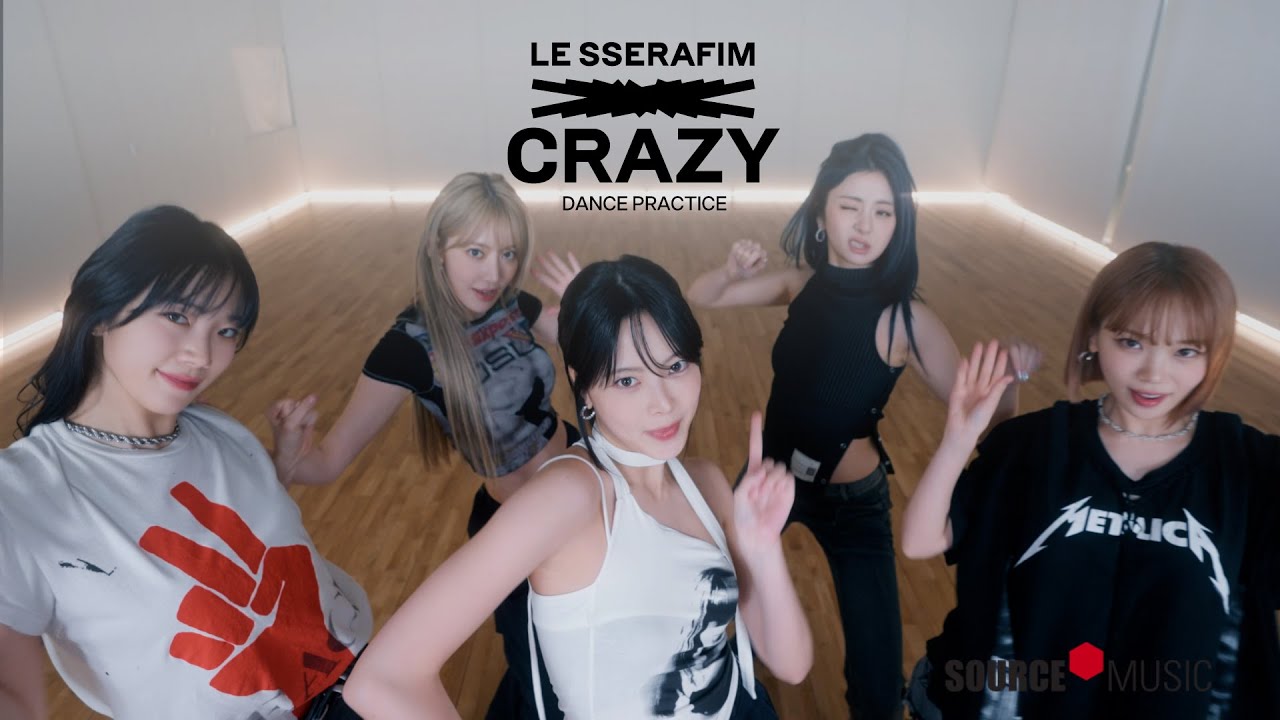
CRAZY Moving Dance Practice: The Camera Joined the Formation
A moving dance practice can clarify choreography or turn the camera operator into an unofficial sixth member. Here the motion mostly helps: it shows how LE SSERAFIM build club looseness on top of brutally specific spacing.
Release file
Released: September 1, 2024
Runtime: 2:54
Artist / channel: LE SSERAFIM
Exact-file focus: The exact moving-version dance practice, formation geometry, camera travel, member texture and how the choreography embodies CRAZY’s permission to lose composure.
Exact official dance practice deep dive · video ZJwC0VYzGIs
A moving practice camera is not neutral documentation, but it reveals more formation logic than the MV while making the lens another dancer. This exact upload shows how “CRAZY” is built, not only how it is styled.
Bottom line
The choreography earns the repetition through angles, level changes and confident walking. The risk is that a moving camera can manufacture impact the bodies should create; here the five members mostly survive that test.
The exact-upload rule
This page reviews video ZJwC0VYzGIs, the official dance practice assigned in the playlist. A matching song title is not permission to swap in another language version, choreography cut, performance film or distributor upload. Captions, comments, edits, audience path and even the visible performance can differ. IDs are records; titles are labels.
The five-member relay
Sakura brings veteran camera judgment and a willingness to reshape an established idol identity. Chaewon creates compact authority in vocals and movement. Yunjin adds scale, grain and the perspective of a working songwriter. Kazuha uses classical control best when she allows groove to loosen it. Eunchae changes the temperature with brighter timing and increasingly confident transitions.
Those descriptions do not require permanent position stickers. The video redistributes focus according to its own arrangement. Watch who prepares the next entrance, maintains the edge of the formation and completes another member’s reaction. Group craft lives outside the close-up too.
The beat and vocal architecture
The choreography earns the repetition through angles, level changes and confident walking. The risk is that a moving camera can manufacture impact the bodies should create; here the five members mostly survive that test.
LE SSERAFIM songs often create tension between cool delivery and physically demanding staging. The recorded voices establish color and phrasing; the video proves concept performance and editing choices. It does not independently prove live stability. Use actual live stages for that claim, and do not convert one polished mix or one bad clip into a complete vocal identity.
Concept is a choice, not a personality diagnosis
The members perform an idea for a released artifact. Fierce styling does not prove private toughness; sweetness does not reveal innocence; a lyric does not automatically confess a relationship. Review the camera, movement, writing, production and public performance. Leave private motives outside unless a member states them on the record.
That boundary makes criticism sharper. We can say an edit cuts too quickly, an influence needs better credit, a hook wears thin, a line distribution wastes a tone or a concept finally fits. Evidence does not make the voice timid. It keeps the voice aimed at the thing actually sold.
Influence needs names
LE SSERAFIM’s catalog moves through reggaeton, amapiano, Afropop, house, ballroom, hip-hop and R&B-associated vocabularies. “Global” is not a genre and “K-pop innovation” is not a receipt. When a release borrows from Black, Latino, queer or regional musical histories, coverage should name the lineage and look at credits.
That is not an order to reject the song. Enjoyment and accountability can occupy the same chair. The members’ execution may be excellent while the company’s promotional language remains vague. A review can hold both facts without using performers as shields or targets for decisions made across an industry production chain.
The camera and the formation
Five creates a natural center, but good choreography does not turn the other four into wallpaper. The strongest sections rotate depth, build temporary pairs and let outside members prepare the next focal change. The camera helps when it clarifies that grammar; it hurts when it cuts before movement resolves because somebody feared a complete count might bore us.
On replay, track one member away from center. The performance becomes less like a highlight reel and more like a working system. Spacing, sustained energy and reaction timing explain why a simple hook can look expensive.
Live-vocal discourse without the mob
LE SSERAFIM has faced loud live-vocal criticism. Specific stages are reviewable. Unstable notes, difficult keys, backing-track balance and improvement can all be discussed. Harassment begins when one moment becomes a permanent insult, later evidence is ignored and private accounts become punishment channels.
This official dance practice cannot settle every live claim. It can show recorded delivery, visual performance and how the production presents the group. Keep the sentence no larger than the source, then let actual live material add evidence.
What changed on replay
First watch, the camera movement felt like extra choreography. Second watch, I tracked the members behind the focal point. Third watch, the routine looked harder because the transitions—not the obvious pose—were doing the real work.
Replay section
Replay it with a second job. First enjoy the hook and concept. Then follow the handoffs, the outside formation and the choices that survive without the obvious focal shot. If the video uses a cultural vocabulary or collaboration world, replay with the credits and history open too. Pleasure is not harmed by knowing where the ingredients came from.
Keep going
Use the LE SSERAFIM hub for the complete exact-video tracker. Member profiles: Sakura, Kim Chaewon, Huh Yunjin, Kazuha and Hong Eunchae.
The arrangement earns—or loses—the repeat
A repeated hook is not automatically lazy. Repetition can build hypnosis, comedy, pressure or a physical cue for choreography. The test is what changes around it. Vocal texture, bass movement, editing, a guest entrance or a formation shift must keep giving the same phrase a new job. When nothing changes, an earworm becomes unpaid overtime.
This upload mostly understands that bargain. The five members do not deliver every repeat with one shared expression, and the visual language creates new context around familiar sound. The weaker seconds are the ones where the production trusts recognition more than development. A hook can be the front door without being the entire house.
The edit should trust the performers
LE SSERAFIM has enough camera experience and formation discipline to survive a complete movement. Fast cutting helps a concept feel urgent, but it can also interrupt facial timing and hide the connective choreography that makes five people read as one team. The best shots choose a point of view and stay long enough for the choice to have consequences.
That matters for new listeners. A comeback is not only a mood film for people who already know every face. It should connect voice, name and movement. Longer shots, accurate captions and a description with credits do more durable promotional work than another dozen vertical clips that vanish into feeds.
The fair counterargument
One can reasonably dislike this song’s repetition, production influence, visual premise or restrained payoff without disliking the members. One can also enjoy the performance while questioning attribution and corporate framing. Art criticism is not a loyalty oath. The release gets stronger when the audience can say what works without being recruited into defense duty.
My answer is proportional: the exact upload earns a replay because the five-member timing, tone and visual commitment create more detail than the title alone promises. It does not earn immunity from criticism, and criticism does not require turning a professional artifact into a referendum on five women’s worth.
One detail to carry forward
The most useful lesson is that individual color and group precision are not opposites. LE SSERAFIM becomes generic when everybody reaches for the same expression; it becomes recognizable when Sakura’s camera timing, Chaewon’s compact authority, Yunjin’s scale, Kazuha’s line and Eunchae’s brightness arrive inside one shared structure. Future releases should trust that difference instead of editing around it.
Receipts
Verdict
CRAZY moving dance practice exact-upload deep dive: music, five-member performance, visual concept, cultural context and replay verdict.
What changed every time I replayed it
The first watch follows the camera because it is impossible not to. The second watch fights that instinct and watches feet, spacing and recovery instead. That is when the choreography’s discipline becomes obvious. Chaewon attacks the center cleanly, Sakura controls detail, Yunjin stretches phrases with personality, Kazuha makes balance look rude, and Eunchae snaps transitions before the eye expects them. On the third replay, the moving lens earns its keep. It enters and exits gaps the dancers create, changes perceived scale and lets the hook feel like a club circle without hiding the formation. The danger is motion sickness masquerading as excitement. This version mostly avoids it because the camera follows choreographic intent rather than inventing a separate routine.
Lyrics and meaning
A dance-practice file does not add new lyrics, but it changes how the existing meaning becomes physical. CRAZY is about accepting the intensity other people label irrational. The choreography translates that idea into controlled release: tight lines break into looser individual textures, shoulders and hands interrupt polished silhouettes, and the group repeatedly reforms after appearing to scatter. That is the point. Losing composure is not the same as losing skill. The members can look reckless because the underlying counts are exact. The moving camera makes that contradiction visible by getting close to the apparent chaos, then pulling back in time to reveal the structure still holding.
RaeRae verdict
This moving practice earns its camera motion because it reveals the choreography instead of smearing it. The formation work is disciplined, the individual textures stay visible and the apparent chaos has receipts.