
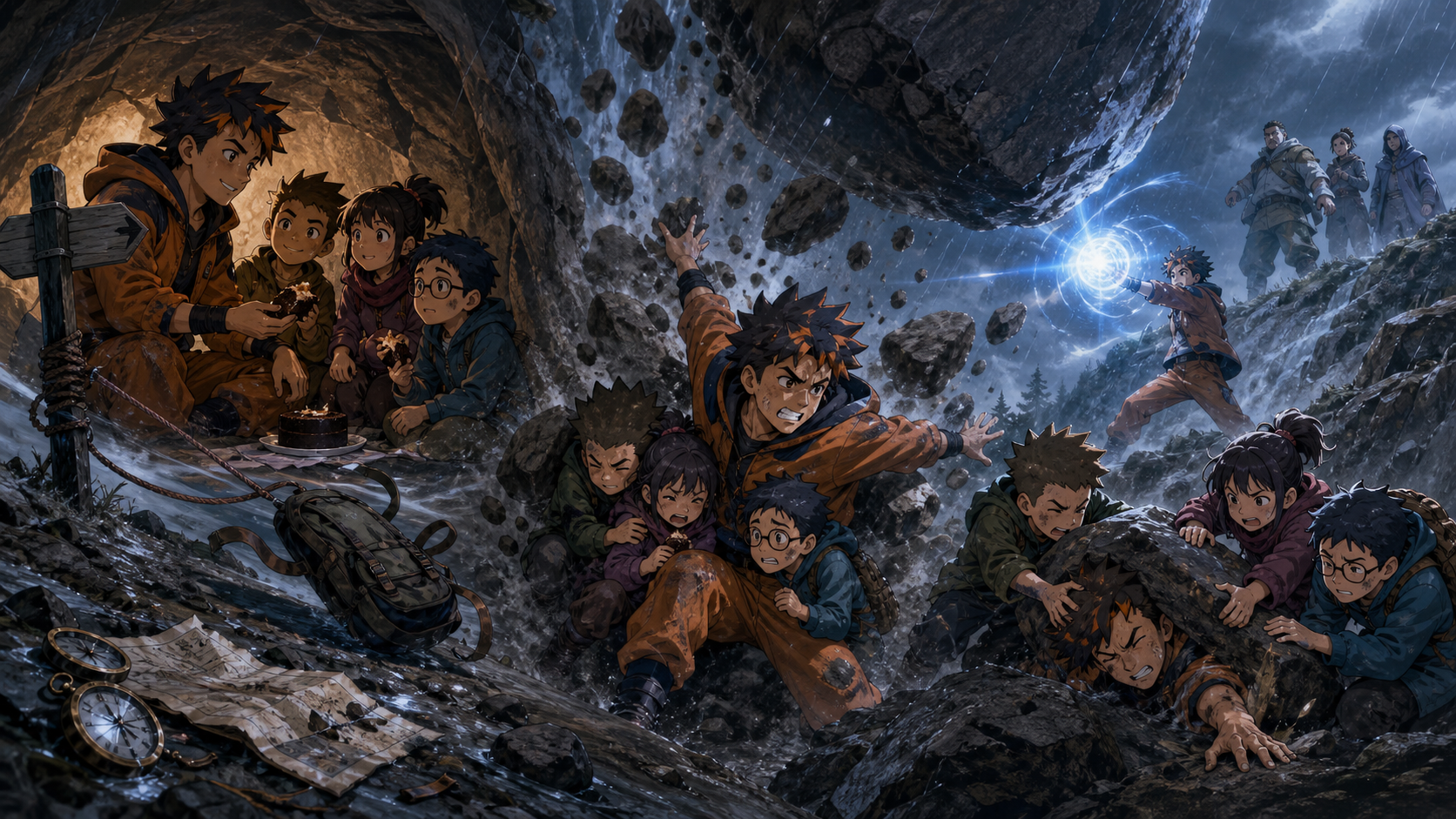
Follow My Lead! The Great Survival Challenge!
Naruto’s courage saves three Academy students from the mountain emergency his shortcut created, exposing the gap between protection and leadership.
Naruto wants to become Hokage. He just does not want to babysit.
Tsunade solves that contradiction by telling him the babysitting is Hokage practice, and suddenly he cannot accept the assignment fast enough.
Episode 158 hands Naruto three Academy students and asks whether his instinct to protect people is the same thing as knowing how to lead them. It is not. Naruto is brave, generous, and willing to put his body between danger and a child. He is also terrible at navigation, dismissive of safety instructions, and so focused on finishing first that he turns a controlled training exercise into an actual mountain rescue.
Saving everyone from the emergency you helped create is still heroic. It is not good leadership.
Hokage Practice Sounds Better Than Babysitting
With regular missions scarce, Konoha assigns genin to lead groups of Academy students through a one-night, two-day outdoor exercise. Naruto immediately refuses. He wants serious training, not childcare.
Tsunade reframes the work. A leader gives clear instructions, protects subordinates, and completes the mission. If Naruto intends to become Hokage, this is exactly the kind of responsibility he needs to practice.
The word Hokage performs its usual magic. Naruto accepts, imagines himself in command, and discovers that his team is Konohamaru, Moegi, and Udon.
Iruka oversees the exercise while Shikamaru assists the instructors. Each team must follow a marked safe route toward the Great Stone Face of Warudakumi on Mount Takurami, handle staged traps and attacks, locate the single secret scroll, and return. Because there is only one scroll, the exercise also encourages competition.
The route rule is explicit. The mountain contains hazards beyond the supervised paths.
That detail will matter when Naruto decides winning is more important than listening.
Everyone Else Brought a Lesson
The episode checks in on other genin leaders, and the contrast is not flattering to Naruto. Choji teaches his students about securing food. Neji explains how to estimate direction from the sun when local conditions confuse a compass. Hinata scouts with the Byakugan. Shino helps his group cross with insects. Tenten handles instructor attacks. Lee becomes emotionally overwhelmed when children call him sensei, because of course he does, but even his enthusiasm gives his students structure.
Naruto's food lesson consists of buying packaged supplies at a store.
Preparation does not need to look impressive. That is the part Naruto keeps missing. Knowing which plants are safe, reading a route, watching weather, and checking whether younger teammates can perform the same movement skills are less exciting than a Rasengan. They are also what keeps a training day from becoming an emergency.
Naruto cannot read the map properly. Konohamaru grabs it and fails too. Moegi takes a turn, and the group circles back again. Udon stares at the unreliable compass until he becomes sick.
Nobody on the team has enough humility to stop and admit they need help.
A Formation Only Naruto Could Inspire
Iruka and the instructor group confront Naruto's team as part of the exercise. Naruto reaches for the Sexy Jutsu, apparently forgetting that Iruka has known him long enough to stop falling for every old trick.
Iruka knocks him down.
Konohamaru, Moegi, and Udon answer with their own transformation formation, producing a trio designed around the same embarrassing theory of adult distraction Naruto taught Konohamaru. The instructors react, and the students create an opening before Shikamaru brings Naruto's celebration back to earth.
The gag proves Naruto has influenced the younger three. That does not mean he has prepared them well. They learned his flashiest nonsense because he made it memorable. The harder lessons still have to come from experience.
Night approaches, and a dangerous storm moves toward the mountain. The instructors cancel the exercise and notify the team leaders.
Naruto's group does not receive the message because it is lost.
The Shortcut Is the Real Failure
Naruto still wants to finish first, so he orders the team onto an unmapped shortcut. The students object. He pushes ahead.
This is where poor navigation becomes poor leadership. Getting lost can happen. Ignoring the safe-route rule during worsening weather is a decision.
Naruto scales part of the mountain with chakra and expects the others to follow, forgetting that Academy students have not learned the same control. He treats his own ability as the baseline for people younger and less trained than he is.
Strong wind catches Udon's backpack and nearly carries him away. Konohamaru and Moegi grab him, and Naruto finally responds to the situation in front of him. He cuts away the pack, uses rope, and helps the students reach shelter.
The lost backpack later gives Iruka and Shikamaru a clue to the team's location. In the moment, losing it leaves the group wet, cold, and short on useful supplies inside a cramped cave.
They begin blaming one another. Hunger makes every complaint louder.
Naruto checks what food remains. Most of it requires water they cannot spare or safely collect. He finds one small angel cake, cuts it into three pieces, and gives all of it to the students.
Kakashi's Lesson Finally Shows Up
Naruto remembers the bell test, when Kakashi punished Team 7 for breaking rules and then revealed that abandoning a teammate was worse. Sasuke and Sakura shared their food with Naruto despite the threat of failure. That choice turned three competitive students into a team.
Now Naruto sits in Kakashi's old position, except he is the hungry person choosing to go without.
Konohamaru, Moegi, and Udon each break off part of their cake and give it back to him. They are not obeying a formal order. They understand that their leader belongs inside the group he is protecting.
It is Naruto's best leadership moment because nobody is performing authority. He meets a basic need, puts the students first, and accepts their care in return.
Then he leads them back onto the mountain instead of waiting for rescue.
The episode refuses to let one good choice repair the entire plan.
The Students Rescue Their Leader
A rockslide begins above the group. Naruto creates shadow clones and holds back a massive boulder long enough for the children to move. The weight overwhelms him, and he becomes pinned beneath the collapse.
Konohamaru, Moegi, and Udon could run. Instead, they return.
They coordinate their effort, shift smaller rocks, and work together against the largest obstruction. The children Naruto considered a babysitting burden become the people keeping him alive.
That reversal is the episode's strongest proof of what leadership can do. Naruto has not taught them polished wilderness skills, but his refusal to abandon them has become mutual. They understand a team as people who come back.
Iruka and Shikamaru arrive as another section of the slope gives way. Naruto sends clones to move the students toward safety and uses the Rasengan to destroy the largest falling rock.
Everyone survives. The exercise is over in every sense.
Bravery Does Not Cancel the Report
Back in Konoha, Tsunade asks what happened. Konohamaru, Moegi, and Udon explain that Naruto forced them onto a dangerous shortcut despite their objections.
Naruto looks betrayed. He should not.
The students are telling the truth during a safety review. Protecting Naruto from consequences would repeat the same mistake that put them on the mountain: treating loyalty as silence.
Naruto deserves credit for sharing his food, shielding them from rocks, and trusting their teamwork. He also deserves Tsunade's anger for ignoring the route, failing to account for their skill level, and prioritizing first place during a storm.
Both judgments can be true. That is the lesson he needs if Hokage is more than a word that makes unpleasant work sound important.
Naruto runs from Tsunade before punishment lands. The ending chooses comedy, but the exercise has already made its point. A leader is not simply the strongest person in front. Strength matters when the boulder falls. Leadership matters earlier, when a map, weather warning, or junior teammate says the shortcut is a bad idea.
Naruto knows how to save his team. Episode 158 shows how much he still has to learn about not endangering it.
Naruto hears “babysitting” where Tsunade assigns command
Leading Academy students does not look prestigious enough to him at first. The reaction exposes how easily shinobi culture confuses danger with importance. Konohamaru, Moegi, and Udon are less experienced, which makes the assignment more demanding ethically, not less valuable. A leader’s competence is clearest when the people following cannot compensate for his mistakes.
Tsunade frames the exercise as preparation for Naruto’s stated dream
He wants to become Hokage, a role built from responsibility for people with different abilities and needs. Commanding three students through a supervised route is a reasonable test of whether he can translate courage into planning. The lesson is not that every Hokage must be an expert camper. The lesson is that authority makes another person’s safety part of every decision.
A training exercise has a designed safety envelope
The marked route, instructor traps, map, and expected timing create boundaries where mistakes can teach without becoming disasters. Naruto treats those elements as obstacles to excitement. Ignoring them converts a controlled drill into an unsupervised expedition. Training only works when participants understand which risks are simulated and which rules keep the simulation from becoming a rescue operation.
Throwing away navigation tools is a leadership failure
A map and compass are not signs of weakness. They externalize information so the team can check position even when confidence is wrong. Naruto discards the tools because he believes instinct will move them faster. Once the group is lost, the students pay for his pride through distance, exposure, and uncertainty. Good leaders keep tools that allow subordinates to question direction with evidence.
The shortcut removes the group from instructor support
Leaving the marked route means the Academy’s search plan no longer matches their location. Traps meant to test observation are replaced by terrain nobody prepared or monitored. Naruto’s desire to finish impressively expands risk beyond what the children agreed to face. Consent to a school exercise is not consent to an unknown mountain route during worsening weather.
Konohamaru’s admiration makes disagreement harder
He sees Naruto as an older peer who defied adults and earned recognition. That bond can inspire him, but it also makes Naruto’s reckless choice look heroic. A leader must account for the influence that makes younger teammates imitate confidence before they understand consequences. Konohamaru needs permission to question Naruto without proving disloyal.
Moegi and Udon deserve active roles in route decisions
The episode can treat them as children swept behind Naruto’s momentum, yet both can read conditions, remember instructions, and notice when the plan changes. A simple check-in would ask whether anyone recognizes the terrain, what supplies remain, and whether returning is safer than pressing forward. Participation builds skill while giving the leader information he may have missed.
The storm changes the mission and should end the shortcut
Rain increases cold exposure, reduces visibility, destabilizes slopes, and makes wind more dangerous. Once instructors cancel the exercise, the only objective is safe recovery. Reaching the secret scroll no longer matters. Leaders must be able to release a goal when conditions invalidate it instead of treating persistence as proof of character.
Udon nearly being carried away shows the cost of uneven bodies
Naruto may be able to brace against wind that overwhelms a smaller student. Planning from his own capacity ignores the people he leads. Formation, handholds, spacing, and shelter should be chosen for the least stable member, not the strongest. Equality in a dangerous environment often means adjusting support rather than expecting identical performance.
The cave solves exposure but creates new checks
Shelter from wind and rain is necessary, yet an unfamiliar cave can contain unstable rock, animals, flooding, or poor ventilation. Naruto should inspect the entrance, keep everyone away from loose walls, establish a visible position for rescuers, and avoid a fire if smoke cannot escape. Survival decisions remain active after reaching cover.
One small cake becomes a test of resource distribution
Naruto divides the food among the students and initially takes none. The choice shows protective instinct, but a leader also needs enough energy to navigate, carry someone, or respond to danger. Sustainable care does not require the responsible person to disappear from the ration plan. The students sharing it back creates a healthier model where the group maintains every member.
Kakashi’s teamwork lesson finally becomes material
The cake echoes the principle Naruto learned when Team 7 shared food despite an order not to. Here, cooperation is not a sentimental slogan. Calories, warmth, and morale are limited. The children refuse a version of leadership where one person absorbs all deprivation while everyone else remains dependent. Mutual care makes the team harder to break.
Naruto protects the students during the rockslide
When the slope fails, he places his body between falling stone and the younger children. That action is brave and appropriate to the immediate emergency. It also occurs inside the risk created by abandoning the safe route. Praising the shield cannot erase the decision that made a natural hazard more likely to reach them without instructors nearby.
Being pinned changes Naruto from protector to rescue subject
Konohamaru, Moegi, and Udon must decide whether to flee for help or coordinate around the person who led them into danger. They refuse to abandon him and apply what they know together. Their choice proves they are not cargo. The exercise becomes reciprocal: the students Naruto underestimated become the team that keeps him alive.
The students’ rescue deserves specific credit
They assess the weight, combine effort, communicate, and act while frightened. Naruto destroying the final boulder is the louder image, but he reaches that moment because they free him. A truthful account should name their actions rather than collapsing the whole emergency into another story of Naruto saving children.
The final boulder proves capacity under crisis, not sound command before it
Naruto’s strength prevents another impact once he can move. That is an important success. Leadership evaluation must separate emergency performance from risk creation. Someone can be excellent at rescue and still make poor decisions that cause rescues to become necessary. Both facts belong in the same report.
The instructors’ search reflects duty of care
When weather cancels the exercise and a group is missing, staff must activate search procedures rather than waiting for the trainees to appear. The unmarked shortcut complicates that response. A useful review should ask how quickly absence was detected, what routes were checked, and whether future participants carry signals or location markers.
The debrief must be truthful even when everyone survived
Survival can tempt the group to reframe the day as a triumphant adventure. That story would hide the discarded tools, unauthorized route, delayed recovery, and preventable exposure. Naruto should state those decisions himself before praising the students. Accountability becomes leadership when the person with authority names the failure without making subordinates carry the accusation.
Tsunade’s anger should lead to instruction, not only punishment
Consequences are appropriate because Naruto endangered three students. The village also assigned him leadership knowing his training gaps. A corrective plan could include navigation practice, weather thresholds, youth supervision, emergency communication, and another exercise under observation. Punishment alone may teach him to hide mistakes rather than make better decisions.
Konohamaru’s team should participate in the review
The students can explain when they became worried, whether they felt able to object, and what helped them coordinate the rescue. Their experience is evidence, not an embarrassing footnote. Listening also teaches that junior members have standing to report unsafe command. Future leaders need to hear that authority does not make perception flow only downward.
RaeRae’s full take
Episode 158 gives Naruto a miniature version of the job he says he wants and exposes the gap between being brave and being responsible. He protects the children when the mountain starts falling. He also threw away the map, ignored the route, and brought them to that slope after the exercise should have remained supervised.
The students are the reason I like the ending. Konohamaru, Moegi, and Udon do not remain three small bodies waiting for Naruto to save them. They share the cake, refuse to leave him pinned, and coordinate his rescue. Their loyalty deserves credit without requiring them to excuse his choices.
Tsunade should be angry. She should also train him. Naruto needs to learn that a Hokage cannot create an emergency and use courage inside it as proof the original decision was right. Leadership is the quieter work that keeps the emergency from happening.
Emergency communication should travel with every student group
A whistle, flare, signal tag, or scheduled check-in could have narrowed the search once the storm canceled the exercise. The Academy knows that trainees may become lost while instructors deliberately place obstacles along the route. Building communication into the drill would teach students when to request help instead of treating rescue as evidence of shame.
Naruto also needs to report their position before improvising another move. Leadership under pressure is not a private test of whether he can solve everything alone. Giving instructors accurate information protects the children and lets rescuers bring medical supplies suited to cold exposure and rock injuries. Asking for help can be the decision that proves he understands command.
RaeRae checkpoint: Naruto is brave during the rockslide and unsafe before it. A truthful debrief must honor the students who rescue him while naming the discarded map and shortcut that turned a supervised drill into a real emergency.
Watch Naruto Episode 158
- [Naruto Official episode guide](https://naruto-official.com/en/anime/naruto1/list/01_382)
- [Watch “Follow My Lead! The Great Survival Challenge!” on Crunchyroll](https://www.crunchyroll.com/watch/GR752QNNY/follow-my-lead-the-great-survival-challenge)
- [Browse official Naruto viewing options from VIZ](https://www.viz.com/anime/tv-show/naruto-video/video-unit/1)
Receipts and official routes
- Episode number, licensed title, and official synopsis: Naruto Official Site.
- Japanese title, synopsis, and November 2, 2005 broadcast record: TV Tokyo.