
Funeral March for the Living
Naruto discounts an occupied town until it might lead toward Sasuke, while Lee understands that removing the gang and recovering its frightened recruit are one mission.
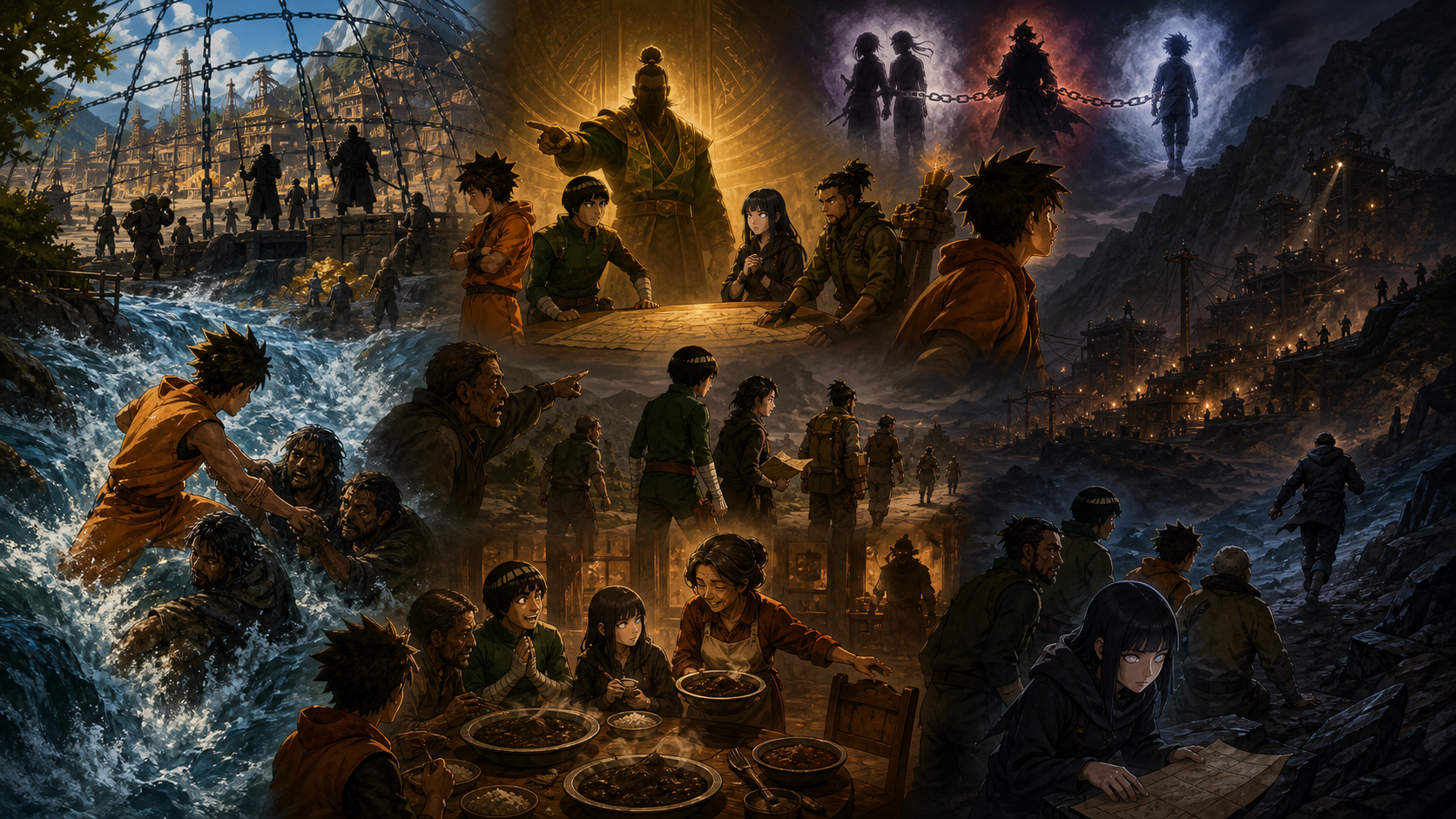
Naruto is back to training alone, and he is not taking the latest dead end well. The Bikochu plan failed, Jiraiya is still away, and Sasuke feels no closer than he did before. Then three exhausted men tumble through the river outside Konoha, and Naruto pulls them out before the current can finish what their pursuers started.
The rescue opens a new mission, but Naruto does not greet it like a hero eager to help. At first, he only wants to know what it has to do with Sasuke.
That ugly little hesitation matters. Episode 152 does not pretend Naruto's determination is automatically noble just because it is intense. Three men have crossed country borders to beg for help, their home has been occupied, and their neighbors are being killed. Naruto still measures the crisis against his private search. It takes one familiar name from the wider shinobi world to snap his attention into place.
Three Men from Katabami Gold Mine
The rescued men are Rokusuke, Sangoro, and Hachidai. They come from Katabami Gold Mine, a settlement in River Country that once prospered through its mining work. That prosperity attracted the Kurosuki Family, a gang that arrived with the language of protection and stayed as an occupying force.
Their arrangement is extortion dressed in respectable clothes. The Kurosuki Family claims to keep the settlement safe, but the miners are the people who need protection from them. Residents are worked, threatened, and killed at the gang's pleasure. Rokusuke and his companions escaped because asking Konoha for intervention was the only option they had left.
Tsunade responds with a direct assignment. Naruto will travel with Lee, Neji, and Tenten, escort the petitioners home, and help remove the Kurosuki Family from the mine. It is a sensible team for hostile terrain: Neji can scout with the Byakugan, Tenten brings range and preparation, Lee supplies speed and close combat, and Naruto can turn one fighter into a crowd whenever the situation breaks open.
Naruto, however, hears only another mission that does not point toward Sasuke. His recent assignments have trained him to search every briefing for that connection. When he cannot see one, he treats the suffering in front of him as a delay.
Then Guy gives him the detail that changes everything.
The Name Behind the Kurosuki Family
The gang's leader is Raiga Kurosuki, and rumor places him among the Seven Ninja Swordsmen of the Mist. That title immediately creates a chain Naruto understands. Kisame is one of the Seven Swordsmen. Kisame travels with Itachi. Itachi may lead back to Sasuke.
Naruto is suddenly ready to go.
The logic is thin, but it is not impossible. Information travels through old allegiances, rivalries, and grudges in the shinobi world. Raiga might know Kisame, and any clue about Kisame could become a clue about Itachi. Naruto has been surviving on possibilities like this since Sasuke left.
Still, the timing exposes him. The danger at Katabami has not changed. Rokusuke's fear has not become more valid in the last thirty seconds. Only Naruto's belief that the mission might serve him has changed.
Episode 152 leaves room for that discomfort. Naruto's loyalty to Sasuke is one of his finest qualities, but loyalty can narrow a person's vision until every stranger becomes either a lead or an obstacle. Katabami is about to demand more from him than relentless pursuit. It will ask him to see people whose pain has nothing to do with Team 7.
Neji Keeps the Mission Grounded
Once the group sets out, Neji naturally becomes its cautious center. Naruto and Lee are both quick to commit themselves, though for different reasons. Tenten understands her teammates well enough to know how rapidly emotion can become a plan. Neji keeps returning the group to what they actually know.
Rokusuke does not share his patience. His friend Kanpachi is still trapped at the mine, and every hour spent traveling or planning feels like another hour in which the Kurosuki Family can hurt him. Neji's caution makes tactical sense. Rokusuke's urgency makes human sense.
That tension gives the trip weight before the team ever reaches Katabami. For the shinobi, this is a dangerous assignment that requires reconnaissance. For Rokusuke, it is home, and someone he loves may not survive a careful timetable.
The team pauses at a small curry shop run by Sansho. Lee recognizes it immediately. During earlier training with Guy, he once collapsed from exhaustion nearby, and Sansho's Curry of Life helped bring him back to his feet.
The name sounds comforting. The curry itself is an assault.
Curry Strong Enough to Wake the Dead
Sansho serves a black curry so fiercely spiced that most of the group can barely endure it. Lee remembers the meal with glowing gratitude, while everyone else meets it like a second mission. The scene is broad, physical comedy, but it also gives the episode a warm room before the story moves into an occupied town.
Sansho feeds travelers because that is what she does. Her shop is a place where an exhausted child once received care without needing to earn it first. Lee has carried that kindness with him, and his delight at returning is as sincere as everyone else's panic over the spice.
The visit also brings the mission closer to home. Lee asks about Sansho's son, Karashi, expecting to find him nearby. Instead, Sansho explains that Karashi joined the Kurosuki Family. Bullied and desperate to become strong enough that no one could push him around, he chose the people who appeared powerful.
That explanation catches Lee immediately.
Lee knows what it is to be judged as weak. He knows the shame of falling behind people who seem naturally equipped for the life he wants. Yet Lee found Guy, a teacher who turned his hunger for strength toward discipline, loyalty, and care. Karashi found Raiga's gang, which offered him a place beside the people doing the frightening.
Lee does not write him off as a traitor. He asks that bringing Karashi home become part of the mission, and Neji agrees.
It is the episode's clearest act of empathy. Naruto needs a possible path to Sasuke before Katabami earns his full attention. Lee needs only to hear that a boy wanted strength and followed the wrong person. He recognizes how easily pain can be recruited.
Strength Is Not the Same as Safety
Karashi's choice fits the Kurosuki Family's entire system. The gang calls domination protection. Karashi mistakes proximity to domination for safety. Both lies depend on the belief that strength belongs to whoever can make someone else afraid.
Lee represents a harder answer. His strength was built through bruising, repetitive work, but its purpose is not to ensure that he is never vulnerable again. It lets him stand beside other people when they are vulnerable. That difference is why he can look at Karashi's decision without excusing it and still believe the boy is worth retrieving.
The mission now has several motives traveling together. Rokusuke wants to save Kanpachi and free his home. Lee wants to bring Karashi back to Sansho. Naruto wants information that might lead to Sasuke. Neji wants to complete the assignment without letting urgency push the team into a trap. Tenten is moving with teammates whose hearts are already pulling in several directions.
None of those motives cancel the others, but they are not equally generous. The mine will test which ones survive contact with the people living under Raiga's rule.
Rokusuke Cannot Wait
Neji's plan is to approach Katabami carefully and observe before the team acts. Against an unknown gang led by a rumored former Seven Swordsman, anything else would be reckless. They do not know the mine's layout, the number of fighters inside, or what Raiga can do.
Rokusuke hears the same plan and sees Kanpachi waiting alone.
During the night, he leaves without the team. It is not a clever choice, and the episode does not need it to be. Fear has already carried him all the way to Konoha and back. Now that his friend is close, asking him to remain still becomes impossible.
The Konoha shinobi discover his absence and follow toward the mine. Their reconnaissance has become a rescue before it has properly begun.
Episode 152 ends on that forward pull. The curry shop's warmth is behind them. Ahead is a settlement where protection means obedience, strength means terror, and a man named Raiga may hold one fragile thread leading back to Sasuke.
Naruto joined the mission for that thread. What he finds at Katabami will have to teach him why the mission matters even if it leads nowhere else.
Naruto rescues the petitioners before deciding whether their problem matters
His body responds to danger faster than his attention responds to the story behind it. He pulls Rokusuke, Sangoro, and Hachidai from the rapids because people are drowning. Once they are safe and describe an occupied mining town, Naruto starts measuring their need against his search for Sasuke. The rescue proves his compassion is present. The briefing exposes how grief has narrowed where he permits that compassion to lead.
Katabami’s request is already urgent without a famous connection
The Kurosuki Family entered under the language of protection and turned that access into domination. Residents face arbitrary killing, forced obedience, and isolation from outside help. None of those facts becomes more serious because Raiga may know another member of the Seven Ninja Swordsmen. The village deserves aid because people are being harmed, not because their oppressor might become a link in Naruto’s private chain toward Sasuke.
A protection claim is one of the oldest doors into occupation
The gang does not need to announce itself as an invading army. It offers security, establishes control, and then makes residents dependent on the very force threatening them. That pattern matters beyond one filler arc. Power can arrive wearing the language of service. A legitimate protector remains accountable to the people being protected, accepts limits, and does not punish a community for wanting that protection withdrawn.
The three petitioners carry risk all the way to Konoha
Leaving Katabami means crossing dangerous terrain while knowing the gang may retaliate against relatives and neighbors. Their arrival is not passive victimhood. They gathered evidence through lived experience, escaped surveillance, and requested help from a state capable of intervening. Konoha should treat them as partners with local knowledge, not packages to escort home after the important ninja begin making decisions.
Tsunade’s team composition offers complementary forms of sight
Neji can scout through obstruction, Tenten can prepare tools for distance and restraint, Lee can move civilians quickly, and Naruto can create numbers when the group needs coverage. The assignment becomes strongest when those abilities support the petitioners’ knowledge of roads, mine entrances, homes, and gang routines. A powerful squad without community guidance can still walk directly into an occupation’s preferred trap.
Neji’s reconnaissance plan deserves to survive Naruto’s urgency
An occupied mine contains workers, narrow passages, unstable terrain, and armed enforcers. Charging toward the visible boss could trigger reprisals or a collapse. Neji wants to understand the site before confrontation because civilian safety is part of victory. Naruto’s possible connection to Kisame and Itachi cannot outrank the need to map who is trapped where and how the gang communicates.
Naruto turns Raiga into a possible route toward Sasuke
The rumored Seven Swordsmen connection gives him a reason to care that feels personal. Raiga might know Kisame, Kisame is connected to Itachi, and Itachi is tied to Sasuke. That route is thin enough to break at every step. Pursuing information can be a legitimate secondary objective, but Naruto must not interrogate the mission until the residents’ rescue becomes background scenery.
Grief can explain Naruto’s tunnel vision without excusing it
He has lost Sasuke once and feels every unrelated assignment as time stolen from recovery. Adults around him have not given him a stable way to process that failure. Still, the miners do not owe him a link to someone famous before their suffering deserves his effort. Growth means learning that helping the people in front of him does not betray the person he still hopes to reach.
Lee understands Karashi as part of the mission immediately
Sansho describes a bullied son who joined the Kurosuki Family seeking strength. Lee does not separate removing the gang from bringing Karashi home. That instinct recognizes recruitment as part of occupation. A violent organization survives by converting frightened local people into enforcers, then using their participation as proof they no longer deserve rescue.
Karashi’s fear does not erase the harm he may cause
Being bullied and wanting protection help explain why the gang’s promise appealed to him. If he assists coercion, surveillance, or violence, the community still experiences those actions as harm. Recovery must include accountability appropriate to what he did, truth for people affected, and a route away from the gang. Compassion does not require pretending recruitment removed every choice.
Sansho’s Curry of Life shop keeps care visible inside crisis
The meal scene can look like a pause before the real mission, but food, shelter, and remembered relationships are part of what occupation threatens. Sansho offers care while carrying fear for her son. Her shop represents a community life worth restoring, not merely a location where ninja receive exposition. Removing the Kurosuki Family should make ordinary gathering possible again.
Lee’s promise needs consent and realistic boundaries
Wanting to bring Karashi back comes from loyalty and recognition. Lee also cannot promise Sansho that love alone will reverse recruitment. Karashi may resist, fear retaliation, or remain invested in the power the gang gave him. A safer promise is to find him, interrupt immediate harm, create an exit, and return with truthful information. Rescue cannot guarantee another person’s decision.
The petitioners should help define what liberation means
Defeating Raiga is an important tactical goal, but residents may also need food routes restored, injured people treated, mine operations inspected, and collaborators addressed without mass revenge. Konoha’s mission order uses the clean phrase “remove the Kurosuki Family.” The community will live with everything that phrase leaves behind. Their priorities should guide the transition before the ninja depart.
Mining wealth makes Katabami attractive and residents vulnerable
A prosperous mine concentrates resources that outsiders can seize while trapping workers through geography and livelihood. The gang can present control as necessary security for valuable production. Any recovery plan should protect workers from being pushed straight back into dangerous extraction simply because ownership changes hands. Freedom means more than replacing who collects the mine’s value.
Rokusuke leaves alone because waiting has become unbearable
His friend Kanpachi remains inside the occupied town, and every delay feels like permission for another funeral. The decision to slip away is dangerous, but it grows from specific fear rather than generic foolishness. Neji’s plan must account for what civilians know emotionally as well as tactically. People who believe loved ones may die will not always tolerate an unexplained pause.
The team needed a transparent waiting plan
If reconnaissance requires several hours, tell the petitioners what is being checked, what signs would trigger immediate movement, and how they can contribute safely. Silence makes caution look like indifference. Rokusuke might still choose to leave, but shared information gives him a reason to trust the squad’s timing. Mission leadership includes managing the fear of the people whose home is at stake.
A lone return risks both the petitioner and everyone hiding inside
Rokusuke knows routes the ninja do not, yet the gang may recognize him, follow him, or punish residents accused of helping. His capture could reveal that Konoha is approaching before Neji finishes reconnaissance. The urgency to reach Kanpachi is real. The consequences of being discovered are also collective. Escort rules should protect local agency without pretending one person’s risk affects only that person.
Raiga’s rumored title should not substitute for verified intelligence
The Seven Ninja Swordsmen connection changes Naruto’s attention and raises the expected threat level. A rumor is not enough to build the whole plan. Tsunade should verify known techniques, associates, movement history, and whether the Kurosuki Family answers to anyone beyond the mine. Sending four young ninja toward a suspected elite swordsman requires more than a name passed through frightened witnesses.
The episode’s title tells us the occupation has normalized death rituals
A funeral march for living people turns mourning into a threat performed before death. The gang does not only kill; it controls anticipation, forcing residents to imagine themselves already gone. That psychological violence can keep a community obedient even when enforcers are not physically present. Liberation must restore the right to imagine a future, not simply stop the next burial.
RaeRae’s full take
Episode 152 begins with Naruto doing the right thing before he has time to make it about Sasuke. He sees people in the water and saves them. I want that instinct to remain when the danger becomes a town he has never heard of. Katabami should not need a connection to Kisame, Itachi, or Sasuke before its people qualify as worth his attention.
Lee understands the deeper assignment better. Removing the gang and recovering Karashi are connected because occupations recruit through fear, shame, and promises of strength. Karashi may have caused harm. He still deserves a route out that includes accountability instead of a choice between gang loyalty and permanent exile.
Rokusuke slipping away is frustrating, but I understand the clock inside him. Kanpachi is still there while trained ninja discuss timing. The answer is not to dismiss civilian emotion. The answer is to make the plan visible enough that the people living with the risk know caution is active work.
RaeRae checkpoint: Katabami does not become worthy of rescue because Raiga might connect Naruto to Sasuke. The town is occupied, its residents asked for help, and Lee is right that bringing Karashi out of the gang belongs inside the same mission.
Watch Naruto Episode 152
- [Naruto Official episode guide](https://naruto-official.com/en/anime/naruto1/list/01_376)
- [Watch “Funeral March for the Living” on Crunchyroll](https://www.crunchyroll.com/watch/GRVNX48WY/funeral-march-for-the-living)
- [Browse official Naruto viewing options from VIZ](https://www.viz.com/anime/tv-show/naruto-video/video-unit/1)
Receipts and official routes
- Episode number, licensed title, and official synopsis: Naruto Official Site.
- Japanese title, synopsis, and September 21, 2005 broadcast record: TV Tokyo.