
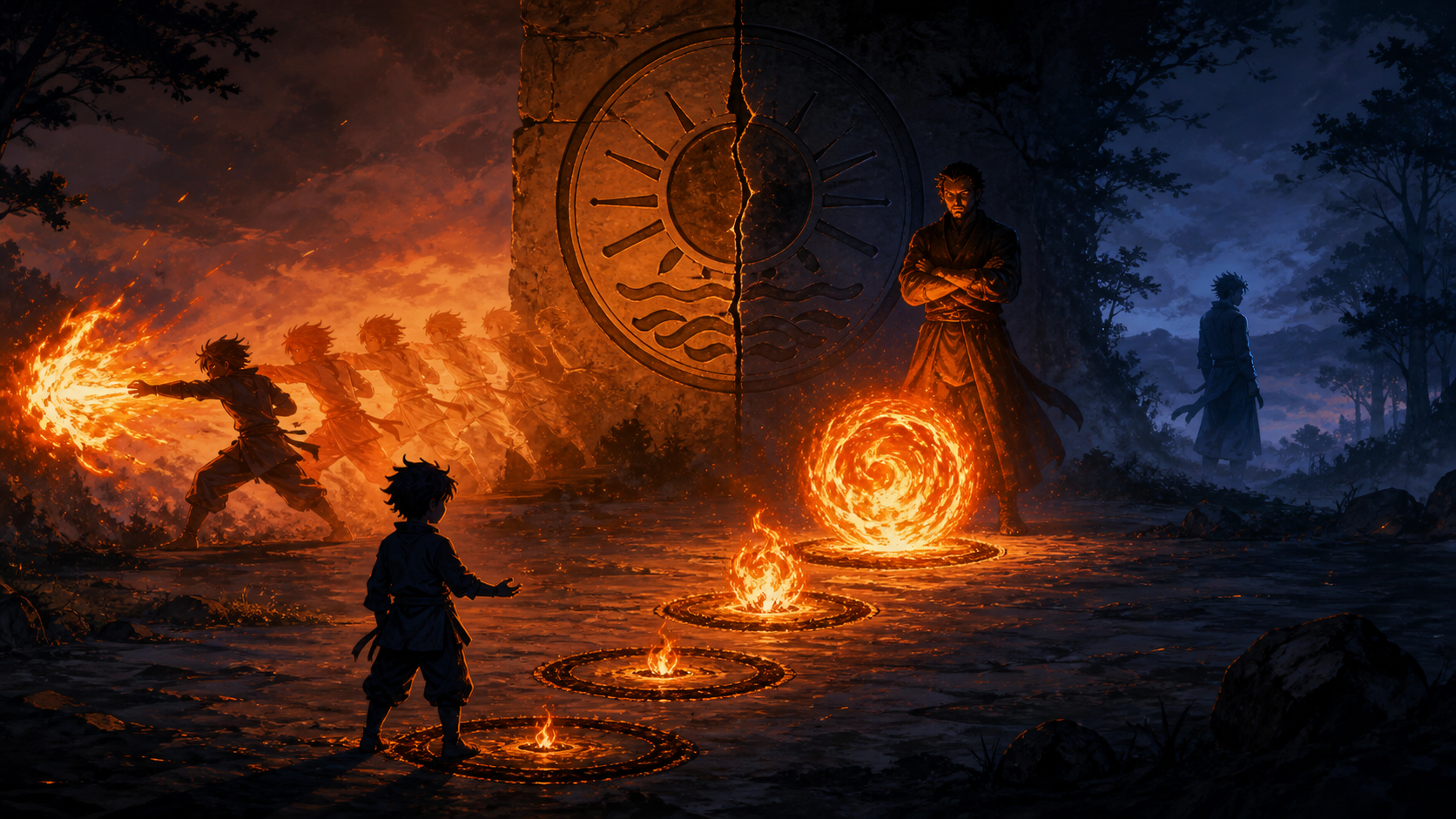
Father and Son: The Broken Crest
A failed fireball becomes Sasuke’s test for the paternal attention he craves, teaching him that power is the price of being seen.
RaeRae Reacts
Episode 130 turns Great Fireball into one of the saddest approval-seeking memories in Sasuke's childhood.
Fugaku finally looks at him.
He teaches Sasuke an inherited Uchiha technique, watches the first attempt fail and later gives rare praise when relentless practice produces success.
Sasuke is thrilled.
Then comes the condition.
Become a man worthy of the crest.
The praise does not tell Sasuke he is enough. It tells him performance has opened the door and more performance must keep it open.
In the present, Sasuke uses that same fire against Naruto.
The technique that once earned his father's attention becomes another weapon proving he can abandon the person asking him to stay.
That crest did not only crack when the family died.
It cracked when love started sounding like a qualification exam.
Naruto Dares Sasuke to Use Sharingan
Naruto gets back up and taunts Sasuke to activate Sharingan.
He insists his ninja way will still win.
If Sasuke wants to measure power, Naruto will meet the strongest version available and refuse to back down.
It is also a response to humiliation. Sasuke has already announced that he dominated the earlier exchange without using the eye Naruto associates with elite Uchiha skill.
Naruto wants the full fight because anything less lets Sasuke keep treating him as an obstacle beneath serious attention.
The demand mirrors young Sasuke trying to make Fugaku look directly at him and admit he matters.
Shadow Clones Fall Again
Naruto creates shadow clones and attacks.
Sasuke handles them in seconds.
Sasuke trained beside Naruto, watched the technique become his signature and understands how numbers disguise the original body.
Naruto often wins by increasing pressure until an opponent's attention breaks.
Sasuke keeps his attention disciplined.
The clone defeat reinforces the message Sasuke wants Naruto to receive: shared history does not give Naruto control over his future, and determination does not equal enough power to stop him.
Then Sasuke shifts to the inherited technique carrying his own family history.
Fire fills the space where the clones stood.
Great Fireball Is a Clan Threshold
Sasuke uses Fire Release: Great Fireball Technique.
Within the Uchiha family, mastering the technique marks entry into full-fledged clan status. It is not merely another elemental attack in the toolbox.
It carries lineage, expectation and belonging.
The present fire links directly to when Fugaku taught Sasuke what technical recognition required.
That makes the attack emotionally precise.
Sasuke is using the proof that he earned the crest while trying to sever a bond formed outside the clan.
He chose Orochimaru for more power, but the language of worth remains the one Fugaku taught him.
Master the technique.
Earn the look.
Become worthy.
Fugaku's Attention Changes Direction
Itachi's standing inside the clan deteriorates.
As the favored prodigy grows distant and resists clan expectations, Fugaku begins taking more active interest in Sasuke.
Young Sasuke experiences that shift as hope.
His father finally has time for his development. The son who lived under Itachi's shadow receives direct instruction and a chance to prove himself.
The timing is painful.
Sasuke is not being recognized in a stable family where both children receive care on their own terms. Attention moves toward him partly because the relationship between Fugaku and Itachi is breaking.
One son's fall from favor creates room for the other son's promotion.
Sasuke cannot know how dangerous that fracture has become.
He only knows the door opened.
Fugaku Teaches the Fireball
Fugaku teaches Sasuke Great Fireball as an inherited Uchiha technique.
For Sasuke, the lesson means far more than chakra control and nature transformation.
His father selected him for a clan threshold.
The instruction implies potential, membership and the possibility of receiving the approval Itachi commanded.
He approaches the lesson carrying all of that emotional weight.
The first attempt does not produce what Fugaku expects.
Sasuke sees disappointment.
The attention he wanted now feels conditional enough to vanish after one failure.
Nobody needs to tell him to obsess.
He already understands the family equation as he has experienced it.
Power earns recognition.
Failure returns you to the shadow.
One Failed Attempt Becomes a Threat
Children fail while learning.
That should be ordinary.
For Sasuke, the failed fireball carries the fear that Fugaku's new interest was temporary and that Itachi remains the only son capable of making the crest look natural.
Sasuke does not have room to laugh at the weak flame and try again tomorrow.
He interprets failure through years of comparison.
Itachi mastered difficult things early.
Fugaku watched Itachi.
Sasuke has received one opening and believes he must justify it immediately.
That is how family pressure turns healthy persistence into panic wearing a disciplined face.
Sasuke Trains Until the Fire Answers
Sasuke practices.
He repeats the technique until his body, breath and chakra produce the fireball Fugaku required.
The improvement is impressive. Sasuke has talent, focus and the ability to correct failure through observation and repetition.
The motivation is not purely love of mastery.
He wants his father to see him.
Every attempt carries the possibility of returning to that moment and replacing disappointment with recognition.
The training succeeds because Sasuke is capable.
It also teaches a dangerous lesson: emotional needs can be solved by pushing the body harder until performance becomes undeniable.
That lesson follows him straight toward Orochimaru.
Fugaku Finally Says the Words
Sasuke demonstrates the mastered fireball.
Fugaku praises him.
The moment lands because Sasuke has waited so long for direct acknowledgment. His effort changed his father's expression and briefly made him the child under focused attention.
This is not fake happiness.
Sasuke wanted that praise, earned the technique and feels proud.
The problem is the structure around it.
Fugaku did not build a secure base of affection where achievement could remain achievement. Praise arrives as scarce evidence that Sasuke may qualify for the regard already attached to Itachi.
When approval is rare, one sentence can control years of behavior.
Sasuke learns to chase the next one.
Become Worthy of the Crest
Fugaku tells Sasuke to become a man worthy of wearing the Uchiha crest.
The statement functions like a lifelong condition.
The crest carries family, history and full clan membership. Being worthy of it means Sasuke's individual value becomes inseparable from performance on behalf of that identity.
He cannot simply be Fugaku's son.
He must become the right kind of Uchiha son.
The standard is powerful enough to motivate excellence and vague enough never to be fully satisfied.
How much power is worthy?
How much discipline?
How much revenge after the clan is gone?
Sasuke answers those questions by escalating because the original approval never taught him where enough lives.
The Crest Was Already Cracking
The episode calls the crest broken before the massacre enters full view.
That is the right choice.
The family symbol cracked through comparison, conditional recognition and the conflict growing between Fugaku and Itachi.
Sasuke's new attention did not repair the household. It reflected where the pressure moved after Itachi stopped performing the role Fugaku and the clan expected.
Itachi became suspect.
Sasuke became promising.
Neither son received space to exist outside institutional need.
The Uchiha crest represented belonging, but the family beneath it was dividing over loyalty, authority and the future of the clan.
Sasuke saw praise without understanding the fracture making it possible.
The Present Fire Carries the Old Approval
At the Valley of the End, Sasuke uses Great Fireball against Naruto because it is effective.
It also carries the emotional architecture of his departure.
Power earned Fugaku's attention.
Greater power might defeat Itachi.
Defeating Itachi might prove Sasuke remained worthy of the family after failing to save it.
The chain is irrational as healing and coherent as trauma.
Naruto stands in front of Sasuke offering worth through friendship instead of achievement.
Sasuke does not trust that language enough to build a life on it.
He trusts fire because fire once made his father look at him and say he had succeeded.
That memory is concrete.
Naruto's promised future still feels uncertain.
What Changes After Episode 130
Naruto challenges Sasuke to use Sharingan and insists his ninja way will prevail.
Sasuke rapidly defeats the shadow clones.
Great Fireball brings Naruto down in the present battle.
The technique is established as an inherited Uchiha threshold for full clan recognition.
As Itachi falls out of clan favor, Fugaku redirects attention toward Sasuke.
Fugaku teaches young Sasuke Great Fireball.
Sasuke's first attempt disappoints his father.
He trains relentlessly and masters the technique.
Fugaku gives him rare direct praise.
He tells Sasuke to become worthy of the Uchiha crest.
Sasuke connects technical power with paternal attention and family belonging.
The crest cracks through comparison and the worsening Fugaku-Itachi fracture before the massacre arrives.
The massacre and Mangekyo demand remain for Episode 131.
Naruto challenging the Sharingan exposes what Sasuke is proving
Naruto recognizes that Sasuke has been controlling the fight without leaning fully on the eye everyone associates with Uchiha superiority. The challenge is partly frustration and partly an attempt to make Sasuke acknowledge their rivalry honestly.
Sasuke hears another test. He has spent childhood learning that ability must be demonstrated before attention becomes secure, so even a friend’s provocation lands inside an old family script.
Shadow clones fall because numbers cannot solve a relational rupture
Naruto fills the space with bodies and effort, the strategy that has so often turned isolation into collective force. Sasuke reads the movement and breaks through. The loss does not mean Naruto’s signature technique has become meaningless.
The technique answers combat geometry. It cannot answer why Sasuke believes connection threatens the only duty he has left.
Great Fireball was never merely another jutsu
Within the Uchiha family, mastering the technique marks a child’s movement toward recognized adulthood. Fire becomes a threshold, a public sign that the clan’s inheritance lives properly in the next body.
For Sasuke, the lesson carries an extra promise: if he produces the right flame, perhaps his father will finally look at him without comparing the result to Itachi.
Fugaku’s changed attention arrives through disappointment elsewhere
Sasuke receives more instruction as tension grows between Fugaku and Itachi. That timing complicates every warm moment. A child should not have to wonder whether affection is genuine or simply the light left over after another relationship darkens.
Fugaku may care deeply for both sons. His way of distributing attention still teaches them that family recognition follows usefulness and alignment.
Teaching the fireball becomes a rare private opening
When Fugaku demonstrates the technique, Sasuke receives what he has been seeking: direct time, serious instruction, and acknowledgment that his father expects him to carry clan skill. The moment matters because it is so scarce.
Scarcity makes the lesson emotionally dangerous. Failure now risks losing more than competence. It risks losing access to the parent who finally turned toward him.
One failed attempt becomes evidence of unworthiness
Sasuke’s first flame is small. A beginner’s imperfect result should be ordinary. Inside his household, the failure feels like confirmation that the distance between brothers is permanent.
Children convert adult silence into explanations about themselves. When Fugaku does not provide patience and reassurance, Sasuke supplies the missing message: I am not enough yet.
Sasuke trains until his body produces the answer adults withheld
He practices alone, exhausts himself, and treats pain as the price of admission. Repetition gives him control where family emotion remains uncertain. The fire either appears or it does not.
Measurable success feels safer than asking whether his father loves him. A technique cannot reject him ambiguously. It only demands more chakra and breath.
Fugaku’s praise lands because Sasuke was starving for it
“That’s my boy” becomes enormous after years of looking toward a father whose pride seemed reserved for Itachi. The words offer belonging, relief, and proof that effort changed Sasuke’s place in the family.
The tenderness is real. The conditions surrounding it remain harmful. Children should not need to injure themselves into excellence before affection becomes audible.
Become worthy of the crest turns identity into an exam
The Uchiha fan should name a lineage Sasuke already belongs to. Fugaku’s framing makes belonging sound provisional, something confirmed through performance, discipline, and representation of clan expectations.
Sasuke learns that the symbol on his back is both inheritance and assignment. He must keep earning what he was born carrying.
The crest was cracking before the massacre
Political suspicion separated the clan from the village. Household comparison separated the brothers. Secrecy separated children from the truth governing their lives. The visible catastrophe came later, but fractures were already moving through the family system.
A crest can remain visually whole while the relationships beneath it lose trust.
Fugaku’s reserve is not emotional neutrality
A parent who rarely speaks approval may believe discipline prepares a child for a demanding world. The child experiences the same reserve as uncertainty about love. Intent does not cancel impact.
Sasuke’s later hunger for recognition grows partly from this gap. He knows his father noticed excellence because excellence was when warmth became visible.
Itachi’s shadow remains in every lesson
Even when Sasuke trains alone with Fugaku, the older brother is the unstated benchmark. Sasuke wants his own achievement to matter without being interpreted as a smaller version of Itachi’s.
Comparison denies both children ordinary development. Itachi becomes a standard instead of a son, and Sasuke becomes a candidate instead of a son.
The present fire carries remembered approval
When Sasuke uses Great Fireball against Naruto, he is wielding more than clan technique. The jutsu contains the day his father finally praised him. Power and belonging have been fused since childhood.
Walking toward Orochimaru therefore feels like pursuing strength and protecting identity at once. Abandoning the pursuit might feel like losing Fugaku’s acknowledgment all over again.
Naruto sees the attack but not the family memory inside it
Naruto can read danger and answer with his own techniques. He cannot see the riverbank training, the failed flame, or the relief on a child’s face when his father spoke pride.
The information gap makes their confrontation harsher. Each boy reacts to meanings the other cannot fully access.
Sasuke mistakes inherited skill for an inherited obligation
Carrying Uchiha fire can honor family history. It does not require reducing life to revenge. Sasuke has been given no trustworthy adult help in separating remembrance from self-destruction.
Orochimaru exploits the confusion by treating bloodline ability as destiny and offering power as the only faithful response to loss.
Approval tied to performance creates a portable prison
Fugaku no longer stands beside the training ground, but Sasuke continues grading himself through the imagined standard. Every loss to Itachi, Naruto, or anyone else becomes evidence that he has failed the family again.
The external evaluator becomes an internal voice. That is why leaving the village does not automatically produce freedom.
The village also reinforced the family’s achievement economy
Ranks, missions, exams, and reputation make children legible through output. Sasuke’s academy success brings recognition, while his grief remains largely private. Konoha knows how to measure the shinobi and neglects the boy.
Orochimaru offers a more extreme version of the same bargain: become useful enough and your pain will supposedly gain meaning.
Fugaku’s care deserves honesty rather than simplification
He is not a cardboard father who feels nothing. His pride and concern appear in constrained ways inside clan pressure and political crisis. Honest analysis can recognize care while naming the damage created by conditional expression.
Love that cannot be safely felt by the child needs changed behavior, not only charitable interpretation.
Sasuke’s discipline is admirable and frightening
He practices until the fire expands because persistence is one of his genuine strengths. The same persistence later keeps him moving toward revenge after every warning.
A virtue can become dangerous when trauma appoints its destination. Discipline needs a life-serving purpose, not endless praise for endurance.
Naruto is confronting a whole system through one friend
He wants Sasuke to stop, but Sasuke’s departure carries family expectations, village secrecy, survivor guilt, comparison, and Orochimaru’s grooming. One fight cannot untangle all of that.
Naruto’s refusal still matters. It says Sasuke’s life has value beyond what the Uchiha name or Orochimaru’s plans demand.
The broken crest asks who gets to define inheritance
Fugaku defined worth through clan mastery. Itachi’s violence turned the crest into a wound. Orochimaru sees the bloodline as desirable property. Sasuke is trying to answer all three definitions through power.
A freer inheritance would let him remember family, question its failures, keep its skills, and build a self not governed by proving worth to the dead.
The fight cannot provide the praise Sasuke actually wants
Defeating Naruto might confirm technical superiority. It cannot recreate Fugaku’s voice without the conditions that made the voice scarce. It cannot restore the family or explain Itachi.
Winning therefore risks feeding the same hunger rather than satisfying it. Another benchmark will always wait.
RaeRae’s full take
Episode 130 makes one fireball carry an entire household. Sasuke trains because he wants skill, but he also wants his father to see him. When praise finally comes, it arrives beside a command to become worthy of a crest he already wears.
That is the trap. Love, identity, and performance become so tangled that power feels like the only language Sasuke can trust. Orochimaru does not create the hunger. He sees it and offers to feed it with poison.
Naruto is fighting the adult systems that taught Sasuke his body must prove something, even though Naruto does not yet have words for that fight. Bringing Sasuke back will never be enough by itself. Home has to become a place where the boy matters before the flame.
RaeRae checkpoint: Sasuke already belonged to his family before mastering its fire. When praise arrives only after performance, a child can spend a lifetime confusing achievement with permission to be loved.
RaeRae's Verdict
“Father and Son: The Broken Crest” makes one successful fireball explain far too much about Sasuke.
Fugaku finally teaches him, watches him and praises him.
Sasuke glows because the recognition is real.
So is the condition attached to it.
Become worthy.
Power brought attention once, so Sasuke keeps reaching for more power every time a relationship breaks.
In the present, he burns Naruto with the technique that once convinced him he belonged.
Naruto offers unconditional insistence that Sasuke matters.
Sasuke trusts the older lesson.
If he wants worth, he must prove it.
The crest did not break in one night.
The cracks were already running through the family when a child learned that fire was the surest way to make his father see him.
Receipts and official routes
- Episode number and licensed title: Naruto Official Site.
- Japanese title, synopsis, and April 13, 2005 broadcast record: TV Tokyo.
- Streaming availability varies by region; use the licensed route maintained in the episode directory.