
Showdown: Gaara vs. Kimimaro!
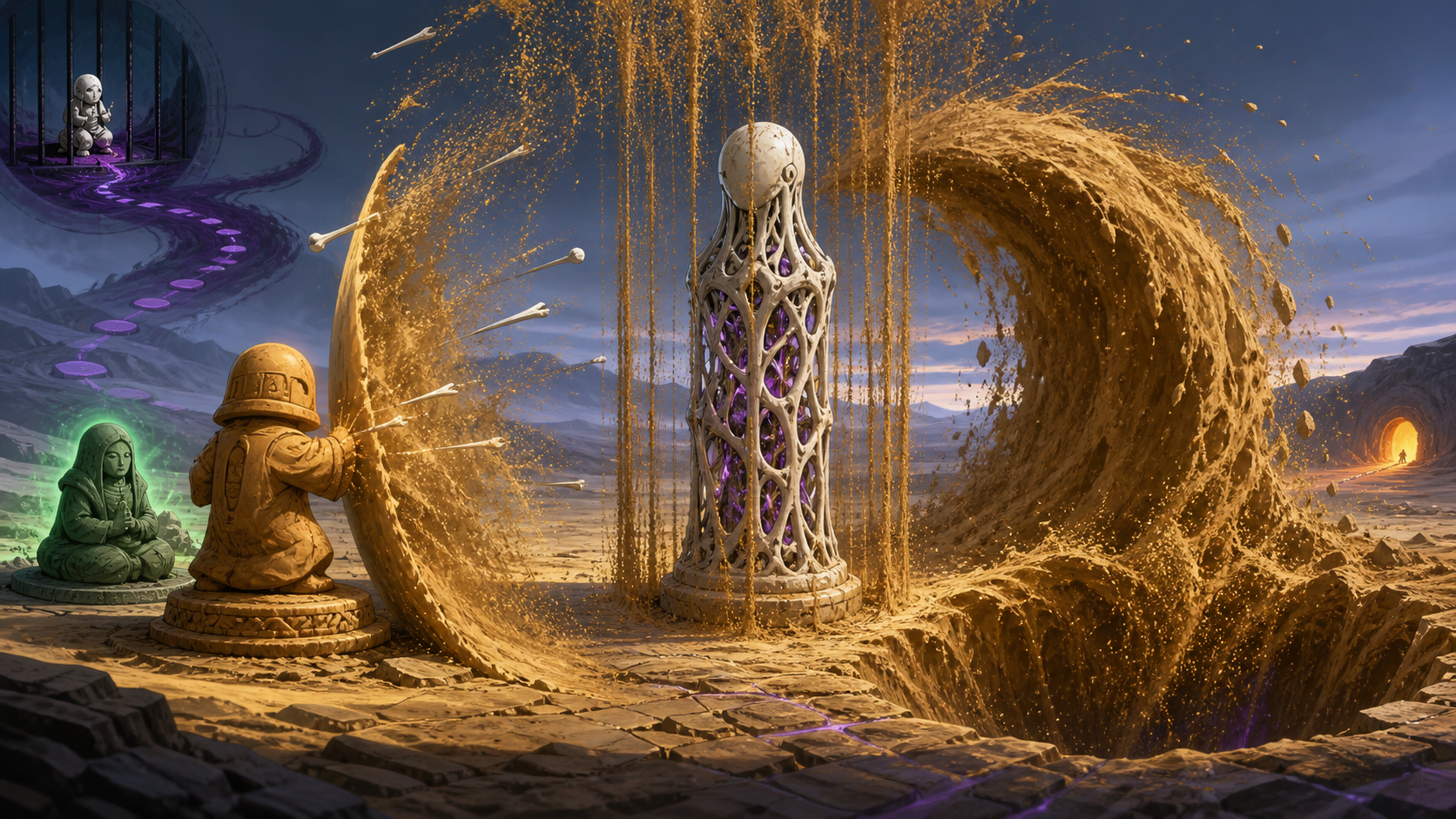
Gaara turns the ground into protection and control while Kimimaro spends his own skeleton for the adult who taught him usefulness was love.
RaeRae Reacts
Episode 126 puts two boys weaponized by their families on the same battlefield and shows what happened after each one found a reason to live.
Gaara protects Lee with the sand that once crushed him.
Kimimaro fires pieces of his own skeleton to protect Orochimaru's claim on Sasuke.
Both bodies were shaped by isolation.
Both bloodlines made adults see value before a child.
The difference is direction.
Gaara now uses power to keep another person alive.
Kimimaro still treats his dying body as the last useful gift he can hand Orochimaru.
The fight is sand against bone.
Underneath, it is recovery against devotion to the person who exploited you.
Gaara Pulls Lee Out of the Fight
Lee wants to continue helping.
Gaara stops him.
He notices Lee's reduced speed, the blood and the condition of the body still recovering from surgery. Then sand catches Lee and pulls him away from Kimimaro.
The action carries uncomfortable history.
Gaara caused the injuries that put Lee in the hospital. During the Chunin Exams, he crushed Lee's arm and leg.
Now he recognizes the damage and refuses to let Lee worsen it.
Gaara does not ask Lee to trust a speech about change.
He protects him, removes him from danger and takes responsibility for the enemy in front of them.
That is the apology the moment can actually use.
Kimimaro Abandons Close Combat
Kimimaro studies Gaara's automatic sand defense and reaches the correct conclusion.
Getting close is a bad plan.
The sand reacts before Gaara consciously commands every movement. It blocks attacks while leaving him free to counter, turning the space around his body into a moving wall.
Kimimaro's bone blades make him lethal at close range, but lethal does not mean entitled to reach the target.
He shifts back and attacks from distance.
Finger bones become projectiles fired toward Gaara and Lee.
The obvious limit appears to be the gourd.
The Gourd Is Not the Whole Supply
Kimimaro assumes Gaara can control only the sand carried on his back.
That would make the fight a resource problem. Keep firing, force enough blocks and drain the gourd until the defense thins.
He grinds rocks and minerals in the ground into additional sand.
The battlefield becomes supply.
Gaara is not restricted to one container while standing over an earth full of material he can break down and control. The gourd gives him specially prepared sand and immediate access, but it is not the boundary Kimimaro hoped to exploit.
Kimimaro brought ammunition inside his body.
Gaara can manufacture ammunition from almost everything beneath them.
Defense and Attack Happen Together
Gaara's fighting style frustrates Kimimaro because it refuses the usual exchange.
One layer of sand intercepts the finger-bone projectiles while another moves toward Kimimaro. Gaara does not have to lower his shield to strike.
Kimimaro's body also combines attack and defense through bone, but he must still manage distance and positioning. His armor protects what the sand catches. His projectiles create pressure without carrying him through the wall.
Gaara controls more of the environment with less physical movement.
Lee watches the matchup and understands why Gaara insisted he stay out.
Taijutsu would require Lee to enter the exact range Kimimaro wants.
Sand makes Kimimaro cross a battlefield that keeps changing shape under Gaara's command.
Sand Drizzle Sets the Trap
Gaara spreads sand overhead through Sand Drizzle while additional sand catches Kimimaro from below.
The upper layer draws attention and threatens attack from one direction. The ground removes movement from another.
Kimimaro cannot solve the technique by watching Gaara's hands or dodging one visible wave. The trap uses the whole surrounding space.
Once the sand restrains him, Gaara closes Sand Binding Coffin around the body.
Gaara once used crushing sand as an expression of pleasure and rage.
Here, he uses it against someone trying to kill Lee and deliver Sasuke to Orochimaru.
The technique has not become gentle.
Its purpose has changed.
Kimimaro's Skeleton Refuses to Break
Gaara follows with Sand Waterfall Funeral and applies crushing pressure.
Kimimaro survives.
His bones possess abnormal density, and he can create a skeletal layer beneath the skin to absorb damage that would pulp an ordinary body. Gaara's signature finish reaches him without producing the expected result.
Kimimaro survived childhood by learning that his body mattered when it could fight. Even his skin hides another weaponized structure built to keep that body performing.
Gaara recognizes that ordinary crushing pressure will not settle the fight.
Kimimaro activates the curse mark and pushes the body farther past natural limits.
The dying vessel keeps finding another layer to spend.
Gaara Sees Sasuke's Eyes in Kimimaro
Gaara tells Lee that Kimimaro carries the same eyes as Sasuke.
He does not mean their bloodlines or appearance.
He recognizes the need to confirm personal worth through a consuming purpose.
Gaara once believed killing strong opponents proved he existed. Sasuke believes killing Itachi will settle the value and meaning of his life. Kimimaro believes usefulness to Orochimaru justifies his remaining breath.
Gaara can identify that gaze because Naruto broke its hold on him.
He learned that protecting another person can create strength without requiring someone else's destruction.
Kimimaro has not encountered a bond he values above Orochimaru's approval.
Kimimaro Grew Up in a Cell
Kimimaro's childhood explains the shape of his devotion without excusing what he does with it.
The Kaguya clan kept him imprisoned in darkness because they feared and valued his bloodline. They released him when they needed his ability for battle.
His earliest instruction was to fight, not learn, play or belong.
The clan treated his body as a stored weapon, then pointed it at an enemy when the time came.
Orochimaru later appeared to offer recognition and purpose. For a child denied both, being selected could feel like rescue.
It was another form of ownership.
Orochimaru valued Kimimaro as a possible vessel until illness made the body unsuitable. Kimimaro responded by searching for another function instead of questioning the person who discarded the first one.
Gaara Chooses a Larger Battlefield
Gaara increases the scale rather than repeating the same coffin.
Quicksand Waterfall Flow sends an enormous wave across the terrain. The attack changes the landscape, removing stable ground and burying the paths Kimimaro might use to escape.
Gaara then follows with Sand Waterfall Imperial Funeral.
The pressure reaches deeper and covers a wider area than the earlier crushing attempt. Kimimaro disappears beneath a mass of sand large enough to make Lee believe the fight may finally be over.
This is Gaara's answer to bone density.
If one layer cannot break Kimimaro, bury him under the field itself.
He is not carrying the battlefield.
He is creating it.
Naruto Follows Sasuke Into the Dark
While Gaara buries Kimimaro, Naruto pursues Sasuke through a cave.
The darkness pulls Naruto through memories of isolation: the child ignored by villagers, the empty spaces where recognition should have been and the loneliness that once defined every day.
Naruto understands the part of Sasuke that wants to cut away pain and knows where isolation leads when nobody interrupts it.
Naruto did not escape loneliness alone. Iruka recognized him. Team 7 gave him bonds worth protecting. Other people gradually answered his insistence that he existed.
Sasuke is choosing to abandon those answers before revenge can disappoint him again.
Naruto keeps moving because the distance between them is emotional as much as physical.
Protection Is Gaara's New Proof
Gaara once used sand to confirm that he could survive without anyone.
Now the same power keeps Lee alive and holds Kimimaro away from Naruto's route.
He commands more sand, reads the battlefield more calmly and chooses attacks according to another person's safety rather than personal rage.
Kimimaro presents the older logic in a different form. He treats complete self-sacrifice as strength because Orochimaru gave him a role.
Both boys know what it means to be valued as a weapon.
Only Gaara has begun asking what the weapon should protect.
That question changes everything his sand does.
What Changes After Episode 126
Gaara pulls Lee out of danger and assumes responsibility for Kimimaro.
Kimimaro abandons close combat and fires finger bones from range.
Gaara's automatic sand defends while additional sand attacks.
He proves the gourd is not his only supply by grinding earth minerals into more sand.
Sand Drizzle and restraint from below set up Sand Binding Coffin.
Kimimaro survives Sand Waterfall Funeral through bone density and skeletal armor.
He activates the curse mark to keep fighting.
Gaara recognizes in Kimimaro the same consuming need for purpose he sees in Sasuke.
Kimimaro's childhood reveals imprisonment and use by the Kaguya clan.
Gaara creates a sand tsunami and buries Kimimaro through Sand Waterfall Imperial Funeral.
Naruto pursues Sasuke through a cave shaped by memories of isolation.
Kimimaro remains beneath the sand, but the battle has not reached its final escalation.
Gaara and Kimimaro turn the battlefield into an argument about purpose
Both boys were treated as dangerous children before they were treated as people. Their abilities made adults afraid, interested, or calculating. Gaara eventually found people who challenged the lonely identity built around him. Kimimaro found Orochimaru, a man who made usefulness feel like love.
The fight is spectacular because sand and bone keep changing the ground. The conflict hurts because every attack carries a different answer to the same question: what does a child do after a powerful adult teaches him that his body is the only reason he deserves to exist?
Gaara protects Lee without asking Lee to forget
Gaara places his sand between Kimimaro and the person Gaara once nearly killed. Lee remembers exactly what that sand did to his arm and leg. The rescue therefore cannot be treated as a clean little redemption receipt.
Changed action matters. So does the survivor’s memory. Lee can accept protection and remain wary. Gaara’s responsibility is to keep choosing care without demanding that Lee hurry into trust.
The sand gourd is a tool, not the limit of Gaara’s world
Kimimaro initially reasons that Gaara controls only the sand carried on his back. That assumption would make the battle a matter of draining a finite reserve. Gaara answers by grinding minerals in the earth and creating more sand beneath his feet.
The reveal expands his power without feeling arbitrary. Gaara does not summon a convenient new element. He understands the material surrounding him and transforms the battlefield into supply.
Gaara’s defense and offense no longer belong to panic alone
Earlier appearances made the automatic sand shield feel like the reflex of a child who believed every person might become a threat. Against Kimimaro, defense becomes deliberate protection and coordinated pressure. Gaara shapes shields, waves, restraints, and crushing force while watching Lee’s position.
The same ability can express a different relationship to the world. Power is not moral by itself. Purpose, restraint, and regard for other people decide what the technique means in practice.
Kimimaro’s bones make his body both weapon and inventory
He pulls ammunition, armor, and blades from his own skeleton. The Kekkei Genkai looks almost elegant in motion, yet the elegance should not hide the violence of a child trained to treat his body as endlessly extractable material.
Orochimaru values that body because it can be used. Kimimaro has absorbed the valuation so completely that injury becomes devotion instead of evidence that somebody should have protected him.
The Kaguya clan taught violence without belonging
Kimimaro’s childhood cell makes the clan’s cruelty plain. They feared his ability, confined him, and released him when they wanted destruction. Kinship did not offer safety. The family name operated as ownership.
When the clan rushed into a suicidal attack, Kimimaro survived without receiving any language for grief, identity, or life beyond combat. Survival left him physically free and emotionally unclaimed.
Orochimaru recognized the vacancy and occupied it
He did not need to invent Kimimaro’s isolation. He needed only to arrive when the boy had no stable attachment and present command as recognition. Being selected felt different from being caged, even though both systems reduced Kimimaro to what his body could do.
Predatory mentorship often works through that difference in feeling. The new controller names exploitation purpose, and the child mistakes relief from abandonment for unconditional care.
Usefulness becomes Kimimaro’s substitute for a self
Kimimaro speaks about serving Orochimaru as if service settles every question of identity. If he is a vessel, shield, or instrument, then he does not have to decide what he wants apart from the person who chose him.
The arrangement gives him certainty at a terrible price. A purpose that disappears when the body fails is not belonging. It is a contract the powerful person never intends to honor equally.
Illness exposes how conditional Orochimaru’s interest always was
Kimimaro was once intended as a vessel. Disease made him unsuitable, and Sasuke became the next desired body. Kimimaro responds by pushing harder to prove value instead of questioning the system that discarded him.
That reaction is painfully believable. A child trained to earn care through performance often treats rejection as evidence that he must sacrifice more.
Gaara recognizes Sasuke’s eyes because obsession has a recognizable cost
When Gaara says Kimimaro has the same eyes as Sasuke, he is not claiming their histories are identical. He recognizes the narrowed gaze of someone who has surrendered every other possible future to one consuming attachment.
Sasuke pursues power through Orochimaru because vengeance has eclipsed safety. Kimimaro serves Orochimaru because service has eclipsed selfhood. Different wounds can still lead toward the same machinery.
Naruto keeps chasing Sasuke while the episode shows the destination
Naruto’s pursuit runs beside Gaara’s battle. That structure matters. Kimimaro is not merely the opponent delaying Naruto. He is evidence of what Orochimaru’s promise can become when a young person hands over body, loyalty, and future.
Naruto wants to bring Sasuke home before that surrender hardens. The urgency is emotional, but the battlefield gives the urgency a physical form.
Sand Drizzle is patient strategy rather than raw spectacle
Gaara lets grains settle around Kimimaro until the environment itself becomes a trap. Kimimaro can break visible attacks, so Gaara prepares pressure from directions that are harder to read.
The move shows how much more composed Gaara has become. He watches, tests, and constructs an answer. Rage no longer has to make every tactical decision.
Kimimaro’s durability keeps turning victory into another threshold
Each layer of bone survives pressure that would end another fight. The durability creates suspense, but it also reinforces the tragedy. His body has been praised for enduring whatever is demanded, so endurance becomes the only response he trusts.
Being able to survive harm does not make the harm acceptable. Strength can hide neglect when everyone celebrates the result and nobody asks why a child must keep proving he can take more.
Gaara’s large-scale attacks carry the history of Shukaku
He can bury a landscape because enormous force has always lived near the surface of his life. Earlier, that scale threatened everyone around him. Now Gaara directs it toward stopping an attacker and preserving Lee’s life.
Control is not the disappearance of danger. It is the ongoing practice of deciding where power ends, who must be protected, and what responsibility follows after the dust settles.
Lee witnesses growth from the least comfortable seat possible
It would be easier for the story to prove Gaara’s change to someone untouched by him. Lee’s presence prevents that comfort. The person receiving protection is also the person whose rehabilitation exists because Gaara once treated his body as disposable.
Redemption becomes credible when it remains accountable to the people harmed. The episode does not need Lee to announce forgiveness for Gaara’s choice to matter.
The fight refuses a simple monster-versus-monster reading
Villages and clans labeled both combatants dangerous. Adults then built systems around containing or exploiting them. Calling either boy a monster would repeat the language that allowed those systems to avoid responsibility.
Gaara has begun to build relationships outside that label. Kimimaro still treats the label’s usefulness as his only shelter. Their difference is relational before it is moral.
Orochimaru’s absence still controls Kimimaro’s every movement
Orochimaru does not need to stand on the field issuing commands. Kimimaro carries the command inside himself. He fights through illness because the imagined approval of his master has become stronger than his own instinct to live.
The deepest control is often the kind a victim has been taught to repeat alone. Distance does not make that control less real.
Gaara offers an accidental counterexample to Kimimaro’s devotion
Gaara is present because an alliance asked the Sand to help and because he chose to answer. His value is not limited to what one adult can extract from him. Lee’s survival matters independently of whether Gaara receives praise.
That is a healthier purpose: specific, accountable, connected to other people, and still compatible with a self after the mission ends.
The episode makes protection look active rather than sentimental
Protection means reading the opponent, managing distance, changing terrain, and keeping an injured ally out of the strike path. Gaara does not simply declare that he has changed. He performs the labor that change requires.
Care becomes visible through attention. The sand moves differently because Gaara is finally watching for someone else’s life as well as his own.
Kimimaro deserves compassion without removing responsibility
His childhood and grooming explain why he serves Orochimaru. They do not make the danger to Lee, Gaara, Naruto, or Sasuke imaginary. Compassion cannot require leaving other children exposed to his attacks.
The ethical answer is to stop the harm while refusing the lie that Kimimaro created himself in isolation. Accountability belongs to him, his clan, Orochimaru, and every system that found his suffering useful.
The mission keeps revealing adults through what children must survive
Gaara and Lee should not have to negotiate trauma during a lethal rescue. Naruto should not be the final barrier between Sasuke and a predator. Kimimaro should not be dying to deliver a replacement body to the man who discarded him.
The children’s courage is real. Admiring it must not become permission to ignore the adult decisions that made this courage necessary.
RaeRae’s full take
Episode 126 gives us a gorgeous fight and refuses to let beauty erase what the fight means. Gaara turns the earth into sand because he has learned to see possibility beyond the gourd on his back. Kimimaro turns his skeleton into weapons because he was taught that his body is the only offering that keeps him worthy of attention.
Gaara protecting Lee is the emotional center for me. The sand does not become innocent because it blocks bone today. Lee’s history stays true, and Gaara’s changed behavior stays true too. Repair has to hold both facts without rushing the injured person toward forgiveness.
Kimimaro is also the warning running beside Naruto’s pursuit. Orochimaru calls exploitation purpose until children volunteer for their own erasure. Naruto is chasing Sasuke because the road ahead already has a body on it, still fighting to be useful to a man who moved on.
RaeRae checkpoint: Gaara’s sand can protect Lee now without erasing what it did before. Changed behavior is evidence. Forgiveness remains Lee’s choice.
RaeRae's Verdict
“Showdown: Gaara vs. Kimimaro!” is not just a cool matchup between sand and bone.
It places two former child weapons in front of each other.
Gaara protects Lee, the person he once nearly killed.
Kimimaro tears ammunition from his own skeleton to serve the adult who discarded him as a vessel.
Gaara manufactures more sand from the earth and buries Kimimaro under a transformed landscape.
Kimimaro keeps surviving because his body learned that usefulness was the closest thing available to love.
The techniques are spectacular.
The real fight is over what a life becomes after other people teach a child he is only valuable as a weapon.
Receipts and official routes
- Episode number and licensed title: Naruto Official Site.
- Japanese title, synopsis, and March 16, 2005 broadcast record: TV Tokyo.
- Streaming availability varies by region; use the licensed route maintained in the episode directory.