
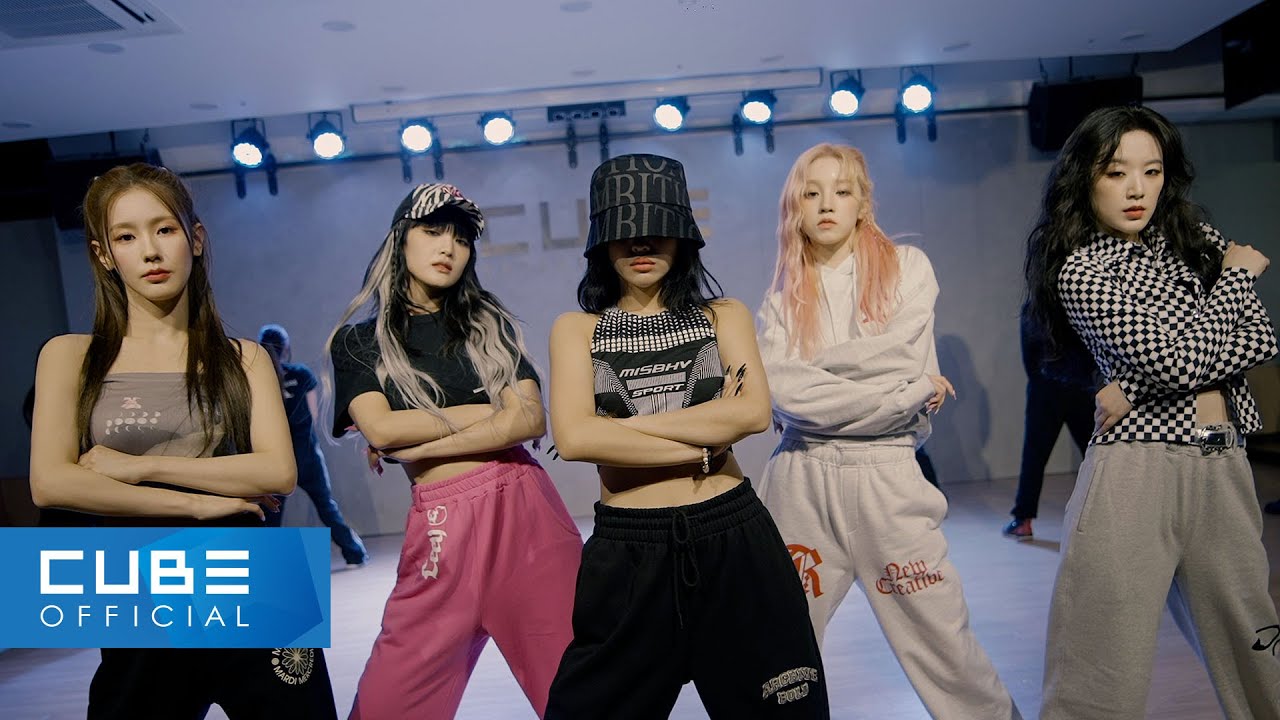
MY BAG Choreography: i-dle Put Five Rap Colors in One Room and Left No Decorative Members
The practice room removes styling alibis and proves the point: five women can share one rap track without anybody being reduced to a pretty pause between the lines people quote.
Release file
Released: March 28, 2022
Runtime: 2:47
Artist / channel: i-dle
Exact-file focus: The exact official MY BAG choreography practice video, not a stage, fancam, dance challenge, short, lyric upload, audio repost or fan edit.
Verdict first: the exact upload matters. This React follows the performance and visual choices in this video, not a neighboring stage, fan lyric upload or different song with the same English title.
First reaction: what the hook is actually doing
“MY BAG” is structured as a sequence of member claims. The beat stays minimal and heavy enough for tone, diction and attitude to function as changing instrumentation. Each verse places a different object in the bag, but the real inventory is five recognizable performance identities.
Catchiness is the entrance, not the verdict. The useful question is how percussion, bass, vocal register and phrasing make the central idea feel repeatable—and whether the repetition reveals more feeling or merely occupies time.
Production under the topline
The arrangement creates a floor before the performers decorate it. Follow the kick and low end, then notice which sounds vanish before a line begins. Empty space can give a low voice more authority than another layer of volume, while a bright response can reset the ear without flattening the groove.
i-dle-related solo work is strongest when the production recognizes the featured voice instead of renting a generic trend. Yuqi’s grain and delayed pocket, Minnie’s atmosphere and Soyeon’s percussive diction require different rooms. The mix here succeeds where it lets identity change structure.
The video argument
The choreography practice makes distribution visible. Centers rotate, surrounding members maintain active shapes and transitions treat the next rapper’s arrival as an event prepared by the whole formation. A plain room proves the routine does not depend on luxury props to communicate possession.
The canonical still above comes from this exact upload. It remains the featured image, hero, Music Reviews card and social preview, so a reader does not click one visual promise and arrive inside another video’s page.
Performance details worth the replay
Soyeon’s attack, Miyeon’s unexpected rhythmic clarity, Minnie’s languid edge, Yuqi’s grounded grain and Shuhua’s cool delivery refuse the idea that one “real rapper” must loan authenticity to everyone else. The differences are the arrangement. Pick one member after her verse ends. The routine’s quality appears in whether she remains a character or becomes background. The best sections keep all five carrying the bag even when only one voice names what is inside.
Watch preparation rather than only impact: the breath before a phrase, the body loading weight before a directional change and the eye line that tells the editor where the next cut can land. Those decisions are the bridge between choreography and camera.
What works, and what I would change
Some gesture-to-lyric matches are literal, and the routine prioritizes swagger over technical expansion. A more intricate shared phrase could complicate the verse relay. The existing choice keeps attention where the song places it: on who is speaking now and who is about to answer.
That tradeoff matters. A harder bridge, longer ending or stranger cut might create complexity, but it can also break the release’s chosen scale. Criticism should identify the price of the existing choice without pretending every song wants to become a different genre.
Participation, not inheritance
The i-dle hub remains connected because the career grew from and continues beside the group. The profile trail follows actual participation, however. A Yuqi and Lexie Liu performance does not automatically belong to all five members; a Yuqi and Minnie duet belongs to both women; a solo choreography file links the solo artist and group history without fabricating group presence.
Bottom line
MY BAG Choreography: i-dle Put Five Rap Colors in One Room and Left No Decorative Members understands the mechanism beneath its hook and gives the camera enough performance evidence to make that mechanism visible. The release has limits, but none of them erase the reason to replay it.
Replay section
- First replay: watch only the performer outside the obvious focal point or the body between named moves.
- Second replay: isolate drums and bass; mark every place the groove removes sound instead of adding it.
- Third replay: follow vocal color and breath, not volume or line count.
- Fourth replay: test the criticism—imagine the proposed change, then decide what pleasure it would cost.
Canonical profile trail
Sources and receipts
The choreography video proves “MY BAG” is an ensemble record even though its structure is a sequence of individual claims. Each member receives movement shaped around her delivery, then the surrounding dancers and formations keep those claims inside one shared architecture. Center time is not charity distributed evenly; it is a changing function of rhythm, attitude and the kind of space each verse needs.
That distinction matters for Shuhua in particular. Her presence is not decorative pause between louder rap colors. Coolness, stillness and measured attack alter the room’s pressure, just as Yuqi’s low weight, Minnie’s looseness, Miyeon’s precision and Soyeon’s directional force do. The camera can stay relatively plain because the members generate contrast without requiring costume changes or narrative cutaways.
Replay the non-center performers during every verse. Small reactions preserve group chemistry while refusing to steal focus, a balance many choreography films lose. The bag metaphor could have become a simple inventory of possessions; performance makes it an inventory of authorship. Five women carry different things, move differently under the weight and still choose to enter the same frame.
Soyeon’s compositional role is audible in how efficiently each section introduces a member. Cadence, register and attitude are treated as structural resources, not obstacles to a uniform rap sound. The arrangement knows when to clear space for a low tone, when to let a phrase glide and when to sharpen percussion around a denser attack. That tailoring is why the verses feel authored for their performers rather than divided after completion.
The fixed setting adds an honest test. With no storyline to provide borrowed importance, viewers can evaluate musicality, synchronization and charisma directly. On replay, compare the identical floor under each center. Nothing physical changes, yet the perceived room does because each member organizes attention differently. That is the strongest possible rebuttal to the idea of decorative membership: remove the decoration and five distinct engines remain.
The song also resists the assumption that rap distribution should be evaluated only by seconds. A concise section can redefine the track if its tone changes the listener’s posture, and a longer section still has to justify its space through development. “MY BAG” distributes function. The choreography makes those functions visible, showing leadership moving across the formation without confusing movement of focus with loss of group coherence.
This is why the performance works as a member guide without becoming a résumé. Viewers learn the group through impact: which voice changes density, which posture makes stillness active, which cadence rearranges the count. Names attach to artistic functions that can be heard and seen. Replay the whole choreography without ranking verses and the design becomes clearer. The song is competitive in attitude but cooperative in construction; every member’s authority increases the credibility of the bag they claim to share.
Shared ownership becomes convincing precisely because nobody disappears inside it.
RaeRae verdict
The MY BAG practice video is why the song’s five-voice premise holds up. i-dle do not merely take turns rapping while everyone else parks at the back. The formations keep each verse specific and make support visible as work. I replay the non-center members and the travel between handoffs. Nobody is decorative, and that is a better flex than any inventory list in the lyric.
What changed every time I replayed it
The second replay follows the member who is not rapping and checks whether the formation keeps her active without stealing focus. The third maps how center changes travel through the group instead of arriving by teleportation between edited close-ups. The fourth listens to each rap color while watching whether posture, weight and gesture match the voice rather than one shared swagger template. The fifth studies recoveries and spacing between the point moves fans clip. By the sixth, the choreography’s real achievement is distribution: every member owns an entrance, supports somebody else’s verse and remains legible inside a track built to announce individual value.
Lyrics and meaning
MY BAG turns possessions into shorthand for self-valuation, but the choreography keeps the bag from becoming a luxury receipt. Five distinct deliveries occupy the same structure without one member serving as decorative proof that the group still has five people. Confidence becomes participation: entering, yielding, framing and returning with authority. The strongest flex is not having more things. It is refusing a group arrangement where somebody else’s shine requires your disappearance.