
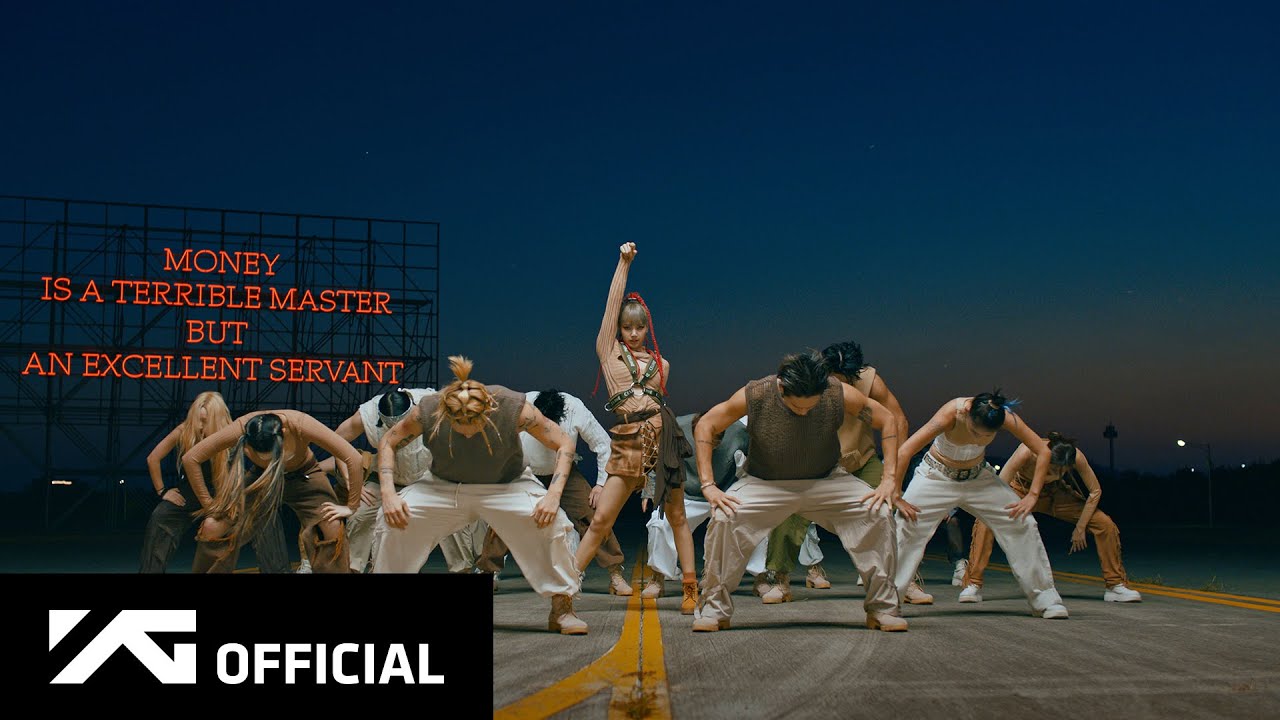
MONEY: LISA Made a Thin Lyric Into a Precise Physical Object
The lyric barely needs a notebook, but LISA and the dancers give every clipped syllable weight, direction and a body the song alone does not earn.
Release file
Released: September 24, 2021
Runtime: 2:50
Artist / channel: LISA / BLACKPINK
Exact-file focus: The exact official MONEY exclusive performance video, not an audio, dance practice, stage, short or fan edit.
Bottom line
MONEY is LISA turning repetition, bass and bodily precision into a song larger than its lyric. The wealth fantasy is blunt and sometimes empty; the performance is not. Its viral life makes sense because every rhythmic pocket creates a visible decision. The critical task is to credit that control without pretending money worship or borrowed hip-hop language becomes profound through popularity.
What changed on replay
Replay one ignores the hook and follows the percussion’s negative space. Replay two watches the dancers as architecture rather than background. Replay three studies how LISA changes attack between spoken rhythm and longer syllables. Replay four asks what wealth means when performed by an artist whose success is real but whose industry still controls many conditions. Replay five separates viral familiarity from the craft that made circulation possible.
The lyric offers fantasy, not financial analysis
Cash is treated as sensation: falling, spending, sound and proof of arrival. The song does not examine labor, inequality or security, and it should not be praised as though it does. Its function is temporary excess. That can be pleasurable while remaining politically narrow. A listener can enjoy the beat and still reject the idea that purchasing power is the clearest measure of freedom.
Repetition becomes choreography
The hook repeats because bodies give each return new information. Hand angles, weight shifts, formation changes and camera distance prevent the phrase from remaining sonically static. Audio-only replay exposes how slight the writing is; performance replay reveals why the record traveled. The full work lives between those experiences.
LISA’s timing is the authorship we can observe
She places consonants against the beat, delays certain releases and changes facial temperature without losing movement precision. Those choices are visible and audible regardless of speculation about behind-the-scenes control. Crediting performance authorship avoids two errors: treating her as a passive corporate image and assigning her every production decision without confirmed evidence.
The ensemble makes wealth look collective
Dancers turn one person’s boast into a shared spatial event. Their synchronization and counter-motion allow LISA to reduce movement while remaining focal. That labor deserves notice. The video’s power is relational; it does not emerge from celebrity alone. A strong star uses an ensemble’s competence instead of requiring everyone nearby to appear less capable.
Hip-hop lineage cannot be wallpaper
The flow, styling and cash language draw from Black musical cultures that global pop repeatedly monetizes. Skillful execution does not cancel that lineage. Responsible criticism names influence, questions which creators receive credit and avoids using chart success as moral clearance. The point is not to deny LISA’s technique; it is to place the technique inside the traditions and power structures that make it legible.
Viral scale changes the song but not the file
Challenges, edits and algorithmic repetition made the hook socially enormous. That afterlife can reveal choreography’s portability, but it does not retroactively add lyrical depth. Popularity is evidence of circulation and audience use, not a substitute for close judgment. The song can be both culturally massive and compositionally limited.
The counterargument
Some listeners hear little beyond a repetitive money chant built for short-form platforms. That response identifies the lyric’s narrow range. The defense is performance design: rhythm, formation and attitude create a complete physical object. Whether that is sufficient depends on whether the listener accepts choreography as part of the text rather than optional promotion.
What I would change
Replace one chorus with a verse about what money cannot purchase—privacy, time, safety or control—without turning the track into a lecture. One contradiction would give the fantasy resistance and make the final boast more revealing. LISA’s delivery can carry complexity the lyric does not currently request.
Replay verdict
MONEY is not secretly profound. It is openly efficient, rhythmically sharp and performed with enough control to expose the difference between a thin lyric and a thin release. The lyric remains narrow; the audiovisual craft is substantial. Both statements belong in the same verdict.
Canonical profiles
Official video
 LISA — MONEY Exclusive Performance VideoDaily+224.2KTotal views1.2B
Receipts
The exact official performance or music video is the primary source; the canonical artist/member profile supplies verified career context.
The replay ladder
Start with the complete performance and allow the hook to work physically. Replay two should follow the dancers at the edge of frame. Replay three is audio-only, exposing how often space rather than melody carries momentum. Replay four maps every flow change and pause. Replay five returns to the video and asks which authority belongs to LISA, which to ensemble design and which to camera/editing. Replay six separates the song’s popularity from its actual formal strengths.
Wealth fantasy and the idol labor contradiction
The song imagines spending without consequence, while idol success rests on disciplined labor, contracts and public availability. That contradiction does not invalidate fantasy; it makes the fantasy revealing. Money can symbolize escape from dependence even when fame creates new dependencies. A stronger lyric would explore that friction, but the performance already hints at control being rehearsed inside a system larger than one star.
The camera participates in rhythm
Pushes, cuts and framing changes land with percussion, making the screen feel choreographed even when LISA pauses. This matters because viral fragments often credit only the person centered in them. The editor and camera team help produce the physical impact viewers remember. Close analysis should distinguish movement generated in the body from movement generated around it, then explain how the two synchronize.
Short-form circulation and loss of context
A dance phrase can travel farther than the complete performance, introducing millions of viewers to sound while disconnecting it from credits, lineage and ensemble labor. That portability is neither inherently exploitative nor automatically democratic. It is an infrastructure effect. The site tracker preserves the exact official file so readers can return from a clip to the full work and the canonical artist relationship.
English-language reach is not neutral
The lyric’s accessibility helped international circulation, but global English is not simply a transparent universal tool. It privileges some listeners and commercial markets while flattening linguistic specificity. LISA’s multilingual career shows that reach can be built through many languages. Future songs need not repeat generic English wealth phrases to prove international viability.
How MONEY changes beside later releases
Rockstar relocates authority to Bangkok, New Woman breaks structure and Moonlit Floor permits melodic ease. Those releases reveal MONEY as one concentrated performance mode rather than the definition of LISA’s solo identity. A unified profile prevents viral success from freezing her catalog around the loudest algorithmic moment.
Editorial scorecard
Songwriting: intentionally blunt and materially limited. Production: sparse enough to foreground rhythm. Performance: precise, focal and ensemble-dependent. Choreography: the central text, not promotional garnish. Cultural context: requires explicit hip-hop lineage and credit awareness. Virality: important history, not proof of quality. Replay value: high for movement analysis, lower for listeners seeking lyrical development.
The final durability test
The final test is whether the performance remains interesting after the challenge move is familiar. It does, because LISA keeps changing scale: a small shoulder release can answer a large ensemble hit, and stillness can make the next count feel faster. That evidence is more durable than the cash fantasy. The song’s cultural footprint may have begun with repetition, but its craft becomes visible through variation. Future tracker notes should preserve both histories—the viral hook people encountered and the complete performance file where dancers, camera and timing explain why it moved.
Verdict
LISA MONEY React examining wealth fantasy, viral choreography, performance authorship, hip-hop lineage and replay verdict.
What changed every time I replayed it
The second replay ignores the flex vocabulary and follows consonants landing against the beat. The third watches formation changes turn currency language into direction, level and pressure. The fourth notices how the dancers make repetition accumulate instead of merely restart, and the fifth confirms the uncomfortable truth: the performance video gives this song more structure than the lyric or composition provides on its own.
Lyrics and meaning
The lyric treats money as pleasure, status and proof that labor has converted into control. That fantasy is familiar because pop regularly turns wealth into visible safety. The song does not examine who gets paid, who makes the spectacle possible or why financial excess is offered as freedom; the performance supplies precision where the writing avoids consequence.
RaeRae verdict
MONEY is a thin song with an extremely capable body. LISA’s timing, weight changes and focal control make every repetition tangible, while the ensemble turns a flex into architecture. I replay the performance because the dancers earn it—not because the lyric discovers anything new about wealth.