
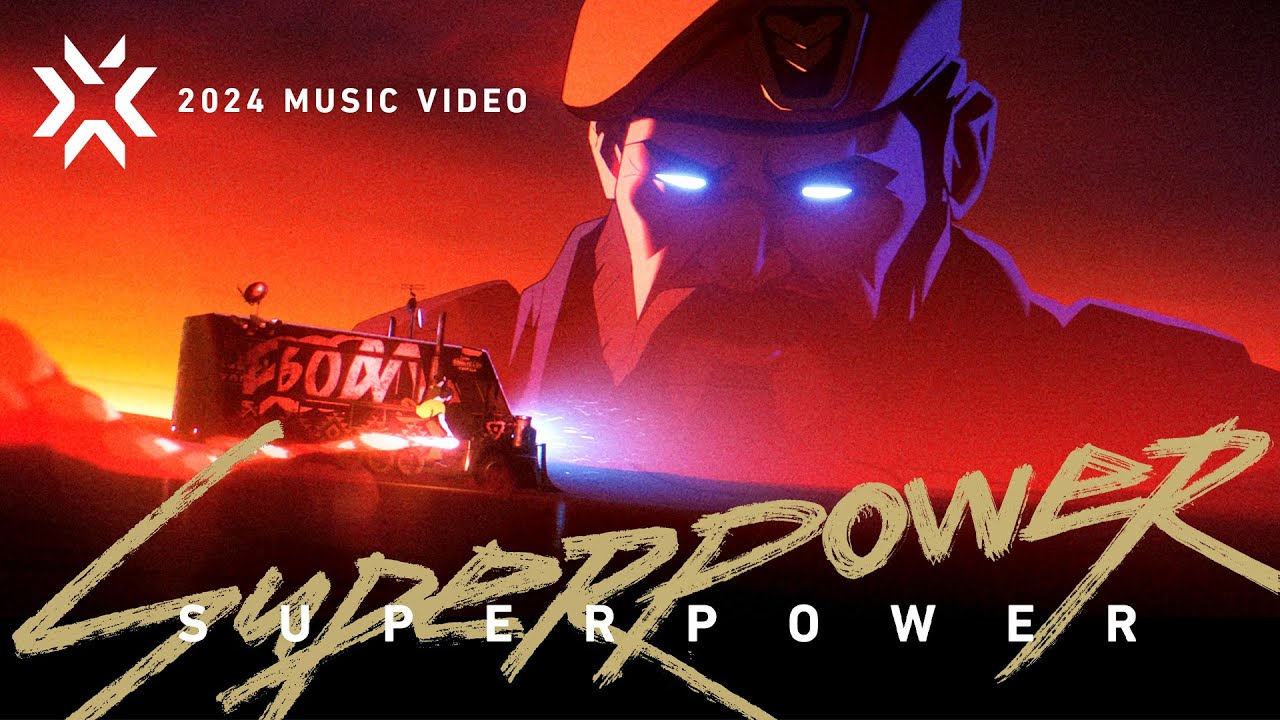
SUPERPOWER: VALORANT Turned Pain Into an Esports Boss Battle
Julie, Natty and Mark Tuan turn professional pain into tournament fuel while VALORANT history gets promoted to mythology.
Release file
Released: July 23, 2024
Runtime: 3:10
Artist / channel: Julie, Natty and Mark Tuan / VALORANT
Exact-file focus: The exact official VALORANT Champions 2024 anthem music video, not a ceremony stage, game clip, short or fan upload.
Official anthem and MV deep dive · released July 23, 2024 · VALORANT Champions 2024
Riot Games asked Julie and Natty of KISS OF LIFE plus Mark Tuan of GOT7 to turn professional pain into tournament fuel, then animated VALORANT history like everybody’s worst match had been promoted to mythology. The result never walks. It kicks the door, checks the scoreboard and assumes your emotional recovery has a tactical timeout.
Quick verdict
I like “SUPERPOWER” because the chorus understands exactly what an esports anthem must do: convert damage into momentum fast enough for an arena to shout it. Julie and Natty bring attack and brightness; Mark gives the English-language center a bruised steadiness. The mix keeps everyone moving at championship volume, sometimes so consistently that the song forgets contrast is also a superpower.
The official file
Project: VALORANT Champions 2024 official anthem
Performers: Julie and Natty of KISS OF LIFE, plus Mark Tuan of GOT7
Released: July 23, 2024
Written by: Kill Dave, Cal Scruby, Dabin, Dalton Diehl, Gianni Taylor and Joshua Landry
Korean translation: Young Chance and gxxdkelvin
Produced by: Kill Dave
Mixed by: Tom Norris
Mastered by: Randy Merrill at Sterling Sound
Executive production: Riot Games Music
Music video: Created with WIZZ
Important relationship correction: this is not all four KIOF members
Riot’s official credit names Julie and Natty, not Belle and Haneul. The KISS OF LIFE hub belongs in the relationship because the two performers represent the group, but the member links must stop with the women who actually recorded the song. Belle and Haneul did not gain vocals through proximity. Accurate credits are a kindness to artists and to the person trying to remember who delivered the verse six months later.
Mark’s participation is similarly specific. He appears as Mark Tuan, a solo artist and active GOT7 member. PUBG, VALORANT and Riot Games are not idol groups and do not need fake artist profiles. The clean filing system is a gaming collaboration tag and editorial route: later Riot or VALORANT songs can be found together without pretending the publisher has joined a music show.
My actual first reaction
First thought: the track has already entered the arena and I am apparently late for warm-ups.
The moment I leaned in: the pain-as-power hook lands because an esports audience understands losing as recorded public data.
The side-eye: Mark receives enough time to matter and not enough time to stop people asking why he was invited for approximately one emotionally responsible hallway.
Current status: replayed. I still do not aim better, but the soundtrack is very supportive.
Pain is a useful tournament metaphor because losing leaves receipts
“Pain is my superpower” can sound like motivational merchandise until it meets professional competition. VALORANT players lose on broadcasts, watch mistakes clipped, read strangers explain their own careers and return to the server anyway. Pain is not abstract suffering here. It is failed rounds, elimination, roster pressure and the decision to take another high-risk fight after the last one became somebody else’s highlight.
The lyric’s leap-versus-flight idea fits the same structure. Competitive play punishes hesitation and reckless entry, which means courage is not simply pressing forward. The best players convert failure into timing, information and a decision made under pressure. The anthem simplifies that process for an arena, but the emotional engine remains honest: bruises become useful only when somebody learns from them.
Three performers, three different kinds of pressure
Julie’s lower attack fits the verses because she can sound composed while the production is throwing sparks. Natty brings movement and a brighter rhythmic edge that helps the chorus lift rather than sit entirely in grit. Mark’s steadier tone supplies the reflective angle: the anthem briefly sounds like somebody has lived through the pain instead of merely winning a slogan contest.
The collaboration also works across audiences. KIOF listeners recognize Julie and Natty’s performance authority. Ahgase recognize Mark’s restrained delivery and gaming interest. VALORANT viewers receive voices capable of carrying a live final. None of those audiences need to pretend the song is a normal group comeback. It is a commissioned anthem with a precise job.
The music video treats esports memory like a comic-book canon
WIZZ’s animated film collects professional players, teams and iconic competitive moments rather than turning the singers into agents with suspiciously perfect hair. That choice respects the event. The heroes are the competitors whose decisions created the tournament history; the artists narrate the emotional logic that connects those moments.
The video moves between recognizable pro figures, game-world danger and stylized recreations of famous plays. For existing viewers, references reward memory. For outsiders, the sequence still communicates stakes through pursuit, impact, recovery and the next confrontation. You do not need to identify every player to understand that somebody survived a round people still discuss.
Animation solves a practical problem: real match footage can document action, but it cannot easily show what pressure felt like inside the player. Exaggerated scale turns tactical choices into myth without claiming the game literally contains this exact emotional weather. The video is not a tutorial. Please do not use it to learn positioning.
The opening ceremony proves why the song was built this way
Julie, Natty and Mark performed the anthem live before the grand final in Incheon. A championship opener needs immediate shape, a chorus thousands can recognize and enough sustained energy to carry cameras from performers to players. “SUPERPOWER” meets that assignment. Its refusal to calm down makes more sense in an arena than in a quiet headphone audit.
That context does not erase the arrangement’s limitation. A deeper breakdown or a more exposed Mark section could have made the final return hit harder. When every section arrives already armored, escalation becomes difficult. The live function explains the choice; it does not make dynamics illegal.
The fair counterargument
Some VALORANT fans rank it below earlier Champions anthems because the energy stays flat at one high level, the singers feel mixed behind the production or the hook lacks the emotional climb of a tournament classic. Mark’s relatively limited presence also makes the three-name billing feel uneven. Those criticisms are fair.
My answer is that the song’s chorus, multilingual delivery and animated pro-player focus still do the commissioned job. It may not become every fan’s “Die For You,” but it gives the 2024 tournament a distinct resilience theme and a collaboration that belongs to this event rather than a recycled K-pop single wearing a game logo.
What changed every time I replayed it
First play: chorus and animation carried everything.
Second play: Julie’s compact attack became the cleanest bridge between hip-hop production and arena scale.
Third play: Natty’s rhythmic brightness stopped the record from sinking under its own bruises.
Fourth play: Mark’s limited section felt more necessary and more frustrating.
Video replay: the pro references changed from generic hero shots into a record of actual competitive memory.
Replay verdict
Keep it on the tournament playlist. “SUPERPOWER” is built for the second before a final begins, when pain has to become useful because nobody can reschedule the bracket. I want more contrast and more Mark. I also understand why the chorus arrives wearing full armor.
Keep going
Use the KISS OF LIFE hub for Julie and Natty’s group context, and the Mark Tuan profile for his solo and GOT7 file. File future game music under the gaming-collaboration route; Riot and VALORANT are publishers and competitive properties, not idol groups.
Receipts
The seven current GOT7 profiles
- GOT7 group profile
- JAY B profile
- Mark Tuan profile
- Jackson Wang profile
- Jinyoung profile
- Youngjae profile
- BamBam profile
- Yugyeom profile
Verdict
SUPERPOWER review: Julie and Natty of KISS OF LIFE with Mark Tuan turn pain into the VALORANT Champions 2024 anthem. Full song and animated MV deep dive.
Bottom line
“SUPERPOWER” works as an esports anthem because Julie, Natty and Mark Tuan bring three distinct kinds of force. The video turns tournament memory into spectacle, but the performers keep the song human enough to matter outside the opening ceremony.
Lyrics and meaning
Pain becomes useful here because professional loss leaves public receipts: failed rounds, elimination, roster pressure and clipped mistakes. The anthem simplifies recovery for an arena, but the larger argument remains honest—bruises become power only when someone converts them into timing, information and another decision under pressure.
RaeRae verdict
SUPERPOWER does the commissioned job: it turns damage into momentum before a final begins. I want more contrast and more Mark, but Julie, Natty and Mark Tuan give the arena three distinct kinds of force instead of one generic victory voice.