
Fairy Tail Episode 34 React: Jellal
Jellal
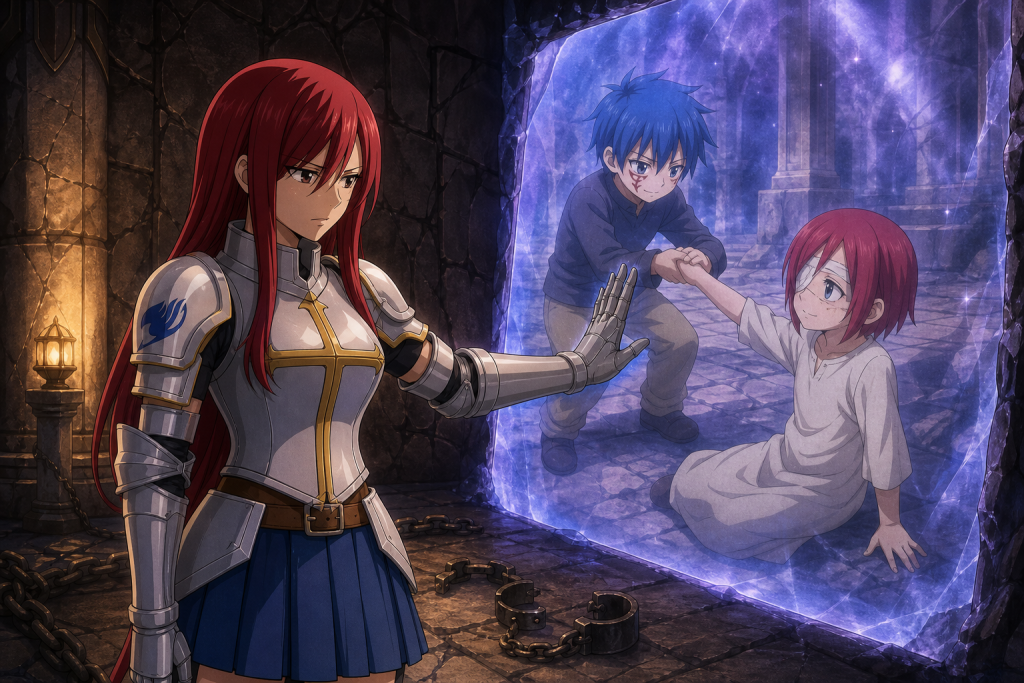
Bottom line: Episode 34 lets Erza tell the truth she has been carrying alone: she and the others were enslaved as children to build the R-System, her right eye was destroyed during punishment, and Jellal once risked himself to save her before torture changed him. While Erza finally gives her team context, the Magic Council debates erasing the tower with Etherion, including everyone trapped inside it.
One institution built a resurrection weapon with children. Another considers solving that crime by vaporizing the survivors.
The receipt box
- Episode: 34
- English title: Jellal
- Japanese title: ジェラール
- Romanization: Jerāru
- Original Japanese air date: June 21, 2010
- Series: Fairy Tail (2009–2013)
- Episode type: Manga canon
- Manga material: Chapters 78–80
- Arc: Tower of Heaven
- Opening: “Ft.” by Funkist
- Ending: “Gomen ne, Watashi.” by Shiho Nanba
- Where to watch: Watch Jellal on Crunchyroll
Erza's story begins with labor, not romance
Jellal’s name titles the episode, but Erza’s testimony gives the name meaning. Before fans turn their relationship into ship edits, the story establishes the material floor: children were abducted or imprisoned, forced to build the R-System, punished for resistance, and taught that their bodies belonged to a project meant to revive Zeref.
Erza and Jellal met inside forced labor.
That context shapes every later feeling between them. Their bond grew through mutual protection under an institution that denied them ordinary childhood. Affection in that environment can be real without becoming a magic solvent for accountability. Trauma can explain why a relationship feels foundational. It cannot decide what either person owes after later harm.
Episode 34 does not yet reveal the complete mechanism behind Jellal’s change. It gives Erza’s evidence: he was kind, he defended her, he was captured, he was tortured, and afterward he behaved like another person. That is the boundary. Anything about the exact voice, controller, or later responsibility belongs to later episodes.
Sho's childhood fear becomes adult accusation
Erza remembers the attempted escape. When guards demand the mastermind, Sho cannot confess that the plan was his. He is a frightened child facing people who use pain as administration.
Jellal steps forward. Erza also tries to protect Sho. The guards decide Erza is responsible and take her for punishment anyway.
Adult Sho later apologizes for lacking the courage to confess. That apology matters because he has spent years holding Erza responsible for abandonment while his own memory includes a moment when she accepted danger in his place.
This is not a reason to shame a child for failing a bravery test under torture. Sho was coerced. The adult accountability question is what he does with that memory now. Does he let it complicate the story Jellal gave him, or does he preserve the accusation because it organizes his pain?
Survivor guilt can point inward and still be weaponized outward.
The loss of Erza's eye is not character decoration
Erza’s right eye is injured during punishment, leaving it unable to function normally. The series later gives her an artificial eye through Porlyusica’s medical intervention. Episode 34 shows the origin of that physical difference.
The scene should not be consumed as the stylish backstory behind a cool scar. The injury is an institutional mark. Guards damage a child’s body to control a group of enslaved workers.
Erza’s later relationship to armor and bodily control makes more sense here. Requip lets her decide what covers her, what protects her, and what form she presents to the world. Her artificial eye and armor are not proof trauma made her stronger in some inspirational bargain. They are adaptations after harm that should never have occurred.
The episode earns emotion when it keeps that sequence intact: violence happened, Erza survived, and survival required ongoing adjustment. The harm was not secretly a gift.
Young Jellal protects before he controls
Jellal tries to claim responsibility for the escape plan and later fights to reach Erza after her punishment. He tells the children they should resist rather than accept slavery.
That child matters.
He should not be erased simply because the adult tower ruler commits harm. Recognizing his earlier courage is not the same as excusing everything that follows. It gives us a factual baseline for change.
The harder question is how to hold continuity and rupture together. Jellal’s body, memories, and relationships continue. His conduct changes after captivity and torture. Erza experiences the change as the loss of someone she knew.
Stories often use corruption or mind control to turn accountability into a switch: good person before, evil puppet after, therefore nobody has to examine consequences. Episode 34 has not reached that answer, and we should not force it there early. Torture can destroy judgment and make manipulation possible. People harmed by later actions still require recognition.
Explanation must not become erasure in either direction.
Erza starts the revolt
Jellal’s call to resist survives even after he is taken. Erza acts on it. The child who has just been punished and maimed helps begin a revolt against the tower guards.
This is one of the most important pieces of Erza’s leadership history. She does not become brave when she joins Fairy Tail. She carries an organizing instinct from the tower.
That instinct also comes with a dangerous habit: she places herself between other people and punishment. She tried to take the blame. She later led resistance. In the present, she repeatedly treats her own body as the acceptable cost of protecting a group.
The pattern is heroic and unsustainable.
Protection becomes self-erasure when the leader cannot imagine a solution that leaves her alive, supported, and accountable to others. Team Natsu’s refusal to leave the tower matters because they reject Erza’s claim that she alone should manage the consequence.
The team listens after refusing evacuation
When Natsu, Lucy, Gray, and Juvia reach the tower, Erza orders them to leave. She promises to recover Happy and handle Jellal herself.
They refuse.
Natsu’s refusal could look like another case of him ignoring a woman’s stated choice. Context makes it more complicated. Erza is trying to send uninformed teammates away while assuming sole responsibility for a threat that already attacked them and kidnapped Happy. The others have stakes and agency too.
The ethical response is not to seize control of Erza’s story. It is to require enough information for everyone to choose knowingly. That is what the conversation begins.
Erza cries because the team stays after seeing that she is not invulnerable. Their loyalty does not depend on her maintaining Titania at full volume.
The scene works because they listen. If Natsu had interrupted the testimony with a speech about what Erza “really” needs, found family would become another form of control.
Juvia joins the rescue before receiving easy acceptance
Juvia travels with Natsu, Lucy, and Gray and uses Water Magic to conceal their approach and create air bubbles for an underwater route into the tower.
Her contribution is practical, not decorative. Without her, the group has a much harder time reaching the structure unseen.
This does not erase her role in Phantom Lord’s attack or reduce her motivation to a crush on Gray. Juvia is making choices after the collapse of her old guild. Helping rescue Erza and Happy is conduct that can support a new relationship with Fairy Tail.
It should not function as instant moral repayment. One useful mission does not settle accountability. It does show direction.
The team benefits when it lets a former opponent contribute without pretending the past never happened. That balance will matter repeatedly as Fairy Tail expands.
The dead birds and fish make the tower's danger physical
The anime adds birds falling from the sky and dead fish near the tower, along with wreckage from Council ships. The images widen the threat before anyone enters.
The R-System is not only a building holding private trauma. Its magical contamination or defensive field affects the surrounding environment. The water and air carry evidence that the tower’s power cannot be contained neatly within its walls.
Juvia’s Water Dome conceals the boat, another anime addition that gives her magic strategic relevance. The approach becomes more than travel between plot points. It shows the team entering a zone where ordinary life is already being pushed out.
The environmental imagery also makes Etherion’s proposed destruction more alarming. The Council is considering adding catastrophic force to an area already damaged by magical weapons.
Apparently their environmental policy is “have we tried a larger explosion?”
Etherion is mass death disguised as decisive leadership
The Magic Council learns the Tower of Heaven is an active R-System. Siegrain proposes firing Etherion, the Council’s ultimate weapon, to destroy it.
Council members understand that people inside the tower would die. Siegrain treats that cost as acceptable, even while presenting Jellal as his twin.
The proposal creates a familiar institutional temptation: when a dangerous site contains victims, perpetrators, uncertain loyalties, and politically embarrassing history, destroy the site and call the absence of evidence safety.
Etherion might stop the R-System. It would also kill enslaved workers, manipulated survivors, captives, rescuers, and anyone else inside the blast. The Council has not separated those categories before debating execution.
This is where “greater good” language earns side-eye. An institution cannot claim moral seriousness while refusing to count the people it plans to sacrifice.
Siegrain's performance inside the Council
Siegrain presents himself as a Council member discussing the threat posed by Jellal, whom he identifies as a twin. The episode asks viewers to accept that relationship provisionally.
His conduct already deserves scrutiny. He pushes Etherion while framing personal cost as proof of resolve. “I would sacrifice my own brother” sounds impartial. It can also be theater designed to make mass killing look principled.
Ultear supports the proposal, and another vote moves Etherion closer to authorization. The Council scene is not bureaucratic filler. It establishes that the tower conflict has two command centers: Jellal controls the structure, and Siegrain shapes the institution deciding how to attack it.
The audience should track evidence, not rush ahead. Episode 34 has not disclosed the full relationship between those identities. What it proves is that Siegrain benefits from the Council believing him separate from Jellal.
Jellal turns rescue into a game
The rescue team encounters guards, reaches an interior route, and realizes they are being allowed to advance. Jellal opens the way because he wants participants in his game.
That choice converts the tower’s history of forced labor into entertainment for its current ruler. People remain pieces on a board. Consent remains optional.
The food waiting inside adds to the wrongness. Hospitality becomes control when the host decides the route, the stakes, and whether guests can leave.
Jellal does not merely defend the tower. He curates the confrontation. That creative control matters because it shows how thoroughly the institution’s logic has been reproduced. The enslaved child who once urged revolt now places other people inside designed trials.
Again, later explanation may change how we understand his mental state. It will not make the people subjected to the game unreal.
Adaptation changes and visual ethics
Episode 34 adapts Chapters 78–80 and expands the tower’s approach, interior, guards, and childhood punishment material. The anime gives the Tower of Heaven a more jagged Lacrima-heavy design than the manga’s straighter structure. It also adds the dead wildlife, Juvia’s concealment spell, and extra guard encounters.
Some changes deepen atmosphere. Others alter how trauma is displayed. The anime changes details of Erza’s confinement and the mechanics of Jellal’s rescue attempt. It adds attacks on Jellal and Simon during the childhood sequence while moving parts of Erza’s revolt offscreen.
Direction matters here. Showing enough violence to establish institutional cruelty is necessary. Lingering on a child’s suffering for aesthetic intensity is not.
The most ethical visual anchor is Erza’s present narration. The flashback exists because she chooses to tell her team. The camera should preserve that frame rather than acting as if viewers have unrestricted access to her pain.
RaeRae's verdict
Episode 34 gives Erza’s strength a history without pretending the history was good for her.
She was enslaved. She protected Sho. Guards destroyed her right eye. Jellal tried to save her. She carried his call to resistance into a revolt. Then torture changed the person she knew, and the tower kept building itself through the survivors.
In the present, Erza tries to carry the crisis alone. Her team refuses, then does the one thing she actually needs: they listen.
Meanwhile, the Magic Council debates Etherion because apparently nothing says responsible governance like solving child slavery with a superweapon aimed at the surviving children.
Jellal’s exact responsibility is not fully resolved. Erza’s pain is. The next episode can explain the voice in the darkness. It cannot make the consequences disappear.
Continue the watch
- Previous: Fairy Tail Episode 33 React: The Tower of Heaven
- Next: Fairy Tail Episode 35 React: Voice in the Darkness
- Browse every Fairy Tail episode
- Open the Fairy Tail Episode Reacts hub
- Return to the Fairy Tail hub
Sources
- Crunchyroll: Fairy Tail Episode 34, “Jellal”
- Fairy Tail manga, Chapters 78–80 by Hiro Mashima