
RAERAE REACTS • FAIRY TAIL EPISODE 27
The Two Dragon Slayers
Lucy turns a furnace into strategy while Natsu and Gajeel try to make violence look like destiny.
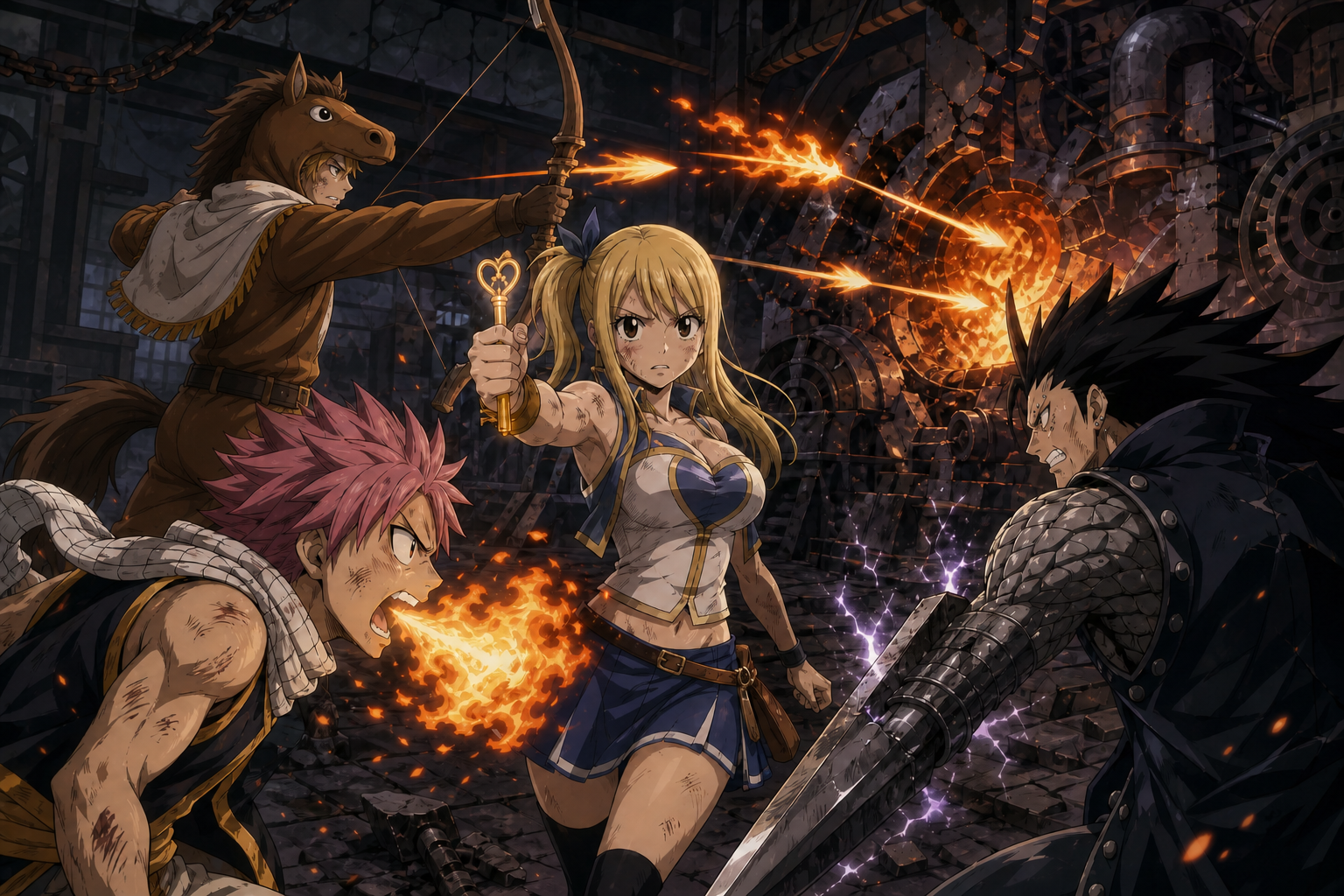
Bottom line: Episode 27 is not Natsu winning because friendship secretly refilled his battery. Gajeel has iron to eat inside an iron fortress. Natsu runs out of fire. Lucy identifies the resource problem, summons Sagittarius with a key she has barely begun using, and turns an industrial furnace into lunch. Natsu finishes the fight because Lucy changes the conditions. The episode calls itself “The Two Dragon Slayers,” but the decisive tactical mind belongs to the Celestial Spirit mage standing between them.
Receipt box
- Episode: 27
- English title: The Two Dragon Slayers
- Japanese title: 二人の滅竜魔導士(ドラゴンスレイヤー)
- Romanization: Futari no Doragon Sureiyā
- Original Japanese air date: April 26, 2010
- Story placement: Phantom Lord arc
- Manga source: Chapters 61–63 of Hiro Mashima’s manga
- Japanese principal cast: Tetsuya Kakihara as Natsu, Wataru Hatano as Gajeel, Aya Hirano as Lucy, Rie Kugimiya as Happy, Masaki Kawanabe as Sagittarius, Ryōko Ono as Mirajane, and Takashi Matsuyama as Jose Porla
- Opening / ending: "Ft." / "Gomen ne, watashi"
- Where to watch: Fairy Tail Episode 27 on Crunchyroll
- Episode type: Manga canon
- Official references: Crunchyroll’s Episode 27 listing, TV Tokyo’s Fairy Tail staff and cast archive, and TV Tokyo’s Fairy Tail character archive
Fire and iron begin with the same body logic
Natsu and Gajeel use Dragon Slayer magic built around different elements.
Their bodies do more than cast spells.
Natsu produces, consumes, and fights through fire. Gajeel produces, consumes, and fights through iron. Each can transform parts of his body into the properties and weapons associated with his element.
That shared structure makes the battle informative.
The audience has watched Natsu’s abilities since Episode 1. Gajeel reveals that Dragon Slayer magic is not unique to one missing dragon and one loud pink-haired guild member.
Another dragon raised another child.
Another body learned another element.
The similarity threatens Natsu’s sense of special history before either fighter learns the full connection.
For the moment, the revelation arrives through fists.
Gajeel’s iron forms are body transformation, not equipment
Gajeel changes his arms into an Iron Dragon Club and Iron Dragon Sword. He hardens his skin with iron scales. His roar carries metal force.
These are not weapons he equips from storage.
They are Dragon Slayer transformations.
That distinction matters visually and mechanically. Gajeel does not become a knight wearing dragon armor. His body becomes the material.
The magic gives him reach, hardness, cutting power, and defensive resilience.
It also provides fuel because the fortress around him contains iron.
Gajeel is fighting in a pantry.
Natsu is fighting after several consecutive battles in a structure built from his opponent’s food group.
The environment is not neutral.
Power comparisons that ignore the room are just fandom yelling with numbers attached.
Natsu’s anger does not solve stamina
Natsu is furious about what Gajeel did to Lucy, Levy, Jet, Droy, and Fairy Tail.
The anger gives him direction.
It does not create endless magic.
He fought through Phantom Lord’s defenses, destroyed Jupiter, faced Totomaru, survived Aria, and reached Lucy. Gajeel begins their main battle with greater access to his element and fewer immediate resource problems.
Natsu slows.
That limit makes the fight better.
If righteous anger automatically produced infinite output, the episode would have no tactical question. The most emotionally justified person would always win by shouting the reason again.
Instead, Natsu reaches a point where his body cannot convert loyalty into more flame.
He needs fuel.
The story says so directly.
Gajeel treats endurance as proof of superiority
Gajeel presses the advantage when Natsu’s energy drops.
He reads the resource gap as evidence that iron is stronger and that Phantom Lord’s Dragon Slayer is the superior one.
That interpretation fits his worldview.
Gajeel has spent the arc turning strength into permission. He can destroy the guild hall because he is strong enough. He can brutalize Shadow Gear and Lucy because nobody present can stop him. He can call Natsu trash when Natsu runs out of fire.
The logic is circular.
Winning proves he deserves to dominate.
Dominating proves he is winning.
Episode 27 interrupts that story by showing the battle conditions change through cooperation.
Gajeel has a fortress full of iron.
Natsu has Lucy.
Those are not equivalent resources, because Lucy is not property or fuel.
She chooses to help.
That choice is the moral and tactical difference.
Lucy diagnoses the fight instead of cheering from the wall
Lucy sees Natsu weakening and identifies the problem.
He needs fire to eat.
The solution is not obvious because the battlefield does not contain a convenient bonfire. Lucy checks the magical tools she still has available.
Her remaining option is Sagittarius.
The decision requires imagination.
Sagittarius is an archer, not a fire Spirit. Lucy does not summon him because his profile says “Dragon Slayer support unit.” She summons him because an archer can hit a distant target and she needs to turn something in the environment into flame.
This is what competence looks like before a mage owns a huge spell list.
Lucy combines limited resources correctly.
One key.
One archer.
One furnace.
One hungry teammate.
Sagittarius is new, literal, and useful
Lucy received the Sagittarius key after the Galuna Island mission.
She has not built years of experience with him.
His first answer is that producing fire is not what an archer does.
Fair.
Lucy then reframes the assignment.
He does not need to conjure fire from his body. He needs to shoot a target that can burn.
Sagittarius’s literal manner and horse costume bring comedy into a brutal episode, but the Spirit is not useless joke furniture. His marksmanship creates the condition Natsu needs.
The scene also demonstrates the relational flexibility of Celestial Spirit magic.
Lucy does not press a button labeled flame. She communicates with a person whose ability can be applied indirectly.
That is strategy and partnership.
The furnace makes the power-up material
Sagittarius fires arrows into a damaged engine or furnace and produces flame.
Natsu eats it.
The power restoration has a physical source the audience can see.
That is important because Fairy Tail is often accused of resolving fights through emotion alone. Emotion matters throughout the series, but Episode 27 gives the comeback actual mechanics.
Natsu’s Dragon Slayer body can replenish through external fire.
Lucy and Sagittarius create external fire.
Natsu consumes it.
His energy returns.
The friendship is present in the decision to help and the trust required to coordinate under pressure.
The fuel is still fuel.
Calling the sequence “power of friendship” without the furnace is an efficient way to announce you watched the vibes and skipped the nouns.
Lucy’s intervention is not support in the small sense
Fans sometimes use “support character” to mean the person who stands near the important fighter and keeps him emotionally motivated.
Lucy does more than that.
She changes the resource economy of the battle.
Before Sagittarius’s arrows, Gajeel has access to iron and Natsu lacks access to fire.
After the furnace ignites, both Dragon Slayers can replenish their element.
That change makes Natsu’s final attack possible.
Lucy does not land the finishing blow. She creates the conditions under which a finishing blow exists.
That is not lesser strategy.
It is the difference between a plan and a corpse with good intentions.
The episode title names two men.
The turning point belongs to a woman and her Spirit.
Put her in the recap.
Natsu and Lucy function as a team without merging roles
Natsu protects Lucy from Gajeel in Episode 26.
Lucy protects Natsu’s chance to win in Episode 27.
The actions are different and reciprocal.
Reciprocity does not require identical power. Lucy does not need to punch through iron scales to be an equal participant in the outcome.
Natsu does not need to summon Sagittarius to respect her contribution.
Their partnership works because each responds to a problem the other cannot solve alone in that moment.
That is stronger than a romance reading that reduces every rescue to proof of attraction.
If romance develops, fine.
The relationship already has a useful foundation: they make one another more capable without demanding the same job.
Gajeel’s conduct gives Natsu a moral target and a dangerous temptation
Natsu is not fighting Gajeel only because they share a magic category.
He is responding to harm.
Gajeel attacked Fairy Tail’s building, brutalized Shadow Gear, and abused Lucy. Natsu wants accountability in the language he knows best.
The danger is that anger can make punishment feel identical to protection.
Defeating Gajeel stops the immediate threat.
Hurting him after the threat ends would not restore Lucy or Levy.
Episode 27 stays inside the active fight, so the distinction has not yet become an aftermath decision. It still matters to how the audience frames the win.
Natsu is not morally correct because his punches are hotter.
He is correct about stopping Gajeel because Gajeel is still choosing violence.
Accountability begins with ending the conduct.
It cannot end with a cool final attack.
The shades show the war is larger than one duel
Outside the Dragon Slayer fight, Jose’s shades attack Fairy Tail’s exhausted members.
The crosscutting keeps the duel from becoming a private sporting event.
Natsu and Gajeel can spend time comparing elements because other guild members are absorbing the wider cost.
Cana, Macao, Wakaba, Laki, and the rest of Fairy Tail keep defending the guild while injured and depleted.
Their struggle matters.
Main-character framing can make background fighters look like scenery until a named hero completes the boss battle. Episode 27 shows that the institution survives through distributed labor.
Natsu may defeat Gajeel.
He cannot simultaneously protect every person from every shade.
Fairy Tail’s endurance belongs to more people than the title can fit.
Two Dragon Slayers means two dragon histories
The fight confirms that Gajeel learned Iron Dragon Slayer magic from a dragon, just as Natsu learned Fire Dragon Slayer magic from Igneel.
The deeper Metalicana and July 7, X777 connection is not fully resolved inside this episode’s fight.
That boundary matters.
Longtime viewers know the missing dragons share a larger plan and timeline. Episode 27 gives the first disruptive evidence: Natsu’s private mystery is part of a pattern.
Gajeel is not an imitation who copied the magic from a book.
He is another child shaped by a dragon relationship.
That similarity does not excuse his current behavior.
Shared abandonment can explain why two people developed differently.
It cannot make every choice after abandonment morally equal.
Natsu found Fairy Tail.
Gajeel found Phantom Lord.
Both guilds gave their Dragon Slayer a social structure. Episode 27 shows what those structures encouraged them to do with power.
Fire and iron carry different cultural meanings in the fight
Fire moves, consumes, spreads, and changes whatever feeds it.
Iron holds shape, resists impact, and becomes a tool through force and heat.
The episode uses those material qualities without needing a lecture.
Gajeel presents iron as hardness that proves superiority. Natsu presents fire as motion that refuses containment.
Lucy introduces the missing process between them.
Fire can heat iron.
Iron can contain fire.
Neither element exists as an absolute winner outside conditions.
The fight therefore works better as a clash of bodies and environments than as a permanent power-ranking statement.
Later Natsu and Gajeel will cooperate. The same differences that make them rivals can make them complementary.
Episode 27 is not ready for that friendship.
It does establish the material grammar.
Japanese performance makes resource failure audible
Tetsuya Kakihara lets Natsu’s exhaustion affect rhythm and breath. The anger remains, but the body cannot sustain the same output.
That makes the furnace restoration legible before the animation completes the idea.
Wataru Hatano gives Gajeel a rough confidence that grows as Natsu weakens. He sounds at home in the advantage.
Aya Hirano keeps Lucy urgent without making her helpless. Her performance moves through diagnosis, uncertainty about Sagittarius, instruction, and relief.
Masaki Kawanabe’s Sagittarius brings formal comic timing through his repeated mannerisms, but the delivery does not prevent him from becoming operationally useful.
Rie Kugimiya’s Happy helps connect Lucy’s idea to Natsu’s known eating mechanic. His familiarity with Natsu turns panic into a specific requirement.
The voices make collaboration sound like several people solving different pieces rather than one hero receiving inspirational noise.
Manga and anime: the battle expands without losing the furnace logic
Episode 27 adapts Chapters 61 through 63.
The manga supplies the central fight, Natsu’s fuel problem, Lucy’s Sagittarius solution, and the continuing attack on Fairy Tail outside.
Animation enlarges the material clash.
Iron limbs can change shape in motion. Fire and metal roars can collide across the room. Natsu’s weakening can unfold over several exchanges instead of one static transition.
The danger of expansion is repetition. A longer fight can make tactical limits feel temporary if characters keep trading spectacular attacks after the story says one is exhausted.
The furnace sequence restores clarity.
The audience sees the new source, sees Natsu consume it, and sees the performance change.
That cause-and-effect keeps spectacle attached to mechanics.
The episode is loud.
It is not random.
What Episode 27 changes
Natsu and Gajeel establish Fire and Iron Dragon Slayer mechanics against one another.
Gajeel’s environment gives him a fuel advantage.
Natsu reaches a genuine stamina limit.
Lucy summons Sagittarius and turns marksmanship into a fire source.
Sagittarius proves useful before Lucy has a long contract history with him.
Natsu replenishes through external flame rather than emotion alone.
The rematch swings because Lucy changes the conditions.
Fairy Tail’s wider members continue resisting Jose’s shades.
The fight reveals that Natsu’s dragon-raised history is not unique.
Most importantly, teamwork becomes technical.
The guild bond does not replace magic rules.
It helps people use those rules together.
RaeRae’s verdict
Episode 27 is exactly why “Natsu won with friendship” can be such a lazy summary.
Friendship did matter.
Lucy cared enough to stay in the room and solve the problem. Sagittarius trusted her direction. Happy knew what Natsu’s body needed. Natsu trusted the fire they created.
But care did not float into his stomach as glitter.
Sagittarius shot a furnace.
The furnace made fire.
Natsu ate the fire.
Then he could fight again.
That chain is not less emotional because it has mechanics. It is more satisfying because everybody’s contribution has shape.
Gajeel has iron, power, and a building designed around his advantage.
Natsu has a team that can think beyond his fists.
The title gives us two Dragon Slayers.
Lucy gives one of them another round.