
Ghost in the Shell Character Directory
Ghost in the Shell Characters
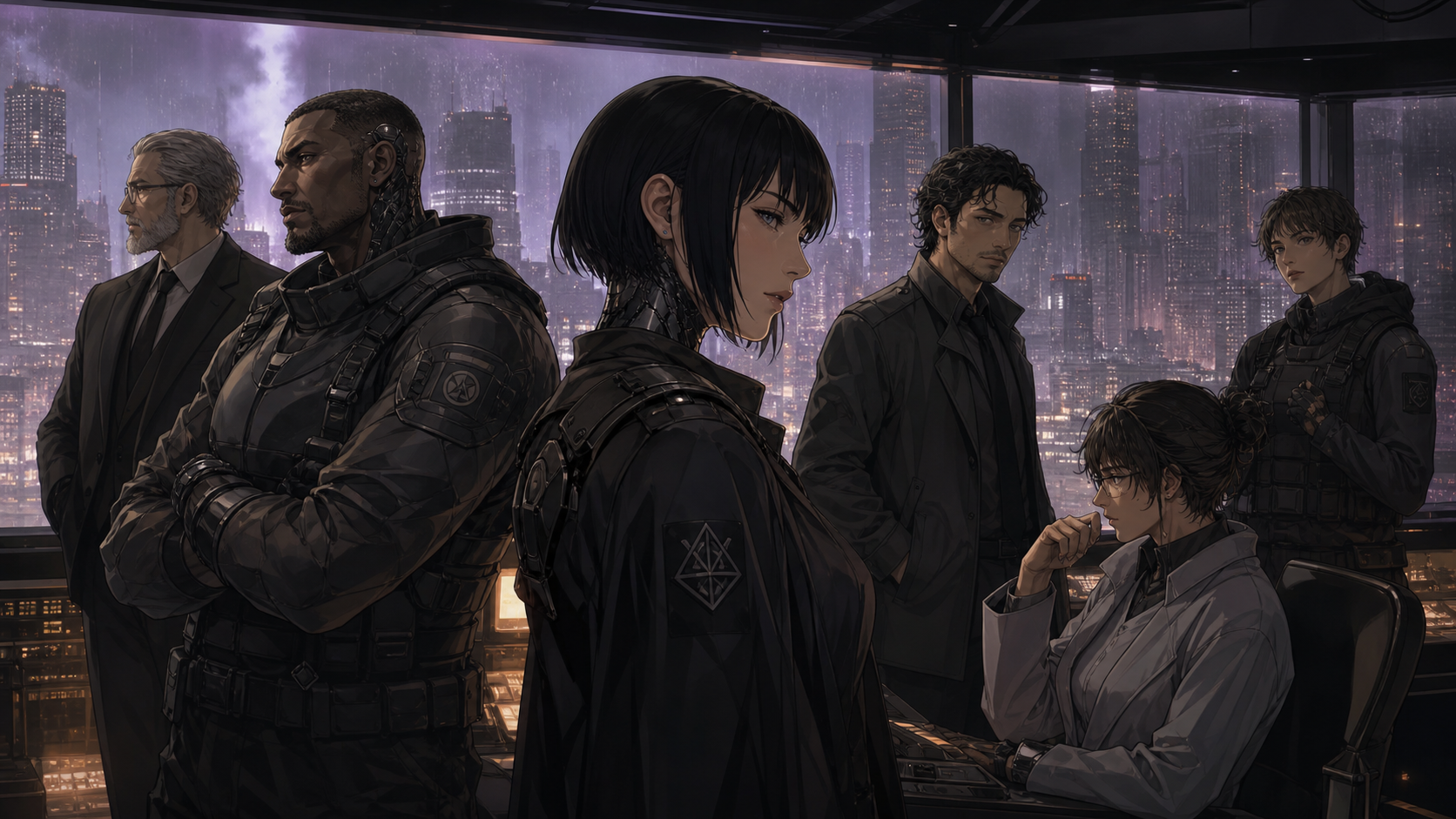
Section 9 survives because nobody agrees too easily. The Major moves like certainty while questioning whether her memories belong to her. Batou trusts the person beneath the body. Aramaki trusts preparation, Togusa trusts evidence, and every hacker they chase proves identity can be edited before anyone notices the wound.
A team built for crimes that can rewrite the witness
Ghost in the Shell does not treat the cast like a row of cool uniforms. Every major character carries a different answer to the franchise’s central question. Motoko asks whether a person can outgrow the body and history assigned to her. Batou tests whether loyalty survives radical change. Togusa protects the ordinary human perspective inside a unit filled with cybernetic specialists. Aramaki shows how an ethical person works inside institutions that rarely deserve complete trust.
The people who make the machine answerable
Motoko Kusanagi
The Major leads from the front, reads networks like terrain, and refuses to let state ownership of her prosthetic body settle the question of who she is.
Batou
Batou brings military strength, sharp instincts, and the stubborn emotional loyalty that keeps Motoko connected to people when abstraction begins swallowing the room.
Daisuke Aramaki
Aramaki wins through patience, political memory, and the refusal to confuse government authority with moral legitimacy.
Togusa
Togusa carries old-fashioned police habits into cybercrime cases. His family, skepticism, and mostly human body make every risk feel less theoretical.
Ishikawa
Ishikawa turns scattered files, buried histories, and digital traces into the connective tissue that lets Section 9 understand the crime behind the spectacle.
Saito
Saito sees the battlefield from a distance without becoming emotionally distant from the team. His discipline matters most when technology makes certainty dangerous.
Borma
Borma combines physical force with technical skill, proving the unit cannot separate fieldwork from the network that shapes every operation.
Pazu
Pazu understands criminal spaces, quiet observation, and the cost of maintaining distance as a professional survival method.
Tachikomas
The cheerful tanks become one of the franchise’s clearest tests of whether curiosity, sacrifice, memory sharing, and choice can produce a genuine self.
The opposition rarely stays outside Motoko’s head
The Puppet Master
A life-form born from information networks asks for political asylum and forces Motoko to confront a consciousness that the government still calls property.
Hideo Kuze
Kuze turns shared pain, refugee politics, and networked identity into a challenge that Motoko cannot dismiss as ordinary terrorism.
The Laughing Man
A hidden original, countless imitators, and a media symbol expose how institutions manufacture consensus while pretending the public reached the conclusion alone.
Same names, different histories
The Oshii films give Motoko a quiet distance from Section 9 and push her toward transformation. Stand Alone Complex gives the team more room to work, argue, investigate, and reveal their relationships. Arise rewrites the beginning of those bonds. SAC_2045 continues the Stand Alone Complex route under new economic and technological pressure. The 2026 Science SARU series opens another adaptation path.
Each profile will state the route being discussed. A character card should never smuggle one continuity’s facts into another because the faces and names look familiar.