
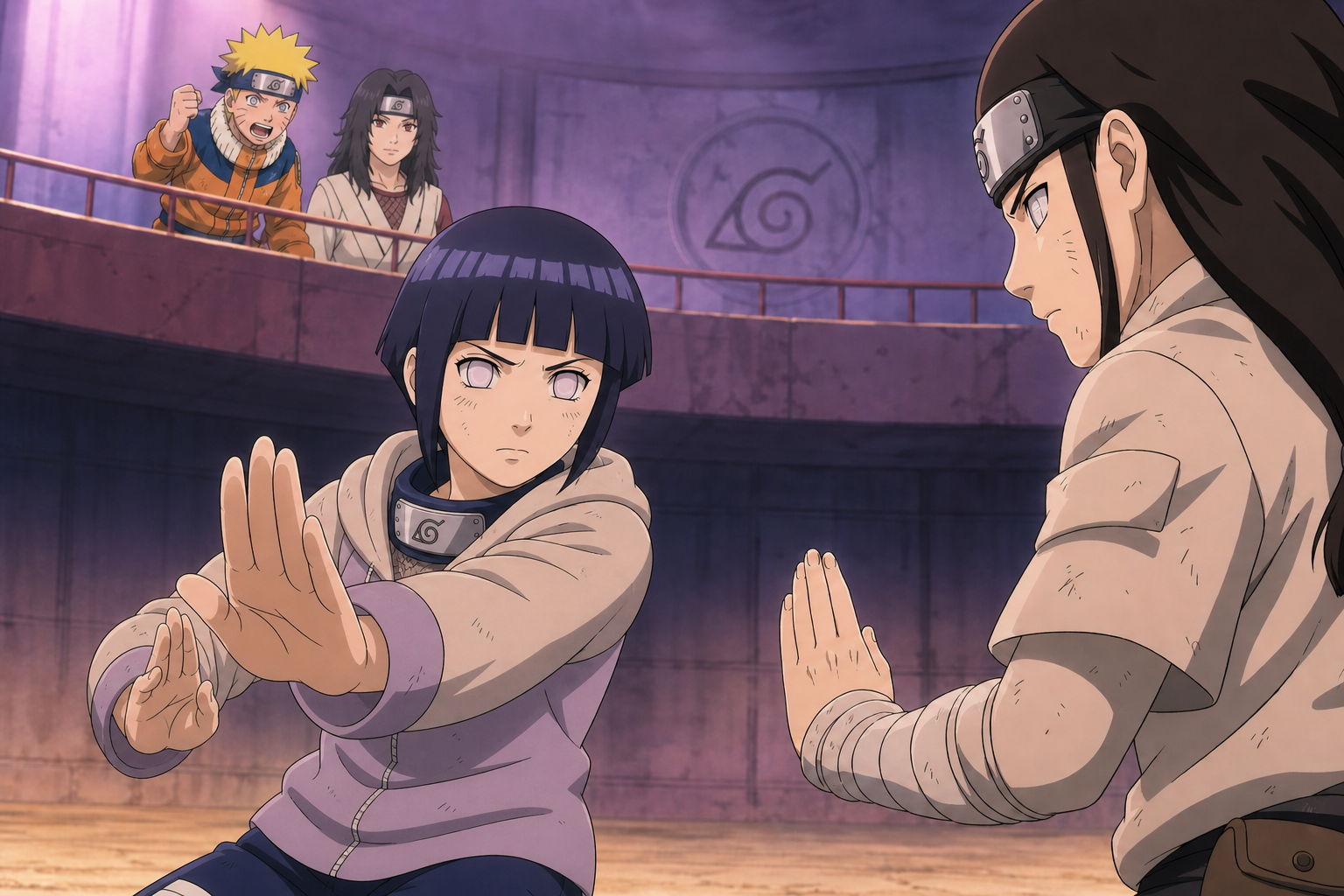
Byakugan Battle: Hinata Grows Bold!
Hinata draws the one opponent who knows exactly where her confidence was broken. Neji does not begin with his palms. He begins with the Hyūga family verdict, using intimate knowledge as a weapon. Naruto cannot fix that history from the balcony, but his loud refusal gives Hinata enough room to choose the fight herself.
Episode 46 is not a shy girl becoming brave because a boy yelled her name. It is a child from the Hyūga main family confronting the branch-family cousin who can read her habits, injuries and family shame because the same institution damaged both of them differently. Naruto’s encouragement matters because it interrupts Neji’s claim that Hinata’s past has already decided her future.
Hinata still has to make the decision. She activates the Byakugan, raises her own hands and enters a Gentle Fist exchange against somebody more experienced. The episode ends before the full physical consequence arrives. Its real action is the moment Hinata stops letting inherited judgment speak as though it were destiny.
The bracket turns family violence into public sport
The eighth preliminary match pairs Hinata Hyūga with Neji Hyūga. The exam presents the pairing as random, but the social meaning is anything but neutral. Hinata belongs to the clan’s main house. Neji belongs to the branch house created to serve and protect it.
Everyone in the arena receives a match. These two receive a family structure made visible through violence. The village can observe the conflict without first asking why children from one bloodline arrive carrying opposite forms of resentment and shame.
The institution calls that evaluation. The Hyūga system calls it hierarchy. Hinata and Neji have to experience it through their bodies.
Neji knows where Hinata learned to disappear
Neji does not need rumors to identify Hinata’s insecurity. He knows the clan, her position and the expectations attached to the main family. His Byakugan can read physical signs, while family history gives him the language to turn those signs into accusation.
He describes Hinata as timid, conflict-avoidant and unable to change. Some observations are accurate. That does not make his conclusion fair. A person can recognize symptoms and still lie about their permanence.
Neji’s cruelty lands because it is intimate. Generic mockery can be dismissed. He speaks with the authority of someone who understands how the family made her afraid.
Psychological attack is part of Neji’s technique shelf
Neji is already one of the strongest genin in the room. He does not need to frighten Hinata to have a physical advantage. He chooses to do it because reducing her will to fight is efficient and because the match activates his resentment toward the main house.
He watches posture, breath and hesitation, then narrates those responses as proof that destiny cannot be changed. The analysis sounds clinical. The purpose is coercive. He wants Hinata to withdraw before her body can produce evidence against his theory.
This is why intelligence and moral authority must not be confused. Neji can read the room beautifully and still use the reading to dominate somebody more vulnerable.
Hinata’s silence was built, not born empty
Hinata has a quiet temperament, but the clan turned quietness into a survival posture. She was evaluated as the heiress, compared against expectations and treated as a disappointment when her disposition did not match the family’s preferred style of command.
Repeated judgment teaches a child to anticipate failure before action. Hesitation then becomes new evidence for the adults who created it. The loop makes oppression look like personality.
Episode 46 lets Neji repeat that logic from another wounded position. His grievance against the main house is legitimate. Using Hinata as the nearest body available for punishment is not.
The main house and branch house are not equal wounds
Hinata suffers under main-family expectations. Neji lives under a branch system that marks his body and limits his freedom for the protection of hers. Those harms are connected, but they are not interchangeable.
Hinata has formal status Neji does not. Neji has skill and confidence Hinata does not. The clan distributes power unevenly enough that each child can appear privileged from one angle and trapped from another.
A useful reading holds both facts without flattening them. Hinata is not the architect of Neji’s bondage. She is also not outside the institution that benefits her position.
Byakugan turns perception into inherited authority
Both fighters activate the Byakugan, the Hyūga clan’s inherited dōjutsu. It expands visual perception, allows users to inspect chakra pathways and supports the precision required for Gentle Fist.
The shared eyes make the family connection visible. Hinata and Neji possess the same bloodline capacity while occupying different political roles. Biology provides an ability. The clan decides whose body will inherit command and whose body will inherit service.
The episode refuses the lazy idea that bloodline automatically produces unity. Shared inheritance can become the terrain on which hierarchy is enforced.
Gentle Fist is intimate violence
Gentle Fist targets the chakra pathway system rather than relying only on visible external impact. A precise palm strike can disrupt internal chakra flow and damage organs. The name sounds soft because the motion can look controlled. The consequence is not gentle.
That makes this family match especially invasive. The fighters can see and reach systems hidden beneath ordinary sight. Neji does not merely know Hinata’s emotional history. His clan training gives him a way to attack the internal network that lets her body function as a shinobi.
The technique turns family knowledge into bodily access. Beautiful form should not distract from what that access can do.
Naruto interrupts a verdict, not a diagnosis
Naruto hears Neji define Hinata as someone who cannot change and immediately rejects the conclusion. He is not qualified to evaluate Hyūga politics, and he does not understand the full branch-house grievance yet.
What he recognizes is the sound of a fixed public identity. Adults and classmates spent years describing Naruto as failure, nuisance and dead end. Neji’s language points at a different person, but the structure is familiar.
Naruto’s intervention matters because certainty has filled the room. He provides contradiction before Hinata has enough confidence to provide it herself.
Encouragement is support, not authorship
Naruto’s voice helps Hinata. It does not own her courage. She has watched him refuse humiliation, recover from loss and keep moving without permission. That long observation gives the current shout weight.
Hinata decides to remain in the arena. She activates her eyes. She takes the stance. She risks the consequences. A boy can matter deeply without becoming the author of a girl’s agency.
This distinction protects the scene from romantic reduction. The crush is present. So are identification, aspiration and the need to prove something to herself.
Kurenai recognizes the danger beneath the posture
Kurenai Yūhi watches her student with concern grounded in knowledge. Team 8’s instructor has seen Hinata’s temperament and progress outside this single bracket moment.
A teacher can want a student to claim agency while still understanding that courage does not remove a skill gap. Kurenai’s concern honors both sides. Hinata’s decision is meaningful, and Neji remains dangerous.
Good mentorship does not confuse encouragement with a guarantee. It helps the student act while staying awake to consequence.
Team 8 has been teaching Hinata another relationship model
Kurenai, Kiba and Shino give Hinata a team identity outside the Hyūga household. Their specialties differ, but the team depends on observation, tracking and coordinated support.
That daily structure offers something the clan failed to provide consistently: a place where Hinata contributes without carrying the entire symbolic burden of heirship. Her growth does not begin when Naruto speaks in Episode 46. It has been accumulating through missions, teammates and survival.
The arena makes the change visible. The work happened before the spotlight arrived.
Neji’s destiny argument protects him from uncertainty
Neji insists that people cannot escape the nature and position assigned to them. The belief reflects real evidence from his life. A branch-family child cannot simply decide the seal and duty structure no longer apply.
He extends that institutional truth into a total theory of personhood. If every person is fixed, then his own suffering becomes inevitable rather than the result of choices made by powerful relatives and village traditions.
Fatalism can protect a wounded person from hope because hope creates another risk of disappointment. It can also become permission to wound others before they challenge the theory.
Hinata’s boldness is small enough to be honest
The title says Hinata grows bold, but the episode does not transform her into a loud extrovert. She remains visibly afraid. Her body still carries hesitation. Boldness means acting while those signals remain.
That scale matters. Stories often represent growth by replacing a character’s personality with a more socially approved one. Hinata does not need to become Naruto to demonstrate courage.
She needs to make one decision that belongs to her more than it belongs to Neji, her father or the bracket.
The episode ends before courage receives its invoice
Episode 46 establishes the family conflict, activates the Byakugan and begins the Gentle Fist confrontation. It does not contain the entire physical outcome of Hinata versus Neji.
That boundary matters because courage is not a magic defense. Naruto’s support changes Hinata’s willingness to fight. It does not erase Neji’s experience, precision or capacity to close chakra points.
The next episode will show what the decision costs. This episode earns attention by making the decision itself legible before consequence arrives.
Japanese performance separates quietness from emptiness
Nana Mizuki performs Hinata in the original Japanese anime. Her quieter delivery does not leave the character blank. Breath, hesitation and changes in firmness let the audience hear a decision forming before Hinata can present it as confidence.
Kōichi Tōchika performs Neji with controlled certainty. The calm delivery makes the psychological attack more severe because he speaks cruelty as settled fact rather than uncontrolled anger.
Junko Takeuchi gives Naruto’s encouragement the volume of someone who has never accepted that public shame should be handled privately. The three performances create different relationships to certainty: Hinata reaches for it, Neji claims ownership of it and Naruto breaks into the room before either can finish.
A Confucian lens finds hierarchy without reciprocity
Family roles can organize responsibility, care and continuity. The Hyūga structure preserves hierarchy while failing the reciprocal obligations that would make authority ethical.
The main house receives protection from the branch house. The branch house receives bodily control and inherited resentment. Hinata receives status but not secure care. Neji receives training but not freedom.
Respect for family becomes distorted when elders demand duty without answering for the damage produced by their arrangement.
A Buddhist lens questions the self Neji freezes
Neji treats Hinata’s fear as permanent essence. He also treats his branch status as proof that all paths are fixed. Both conclusions cling to identity as something solid and complete.
Hinata’s decision does not abolish history. It demonstrates movement inside history. She remains the child shaped by clan judgment and becomes the person who takes a stance anyway.
Impermanence does not promise equal outcomes. It denies Neji the right to call the current condition eternal.
The clan system converts children into symbols
Hinata is asked to represent main-family legitimacy. Neji is asked to represent branch-family excellence and obedience. Neither child gets to enter the arena as only a person.
Their match carries adult history that adults have not resolved. This is a recurring shinobi-world pattern: institutions inherit conflict downward, then evaluate children by how effectively they carry it.
The Chūnin Exams do not create the Hyūga wound. They provide a stage, an audience and a score.
Fandom misreadings I am rejecting
“Naruto gives Hinata courage.” His encouragement interrupts Neji’s verdict. Hinata chooses, activates the Byakugan and takes the risk.
“Neji is simply jealous.” His resentment grows from a coercive branch-house system. His grievance is real even when his treatment of Hinata is wrong.
“Hinata is privileged, so her pain is fake.” Main-family status gives structural advantage and still allows emotional neglect, comparison and failure pressure.
“Hinata and Neji are equally oppressed.” Their wounds connect but are not identical. Neji’s branch seal and compulsory service create a distinct loss of freedom.
“Gentle Fist is weak because it looks soft.” The style targets chakra pathways and internal systems with precision.
“Hinata becomes a different person.” She remains quiet and afraid. Growth appears through action, not a personality transplant.
What Episode 46 changes
Hinata publicly rejects Neji’s claim that her fear has already decided the match. Naruto’s encouragement helps her convert years of observation into one chosen action.
The series introduces the political split between the Hyūga main and branch families as a living conflict carried by children. Shared Byakugan inheritance does not produce shared power.
The match begins through psychological pressure and Gentle Fist positioning. The physical outcome remains unresolved, preserving the difference between deciding to fight and surviving everything the fight will demand.
RaeRae’s verdict
Neji came to the arena with a bloodline, a family grievance and the confidence of a boy who thinks reading somebody means owning the ending. Sir, a diagnosis is not a deed to the property.
Hinata does not become loud. She becomes unavailable for surrender. That is smaller than a makeover and much harder to fake.
Receipts and official routes
Episode number, licensed English title and official synopsis: Naruto Official Site. Japanese title and original August 20 broadcast record: TV Tokyo. Streaming availability varies by region; use the official options linked from the episode directory.