
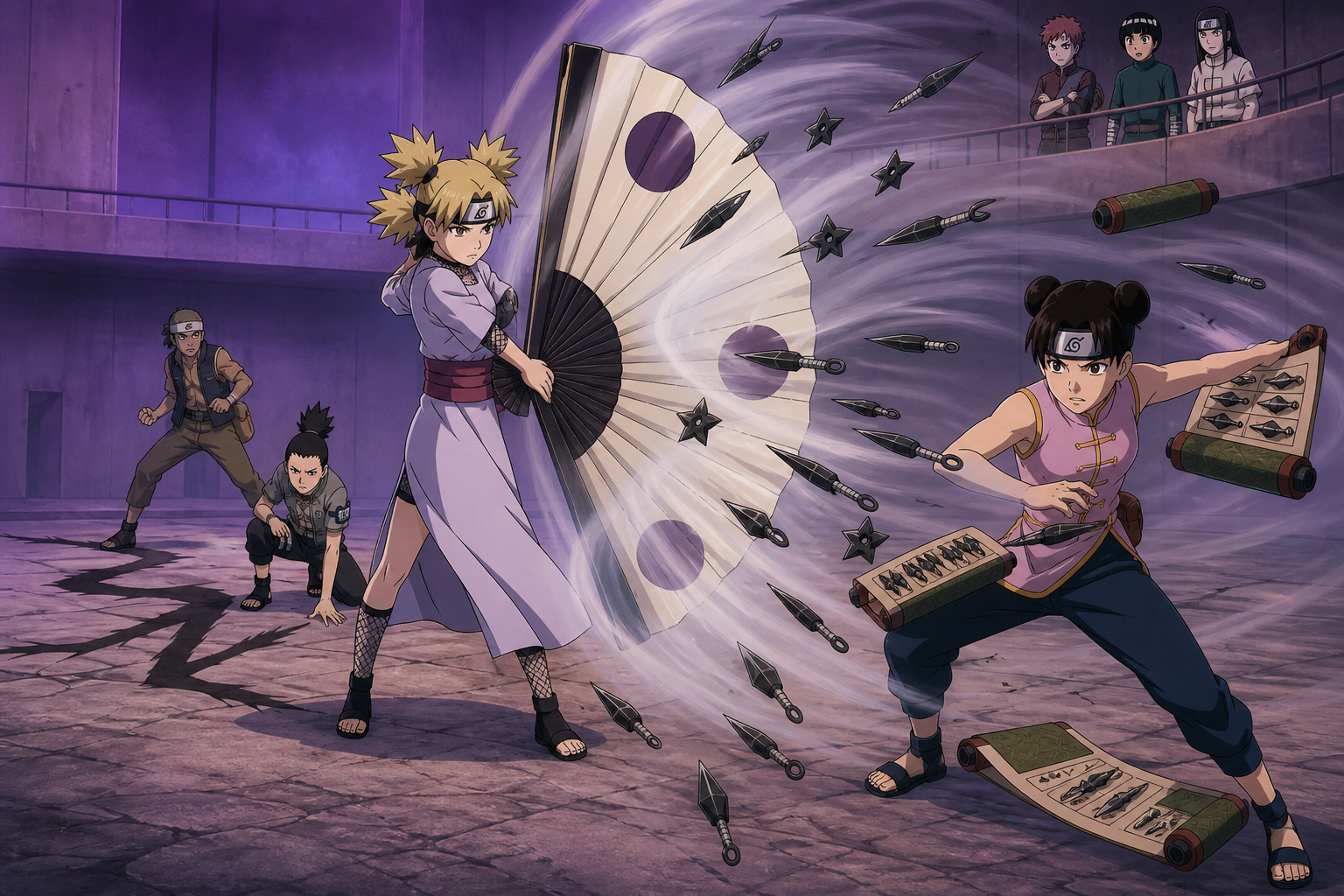
Killer Kunoichi and a Shaky Shikamaru
Tenten brings an arsenal. Temari brings the exact wind wall that makes the arsenal irrelevant. Then Shikamaru wins a mirrored-motion fight by remembering that two people can perform the same movement and hit different walls.
Episode 43 is a two-part lesson in matchup logic. Tenten is skilled, prepared and completely countered. Her weapon control means little against a fan that redirects the entire field before metal reaches its target. Temari does not prove Tenten lacks talent. She proves talent needs a condition in which it can function.
Shikamaru gets the opposite problem. Kin controls sound, needles and the viewer’s attention. He cannot simply overpower her. He uses Shadow Possession to make their movements identical, then weaponizes the one thing the jutsu does not equalize: position. Kin’s head meets the wall behind her. Shikamaru’s meets empty air. Same motion, different consequence. That is the good nerdy stuff.
Tenten enters as a specialist, not a background prop
Tenten has built her combat identity around weapons, accuracy and scroll storage. She can summon a varied arsenal without carrying every blade openly on her body.
That style requires more than throwing hard. She needs placement, timing, control of multiple trajectories and the sealing knowledge needed to store and release tools from scrolls.
The preliminary gives her a real chance to display that range. It also gives her the opponent least interested in respecting the usual value of projectiles.
Scrolls turn logistics into combat speed
A weapon user normally faces a carrying problem. More tools increase options and weight. Storage scrolls change the equation by compressing an arsenal into portable sealed space.
Tenten’s technique therefore represents infrastructure. Her visible attack depends on preparation, inventory, sealing and practiced release patterns.
That is not less “ninja” than an elemental blast. It is shinobi labor expressed through equipment rather than bloodline spectacle.
Temari’s fan controls the medium around every weapon
Temari uses an enormous folding fan marked with three moons. Opening the fan changes the scale and power of the wind she can produce.
The fan does not need to strike each kunai. It moves the air surrounding all of them. Tenten attacks objects; Temari controls the medium carrying the objects.
That is why the counter looks absolute. Every additional projectile gives the wind more metal to redirect rather than increasing the chance of contact.
A complete counter is not proof of complete incompetence
Tenten loses decisively. The result is real. So is the matchup.
If the audience only records winner and loser, Temari becomes strong and Tenten becomes useless. If we record mechanics, Temari possesses the exact wide-area defense that nullifies Tenten’s current offensive plan.
Skill evaluation needs conditions. A locked door does not prove every key is badly made. It proves this key does not fit this lock.
Temari reads the fight before Tenten changes it
Temari recognizes the projectile pattern and trusts her fan. She does not panic as the weapon count rises because the governing counter remains the same.
Tenten continues escalating the arsenal, hoping volume will overwhelm defense. The strategy makes sense against limited blocking capacity. Temari’s defense is environmental rather than item-by-item.
The fight shows the danger of improving the quantity of an answer after the opponent has already invalidated its category.
The Sand siblings keep advertising complementary power
Kankurō demonstrated deception and puppetry. Temari demonstrates ranged control and battlefield scale. Gaara carries automatic defense and lethal sand.
The three siblings make Sunagakure look versatile, which serves the Chūnin Exams’ political purpose as a display of village military strength.
Konoha sees one of its weapons specialists neutralized without Temari needing to reveal every layer of her arsenal. That is useful intelligence for allies and rivals watching from the balcony.
Tenten’s defeat exposes the story’s investment gap
The anime can show a dramatic weapon spread, but Tenten receives less interior setup than many classmates. Her loss therefore risks becoming her defining receipt.
This is partly a writing-allocation problem. Viewers know why Lee must prove taijutsu and why Neji believes in fate. Tenten’s ambition and training receive less narrative space before the bracket asks us to evaluate her.
Fandom then treats the absence of authorial attention as evidence that the character contains nothing. Baby, those are different failures.
Gendered power scaling punishes her twice
Tenten loses to another girl, so the match cannot be dismissed through the lazy claim that male physiology alone decided it. Some viewers respond by dismissing both.
Temari’s wind control is elite matchup power. Tenten’s preparation is real. The decisive result does not require either woman to be unserious.
Women in battle anime often receive less patience for specialized limits. A male character with a bad matchup gets analysis. A girl gets a meme. I am declining that invitation.
The next match looks like effort versus inconvenience
Shikamaru Nara would rather avoid unnecessary work. Kin Tsuchi enters prepared to exploit that apparent laziness.
Shikamaru’s complaint is not lack of intelligence or skill. It is a motivational economy. He calculates effort and resents spending it on systems he does not value.
The exam forces him to show whether reluctance survives contact with responsibility.
Kin uses sound to create false certainty
Kin’s senbon carry bells and hidden auditory tricks. The visible bell suggests one source of sound while threads and additional cues complicate where the attack is coming from.
Sound is useful because closing the eyes does not solve it. A fighter can know deception exists and still react to a signal before conscious analysis catches up.
Kin’s technique attacks attention. She wants Shikamaru tracking the wrong relationship between needle, bell and direction.
Shikamaru’s shadow needs contact, range and geometry
The Shadow Possession Technique extends Shikamaru’s shadow across surfaces. When it connects to a target’s shadow, the target mirrors his movement.
The jutsu does not teleport control. Lighting, distance, shape and available path matter. Shikamaru therefore treats the arena floor as a diagram.
His clan technique supplies the rule. His intelligence decides how to turn that rule into consequence.
He uses the environment as part of the shadow path
Shikamaru finds ways to extend and disguise the route of his shadow instead of sending an obvious line straight at Kin. The arena and objects around them become part of his reach.
This is the opposite of Tenten’s problem. Temari controls the environment to erase incoming tools. Shikamaru recruits the environment to expand a limited technique.
Neither match is only about personal power. Space is an active participant.
Mirrored movement does not create mirrored consequence
Once Shadow Possession lands, Kin must copy Shikamaru’s movement. That sounds like symmetry.
Shikamaru positions them asymmetrically. A wall stands behind Kin while he has open space behind him. When both throw their heads backward, only Kin strikes the wall.
The finishing move is not stronger motion. It is unequal context attached to equal motion. That is an entire strategy lesson hiding inside slapstick geometry.
Kin loses because she reads laziness as emptiness
Shikamaru’s posture and complaints encourage opponents to underestimate his investment. Kin sees reluctance and mistakes it for a shortage of plans.
He uses that expectation. The less threatening he appears, the more time he has to construct the board.
Laziness remains a real flaw when other people need him. In combat, the persona also becomes camouflage for concentrated effort.
The Sound genin keep paying for Orochimaru’s economy
Kin, Zaku and Dosu entered as tools inside Orochimaru’s operation. Their techniques are dangerous, but their employer’s real interest is Sasuke.
Each Sound candidate fights for advancement inside a structure that never promised reciprocal care. Victory might prove usefulness. Defeat makes replacement easier.
Kin’s loss is therefore personal and institutional. She fails a match while serving an adult who designed subordinates to be disposable.
Japanese performance separates confidence from contempt
Romi Park performs Temari in the original Japanese anime with control that makes the fan feel like an extension of judgment. The scene does not need frantic exertion because Temari understands the counter.
Yukari Tamura gives Tenten focus and escalation rather than comic panic. Shōtarō Morikubo gives Shikamaru his familiar reluctance while letting calculation sharpen underneath it.
Akiko Koike performs Kin with confidence grounded in a real sensory trick. The loss does not require turning her into a shrieking caricature.
Direction makes the two matches visually opposite
Tenten and Temari fill the frame with motion. Metal spreads, air sweeps and the fan claims space.
Shikamaru and Kin turn attention toward small cues, floor distance and placement. The decisive weapon is a line of darkness and a wall.
The episode moves from spectacle to geometry without treating either as less legitimate combat intelligence.
A Confucian reading values mastery of role and tool
Tenten, Temari, Kin and Shikamaru each bring a practiced specialty inherited from teachers, clan or village culture.
Mastery is not possession of a tool. It is judgment about when and how the tool serves the situation. Temari and Shikamaru demonstrate that judgment most completely.
Rank should evaluate responsibility and adaptable thinking, not only the size of visible output. Episode 43 makes that principle legible.
A Buddhist lens sees attachment to one answer
Tenten keeps increasing weapon volume after wind has invalidated the attack category. Kin remains attached to her reading of Shikamaru as lazy and manageable.
Temari and Shikamaru appear more flexible because they respond to conditions rather than defending one preferred image of themselves.
Nonattachment in combat does not mean passivity. It means releasing the answer that reality has already disproved.
The exam records outcomes and hides development needs
The bracket records Temari and Shikamaru as winners. It does not record what Tenten or Kin would need to change. A promotion tournament filters people; it does not automatically educate them after the filter.
Tenten needs options that do not depend entirely on free projectile travel. She could vary range, change release timing, use wire or traps, force enclosed terrain, or develop ways to interrupt the fan before Temari establishes wide-area control. The loss identifies a design problem in her current kit. It does not prescribe retirement.
Kin needs a plan for opponents who can work through auditory confusion and control movement after contact. Her sensory deception earns initiative, but initiative is not the same as a finish. A serious training system would turn both losses into curriculum. The exam mostly turns them into elimination.
Temari and Shikamaru win before the finishing motion
Temari’s visible finish comes after she has already established control of distance and airflow. Shikamaru’s backward head movement comes after he has already arranged the wall, shadow connection and relative positions.
This matters because viewers often mistake the last motion for the entire technique. The dramatic beat is only the collection point for earlier decisions.
Chūnin judgment should care about that invisible sequence. Squad leadership requires reading conditions before subordinates pay for them. Temari and Shikamaru demonstrate command thinking even while their personalities could not look more different.
What Episode 43 changes
Temari defeats Tenten decisively and advances, establishing her fan as a major wide-area counter and strengthening the Sand’s public showing.
Shikamaru defeats Kin through Shadow Possession, environmental geometry and asymmetric positioning. He advances despite his reluctance.
The preliminaries continue separating raw technique from tactical judgment. A strong specialty needs a usable condition and a fighter able to recognize when that condition has changed.
RaeRae’s verdict
Tenten threw the whole cutlery drawer, and Temari controlled the air the drawer had to travel through. That is a brutal counter, not proof that Tenten forgot how weapons work.
Shikamaru winning because Kin had a wall behind her is so petty and so intelligent. Same head movement. Different real estate. Case closed.
Fandom misreadings I am rejecting
“Tenten is useless because Temari shut her down.” One wide-area wind specialist perfectly counters her current arsenal.
“Temari only wins because her fan is overpowered.” She reads the matchup, controls scale and refuses the opponent’s preferred condition.
“More weapons should eventually break through.” Volume does not solve a counter operating on the surrounding medium.
“Shikamaru wins through plot armor.” The finish follows the explicit mirrored-motion rule and positional asymmetry.
“Kin was fooled because she is stupid.” She has a functional sensory deception and misreads the opponent’s motivation.
“Quiet matches are less technical.” Geometry, attention and environment carry the second fight.
Receipts and official routes
Episode number, English title and official synopsis: Naruto Official Site. Japanese title and original broadcast record: TV Tokyo. Streaming availability varies by region; use the official options linked from the episode directory.