
Wuxia vs Xianxia: The Swords Look Related. The Universes Are Not.
Both genres can hand one beautiful person a sword, place them on a mountain, and ruin their love life. That does not make them interchangeable. The real difference lives in what kind of world the story believes in, what power can do, and what the hero is trying to become.
The short answer
Wuxia, 武侠
Wu concerns martial force or martial skill. Xia is the chivalric figure who acts according to a moral code that may conflict with official law. Wuxia asks what a skilled human owes other people inside a damaged social order.
Xianxia, 仙侠
Xian points toward transcendent or immortal beings. Xianxia combines the heroic language of xia with worlds shaped by cultivation, cosmology, spirits, divine bureaucracy, reincarnation, and the possibility that a human body can become something else.
The useful distinction: wuxia is organized around the martial hero and the human world. Xianxia is organized around transformation beyond ordinary human limits. Neither sentence is a prison. Chinese genre fiction has been blending traditions since long before streaming platforms needed tidy menu labels.

Wuxia is not simply “realistic martial arts”
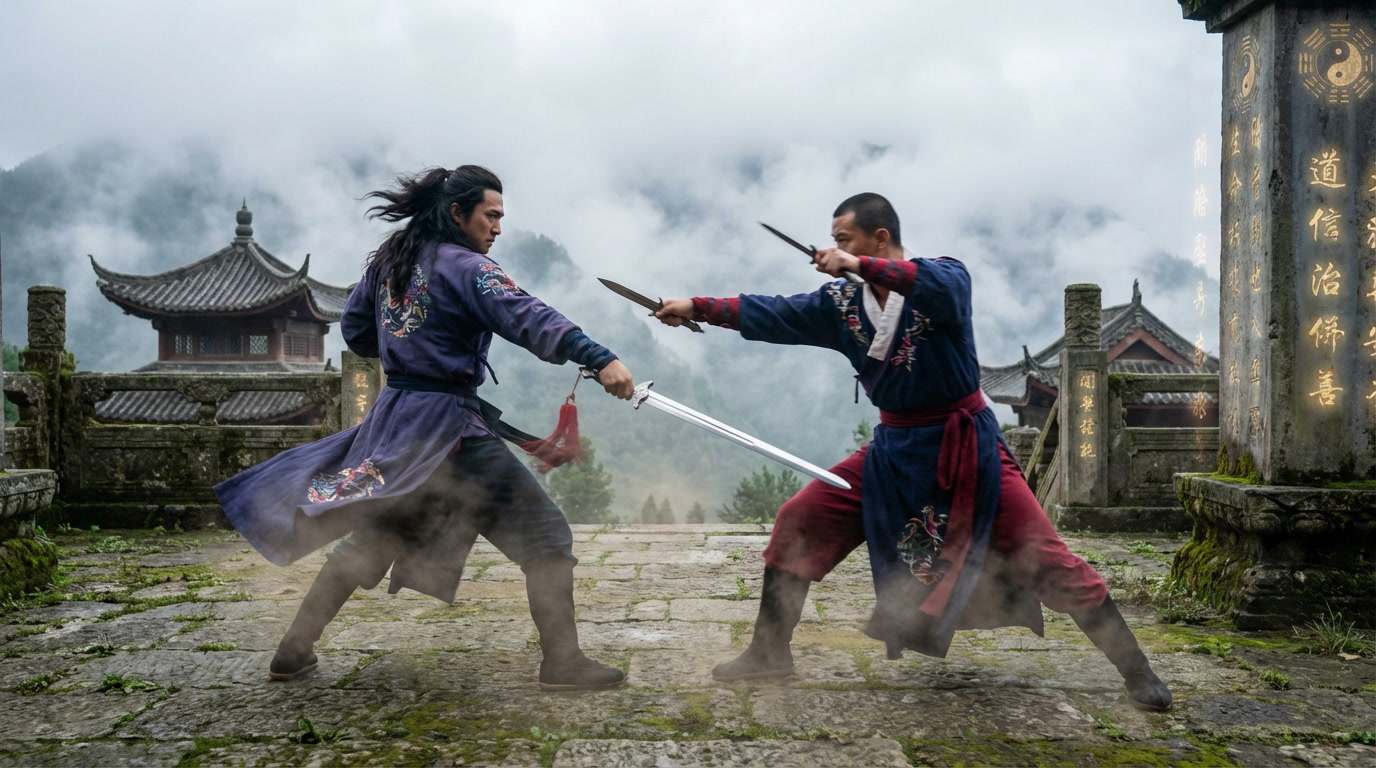
The old version of this page said wuxia has no magic and stays realistic. That is too neat. Wuxia often uses heightened bodies, internal force, pressure-point techniques, impossible leaps, qinggong, secret manuals, and masters who can hear trouble from a suspicious distance. The action may be physically impossible. The story still treats the characters as human beings moving through a recognizably human society.
The genre’s emotional engine is xia. A xia may protect the weak, repay a debt, avenge a teacher, keep an oath, or reject a corrupt court. Those decisions build reputation inside jianghu, the social world of travelers, fighters, sects, performers, healers, outlaws, escorts, and people whose obligations do not fit comfortably inside state institutions.
Helena Yuen Wai’s study of jianghu is useful here because it shows how “rivers and lakes” functions as more than scenery. It is a cultural and literary space shaped by movement, marginality, moral choices, and social networks. Wuxia heroes do not need to be ordinary. They need to remain answerable to a human field of loyalties and consequences.
Xianxia is not merely wuxia with better special effects
Xianxia draws from a much wider reservoir: stories of immortals, Daoist ideas and practices, religious cosmologies, Buddhist concepts, folklore, strange-tale traditions, gods, demons, alchemy, talismans, reincarnation, and modern fantasy systems. A cultivation novel may turn those materials into ranks, resources, sect economies, examinations, heavenly tribulations, or an entire interrealm bureaucracy that desperately needs a competent accountant.
The Stanford Encyclopedia of Philosophy notes that Daoist ideas of longevity and immortality have never meant only one thing. Liberation may appear as union with the Dao, ascension, celestial office, bodily transformation, or an indefinitely extended life. Xianxia fiction borrows and remixes this history. It should not be mistaken for a documentary about Daoist religion.
That distinction matters. A webnovel’s numbered cultivation realms may be the author’s invention. A flying sword may carry older literary associations while serving a thoroughly modern action plot. A heavenly tribulation can be religiously flavored, narratively convenient, economically gamified, or all three before breakfast.
Why the genres keep borrowing each other’s clothes
Wuxia and xianxia share vocabulary because both grew inside Chinese literary and visual traditions rather than in sealed laboratory jars. They may use sects, masters, disciples, swords, qi, martial techniques, vendettas, cultivation, jianghu language, dynastic aesthetics, and historical allusions. Adaptations complicate matters further. A television drama may soften a novel’s supernatural material, while a game may turn a wuxia technique into a visible energy effect because invisible internal force is difficult to sell in a trailer.
Modern Chinese fantasy is also industrial. A study in the International Journal of Asian Studies describes contemporary fantasy media as a recognizable film, television, and animation field whose landscapes and immortal tropes are reshaped by digital production and modern social realities. In other words, “it has clouds” is not a genre test.
| Question | Wuxia usually emphasizes | Xianxia usually emphasizes |
|---|---|---|
| What is the protagonist? | A human martial hero, outlaw, guard, wanderer, disciple, or court-adjacent trouble magnet | A cultivator, reincarnated soul, immortal, spirit, demon, deity, or human trying to cross those boundaries |
| What limits power? | Training, lineage, technique, injury, politics, reputation, and the human body | Realm, aptitude, spiritual resources, karmic or cosmic rules, tribulations, artifacts, and authorial audacity |
| Where does conflict live? | Jianghu, family, sects, local society, court politics, and moral obligation | Mortal and immortal realms, cosmic orders, reincarnated lives, divine institutions, and competing paths to transcendence |
| What does victory mean? | Justice, loyalty, survival, restored honor, protected community, or choosing the least terrible oath | Breakthrough, transformation, freedom from mortality, cosmic balance, mastery, or discovering that immortality did not repair anyone’s personality |
The RaeRae five-question genre test
- If all the immortals vanished, would the main story still work? If yes, you may be closer to wuxia. If the cosmology collapses with them, xianxia is doing structural work.
- Can power change what kind of being someone is? Becoming immortal, reincarnating across species, refining a divine body, or ascending to another realm strongly points toward xianxia.
- Is jianghu the world, or only the starting neighborhood? Wuxia often remains inside its human social network. Xianxia may leave the mortal world behind.
- Does morality operate socially or cosmically? Wuxia consequences often arrive through people, institutions, debts, and reputation. Xianxia may add karma, fate, heavenly law, or metaphysical backlash.
- What is the story obsessed with? Genre is not decided by one sword. Follow the repeated questions, systems, and stakes.
RaeRae take: If somebody jumps onto a roof, I am not calling the genre police. If somebody refines their soul for three centuries, survives purple heavenly lightning, and wakes up as a crane with a tax problem, we have crossed the line.
Research notes and sources
- The Development of Chinese Martial Arts Fiction, Cambridge University Press excerpt. Useful for the literary development and debates around wuxia fiction.
- Helena Yuen Wai, “A Journey across Rivers and Lakes”. A detailed study of jianghu as cultural and literary space.
- Stanford Encyclopedia of Philosophy, “Religious Daoism”. Especially the sections on longevity, immortality, celestial ascension, and the many meanings attached to xian.
- “Materializing the digital landscape: the cinema-ecology complex and Chinese fantasy media”, International Journal of Asian Studies. Useful for understanding modern fantasy production and immortal-world imagery.
Continue the rabbit hole: Read Wuxia 101 · Read Xianxia 101 · Open Novel World 101