
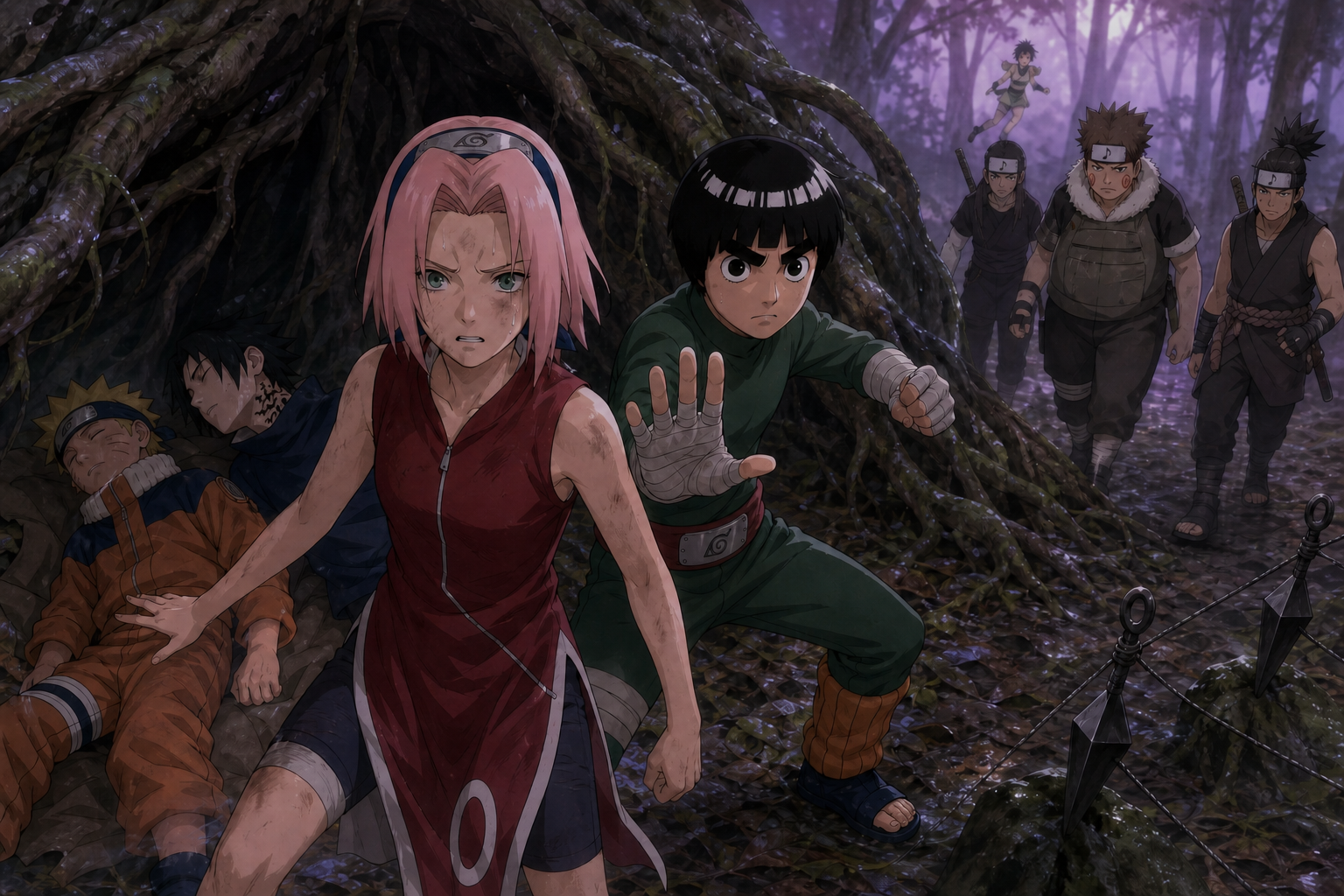
Bushy Brow’s Pledge: Undying Love and Protection!
Sakura spends the night keeping Team 7 alive. The Sound trio comes to collect Sasuke. Rock Lee arrives with a promise, but the episode’s real labor has already been happening beside two unconscious boys.
Episode 31 finally makes visible the work Sakura has been doing while the boys get the dramatic injuries. She stays awake, builds defenses, watches two bodies and holds fear long enough for morning to arrive. Then the Sound genin attack, because Orochimaru’s interest in Sasuke comes with employees.
Rock Lee’s entrance is sweet, ridiculous and brave. It is not the beginning of Sakura’s rescue. Sakura has already been rescuing Team 7 all night. Lee joins her labor and puts his body between the Sound trio and the people they intend to use.
The morning after Orochimaru is not a victory scene
Naruto is unconscious after the Nine-Tails’ chakra was suppressed. Sasuke is unconscious after Orochimaru forced the curse mark onto his neck. Sakura is awake because somebody has to be.
The episode lets exhaustion sit on her face and inside her shaking arms. She did not receive restorative sleep between arcs. She kept watch in a forest designed to reward predation. Every hour she stayed awake was an hour Naruto and Sasuke were not abandoned.
This is the consequence missing from cleaner battle stories. Somebody has to move injured bodies, check breathing, hide a shelter, place alarms and remain alert. Sakura’s work does not make a fire dragon, so fandom often edits it out. The Sound trio does not. They recognize her as the barrier between them and Sasuke.
The traps prove Sakura has been thinking
Sakura uses wires and kunai to create warning systems around the shelter. The setup is not invincible, and the Sound genin are capable enough to test it. That does not make the preparation meaningless. A trap can buy seconds, expose a route or prevent an enemy from walking directly onto an unconscious teammate.
Her Academy knowledge matters here. Sakura has long been presented as academically strong and physically behind her teammates. The forest converts classroom information into practical defense. She cannot overpower three attackers, but she can shape the space before they arrive.
The limits remain honest. Fatigue reduces her reaction time. Fear disrupts her body. Her opponents have specialized techniques she has not seen. The episode does not solve sexism by pretending Sakura secretly had elite combat power all along. It gives value to what she knows and shows why she still needs growth.
Her preparation also exposes what Kakashi’s team structure failed to teach before the exam. Sakura understands theory, but she has received less practical combat investment than the boys around her. Sasuke carries clan techniques and personal obsession. Naruto has shadow clones, abnormal reserves and dangerous sealed power. Sakura enters with sharp control and classroom knowledge but no signature combat system. The forest does not create that gap. It removes the safe conditions that helped everyone ignore it.
The Sound trio are not ordinary examinees
Dosu, Zaku and Kin approach under the Sound Village banner, but their mission serves Orochimaru. They are participants and subordinates at the same time. The exam gives their attack plausible cover while their actual purpose reaches beyond scroll collection.
That makes them young people inside the same exploitation chain as Team 7, though not equally positioned in this scene. They have orders, techniques and confidence. Sakura has two patients. Their own manipulation by Orochimaru explains the labor structure. It does not erase their decision to threaten her.
Orochimaru recruits downward. He identifies vulnerable or ambitious young people, offers belonging and power, then uses them to test other children. The Sound trio are not merely spooky villains with unusual gadgets. They are evidence that his private institution already has a workforce.
Anko reaches Orochimaru and still cannot stop him
Elsewhere, Anko Mitarashi pursues Orochimaru after recognizing the stolen Grass identity. She is a special jōnin with direct knowledge of him. That should make her the best available responder. It still is not enough.
The encounter matters because competence and personal history collide. Anko knows his patterns, but she also carries the curse mark and the memory of having been his student. Orochimaru can address both the officer and the survivor standing in front of him.
Her inability to stop him is not proof that she should have stayed out of the way. It proves the scale of the breach. A major missing-nin entered a youth exam, targeted children and confronted the examiner most equipped to understand him. Konoha’s response arrived after the injury and lacked the force needed to contain the source.
Rock Lee arrives because a promise matters to him
Rock Lee hears the conflict and comes to Sakura’s defense. His crush is obvious, and the title makes the romantic framing impossible to miss. He promised to protect her, so he acts when that promise becomes inconvenient and dangerous.
Lee’s entrance works because it combines comedy with ethics. The bowl cut, eyebrows and self-declared handsome-devil energy are funny. The choice to face three attackers alone is not a joke. He places his body where his words said it would be.
Protection does not make Sakura his possession. She did not accept a romantic contract. Lee’s best quality here is that he helps without requiring affection as payment. The promise tells us who he wants to be, not what Sakura owes him.
Love is not the same thing as entitlement
Anime crushes can age badly when persistence is treated as ownership. Episode 31 mostly avoids that trap because Lee’s action responds to danger rather than rejection. Sakura’s lack of romantic interest does not make her undeserving of help.
Lee also admires Sakura as a person capable of effort. He sees her exhausted and frightened, but he does not tell her to disappear because a man arrived. He joins the defense. The scene is stronger when read as solidarity shaped by affection, not as a prince collecting a future girlfriend.
That boundary matters for Lee too. His worth cannot depend on whether Sakura eventually chooses him. The pledge is meaningful because he acts according to his own value system. If the only reward is keeping people alive, the choice still counts.
Sakura’s care work is shinobi work
The hidden-village system likes visible combat because rank can be attached to victory. Care work is harder to score. Staying awake with injured teammates does not produce a tournament bracket, but missions collapse without it.
Sakura’s vigil combines surveillance, basic field care, resource management and emotional regulation. She is responsible for two teammates who cannot protect themselves. That is leadership under terrible conditions, even if she does not have the title.
The episode also exposes gendered expectations. Sakura is the girl on the team, so audiences can treat caregiving as natural rather than skilled. Nothing about an all-night watch in hostile territory is natural. It is labor, and it costs her strength when the attack begins.
The defense is not clean because exhaustion has consequences
Sakura’s arms tremble. She cannot manufacture full stamina through determination. That detail protects the episode from fake empowerment. Strength does not mean the body stops reporting what it endured.
Lee’s arrival does not erase that consequence either. He is rested enough to fight and trained for close combat. Sakura has been awake caring for two patients. Comparing their immediate output without comparing conditions would be nonsense.
The episode understands that fear can coexist with action. Sakura does not wait to feel confident before resisting. Her body trembles while she keeps herself between the attackers and the shelter. Courage is not a clean facial expression. Sometimes it is an exhausted child making the next defensive choice because nobody else is conscious.
This is where the next episode will deepen the argument. Lee can take the front line, but he cannot permanently absorb every threat. Sakura will still have to decide what protecting the team means when the first rescuer falls.
Reciprocity and the social meaning of a promise
A Confucian lens gives Lee’s pledge weight through enacted duty. Words create expectations, but virtue appears through conduct. Lee does not have formal authority over Sakura. His obligation is self-chosen, which makes the decision to honor it more revealing.
Sakura’s duty is less theatrical and more continuous. She does not announce that she will stay awake until morning. She does it. The episode places Lee’s spoken promise beside Sakura’s quiet practice and asks viewers to respect both.
A Buddhist reading complicates attachment. Lee’s affection can motivate compassionate action, but it can also become suffering if he treats a desired relationship as something he must possess. In this moment, he uses attachment to move toward protection rather than control. That is the healthier direction.
Japanese performance and the episode’s change in center
Chie Nakamura carries the fatigue without turning Sakura into a soft-voiced victim. The fear is audible, but so is the effort to think through it. The episode needs both or Sakura becomes either helpless decoration or an invulnerable rewrite.
Yōichi Masukawa performs Rock Lee in the original Japanese anime. Lee’s sincerity works because the heightened declaration and the physical commitment belong to the same character. The humor does not announce that the feeling is fake.
Hochū Ōtsuka performs Jiraiya elsewhere in the series, but Episode 31’s Orochimaru material belongs to Kujira’s original performance. Her controlled menace keeps the Anko confrontation tied to adult history while the Team 7 scene stays rooted in adolescent danger.
What changes after Episode 31
Sakura becomes the active center of Team 7 because necessity assigns the role. Naruto and Sasuke cannot lead from unconsciousness. The Sound trio makes clear that Orochimaru’s interest will continue through subordinates even after he leaves.
Lee becomes more than the boy who challenged Sasuke in a hallway. He acts on his values when there is no audience, ranking reward or guarantee of success. Anko confirms that the adult threat is real and operating beyond the exam’s control.
The Forest of Death is now running three tests at once: the official scroll hunt, Orochimaru’s private recruitment and the interpersonal test of who protects whom when status stops mattering. Sakura and Lee are the people answering the third.
RaeRae’s verdict
Sakura does not need Lee to make her effort valuable. Lee arrives because her effort has reached its physical limit and three attackers are exploiting it. That is teamwork, not replacement.
The episode’s best move is making protection plural. Sakura protects Naruto and Sasuke through the night. Lee protects Sakura when the Sound trio arrives. Anko tries to protect the entire exam from Orochimaru. Nobody solves everything alone, and the person with the biggest entrance is not the only person doing the work.
Fandom misreadings I am rejecting
“Sakura just sits there until Lee saves her.” Sakura has completed an all-night defensive vigil and placed traps while caring for two unconscious teammates.
“Lee’s protection means Sakura owes him romance.” Help is not a purchase. His action expresses his values, not ownership of her answer.
“The Sound genin are only evil henchmen.” They are responsible for this attack and also operate inside Orochimaru’s exploitation hierarchy.
“Anko fails because she is weak.” She confronts a Sannin-level former teacher whose infiltration already exceeded the exam’s security model.
“Care work is not ninja work.” Surveillance, field protection and keeping incapacitated teammates alive are mission functions.
Receipts and official routes
Episode number, title and official synopsis: Naruto Official Site. Japanese broadcast archive and synopsis: TV Tokyo. Streaming availability varies by region; use the official options linked from the episode directory.