
The Forest of Death
Anko takes a promotion exam, adds theft, isolation, hunger, predators, and possible death, then calls “do not die” advice. The Hidden Leaf really looked at three-person teams of children and said the written test was too gentle.
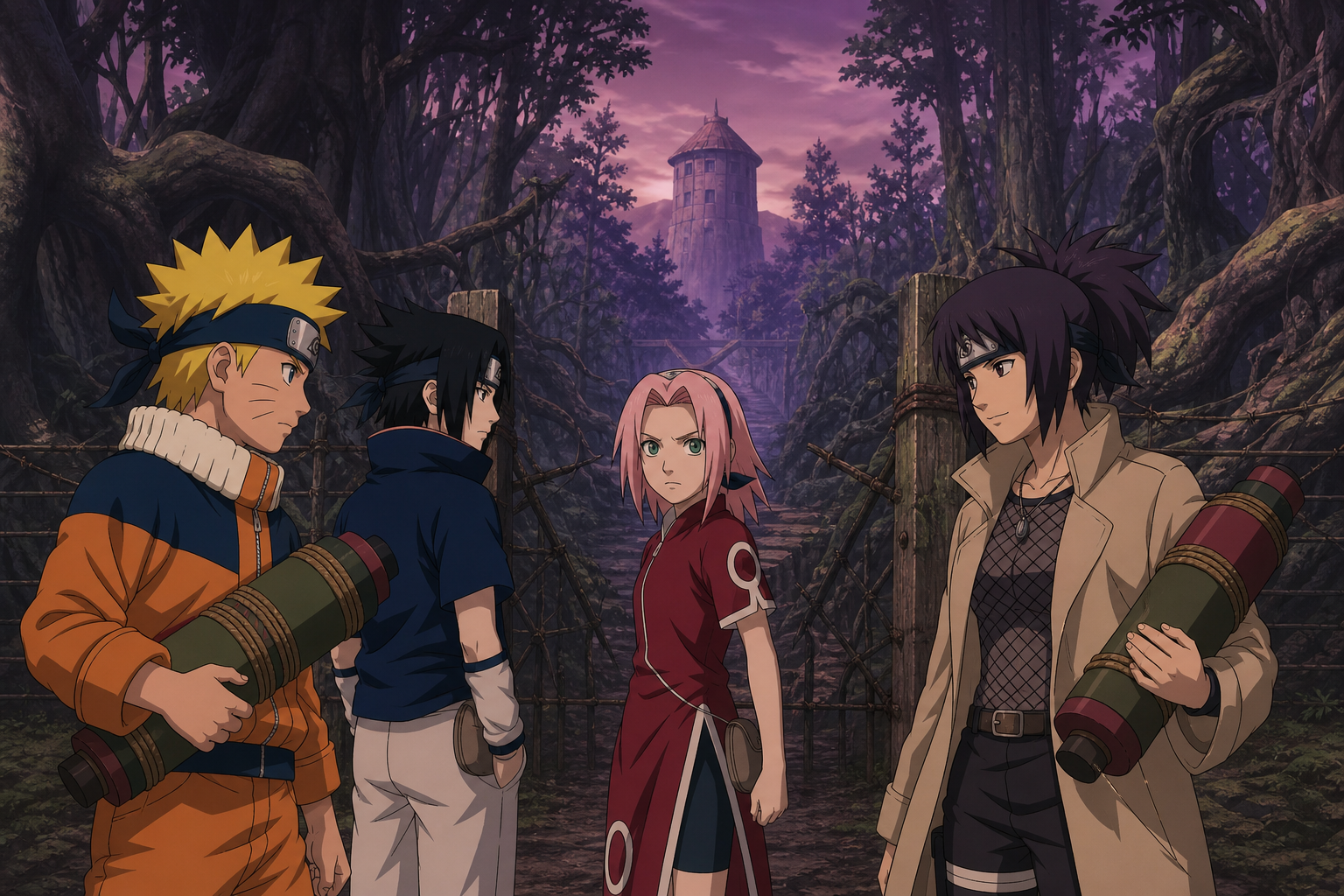
After the recap, the exam finally opens its mouth
The Japanese broadcast paired Episodes 26 and 27 as an hour-long special on April 2, 2003. Episode 26 looked backward through Konohamaru’s student-news framing. Episode 27 moves the surviving teams to Training Ground 44, better known as the Forest of Death. That scheduling history explains why the transition can feel like the real second half of a larger program rather than a completely separate weekly chapter.
There is a tonal reason the pivot works. The first stage tested whether teams could gather information without being caught and whether they could accept an uncertain future without quitting. The second stage takes those ideas outside. Information becomes maps, passwords, scroll types, enemy behavior, food, terrain, and the location of the tower. Uncertainty gets teeth.
Naruto is delighted to survive Ibiki’s psychological trap. He reaches the forest still full of performance energy. Anko answers by introducing a place large enough to swallow that confidence. Her job is not to calm the students. Her job is to make sure they understand that the next five days can kill them.
Scene-by-scene recap and reaction
Anko makes an entrance because subtlety did not apply
Anko arrives at the written-test room by crashing through a window and planting herself between Ibiki and the candidates. The spectacle separates her from Ibiki immediately. He controlled through stillness, rules, and silence. Anko controls through speed, proximity, appetite, and threat. Both proctors turn personality into part of the exam environment.
Her disappointment at the number of remaining teams is funny until we remember what she expected. Anko assumes Ibiki will eliminate more children. She sees a crowded second stage as a problem to correct through danger. This is workplace banter inside a military pipeline, and the children are the inventory.
Naruto challenges her because he cannot let an adult perform dominance without returning the energy. Anko responds with a thrown kunai and a close physical warning. Then the Grass ninja later identified as Shiore returns the weapon with a tongue long enough to make the room file a collective complaint. The moment introduces danger before the gates open. One competitor is already reading Anko, testing boundaries, and showing a body that does not behave normally.
Training Ground 44 is an exam designed as an ecosystem
The Forest of Death is fenced because the danger is not metaphorical. Huge trees, poisonous plants, insects, animals, traps, poor visibility, and hostile teams create a layered environment. The candidates cannot solve it through one specialty. A fighter who ignores food fails. A tracker who cannot defend a scroll fails. A brilliant individual who abandons the team fails the entry condition at the tower.
The official rules are clean. Each three-person team receives either a Heaven Scroll or an Earth Scroll. To pass, it must acquire the opposite scroll from another team and bring both to the central tower within five days. The teams may not open the scrolls before arrival. Loss, theft, and deception are built into the structure.
That makes every team somebody else’s resource. The exam converts peers into targets before anyone commits a personal offense. Manufactured scarcity does the moral work. Give half the teams one object, half the teams another, and make survival depend on taking. The village does not order the children to attack a specific person. It designs a system where attacking becomes rational.
The consent form is doing legal work, not moral work
Anko requires the candidates to sign waivers acknowledging that they may die. The paper lets the institution claim that participants understood the risk. It does not change their age, ambition, family pressure, village loyalty, or the fact that refusing can alter a career. A signature can record consent. It cannot automatically make the power relationship equal.
This is where the episode becomes nastier on rewatch. The Chūnin rank grants status, responsibility, better missions, and leadership opportunities. The villages need competent mid-level shinobi. They also need a way to identify those people under pressure. None of that requires pretending a child’s waiver washes adult responsibility clean.
RaeRae side-eye: if your safety briefing ends with “do not die,” you did not finish the risk-management slide deck. You announced the liability and called it pedagogy.
Team 7 receives the scroll and a new definition of teamwork
Naruto, Sasuke, and Sakura enter as a unit, but the forest will test whether that label has become behavior. The bell test taught them to reject individual reward purchased through a teammate’s exclusion. Land of Waves taught them to coordinate under lethal pressure. The second exam asks whether those lessons survive when the environment rewards suspicion.
Sasuke’s caution becomes immediately useful. Sakura’s memory, control, and ability to read patterns matter in ways raw strength cannot replace. Naruto supplies courage, stamina, improvisation, and enough noise to notify wildlife in three prefectures. The team needs all three skill shapes, which is the point of a cell structure when the story remembers to use it.
The scroll also creates a secret inside the team. They must protect its type, location, and condition. Information discipline becomes survival. Naruto’s instinct is to announce himself. The exam asks whether he can learn that transparency is not always honesty and secrecy is not always betrayal.
The gates open and the adults stay outside
The candidates enter through separate gates, spreading teams across the forest before contact. The physical separation removes immediate witnesses. Proctors establish rules and perimeter control, but the central experience belongs to the genin. This is how the village tests independent operation. It is also how abuse, sabotage, panic, and death can occur without intervention arriving quickly.
The Forest of Death earns its name by withholding reassurance. The first stage kept everyone in one room under visible authority. Here, the authority is environmental and procedural. Anko does not need to stand beside each team. The scarcity rule, time limit, fence, predators, and tower direct behavior from a distance.
That is institutional power at its cleanest and ugliest. The system does not have to shout once the participants begin enforcing its incentives on one another.
What is the exam actually measuring?
Mission intelligence
Teams must understand the objective, protect information, identify targets, read terrain, ration supplies, and decide when combat is worth the risk.
Team integrity
All three members must arrive with both scrolls. A gifted candidate cannot pass alone after treating teammates as disposable weight.
Stress behavior
Fear, hunger, exhaustion, uncertainty, and threat expose habits a classroom cannot. The exam wants to see judgment when the body is no longer comfortable.
Violence management
Candidates must take resources from rivals without spending more strength, time, or blood than the mission requires. Winning every fight is not the same as completing the objective.
Those are legitimate shinobi competencies. The problem is proportionality. A useful assessment can still be reckless. The village behaves as if realism automatically makes a test ethical. Real missions may be lethal, so the exam becomes lethal. That logic skips the adult responsibility to train progressively, protect developing people, and learn from avoidable harm.
Anko is not random chaos in a coat
Anko’s theatrical aggression makes sense for the assignment. She wants the candidates alert before they enter. She uses discomfort to interrupt the confidence produced by passing Ibiki’s stage. Naruto hears “second exam” and imagines another challenge he can overpower. Anko makes the risk physical enough to reach him.
Her style also foreshadows that the forest is personally connected to forces she understands better than the candidates do. Episode 27 does not unload that history yet, so the reaction should not pretend every expression is a complete confession. What we can see is a proctor unusually comfortable with danger and unusually quick to recognize abnormal threat.
She is effective, entertaining, and part of the institutional problem. All three can be true. Fandom often treats competence as moral acquittal. Anko can prepare children well for a harmful structure while still helping the structure continue.
Japanese performance and production boundaries
TV Tokyo’s archive verifies that Episodes 26 and 27 aired together on April 2, 2003 and describes the second half as the start of the survival game. The Naruto Official Site verifies the Heaven-and-Earth scroll rules, central tower objective, expected fatalities, and Anko’s final instruction. Crunchyroll currently lists the episode as Episode 27 with Japanese and English audio availability that varies by region.
Junko Takeuchi is the original Japanese Naruto, Noriaki Sugiyama performs Sasuke, Chie Nakamura performs Sakura, and Takako Honda performs Anko. Those credits are reliable. I am not inventing pitch, timing, or breath analysis without the heard Japanese episode. An accurate credit is criticism’s floor, not permission to hallucinate a vocal waveform.
The episode’s mixed classification reflects the broadcast structure and adaptation use of recap framing around canon story progression. “Mixed” does not mean half the episode is disposable. It tells viewers that adapted manga movement and anime-specific presentation share the slot.
Cultural and institutional reading
The Chūnin Exams are not a private school tournament. Multiple hidden villages send teams into a public demonstration of military talent. Promotion, diplomacy, reputation, and deterrence overlap. Even before later stages bring spectators, the children carry village prestige on their backs.
A Confucian role-ethics lens asks whether authority fulfills reciprocal obligation. Students owe discipline and effort. Teachers and leaders owe cultivation, protection, and moral example. The Forest of Death emphasizes the first side and weakens the second. The village demands mature risk judgment from children while treating potential death as an acceptable sorting cost.
A Buddhist lens brings attachment into focus. Each team can become attached to its current scroll, its plan, its pride, or the idea that retreat equals failure. Survival requires flexibility. Clinging to one strategy inside a changing forest can kill. That does not make ambition wrong. It makes awareness more valuable than ego.
Fandom misreadings that need to stay outside the gate
“The Forest of Death proves the genin are basically adults.” No. It proves the institution gives children adult risk. Responsibility imposed early does not retroactively change developmental age.
“Anko is just crazy.” She is theatrical, dangerous, observant, and professionally suited to a survival stage. Reducing her to chaos erases both competence and the institutional choices she represents.
“The strongest team should win.” The objective rewards information, stealth, alliance judgment, deception, logistics, and timing. A strong team can fail by fighting the wrong battle.
“Signing the waiver makes everything fair.” A form documents risk acceptance. It does not equalize power or remove the village’s duty of care.
RaeRae verdict
Episode 27 works because the rules are simple enough to understand and ugly enough to analyze. Two scrolls, one tower, five days. That structure creates dozens of possible choices without requiring a villain to assign every conflict. The exam itself becomes the antagonist.
I love Anko’s entrance, the immediate shift in physical scale, and the way the forest turns Team 7’s earlier lessons into necessary equipment. I hate that the institution treats death as credible proof of rigor. A hard test and a careless test are not synonyms, no matter how cool the gate looks.
Overall: 8.7/10. The recap-special history makes the transition slightly awkward as a standalone episode, but the survival-game setup is sharp, memorable, and morally rotten in exactly the way the Naruto world needs us to notice.
The Forest of Death makes informed consent impossible
Anko tells the candidates that people may die, then distributes waivers as if a signature can make the institution’s responsibility disappear. These are children entering a controlled examination designed by adults. They can agree to participate, but they cannot fully understand risks the proctors intentionally refuse to disclose.
The form protects the organization more clearly than it protects the candidate. Danger becomes legitimate because it has been documented, not because it has been made proportionate.
The scroll rules reward secrecy before leadership
Teams receive either Heaven or Earth and must acquire the other without opening either scroll. The assignment tests survival, intelligence gathering, combat judgment, and whether a squad can protect information it does not possess in readable form.
It also encourages every team to view strangers as resources or threats. Promotion toward leadership begins through an exercise built around theft, concealment, and controlled betrayal. The contradiction is not accidental. It reflects the profession the villages are preparing them to enter.
Anko’s performance makes danger feel like personality
Anko’s energy is funny, alarming, and deliberately theatrical. She presents the forest as a stage where weak candidates will remove themselves. That performance keeps fear attached to her individual eccentricity instead of the institution that designed the phase.
She did not create the Chūnin Exam, but she knows how to embody its appetite for attrition. The louder she becomes, the easier it is to treat lethal conditions as one unusual adult’s style.
The gate changes teamwork from slogan to material dependence
Inside the forest, Team 7 cannot rely on a teacher stepping between them and consequences. Food, orientation, sleep, information, and the scroll all become shared resources. One person’s panic or ego can expose everyone.
The bell test taught them not to abandon one another. The Land of Waves proved they could act together under threat. The forest now asks whether cooperation can survive when the environment keeps rewarding suspicion.
Naruto’s bravado is preparation and camouflage
He responds to Anko’s threat with noise because noise lets him choose the emotional temperature before fear chooses it for him. The declaration is genuinely brave. It is also a way to avoid admitting that the written exam frightened him and the forest may be worse.
Team 7 needs his refusal to collapse. They also need him to notice when performance makes the group easier to track. Courage must become quieter without losing its force.
Sakura understands the rules beneath the spectacle
Sakura listens, tracks conditions, and recognizes how much the phase depends on decisions that cannot be reversed. Her attention is not glamorous, but it is the team’s protection against Naruto’s impulsiveness and Sasuke’s willingness to pursue danger.
The story often gives her responsibility without equivalent authority. If she warns the boys and they ignore her, she still shares the consequences. Leadership begins when knowledge can alter the group, not merely be correct afterward.
Sasuke enters already vulnerable to the wrong kind of test
Lee’s speed damaged his assumptions about inherited advantage. The exam offers Sasuke a field full of stronger opponents and unknown techniques, which makes it easy to treat every encounter as proof of whether he is advancing toward Itachi.
That hunger can sharpen observation. It can also make a stranger who recognizes the Uchiha name dangerously attractive. The forest contains more than teams seeking scrolls. Sasuke does not yet know somebody entered seeking him.
The exam cannot control the adult threat inside it
Proctors describe rules as if the forest’s danger belongs to weather, animals, and rival genin. Orochimaru’s infiltration changes the category. An adult with private objectives can use the institution’s secrecy and accepted casualties as cover.
The system creates a place where screams, disappearance, and injuries are expected. That makes unauthorized predation harder to distinguish from the official test. The exam’s cruelty becomes a security vulnerability.
The two scrolls turn knowledge into forbidden desire
Candidates must carry sealed information without reading it. The instruction tests restraint because knowing feels like control, especially when the forest provides so little certainty. Opening a scroll promises clarity and may trigger elimination or worse.
The object matters because it asks whether a shinobi can protect a mission from personal curiosity. It also normalizes obedience to secrets whose purpose remains hidden from the people risking their lives to carry them.
RaeRae’s final take
Episode 27 opens the Forest of Death by making danger administrative. Sign the form. Take the scroll. Accept that another team needs what you carry. Walk through the gate and call the result merit.
Anko is entertaining because her menace is honest. The institution behind her is more dangerous because it converts the same menace into procedure. Naruto performs confidence, Sakura reads the conditions, and Sasuke enters with a wound to his pride that somebody else is prepared to exploit.
The forest is not only testing whether Team 7 can survive other genin. It is testing whether they can recognize when the official exam is no longer the most dangerous thing happening inside it.
A waiver cannot transfer every adult responsibility to a child
The signatures make risk visible, but they also create a paper shield for the exam. Candidates are told that entering is a choice even though rank, team loyalty, village expectation, and personal ambition all pressure that choice. Consent under those conditions is real enough to matter and constrained enough to question.
If the institution controls the forest, selects the proctors, admits the teams, and benefits from the results, it cannot make accountability disappear by obtaining names on a form. The document records participation. It does not make every preventable harm the child’s fault.
The forest remains an adult design, even when children agree to enter it.
Watch and verify
Official episode summary and scroll rules: Naruto Official Site. Japanese broadcast structure and date: TV Tokyo episode archive. Licensed viewing availability: Crunchyroll.