
Evangelion Episode Reaction
Evangelion Episode 14: Weaving a Story
A recap becomes an institutional alibi, while Rei supplies the one account NERV cannot file into a clean report.
Bottom Line
The recap is not filler when the institution edits the record
Episode 14 pauses the forward rush after thirteen Angel attacks and asks who owns the story fans have been watching. The first half revisits earlier battles through NERV reports, surveillance images, and SEELE’s interrogation of Gendo. Familiar events return without the children’s fear, pain, or confusion. The official version remembers weapons, targets, damage, and outcomes. Shinji, Rei, and Asuka become pilot data attached to successful operations.
That choice makes the recap matter. NERV has spent the series treating trauma as a technical problem, so the organization naturally tells history as a sequence of technical victories. Angel Attack becomes a deployment record. The Beast becomes a control anomaly. Operation Yashima becomes proof that command planning works. Nobody records what Gendo’s ultimatum did to Shinji, why Rei expected to die, or how Misato keeps using affection beside military authority.
The second half moves away from official narration and gives Rei a fragmented interior monologue. Her thoughts do not arrive as a clean biography because Rei has never been allowed to own a clean self. Images, words, sensation, blood, water, Gendo, and the shape of loneliness pass through her without a stable boundary. The episode places this private uncertainty beside a system that speaks with total confidence.
Then the interchange test gives Shinji access to Unit-00 and Rei access to Unit-01. Unit-00 rejects the arrangement and attacks the observation room. Ritsuko insists the target was probably her, although the Eva’s rage could also reach toward Rei or Gendo. The uncertainty matters more than a tidy answer. NERV built living weapons around buried souls and unresolved relationships, yet command still calls every eruption an equipment failure.
The Recap
Memory changes when command gets the microphone
A television recap can save production time, remind viewers where the story stands, and create breathing room before a new arc. Episode 14 uses those practical functions, but the presentation refuses to behave like a neutral clip show. Battles appear through monitors and formal summaries. The images feel archived rather than remembered. NERV’s language places distance between decision makers and the children who carried every decision inside their bodies.
SEELE’s questions sharpen that distance. The committee wants to know whether Gendo has followed the scenario, especially after the Eleventh Angel’s intrusion into the MAGI. Gendo gives controlled answers and denies facts when denial protects his plan. Fans already know the institution can lie, but the hearing shows how easily lies become history when every powerful participant benefits from the same silence.
The episode therefore divides memory into competing forms. There is operational memory, which records what NERV needs for future battles. There is political memory, which records whatever SEELE can use to judge obedience. There is personal memory, which remains scattered across Shinji’s hospital ceilings, Rei’s injuries, Asuka’s performances, and Misato’s private guilt. Only the first two forms receive official storage.
That imbalance mirrors real organizations. Schools remember attendance and test scores while children remember humiliation. Hospitals record procedures while patients remember fear. Militaries count objectives while survivors carry sounds, smells, and missing people. Data has value, but data chosen by authority can become a way to erase the cost authority created.
Rei
Rei speaks in fragments because her life was built in fragments
Rei’s monologue remains one of the episode’s most important turns. Earlier chapters let other characters interpret her as quiet, obedient, strange, or close to Gendo. Episode 14 briefly removes those observers. Rei tries to describe herself without a dependable language for selfhood. Her thoughts circle around blood, bonds, humanity, and the possibility that the person called Rei may be an arrangement rather than an origin.
The sequence does not solve her mystery. A solution would betray the point. Rei experiences identity as something imposed from outside and barely held together from within. Her name belongs to NERV records. Her body belongs to a program she does not fully understand. Her loyalty to Gendo gives emotional shape to a life designed for use. Even her silence is interpreted by other people before she can decide what silence means.
Visual repetition makes her uncertainty physical. Water suggests birth, suspension, memory, and return. Red suggests blood and the material beneath the franchise’s sterile surfaces. Reflections and empty spaces split Rei from any single image. She does not narrate a past with dates and milestones because the institution denied her an ordinary past.
RaeRae’s verdict on Rei here is simple: obedience does not prove consent when a person was raised without meaningful alternatives. NERV praises reliability because reliability keeps the machinery moving. The organization never asks whether Rei learned to want anything beyond the role prepared for her. Episode 14 begins exposing that cruelty before later revelations explain the mechanism.
Interchange Test
NERV swaps pilots as if identity were another compatible component
The interchange test sounds reasonable within NERV’s engineering culture. If pilots can synchronize with different Evangelions, command gains flexibility during emergencies. The test also reveals the institution’s core fantasy: every intimate bond can be measured, copied, and reassigned. A pilot becomes a signal. An Eva becomes a platform. Compatibility becomes a number that can be improved without discussing why one child connects to one living machine.
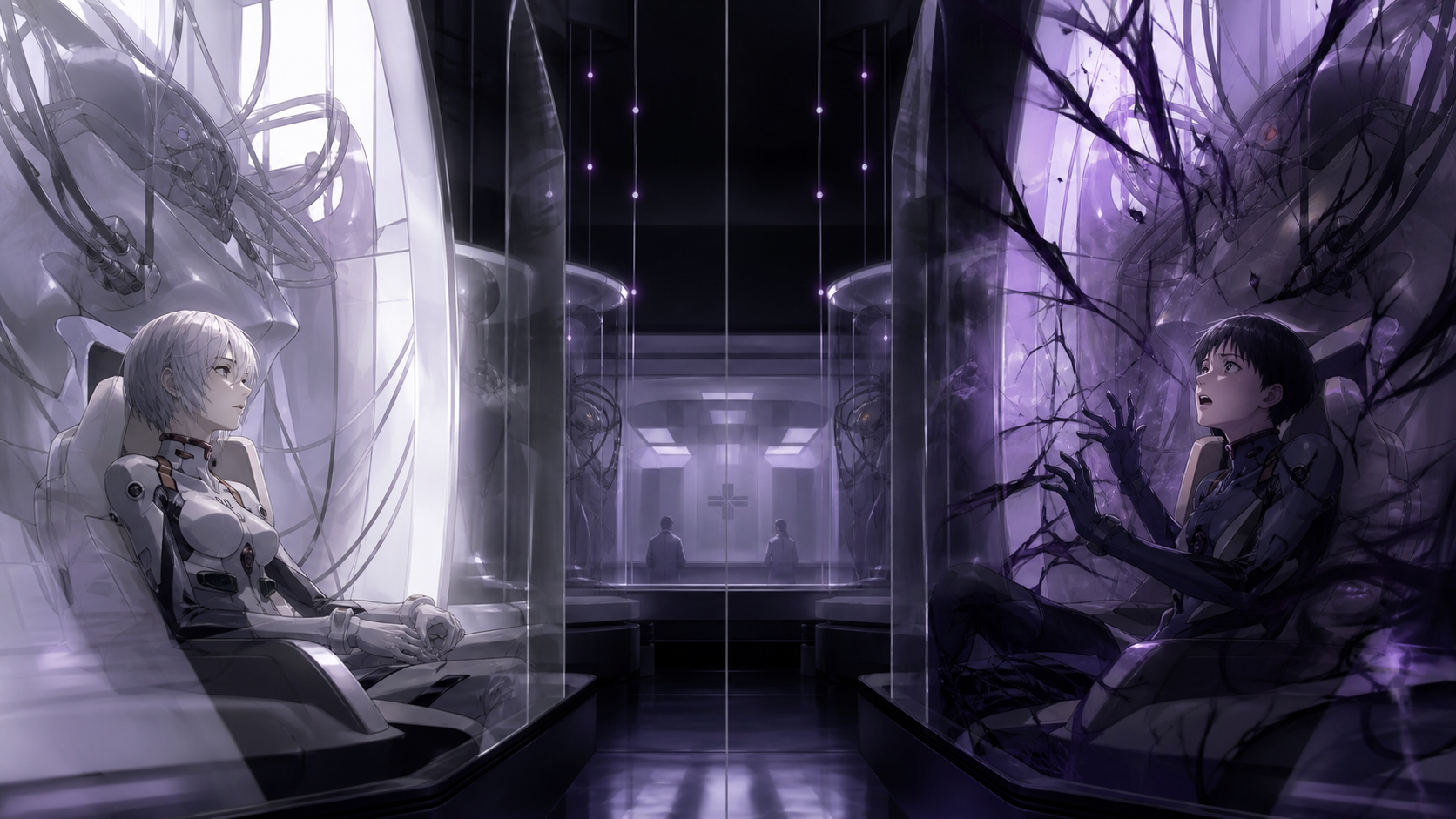
Shinji’s contact with Unit-00 produces discomfort rather than immediate disaster. He senses something associated with Rei, although the impression remains unclear. Rei enters Unit-01, and Unit-00 later breaks containment. The sequence ties bodily memory to machinery while refusing a simple chart of ownership. Every Eva contains more history than NERV admits.
Unit-00’s violence repeats the earlier activation accident but changes the emotional context. Mechanical arms strain, restraints fail, and the Eva attacks the observation room. The adults retreat behind reinforced glass while the pilots remain inside the experiment. NERV once again protects command personnel with structures that cannot protect the children from command decisions.
Ritsuko’s suspicion that Unit-00 aimed for her turns the failure into a family wound. Her mother’s legacy lives inside the MAGI. Gendo controls her professional and emotional world. Rei occupies a place beside Gendo that Ritsuko cannot discuss honestly. Whether Unit-00 recognizes Ritsuko, Rei, or another buried relationship, the attack exposes how personal history contaminates every supposedly objective system in NERV.
Official Records
A clean report can hide a dirty institution
Gendo’s hearing and Ritsuko’s test share the same assumption: authority can manage uncertainty by choosing the right language. Gendo lies through calm denial. Ritsuko labels rage as an activation failure. Both responses preserve operations. Neither response gives the pilots enough truth to understand the danger surrounding them.
The adults are not equally guilty, but every adult works inside a culture that rewards controlled information. Misato wants to protect the pilots while still sending them into battle. Ritsuko wants scientific accuracy while hiding the Eva program’s foundation. Gendo wants Instrumentality and treats every person as material. SEELE wants compliance with a prophecy treated like project governance. Their motives differ, yet secrecy keeps the system intact.
Episode 14 also warns fans about summaries, including this reaction. A summary decides which images become important and which pain becomes background. The honest response is not to avoid interpretation. The honest response is to admit the angle. NERV calls the first thirteen episodes successful defense operations. RaeRae calls them a record of children surviving emergencies designed by adults who refuse to explain the real stakes.
The title “Weaving a Story” fits because stories are constructed from selected threads. SEELE weaves a scenario. Gendo weaves a cover story. NERV weaves battle reports. Rei tries to weave a self from sensations and borrowed language. The episode’s structure makes those acts visible without pretending every storyteller has equal power.
Culture and Structure
The episode turns bureaucratic language into part of the horror
Evangelion arrived during a period when Japanese institutions were under intense public pressure. Economic confidence had cracked, faith in protected systems had weakened, and the Aum Shinrikyo attack had made secretive organizations feel newly terrifying. Episode 14 does not become a direct allegory for one event, but the chapter understands an atmosphere where committees, technical experts, and sealed facilities can produce danger while claiming exclusive authority to define safety.
NERV’s visual language borrows from laboratories, military command rooms, government infrastructure, and corporate hierarchy. Those spaces promise order. The promise feels persuasive because Tokyo-3 faces genuine attacks. The Angels are real, people die, and hesitation can destroy a city. Evangelion’s sharper argument concerns what emergency power permits once fear becomes permanent. Every crisis gives Gendo another reason to withhold information, and every victory makes the withholding look effective.
SEELE adds another layer. The committee does not supervise Gendo for the public good. SEELE protects a private scenario and measures NERV against hidden goals. Oversight therefore becomes theater between competing elites. The public, the pilots, and most employees remain outside the room. Episode 14 presents governance as an argument among people who already agreed ordinary lives do not deserve the full truth.
Rei’s monologue cuts through that institutional confidence because her body carries the consequences of secret planning. She cannot separate personal identity from the project that manufactured her circumstances. Her questions about the self are philosophical, but they are also political. A person denied history, family, and informed choice will struggle to describe freedom because the system removed the reference points freedom requires.
The chapter’s form joins those ideas. Reused images belong to the official past. Rei’s new images resist easy classification. The interchange test tries to convert intimate connection into transferable performance. Unit-00 answers with violence. A bureaucracy can rename that answer as malfunction, yet the audience has already seen enough to recognize a protest buried inside the machine.
That protest also changes the meaning of the earlier recap. The first thirteen episodes looked like a march from one defeated Angel to the next. Unit-00 proves the larger danger was never limited to creatures outside the walls. NERV cannot create an obedient weapon by burying a human history and calling the result hardware. The same warning applies to the pilots. Adults can train children to follow commands, but suppressed fear, grief, and anger do not disappear. Those feelings wait inside the system until restraint fails.
Verdict
Quiet, strange, and necessary
Episode 14 will feel slower to fans waiting for another Angel battle. That slowdown has purpose. The recap marks the end of the series’ first major movement, while the new material shifts attention from external threats toward the bodies, memories, and institutions beneath the battles. The franchise is preparing to make every victory feel less secure.
The strongest material belongs to Rei and Ritsuko. Rei gains an interior voice without becoming easy to explain. Ritsuko gains another reason to look at NERV as family history disguised as professional duty. Unit-00’s attack connects their stories through uncertainty, jealousy, inheritance, and the possibility that living machines remember what people suppress.
The weak point is unavoidable: extended reused footage can still test patience. Viewers watching several episodes in one sitting do not need the same reminder that weekly audiences needed in 1996. The political framing and second-half material keep the chapter from becoming disposable, but the balance remains uneven.
RaeRae’s bottom line: do not skip Episode 14. The chapter teaches fans how Evangelion wants to be read from this point forward. Battles are records, records are arguments, machines are relationships, and silence is never empty. NERV has been weaving a story about competent adults saving humanity. The children, the Evas, and the hidden history are about to tear that story open.
Continue the route: Return to Evangelion Episodes 1–26, revisit Episode 13, or watch on Netflix.