
ASCENDANT SKIES · WORLDBUILDING LAB
Heavenly Descent Weakening Rule
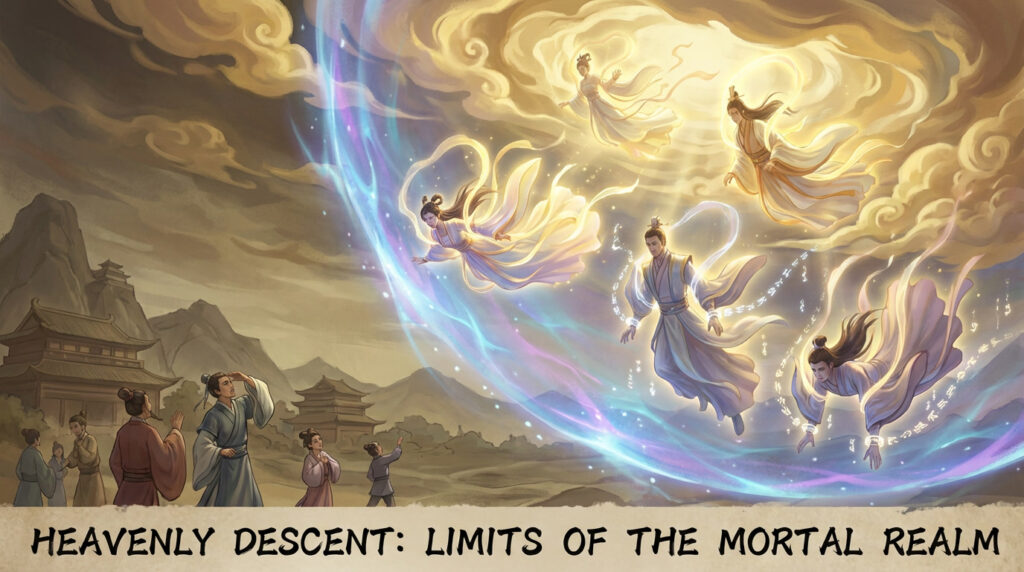
A god arriving in the mortal realm should feel terrifying. It should not end the book in three pages. This is the rule I built to keep celestial characters dangerous without letting them flatten every mortal problem by existing near it.
First, this exact rule is mine
Heavenly Descent Weakening Rule and 落凡约束 are CVM Sekai worldbuilding labels. They are not the name of a standard doctrine from Daoism, Buddhism, Chinese mythology, or Journey to the West. Chinese stories do contain heavenly bureaucracy, mortal incarnations, sealed power, banishment, tribulations, divine offices, local gods, and beings whose authority changes with place or status. Modern cultivation fiction also loves realm pressure and laws that restrict higher beings.
I am borrowing those ingredients. The fifteen-level math and the specific suppression mechanics belong to Ascendant Skies. That line matters because “inspired by Chinese mythology” is not permission to invent a chart and call it ancient.
The actual rule
A higher realm contains denser qi and can support bodies, weapons, and authorities that the mortal realm cannot safely hold. When a celestial being crosses down in person, the mortal realm pushes back. The traveler must compress, seal, divide, or redirect power until the body and surrounding land stop threatening each other.
The restriction begins at the boundary and grows harsher when the visitor uses power openly. A celestial can hide for years by staying quiet. The moment they tear open the sky, the realm notices.
What the mortal realm can suppress
Output
The obvious one. An attack that could split a heavenly fortress may become a strike that destroys one mortal compound. Still awful for everybody in the compound.
Regeneration
A celestial body may heal slowly, require local qi, or fail to replace damage while compressed. An immortal who cannot die easily can still spend months painfully unavailable.
Perception
Higher senses lose range or clarity. That gives mortals room for concealment, formations, decoys, and the ancient tactical art of lying to somebody stronger.
Authority
A title recognized in Heaven may not carry the same permissions on mortal soil. The visitor can retain rank while losing direct command over weather, law, spirits, or fate.
Qi access
The mortal environment may replenish power too slowly. Every large technique becomes an expense instead of a casual gesture.
True form
Some bodies are simply too large, too dense, or too strange to manifest. The being must use a reduced form, vessel, or projection.
How celestials get around the rule
Heaven does not send every official down in their full body. It uses methods that reduce the strain and, conveniently, create better plot problems.
- Avatar: a deliberately limited body carrying part of the original mind and authority.
- Incarnation or rebirth: a celestial enters mortal life and develops inside mortal laws. Memory may return before power does.
- Possession or borrowed vessel: fast and ugly. Compatibility, consent, damage, and identity become immediate problems.
- Seal: most power remains locked until a condition is met. Breaking the seal may save the day and ruin the surrounding county.
- Artifact conduit: authority is carried by a weapon, token, decree, bell, mirror, or other object that the realm can tolerate better than the full being.
- Office and territory: a river god at their appointed river may draw on local recognition. The same god traveling across dry mountains loses that advantage.
Mortal-born and mixed-lineage exceptions
Lady Li and Ling Ling were built under mortal conditions. Their bodies learned the density, rhythms, and limits of this realm from birth. They do not suffer the same sudden compression as a celestial visitor dropping in from above.
That does not make mixed lineage a free cheat code. A mortal body may carry inherited potential it cannot safely release. Awakening can damage meridians, attract celestial attention, trigger old contracts, or expose a bloodline the family worked very hard to hide. Compatibility removes the border penalty. It does not remove consequences.
True API and available API
The Ascendant Power Index records two numbers when suppression matters: the being’s true range and the range currently available in the scene.
| Example | True range | Mortal availability | What remains dangerous |
|---|---|---|---|
| Heavenly soldier | API 7 to 9 | Often API 4 to 6 | Training, formations, discipline, celestial equipment, and knowledge of heavenly procedure. |
| High official using an avatar | API 12 to 14 | Avatar may be API 6 to 9 | Authority, information, contracts, allies, and the ability to replace the avatar. |
| Mortal-born descendant | Measured normally | No border downgrade | Inherited traits may awaken unevenly or exceed what the body can carry. |
| Territorial deity at home | Varies | May rise inside recognized territory | The land, local spirits, worship, and official seals can function as part of the body. |
The numbers are working ranges, not promises. A soldier under orders behaves differently from an outlaw willing to damage the realm. A sealed celestial may choose pain and force more power through. The bill arrives later.
The Wukong correction
An earlier version of this page tried to explain Sun Wukong’s victories by claiming he only fought downgraded heavenly troops in the mortal realm. That was wrong. In Journey to the West, Wukong fights heavenly forces in multiple locations, including Heaven, and the story’s power logic is not a CVM API table.
Wukong’s strength comes from his cultivation, transformations, weapon, supernatural body, multiple layers of immortality, nerve, and the comic-satirical structure of the novel. Nezha, Erlang Shen, Laozi, the Buddha, celestial troops, demons, and other figures cannot be reduced to one universal ladder without losing what their scenes actually do.
The CVM rule may shape a retelling. It cannot be used as proof that the original novel secretly followed my system.
Why Heaven still hesitates
Sending stronger beings creates risk on both sides. The mortal realm can be damaged. The celestial can be stranded, injured, politically exposed, or cut off from the authority that made them untouchable. A rival may attack their unattended office. A mortal may learn techniques Heaven did not intend to share. A family may discover that the frightening visitor bleeds down here.
This is why Heaven prefers messengers, dreams, decrees, local gods, recruited mortals, artifacts, and downgraded forces. It is cheaper. It is deniable. It also explains why mortal cultivators sometimes survive long enough to become a genuine celestial problem.
The rule keeps a god’s arrival important. It also keeps the mortal cast relevant. That is the entire point.