
Anime 101 · Japanese Anime · Story Tropes
What Is Isekai?
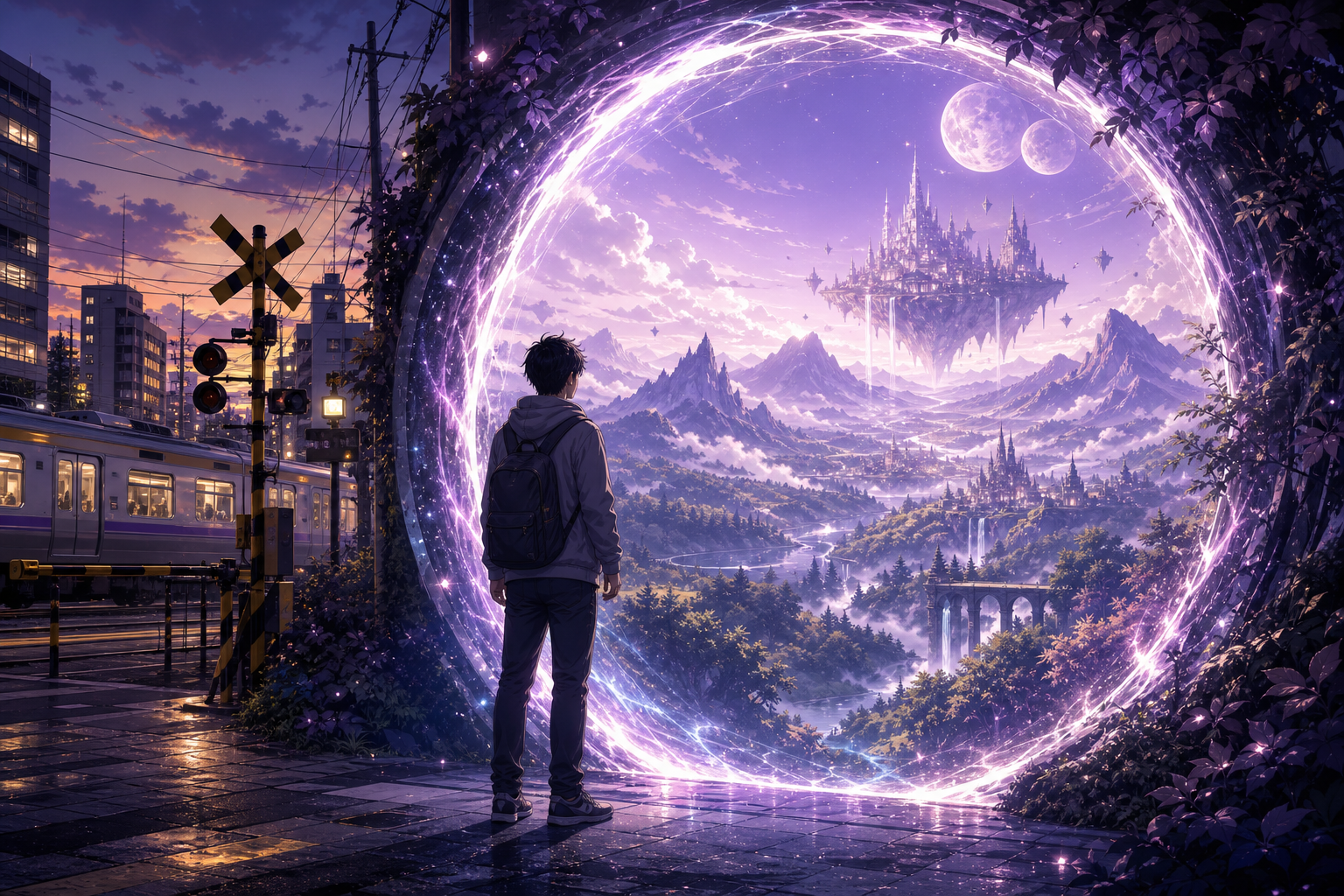
Isekai means “another world.” In an isekai story, someone crosses from the world they know into a different one, gets reborn there, becomes trapped there, or arrives here from somewhere else. The new world may use magic, game rules, court politics, monsters, or none of those things. The world crossing is the part that matters.
Fast facts · recurring furniture · fandom nonsense
The Isekai Trope Passport
World crossing earns the passport. Everything else is a popular stamp. A truck, guild, harem, demon king, or glowing status screen may tell us what neighborhood of isekai we entered, but none of them defines the whole structure.
Truck-kun
A vehicle kills or launches the protagonist, ending the old life with brutal efficiency.
Common, not required
Summoned Hero
A kingdom imports a stranger, calls the kidnapping destiny, and hands over a national emergency.
Common, not required
Cheat Skill
The newcomer receives an ability that breaks the local power scale or economy.
Common, not required
Game Menu
Levels, classes, skills, quests, and stats make the new world readable like an RPG.
Common, not required
Adventurer Guild
One institution organizes work, rankings, monsters, rewards, and a suspicious amount of exposition.
Popular furniture
Demon King
A ready-made enemy gives the hero a mission before anyone asks whether the politics are true.
Popular furniture
Divine Orientation
A god or goddess explains the transfer, offers powers, and sometimes treats reincarnation like customer service.
Common setup
Villainess Route
A heroine wakes inside a romance game or novel as the woman scheduled for disgrace, exile, or death.
Major branch
Slow Life
The protagonist chooses farming, cooking, healing, crafting, or shopkeeping over saving another ungrateful kingdom.
Major branch
Modern Knowledge
Earth knowledge becomes an advantage in medicine, farming, trade, warfare, administration, or food.
Common advantage
Instant Party
Companions arrive quickly and may offer loyalty, romance, or social acceptance the old world withheld.
Common fantasy
Language Download
The traveler understands everyone immediately because subtitles apparently reached the soul.
Convenient shortcut
Reverse Isekai
Someone from another world lands on Earth and discovers rent, transit cards, and labor law.
Required for this branch
World Crossing
A person, consciousness, or identity moves between distinct realities and carries consequences across the boundary.
The defining stamp
Why Truck-kun became fandom management
Truck-kun is the fandom nickname for the truck, bus, van, or other vehicle that kills or transports a future isekai protagonist. Fans turned a repetitive plot device into a character because the vehicle kept reporting for work. It enters, performs one extremely specific human-resources function, and sends another exhausted office worker or distracted teenager to fantasy onboarding.
The device solves several story problems at once. Death closes the return route, removes ordinary obligations, and lets reincarnation begin without making the protagonist choose to abandon anyone. An accident also avoids making suicide the gateway to a better life, although careless stories can still create the ugly implication that death is the only route out of burnout, loneliness, disability, poverty, or social failure.
Truck-kun also exposes the industrial side of the formula. Writers need a fast hook for web-fiction readers who can leave after one screen. A familiar accident spends very little time on logistics. The tradeoff is emotional debt. If the story erases the old family, friends, coworkers, grief, and unfinished life after one bumper impact, the reincarnation becomes convenient accounting instead of a second life.
Why do so many worlds look like a game?
Game systems turn uncertainty into readable numbers. The protagonist can see progress, compare abilities, plan a build, and explain power without years of local education. Readers who know role-playing games understand levels, classes, quests, inventory, and skill trees before the story defines them. That shared literacy saves time.
The shortcut becomes a problem when the interface replaces the world. A status screen can say someone gained farming skill level eight, but it cannot explain soil, weather, hunger, land ownership, inherited knowledge, or why local farmers should trust a stranger. Numbers measure the system the author designed. They do not automatically create culture, labor, or meaning.
Why does pseudo-medieval Europe keep answering the portal?
Castles, guilds, monarchies, swords, churches, taverns, and hereditary nobles give audiences a world they can recognize quickly. The setting offers visible class conflict, weak central institutions, travel danger, and enough technological distance for modern knowledge to look impressive. It also lets fantasy borrow European shapes without rebuilding a precise historical country.
Recognition can slide into wallpaper. A believable society needs regional languages, food systems, property rules, religious disputes, migration, trade, sanitation, law, and people who know more about their home than the visitor does. If every local waits for one Japanese teenager to invent mayonnaise and competent government, the problem is not fantasy. The problem is that the world has been built as applause.
Why are instant loyalty and harems so common?
Many isekai leads begin socially ignored, overworked, bullied, isolated, or convinced that they failed at ordinary life. The new world answers by making them needed. Companions recognize their value quickly. Romance becomes visible. A party replaces the community they never had.
That fantasy can carry real emotional weight, especially when the story lets trust grow through shared risk and care. It becomes hollow when supporting characters exist only to confirm the protagonist’s greatness. A relationship needs competing needs, boundaries, conflict, and the right to leave. Loyalty without agency is another cheat skill wearing a smile.
Isekai or not? Use the mechanism, not the wallpaper
| Story setup | Best label | Why |
|---|---|---|
| A hero was born in a fantasy world and never crosses realities. | Fantasy | Magic and castles do not create isekai by themselves. |
| A person dies on Earth and awakens in another world with old memories. | Isekai reincarnation | Identity crosses through death and rebirth. |
| A kingdom summons a student from modern Japan. | Summoning isekai | The receiving world deliberately causes the transfer. |
| A person returns to an earlier point in the same life and timeline. | Regression | Time changes, but the character may remain inside the same world. |
| A player uses ordinary VR equipment and logs out safely. | VR or game fiction | The player has not become trapped or embodied in another reality. |
| A player becomes physically trapped inside a game-like reality. | Borderline isekai | The answer depends on whether the story treats the space as software, embodiment, or a separate world. |
| A demon, elf, or hero from a fantasy world moves to modern Earth. | Reverse isekai | The direction changes, but world crossing still drives the story. |
| A reader possesses a character inside a novel. | Transmigration or book isekai | Consciousness crosses into a separate fictional reality. |
| A cultivator travels among realms inside one established cosmology. | Cultivation fantasy | Multiple realms do not automatically create isekai when they belong to one native system. |
The question most trope guides skip: who pays for the fantasy?
A trope list tells us what appeared. RaeRae’s test asks what the trope does to people. Who lost a worker, child, friend, or citizen when the protagonist vanished? Who feeds the hero’s party? Who built the guild? Who loses political power when a summoned stranger receives royal access? Who gets called primitive after doing the labor that kept the world alive before the portal opened?
At the personal level, isekai tests identity. At the interpersonal level, it tests whether love and loyalty survive unequal power. At the cultural level, it tests whether the visitor learns or colonizes. At the institutional level, it tests who controls knowledge, land, violence, and movement. At the production level, it reveals which shortcuts an adaptation keeps because viewers already know the code.
The sharper question is: does the other world exist as a society, or as a customer-service desk for one protagonist’s unmet needs? The answer separates a functioning second world from a reward screen with weather.
The word is simple. The shelf label is messy.
Isekai is written 異世界. I carries the sense of different or unusual, while sekai means world. Put them together and you get “different world” or “another world.” That definition sounds easy until fans start arguing over whether a virtual game counts, whether time travel counts, or whether a fantasy story counts when every main character was born there.
Here is the clean test: does crossing between worlds shape the story? If the main character leaves one reality for another, brings knowledge or identity across that boundary, and must live with the consequences, the story uses isekai structure. If the story simply takes place in a fantasy world and nobody crosses into it, that is fantasy. Elves and spell circles do not automatically stamp an isekai passport.
People often call isekai a genre because bookstores, streaming services, publishers, and fandom spaces need useful shelves. That works in ordinary conversation. Structurally, though, isekai behaves more like a premise or story framework. It can carry romance, comedy, horror, war, political drama, slice of life, adventure, satire, or a cooking show wearing a dragon as an apron.
The main ways characters cross worlds
Transportation
The character enters another world while still alive. A portal, spell, accident, train, book, doorway, divine summons, or unexplained cosmic clerical error does the moving. The body usually crosses with the person, so the story can focus on survival, culture shock, homesickness, and the question nobody should ignore: can they get home?
Reincarnation
The character dies and begins another life in a new world. They may keep every memory, recover those memories later, or carry only fragments of their old identity. Reincarnation changes the moral math. A thirty-year-old mind in a child’s body raises questions about consent, maturity, family, grief, and whether memory alone makes someone the same person. Some stories take those questions seriously. Others sprint past them because the baby already knows advanced magic and we apparently have appointments.
Summoning
A kingdom, deity, cult, or desperate group deliberately calls someone from another world. “Chosen hero” stories often use this route. Summoning creates an instant power relationship. The summoners control the information, resources, and return path. The visitor may receive praise, but praise does not erase coercion. If strangers drag a teenager across realities and announce that the teenager now owes them a demon king, that is not a scholarship program.
Trapped in a game or game-like world
Some stories place a player inside a virtual world, transform game systems into physical reality, or make the character wake up as an avatar. Fans debate the border because a digital setting is not always a separate universe. The useful question is not whether health bars appear. Ask whether the character has crossed into a reality that now governs their body, relationships, freedom, and survival. A game interface alone does not do the work.
Reverse isekai
Reverse isekai sends someone from a fantasy or alternate world into ours. The outsider now has to survive rent, transit, office rules, convenience stores, and the strange local magic called paperwork. The structure stays the same. Only the direction changes. Reverse isekai can expose how weird ordinary life looks when someone stops accepting our systems as normal.
Portal travel with a return route
Some characters move between worlds more than once. They may keep a door open, travel through dreams, or return home after each visit. Older fantasy traditions used this structure long before the current isekai label became a marketing magnet. The label may be Japanese, but the desire to step through a doorway and test another life belongs to many storytelling cultures.
The Japanese labels fans keep running into
Japanese criticism, publishing, and fandom use more specific words inside the large isekai bucket. These labels describe how the crossing happens.
- Isekai ten’i (異世界転移)
- Transfer to another world. The character moves rather than being born again. A portal, accident, spell, or unexplained jump can cause it.
- Isekai shōkan (異世界召喚)
- Summoning to another world. Someone on the receiving side deliberately calls the character. Shōkan is a specific kind of transfer, and the summoner’s agenda usually matters.
- Isekai tensei (異世界転生)
- Reincarnation in another world. The old life ends, but memory, personality, knowledge, or part of the soul continues.
Media scholar Tani Levy uses transfer, summoning, and reincarnation as the three main routes into the contemporary isekai formula. That vocabulary helps because “they went somewhere weird” does not tell us whether the character can return, chose to go, kept the same body, or owes anything to the people who pulled them across.
The branches hiding under the isekai umbrella
Villainess and otome isekai often place a heroine inside a romance game, novel, or court story, sometimes as the woman already marked for exile or death. The tension comes from social knowledge, reputation, marriage politics, and whether a supposedly fixed plot can be changed. The heroine may know the routes, but knowing a script does not mean understanding the people who now live inside it.
Slow-life isekai trades demon-king urgency for farming, cooking, healing, crafting, running a shop, or building a quiet community. The fantasy is not always domination. Sometimes the forbidden wish is a safe home, useful work, and enough sleep.
Kingdom-building and civilization isekai turn imported knowledge into policy, war, trade, or infrastructure. These stories become much stronger when they remember that one person cannot manufacture a modern society from trivia. Knowledge needs tools, labor, institutions, raw materials, trust, and people willing to stop the local nobility from stealing everything.
Nonhuman reincarnation gives the protagonist a body that changes how they eat, move, speak, fight, and relate to other species. A slime, spider, sword, monster, or object should create more than a cute title. A different body can force the story to ask what part of a person survives when human appearance and human privilege disappear.
Returnee stories follow someone who comes back to their original world after gaining power, trauma, obligations, or relationships elsewhere. The return matters because “home” may no longer fit. Going back can become a second culture shock rather than a reset button.
What does not automatically count as isekai?
- A fantasy setting: If everyone was born in the same fantasy world, the story may be high fantasy without being isekai.
- Time travel: Moving to another era in the same timeline is not necessarily another world. A branching reality or separate universe can change that answer.
- Dreams: A dream sequence is not automatically world travel. The dream world needs narrative reality and consequences beyond waking up sweaty.
- VR gaming: Playing a game from a bedroom is not enough. Becoming trapped, embodied, or transferred into that world may push the story across the line.
- Amnesia: Forgetting your past in the same world is an identity story, not isekai by itself.
The edges stay fuzzy because stories enjoy refusing neat filing systems. That is fine. Labels should help us discuss a story. The story does not work for the label.
Isekai did not begin with Truck-kun
Another-world stories are older than the current label and older than anime. Japanese discussions often point to the tale of Urashima Tarō as an ancestral comparison: a fisherman visits the Dragon Palace beneath the sea, returns home, and discovers that far more time has passed than he experienced. Calling that folktale “modern isekai” would flatten centuries of context, but the comparison shows that crossing into a marvelous realm and returning changed is not a new hunger.
Western readers may recognize the wider structure as portal fantasy. Alice’s Adventures in Wonderland, The Wonderful Wizard of Oz, and The Chronicles of Narnia send ordinary people into realities with different rules. Those books are not Japanese isekai products. They belong to related story traditions. The family resemblance matters, but so do the cultural and publishing histories that gave each tradition its own language.
Modern Japanese anime used another-world transfer well before the 2010s boom. Sunrise’s official archive dates Aura Battler Dunbine to 1983 and describes Byston Well as an alternate world that draws in people from Earth. Later series such as Magic Knight Rayearth, Fushigi Yûgi, Digimon Adventure, and Inuyasha gave different generations their own versions of the crossing. Many of those stories kept the desire to return home in the center. That detail separates them from some later reincarnation stories, which may cut the old world loose after the opening chapter.
The current wave grew through online participatory culture, web novels, light novels, manga, and anime adaptation. The formula became easier to recognize, sort, market, imitate, and parody. The portal did not suddenly appear. The production pipeline put a neon sign over it.
A quick map of familiar examples
- Classic transfer and portal adventure: Aura Battler Dunbine, Magic Knight Rayearth, Fushigi Yûgi, and Inuyasha.
- Reincarnation: That Time I Got Reincarnated as a Slime and My Next Life as a Villainess.
- Summoning or sudden transfer: Re:ZERO, KONOSUBA, and The Rising of the Shield Hero, although each handles agency and power very differently.
- Reverse isekai: The Devil Is a Part-Timer! and Re:Creators.
- Game-world border debates: Sword Art Online, Log Horizon, and .hack. Fans disagree because virtual embodiment, simulation, and literal parallel worlds are not the same mechanism.
This is a map, not a canon list. A title can mix branches, parody them, or refuse the label while still using the machinery.
Japanese isekai is not the only world-crossing tradition
English-language fandom sometimes uses isekai as a universal word for every story about entering another reality. That makes conversation easy, but it can erase where a work came from. Western publishing often says portal fantasy. Korean web novels and webtoons commonly use reincarnation, regression, possession, and transmigration structures. Chinese fiction has its own world-crossing language and long traditions involving rebirth, cultivation realms, historical displacement, and movement into books or games.
Those ecosystems overlap, borrow, and influence one another. They are not interchangeable. A Korean regression story that sends someone back through their own timeline is not automatically Japanese isekai. A Chinese cultivation story set entirely inside its own cosmology is not isekai merely because it contains multiple realms. Origin, mechanism, and the terms used by the creators all matter.
Why did isekai become so visible?
The modern boom did not fall out of a portal fully animated. The wider manga and light-novel adaptation pipeline helps explain how successful prose can move through publishing and eventually reach television. Many popular anime began as web novels, moved into edited light novels, gained manga versions, and then reached television. Japan’s large web-fiction platforms made it easier for writers to test long-running premises with readers. Publishers could see which stories already held attention before investing in print and adaptation.
That pipeline rewards an immediate hook. “A burned-out office worker dies and wakes up as…” tells readers the setup before the first chapter finishes introducing the furniture. Long descriptive titles also function like tiny sales pages. They tell a browsing reader the main gimmick, social fantasy, and expected tone at once.
Japanese web-fiction platform Shōsetsuka ni Narō treats “another world” as a meaningful classification in its own system, including another-world romance and required keywords for certain reincarnation or transfer stories. KADOKAWA’s light-novel catalog and rankings show how firmly another-world premises sit inside the publishing market. The anime did not create this ecosystem. Anime made an already productive novel and manga pipeline much more visible around the world.
Streaming added fuel. International viewers could watch seasonal anime faster, compare formulas in real time, and turn recurring devices into shared jokes. Truck accidents, skill menus, adventurer guilds, suspiciously European castles, and protagonists with absurd advantages became recognizable shorthand. Once audiences know the shorthand, creators can play it straight, twist it, or roast it.
Isekai is a worldbuilding stress test
Isekai gives a writer a convenient tour guide. The newcomer does not know the rules, so local characters can explain currency, magic, government, religion, food, monsters, and social customs without the audience feeling completely lost. That convenience can build a rich world. It can also become a lazy parade of menus.
A believable other world needs more than a map and a magic ranking. It needs consequences. If healing magic exists, what happens to medicine, childbirth, disability, war, and class? If monsters produce valuable materials, who owns the hunting grounds? If one transported person introduces modern farming, where did the seed stock, tools, labor, water rights, and political protection come from? A clever idea does not float above society. It crashes into somebody’s job.
Culture matters too. Too many worlds borrow medieval European wallpaper, add Japanese food praise, and call the job finished. A real culture has family duties, mourning practices, beauty standards, jokes, prejudices, trade habits, legal customs, religious disagreements, and regional grudges. People do not become background furniture because the protagonist arrived with soy sauce.
RaeRae’s five-question isekai test
- What did the character lose? A second life means something only when the first life leaves a mark.
- What knowledge actually transfers? Remembering a phone is not the same as knowing how to build one.
- Who pays for the protagonist’s advantage? Power changes labor, politics, safety, and relationships.
- Does the new world push back? Local people should have agency, knowledge, and goals that did not begin when the visitor arrived.
- Can the story survive without the gimmick? After the portal closes, characters still need wants, limits, conflict, and consequences.
Why isekai also belongs in Novel World
Isekai belongs under Japanese Anime because anime made the term familiar to many international fans. It also belongs in Novel World because a large part of the modern ecosystem starts in prose. Web novels can spend hundreds of chapters building systems, side characters, economies, and slow political changes. Light-novel editions may revise that material, add illustrations, reorganize arcs, and prepare the story for a broader commercial life.
Adaptation changes the experience. An anime has limited episode time. It may compress internal thoughts, remove explanations, merge events, or turn a paragraph of private panic into one facial expression. That means the anime and novel can carry the same plot while producing different judgments about the same character. Readers get the thought process. Viewers get timing, voices, music, color, editing, and physical performance.
Understanding isekai requires more than one shelf. Anime terminology explains how viewers use the label. Japanese animation history shows how adaptations reshaped it. Web novels and light novels reveal where many modern stories begin, while worldbuilding exposes whether the new society actually works. Isekai crosses those forms, so its explanation should cross them too.
Power fantasy is not the whole answer
Yes, many isekai stories give the protagonist rare skills, instant status, loyal companions, or a world designed to appreciate what the old world ignored. That fantasy is obvious. The better question is why it lands.
A second world can act like an appeal court for a life that felt wasted. The overworked employee becomes valuable. The isolated fan gains a party. The person trapped by class, age, illness, or expectation receives a new set of rules. That can feel comforting, but it can also dodge the harder issue. Did the character grow, or did the universe simply remove everyone who could say no?
The strongest stories do not hand out freedom without cost. They ask whether old habits cross the portal too. Burnout does not disappear because the office became a guild. Loneliness does not heal because five attractive people joined the party. Power does not create wisdom. A new world gives the character another setting. It does not automatically give them another self.
The cultural lenses hiding inside the portal
Isekai often stages pressure that already exists in ordinary life: school competition, exhausting work, rigid social roles, family expectations, isolation, and the fear of becoming invisible inside a system. Another world lets a story rearrange those pressures so the audience can see them from a safer distance.
A Confucian lens asks what the traveler owes to family, community, teachers, rulers, and the people who supported their survival. A Buddhist lens asks whether getting a new body and more power ends suffering, or whether attachment, ego, and ignorance simply change clothes. A modern labor lens asks why so many heroes need death or magical abduction before they receive rest, respect, housing, and meaningful work.
These lenses do not fit every title, and no responsible reading should force them onto a story that gives us no evidence. They help when the plot keeps returning to duty, rebirth, status, desire, social harmony, escape, or the consequences of clinging to an old identity.
Why fans keep opening the door
Isekai offers one of fiction’s oldest promises in a very direct package: your current world is not the only possible world. Somewhere else, the rules may change. You may change. You may finally matter. You may also discover that being important is exhausting and dragons do not care about your transferable office skills.
The format can deliver pure comfort, sharp satire, detailed systems, romance, terror, political fantasy, or a serious argument about identity. Its worst versions use the new world as a vending machine for praise. Its best versions use distance to make us look back at home and notice which rules were never natural in the first place.
Isekai therefore belongs in more than one conversation. It is an anime term, a major web-novel and light-novel pipeline, a worldbuilding laboratory, and a mirror pointed at the life the protagonist wanted to leave.