
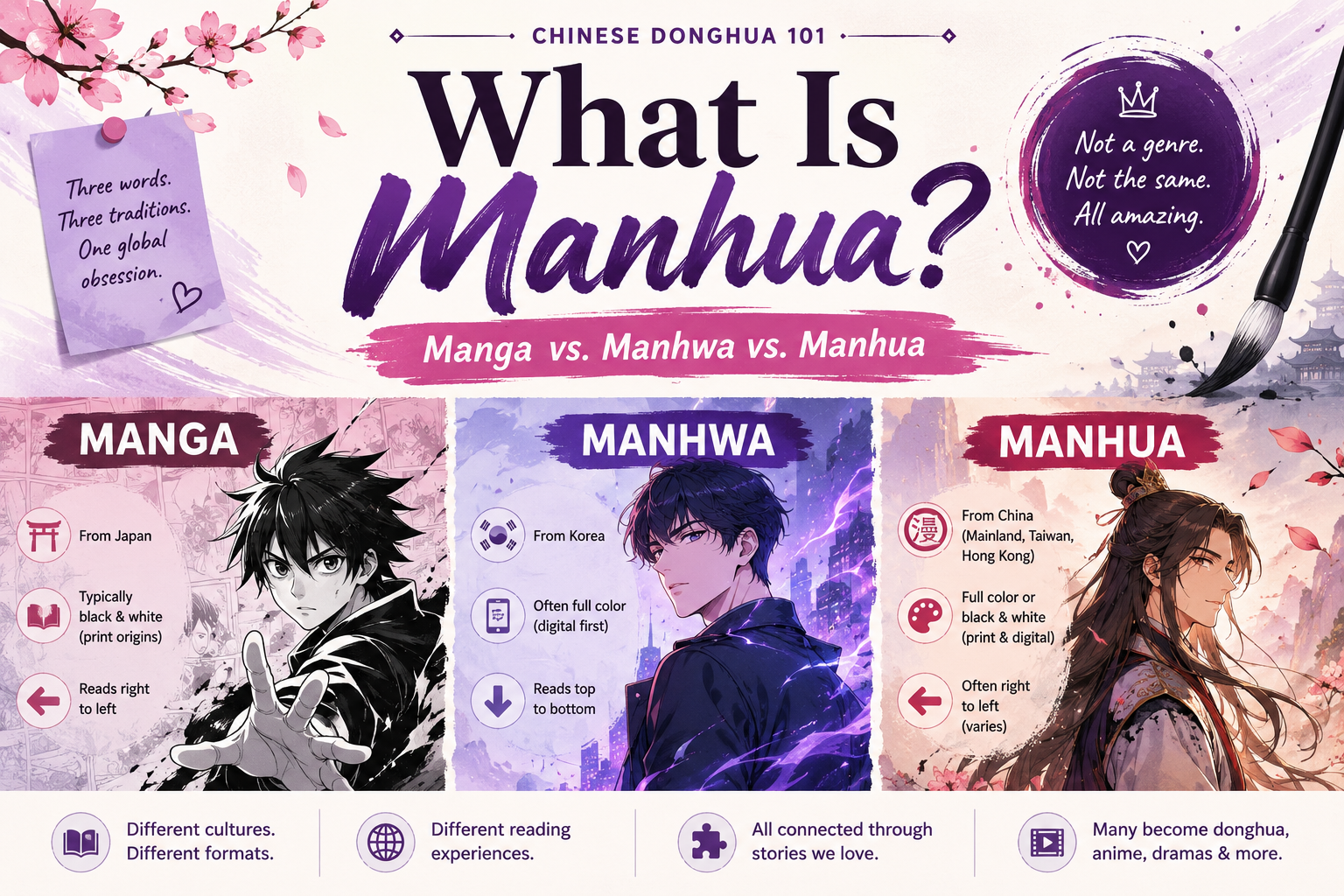
What Is Manhua? Manga vs. Manhwa vs. Manhua
Manga. Manhwa. Manhua. Three words that look close enough to make a new reader wonder whether the internet is testing them, and three enormous comics traditions that absolutely did not organize themselves for the convenience of English speakers. The beginner answer is simple: manga is associated with Japan, manhwa with Korea, and manhua with China and Chinese-language comics traditions.
That distinction is useful, but it is only the front door. Modern comics do not stay neatly inside one format anymore. Printed books sit beside digital chapters. Black-and-white pages sit beside lavish full-color art. Vertical scrolling, mobile apps, web serialization, platform exclusives, print editions, web novels, donghua adaptations, dramas, games, and global licensing have created a media ecosystem where two comics from different countries may look more similar on your phone than two comics from the same country created thirty years apart.
So the useful question is not, “Which one has color?” or “Which one scrolls downward?” Those are clues about format. Manga, manhwa, and manhua are primarily useful as cultural and publishing-origin terms. Genre, art style, reading direction, release format, and adaptation history are separate layers. Once we stop trying to make one word explain all of them, this gets much easier.
- What does manhua mean?
- Manga vs. manhwa vs. manhua
- Why do the words sound so similar?
- Did manhua exist before modern webcomics?
- Mainland China, Taiwan and Hong Kong
- Is manhua usually full color?
- Which direction do you read manhua?
- How digital publishing changed manhua
- Manhua and Chinese web novels
- How manhua connects to donghua
- Which version is actually the source?
- Why these terms are not genres
- Why titles change in English
- Common myths
- Why the distinction matters
The easiest way to stop mixing them up
Start with the country or comics tradition, then ask about format separately. That one habit prevents most of the confusion. A full-color comic does not become Korean because it scrolls vertically. A black-and-white comic does not become Japanese because it has panels. A Chinese fantasy comic does not become manhua because somebody is cultivating. It was already manhua because of the comics tradition it belongs to.
What does “manhua” actually mean?
Manhua is written 漫画 in simplified Chinese and 漫畫 in traditional Chinese. In Mandarin, it is pronounced mànhuà. In modern international fandom, the word is generally used for Chinese comics and Chinese-language comics traditions. That gives English-speaking readers a practical way to distinguish Chinese comics from Japanese manga and Korean manhwa when all three are being discussed in the same space.
The category itself is much older and broader than the glossy digital fantasy comics many international readers meet first. Chinese comics have appeared through newspapers, magazines, political cartoons, satirical art, children’s publications, books, serialized stories, martial-arts comics, illustrated narratives, online platforms, mobile apps, and many other forms. Different regions developed their own publishing environments, and those environments changed again as print gave way to increasingly digital readership.
That means there is no single “manhua art style.” One creator may use highly rendered digital fantasy illustration filled with luminous clothing and elaborate architecture. Another may work with simplified cartooning. A martial-arts comic from Hong Kong can look completely different from a Mainland romance webcomic or a Taiwanese slice-of-life work. They do not need to resemble one another to belong to Chinese comics history.
Modern international recommendation spaces can distort this because the works most likely to cross language barriers are often connected to popular web novels, romance, danmei, cultivation, historical fantasy, or other genres with already-active overseas fandoms. If those are the first twenty manhua someone encounters, it becomes tempting to define the entire medium by the export shelf.
Manga vs. manhwa vs. manhua
The cleanest distinction is still origin. Manga belongs to Japanese comics culture, manhwa to Korean comics culture, and manhua to Chinese comics culture. Once we establish that, we can talk about the tendencies modern readers recognize without confusing those tendencies for definitions.
Japanese manga developed an especially powerful print ecosystem built around magazines, demographic publishing markets, collected volumes, and enormous genre diversity. Black-and-white interiors became common partly because serialized print production rewarded economical workflows, although color pages, digital releases, and fully colored works also exist. International editions frequently preserve the Japanese right-to-left page order, which became one of the easiest visual signals for readers learning manga.
Korean manhwa has its own long print history, but its modern international identity became deeply tied to the rise of the digital webtoon. Platforms and smartphones encouraged full color, long vertical canvases, scroll-based pacing, dramatic empty space, and visual reveals controlled by how far the reader moves down the screen. Because Korean webtoons became so globally successful, international fandom sometimes uses manhwa and webtoon as though they mean exactly the same thing. They do not.
Chinese manhua also moved heavily into digital publishing and can therefore resemble Korean webtoons in format. Full color, vertical scrolling, mobile interfaces, dramatic panel spacing, and digital effects are not national property. Once multiple comics industries began designing for the same rectangular phone screen, some visual convergence was inevitable.
| Term | Primary Context | Common Modern Associations | Do Not Assume |
|---|---|---|---|
| Manga | Japan | Print serialization, collected volumes, black-and-white interiors, right-to-left page order, digital manga. | That every manga is monochrome, reads identically, or belongs to one recognizable “anime” genre. |
| Manhwa | Korea | Digital webtoons, full color, vertical scrolling, mobile reading, online serialization. | That all Korean comics are webtoons or every vertical comic is Korean. |
| Manhua | China and Chinese-language comics traditions | Print comics, digital comics, full-color webcomics, martial arts, fantasy, romance, adaptations, mobile platforms. | That all manhua is full color, cultivation-based, historical-looking, or read in one direction. |
An enormous Japanese comics ecosystem spanning mainstream magazines, niche publications, digital platforms, collected editions, independent work, children’s comics, adult drama, romance, horror, history, sports, fantasy, memoir, and practically every other category that can survive being drawn.
Korean comics across older print traditions and the modern webtoon industry, where digital platforms transformed page layout, color, serialization, monetization, international licensing, and the way readers encounter comics on mobile devices.
Chinese comics across Mainland China, Taiwan, Hong Kong, digital platforms, traditional publishing, simplified and traditional Chinese, web adaptations, martial storytelling, contemporary life, fantasy, and far more than the handful of genres most visible overseas.
Why do manga, manhwa and manhua sound so similar?
The resemblance comes from shared East Asian linguistic and cultural history. The characters 漫画 / 漫畫 are part of the vocabulary associated with comics and drawings in Chinese. Japanese adopted the same characters for manga, while Korean manhwa reflects Korean vocabulary historically connected to the same character pair. Mandarin gives us manhua.
So the words are related long before English fandom starts filing them into separate shelves. What changed is the usefulness of the distinction. International readers now consume comics from several countries side by side, so the borrowed words become shorthand for origin. “Manga” tells the English-speaking reader to begin with Japan. “Manhwa” points toward Korea. “Manhua” points toward Chinese comics.
That filing system is especially useful because calling everything comics can erase information international readers actually need. Which language should I search? Which original title am I looking for? Which publisher or platform might have released it? Was the series adapted into anime, donghua, or a Korean animated production? Is there a source web novel? Different origin words give us a better starting point for answering those questions.
The trick is remembering that a starting point is not a complete biography. Knowing a comic is manhua tells us something important. It does not tell us everything.
Manhua did not begin as a full-color scrolling webcomic
Modern digital manhua can make the medium look extremely new because so much international discovery now happens through apps, social media panels, translated web releases, and recommendations connected to Chinese web novels. Chinese comics history stretches much farther back. Illustrated satire, political cartoons, newspaper comics, sequential art, commercial publishing, children’s material, and other forms developed through changing periods of Chinese history long before anyone could scroll through a chapter with one thumb.
The modern word manhua became associated with comics during a period when East Asian artists, publishers, and readers were encountering both local visual traditions and international cartooning. Chinese comics subsequently developed under very different social and political conditions across the twentieth century. War, revolution, migration, censorship, commercial publishing, regional markets, and changing relationships with Hong Kong, Taiwan, Japan, Europe, and the United States all affected what could be produced and how readers encountered it.
Hong Kong became especially important to commercially popular Chinese comics, including martial-arts and action traditions that developed strong visual identities of their own. Taiwan built another publishing environment shaped by its own history and cultural influences. Mainland Chinese comics changed across different political and economic periods before digital publishing created another major transformation.
This history is why reducing manhua to “China’s version of manga” feels increasingly inadequate once you look beyond the beginner definition. Japanese comics influenced neighboring media industries, just as American, European, Korean, Hong Kong, Taiwanese, and Mainland Chinese creators have influenced one another. Influence is normal. It does not erase separate histories.
Mainland China, Taiwan and Hong Kong are not one identical comics market
International fandom often uses manhua as a convenient umbrella for Chinese comics, but the Chinese-language world contains several major publishing environments. Mainland China, Taiwan, and Hong Kong have different political histories, languages in everyday use, character systems, publishers, censorship environments, commercial structures, and relationships with neighboring comics industries.
Mainland China primarily uses simplified Chinese characters in contemporary publishing. Taiwan generally uses traditional Chinese. Hong Kong also uses traditional Chinese and exists inside a strong Cantonese-speaking cultural environment. A work can therefore be recognizably Chinese while still carrying regional linguistic and publishing characteristics that matter when identifying the original edition.
Hong Kong manhua became internationally notable for highly detailed action and martial-arts comics, with artists developing approaches that do not map neatly onto either Japanese manga stereotypes or modern mobile webcomics. Taiwan has produced its own creators, magazines, publishers, independent comics, and digital works. Mainland China’s contemporary online publishing ecosystem has exploded alongside web novels, mobile entertainment, and animation platforms.
The distinction becomes particularly important when a work travels. A title originally published in traditional Chinese may later receive a simplified Chinese edition. Mainland platforms can host works originating elsewhere. International translations may identify everything simply as “Chinese comics,” removing the regional information entirely. That is fine for casual reading. It is less fine if we are trying to build an accurate media database.
Is manhua usually full color?
A lot of modern manhua encountered through international digital platforms is full color, and that creates one of the strongest visual stereotypes surrounding Chinese comics today. Fantasy palaces glow. Cultivation effects light up the page. Historical clothing gets rendered with enough detail that I begin worrying about the illustrator’s wrist. Romance comics use elaborate palettes, digital lighting, textured backgrounds, and polished character art designed to make a phone screen feel much larger than it actually is.
None of this means manhua is inherently a full-color medium. Chinese comics existed in black and white, limited color, newspaper print, books, magazines, painted formats, illustrated satire, and many other visual forms before contemporary digital publishing became dominant. Modern color is partly a product of technology and distribution. Digital platforms removed some of the printing constraints that historically made extensive color more expensive.
That same technological change affected Korea and Japan differently. Korean webtoons became strongly associated with color because they developed inside a digital platform ecosystem where color and vertical layouts were part of the native format. Japanese manga continues to have an enormous print industry where black-and-white interiors remain efficient and culturally familiar, even as digital manga grows. Chinese platforms developed their own combinations of page-based and scrolling comics.
So yes, full color may help your brain guess that the gorgeous fantasy comic on your phone is manhua or manhwa rather than a conventional Japanese print manga. It is a clue. It is not evidence strong enough to convict.
Manhua does not have one universal reading direction
International manga readers were trained to expect a rule: many Japanese print manga editions read from right to left. Publishers even spent years adding little warnings because somebody would inevitably open the book from the English-language front, reach what was actually the ending, and become very confused very quickly. That strong convention makes readers want a matching rule for Chinese comics.
Manhua refuses to make our lives that tidy. Reading order can depend on era, region, publisher, format, and platform. A modern Mainland digital comic may flow left to right or vertically downward. Taiwanese or Hong Kong print works may preserve other page traditions. Older Chinese texts and publications can reflect vertical writing conventions. International licensed editions may rearrange or reformat material for a new audience.
Vertical-scroll comics simplify part of the question because the main direction becomes downward. Even there, the order of speech bubbles or side-by-side elements can vary. The safest approach is to pay attention to panel composition, dialogue flow, and the interface used by the actual edition you are reading.
This is one of those places where demanding a universal cultural rule creates more confusion than accepting variation. Manhua has existed through too many formats and publishing environments to obey one reading-direction commandment.
Digital publishing changed the look, pacing and business of manhua
A printed comic page has fixed dimensions. The artist knows the reader will encounter a complete page or spread inside a physical object. A mobile comic has a completely different canvas. It can continue downward for what feels like several floors of a building. Space between panels can control timing. A character reveal can remain hidden until the reader physically scrolls farther. Large illustrations can occupy an entire phone screen before the next line of dialogue appears.
That changes pacing. Empty vertical space can create hesitation or suspense. A long fall can literally become a long scroll. A transformation can unfold gradually. A joke can hide its punchline below the screen edge. Backgrounds can become taller and more cinematic. Chapter length becomes less tied to traditional printed page counts and more tied to platform expectations, creator schedules, monetization models, and reader habits.
Digital platforms also change the relationship between creators, readers, and intellectual property. Readers can comment immediately, purchase or unlock chapters, receive notifications, follow rankings, and discover related titles through recommendation systems. Popularity data becomes visible at a scale older print publishers could only estimate through sales and reader surveys.
That creates fertile ground for adaptation. A digital comic with an existing readership is already a measurable property. A web novel with millions of readers can become a manhua. The manhua builds a visual identity. A donghua or drama can then inherit part of that audience. Music, games, merchandise, audio dramas, promotional shorts, and character collaborations can surround the same property.
This is where comparing modern manhua only to traditional printed manga becomes especially misleading. The better comparison is often between entire digital entertainment ecosystems.
Chinese web novels and manhua are deeply connected, but they are not the same medium
China’s online literature ecosystem produces vast amounts of serialized fiction. Fantasy, xianxia, xuanhuan, wuxia, romance, danmei, historical fiction, science fiction, gaming stories, rebirth, transmigration, system fiction, apocalypse stories, modern drama, and more can accumulate enormous audiences before anyone draws a comic panel.
That makes web fiction an important source of modern manhua. A successful novel already brings characters, worldbuilding, plot, terminology, fandom, and commercial proof that people care. The manhua adaptation then has to convert prose into sequential art. A description becomes a costume. Internal thought becomes expression, dialogue, narration, or silence. A landscape described over half a page becomes one panel. A cultivation breakthrough that required several paragraphs can become an enormous glowing explosion followed by everybody nearby realizing they have a new problem.
Visual adaptation also locks in details that prose leaves flexible. Readers may have imagined a character differently. The comic now gives that person a specific face, hairstyle, body type, robe, weapon, color palette, and environment. Those designs can become influential enough that later adaptations feel “wrong” when they choose another interpretation even though the original novel never required the comic’s version.
Compression is another major issue. Long web novels can contain hundreds or thousands of chapters, sprawling side characters, detailed political relationships, extensive cultivation theory, repeated training, and internal narration that simply cannot all survive unchanged inside a visual chapter. The manhua selects. It speeds up. It combines. It cuts. Those decisions may later become another layer of confusion if a donghua makes different choices.
That is why “the comic changed the novel” and “the animation changed the comic” can both be true, partially true, or completely wrong depending on the actual adaptation tree.
How does manhua connect to donghua?
A manhua can directly become source material for a donghua. In that case, the animation team inherits an existing visual interpretation of the characters and story. Costumes, locations, expressions, action poses, and scene composition may already have recognizable designs. Fans of the comic arrive with expectations before the first animated frame moves.
Animation still has to rebuild everything for another medium. Panels do not determine exact timing. A dramatic page turn has to become an edit. A character’s expression has to move instead of remaining frozen at the most effective instant. Dialogue receives actual voices and pauses. Action needs choreography between the poses. Music and sound can completely change how a scene feels. A comic artist can imply a crowd with selective detail; an animation pipeline has to decide what that crowd actually does for several seconds.
Chinese franchises can also follow a more complicated route. The original source is a web novel. The novel gets a manhua adaptation. The same property later receives donghua. The animation may adapt the original novel while borrowing some visual ideas from the comic, or it may follow the manhua more directly. Then a live-action drama arrives and changes everything again because actors are stubbornly three-dimensional humans with physical bodies, budgets, sets, and schedules.
Once games, audio dramas, merchandise, music projects, and promotional collaborations join the property, “what is the original?” becomes a question worth answering carefully rather than guessing from whichever adaptation reached English-speaking audiences first.
Which version is actually the source?
One of the easiest mistakes in modern Chinese media is assuming publication order in your country equals source order. Maybe the English manhua translation appeared before the donghua was legally available to you. That does not mean the animation adapted the comic. Both could come from a Chinese web novel that had already existed for years.
Even domestic release dates do not always tell the complete story. Adaptations can be developed in overlapping time periods. A manhua might begin publishing while an animation project is already planned. Visual design teams may work from shared franchise materials. Later versions may influence each other even when they started from the same original source.
The distinction matters most when fans compare differences. Suppose the manhua includes an entire side plot that the donghua skips. If the animation adapted the manhua, that is a direct omission from its source. If both adapted the novel separately, the animation team may simply have made a different selection from the same original material.
The same principle applies to character designs. A manhua adaptation may invent visual details the novel never specified. The donghua can choose a different design without contradicting the prose. Fans who met the comic first may still hate it, which is our sacred fandom right, but the adaptation relationship explains what actually happened.
Manga, manhwa and manhua are not genres
Popular exports create stereotypes because international readers do not receive every title equally. Battle manga becomes globally visible, so “manga” starts sounding like an action genre. Korean romance-fantasy and hunter webtoons explode internationally, so “manhwa” starts sounding like towers, regression, dukes, gates, game systems, and emotionally unavailable men with excellent cheekbones. Chinese cultivation and historical fantasy travel widely, so “manhua” starts sounding like xianxia with expensive hair.
Those are recommendation patterns, not definitions. Manga includes romance, cooking, memoir, business drama, horror, sports, comedy, children’s stories, history, politics, avant-garde work, and almost anything else. Manhwa includes far more than webtoon romance and action. Manhua includes satire, science fiction, martial arts, contemporary drama, children’s material, romance, horror, history, comedy, fantasy, and other forms developed across multiple Chinese-speaking markets.
The useful way to classify a work is in layers. Manhua tells us about its Chinese comics context. Xianxia might tell us about its genre. Vertical-scroll webcomic tells us about its format. Web novel adaptation tells us about its source relationship. Full color tells us something about visual production. None of those labels has to eat the others.
Why one manhua can appear under several English titles
Chinese comics frequently arrive in international fandom carrying multiple names. The original work has a Chinese title. That title can be represented in Chinese characters, Mandarin pinyin, a close English translation, an official localization, a platform-specific marketing title, or a fan translation established before official licensing existed.
If the manhua adapts a web novel, the situation gets worse because the novel may already have an internationally recognized English title. The comic platform may choose another. A donghua adaptation might use a third. Search engines then happily scatter all three across separate results while acting like this is a problem we created personally.
Some differences come from translation philosophy. A Chinese title may contain an idiom, poetic phrase, genre convention, cultural reference, or wordplay that becomes clumsy in literal English. One translator preserves the original wording closely. Another tries to reproduce the meaning. A marketing department chooses something shorter and more clickable.
Romanization also matters. Pinyin usually gives modern readers a standardized way to represent Mandarin pronunciation with the Latin alphabet, but names may have older spellings, regional pronunciations, or established fandom forms. A title from Hong Kong may be encountered through Cantonese romanization rather than Mandarin pinyin.
This is why CVM Sekai should preserve major alternate titles when we have them. The goal of a reference page is to help people find the work they are already looking for, not to punish them because they learned a different English translation first.
Common manga, manhwa and manhua myths
Why knowing the difference actually helps
The first practical benefit is search. If you know a work is manhua, you know to look for Chinese characters, Chinese creators, Chinese publishers or digital platforms, source web novels, donghua adaptations, and Chinese title variants. Searching for the same work as though it were Japanese manga can bury useful information under the wrong industry.
The second benefit is adaptation literacy. A Japanese manga becoming anime, a Korean webtoon becoming animation or drama, and a Chinese web novel becoming manhua and donghua can all be described casually as “comic stuff getting adapted,” but the commercial ecosystems underneath them are different. Understanding the source chain makes it much easier to track changes, release history, alternate versions, and why two adaptations disagree.
The third benefit is cultural context. Calling manhua “Chinese manga” forever quietly makes Japanese comics the default measuring stick for another tradition. That phrase is fine when somebody needs the ten-second answer. After that, we can afford the extra word. Manhua has its own history and its own place inside Chinese media.
And finally, it opens the shelf. If you think manhua means cultivation fantasy, you will assume Chinese comics have nothing for you once you tire of cultivation fantasy. If you understand manhua as the much larger Chinese comics tradition, the possibilities expand immediately. The format stops being a genre recommendation and becomes a place to explore.
I knew the country difference. The rest of my brain had apparently been freelancing.
The beginner rule was never my problem. Manga is Japan. Manhwa is Korea. Manhua is China. Fine. My brain filed that correctly and then immediately started attaching a bunch of unofficial accessories. Manga became black and white. Manhwa became shiny vertical romance or hunter stories. Manhua became full-color cultivation fantasy where every man has enough hair to violate workplace safety regulations.
The stereotypes work just well enough to survive, which is what makes them annoying. If somebody sends me an unlabeled screenshot from a modern comic, the format and art may genuinely give me clues. But clues are not definitions. Once Chinese and Korean comics both live on phones, both use full color, and both scroll downward, “it looks like a webtoon” stops telling me where the story came from.
The source issue is even worse because Chinese media properties have no respect for my desire to keep folders tidy. There can be an original web novel, a manhua adaptation, a donghua, a live-action drama, an audio drama, games, and international translations floating around under titles that look like completely different franchises. Then I discover the donghua did not actually adapt the manhua I thought it did. Both adapted the novel. Great. Wonderful. My spreadsheet has developed emotional needs.
But this is also why I like learning the distinction. Once the pieces are separated, the whole ecosystem becomes more interesting. Manhua is the comic. Donghua is the animation. A web novel may be the source. Xianxia may be the genre. Cultivation may be the power system. The vertical scroll is the format. None of them needs to steal another word’s job.
Manga, manhwa and manhua are related names for different comics traditions. The resemblance is real. The interchangeability is not.