
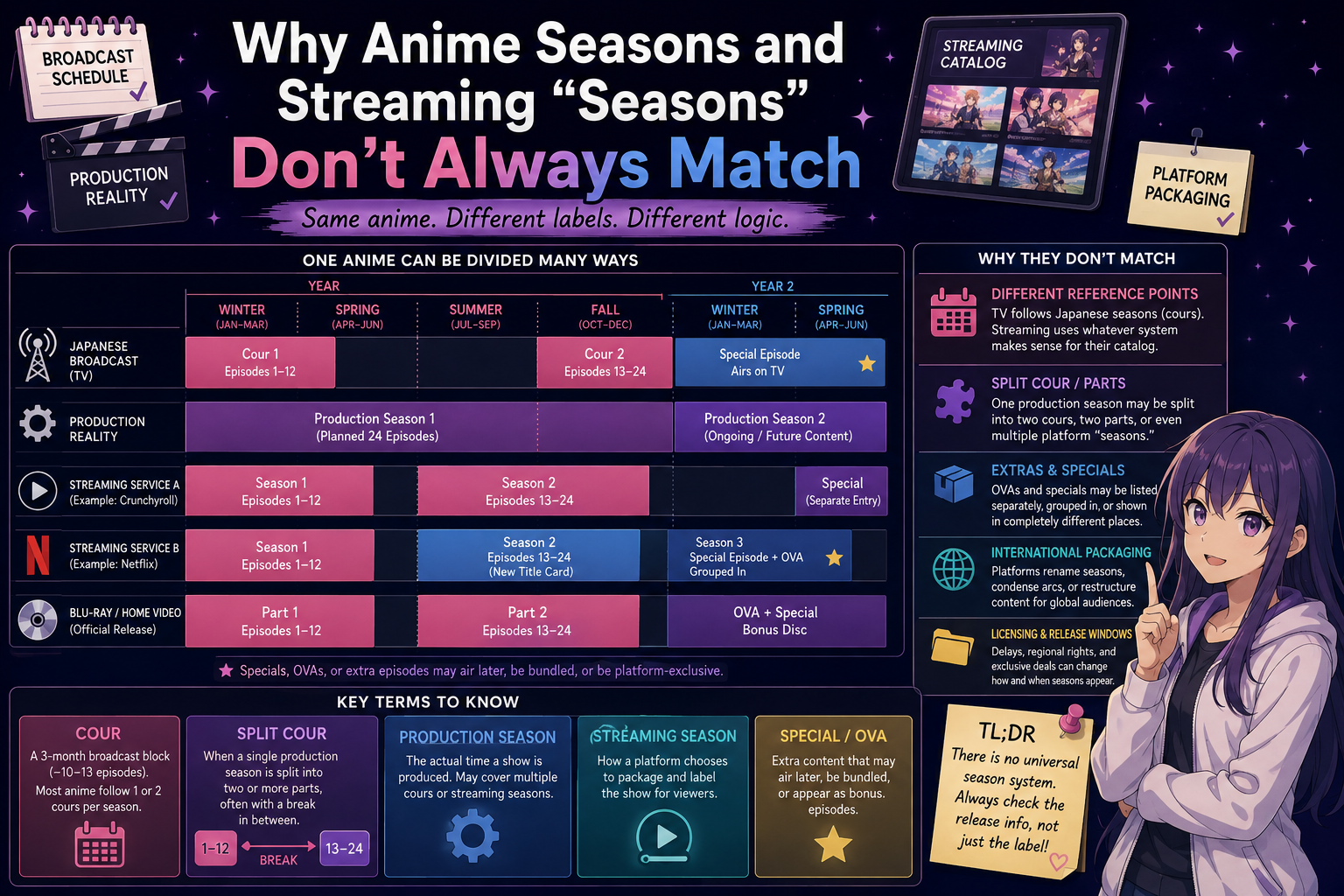
Why Anime Seasons and Streaming “Seasons” Don’t Always Match
Anime has a wonderful ability to make something as basic as “what season am I watching?” feel like an entrance exam. One service says Season 2, another calls it Part 2, Japanese promotional material talks about a second cour, a Blu-ray box groups everything differently, and the fandom is arguing over whether the newest batch is technically Season 3 or the second half of Season 2. The problem is usually not that everyone forgot how counting works. They may be dividing the same anime according to completely different systems.
- Why the word “season” causes trouble
- What a cour has to do with this
- What is a production season?
- What is a split cour?
- Continuous cour vs. split cour
- Why anime gets called Part 1 and Part 2
- What is a streaming “season”?
- Why platforms repackage anime
- Why international labels can differ
- Why episode numbering is not enough
- Where OVAs and Specials enter the mess
- What happens when movies sit between seasons?
- Release order vs. season numbering
- Season number is not the same as watch order
- How licensing can affect catalogs
- Why databases disagree
- Why a platform may change labels later
- A fake example that makes this easier
- How to decode a confusing anime listing
- Common season-numbering myths
- Why fans should care
- Sources and deeper reading
1. The first problem is that “season” is doing several jobs at once
English-language television trained many viewers to think of a season as one very stable thing: a group of episodes produced and released together under one numbered label. Season 1 ends, then Season 2 begins. That expectation works well enough until anime starts mixing Japanese broadcast terminology, production announcements, split releases, streaming catalogs, and international marketing into the same conversation. Now “season” can refer to the production itself, the next batch of episodes, the way a distributor groups episodes, or simply whatever a database decided should sit under the heading “Season 2.”
None of those uses is automatically nonsense. The problem appears when people assume everyone is using the word at the same level. A Japanese announcement may treat twenty-four episodes as one larger production divided into two broadcast blocks, while an international service places the second block under “Season 2” because that is easier for its interface. Fans then compare the labels without noticing that one side is describing production structure and the other side is describing catalog organization.
2. A cour is not automatically the same thing as a season
A cour is roughly a three-month block of Japanese television programming, which is why weekly anime so often appear in runs of around twelve or thirteen episodes. Four broad broadcast periods fit inside a year: winter, spring, summer, and fall. An anime can occupy one cour, continue across two consecutive cours, disappear for a break and return for another cour, or operate under a completely different release structure outside ordinary television.
The important distinction is that a cour describes scheduling. It does not automatically declare a new creative season every time another quarter of the calendar begins. A twenty-four-episode anime can run continuously across two cours and still be treated as one season. Another production can release twelve episodes, pause for several months, and return with twelve more while still being described as two parts of the same larger season.
This is why translating “cour” directly into “season” can create problems. Sometimes the two line up nicely because one twelve-episode season occupies one cour. Other times they absolutely do not. The cour is telling you where the anime sits in the television calendar, while the season label may be telling you how the project itself is organized.
If this still feels slippery, read What Is a Cour? first. That page goes much deeper into the Japanese broadcast calendar, episode counts, and why twelve episodes keep following anime fans around like an extremely punctual ghost.
↑ Return to top3. A production season can be larger than the block you are currently watching
When people talk about a production season, they are usually trying to describe the larger unit the anime itself was planned or presented as rather than whichever catalog folder currently contains the episodes. That season might be twelve episodes, twenty-four episodes, or another length depending on the project. It can run continuously or be divided into separate release blocks. The defining idea is that the larger group belongs together as one planned installment of the anime.
This matters because breaks do not necessarily create a new season. If a twenty-four-episode production is planned as one season but intentionally divided into twelve episodes in spring and twelve more in fall, the break between them does not magically manufacture a second production season. Viewers may experience two release periods, but the project can still be understood as one larger season split for scheduling or production reasons.
4. A split cour is exactly where half the naming arguments are born
A split-cour production divides a larger run into separate broadcast periods with a planned break between them. A twenty-four-episode season might release Episodes 1 through 12 during one cour, pause for several months, and then return with Episodes 13 through 24. The two halves are separated in the calendar, but that does not automatically mean the second half is a completely new season.
From the viewer’s perspective, however, the break can feel exactly like the end of a season. There is a finale, several months pass, promotional material begins again, a new opening theme may appear, and the anime returns during a new broadcast quarter. A streaming platform may decide that this looks enough like a new season to place the returning episodes under a separate Season 2 heading, especially if its interface is built around numbered seasons rather than Japanese cour terminology.
| Structure | Example Shape | How It May Be Described |
|---|---|---|
| One-Cour Season | Episodes 1–12, then season ends | Season 1 |
| Two Continuous Cours | Episodes 1–24 with no major seasonal break | One 24-episode season |
| Split Cour | Episodes 1–12, break, Episodes 13–24 | Season 1 Parts 1 & 2, or one season across two cours |
| Streaming Repackage | Same 1–12 / 13–24 structure | Platform may display Season 1 and Season 2 |
That last row is where fans start accusing each other of being wrong when they may simply be reading different labels. If the service says Season 2 on your television, you are not hallucinating. If Japanese production information treats it as the second part of the same larger season, that information can also be correct. The catalog and the production structure are answering different questions.
↑ Return to top5. Continuous cour and split cour are not the same thing
Two-cour anime often get discussed as though they are all structurally identical, but the break matters. A continuous two-cour run moves from one broadcast quarter directly into the next. The anime may change opening and ending themes, enter a new story arc, or even receive slightly different branding during the second half, but viewers continue receiving episodes every week without a planned multi-month pause.
A split cour deliberately separates the parts. That gap can provide additional production time, align the anime with another release window, or simply be part of the project’s planned scheduling. The audience experiences a break, which is why the returning cour often feels season-like even when production materials describe both parts as one larger unit.
Neither structure tells you whether the second half is creatively strong, rushed, better animated, or secretly produced six hours before broadcast. The terminology describes scheduling structure rather than quality. Anime production will find other ways to frighten us.
↑ Return to top6. Why do anime seasons suddenly have Parts?
“Part” is useful because it allows distributors and producers to acknowledge that a larger season belongs together while still giving each release block its own label. Season 2 Part 1 and Season 2 Part 2 tell the viewer that both batches belong to the second major season even though they were released separately. This is particularly helpful for split-cour productions because it avoids pretending the break created a completely new season.
Unfortunately, “Part” is not governed by one universal anime authority either. A production may use Part 1 and Part 2 officially, a streaming service may introduce those labels for convenience, or international fandom may adopt them because the Japanese title does not map neatly onto English season numbering. The word is useful precisely because it is flexible, which also means you still need context.
Parts become especially chaotic when a season already has a subtitle or named story arc. Now one property can simultaneously have a franchise title, a Season 2 label, a Part 2 label, an arc title, and a cour designation. All of those can be technically describing different layers of the same twelve episodes.
7. A streaming “season” may simply be a catalog folder
Streaming services need interfaces that make sense to millions of users who may know nothing about cours, Japanese broadcast calendars, production committees, manga publication history, or the specific way one franchise numbers itself. “Season 1, Season 2, Season 3” is familiar, searchable, and easy to display. A platform can therefore group episodes into season labels that prioritize usability rather than reproducing the original Japanese terminology exactly.
This can be perfectly reasonable. If a show disappeared for six months and returned with twelve more episodes, an ordinary viewer may find “Season 2” easier than “Season 1, second cour after planned split.” The trouble begins when fans treat the platform’s interface as evidence that the underlying production was officially structured the same way. The streaming label tells us how that service presents the anime to its customers. It does not necessarily tell us how the project was originally planned.
8. Why would a platform deliberately package the same anime differently?
Catalogs are built for viewers, not historians. A distributor may want clear season buttons, manageable episode groups, standardized metadata, and labels that match the rest of its television library. One enormous continuous list of sixty episodes can be less useful than breaking the property into several sections, especially if the anime itself disappeared for long periods, changed subtitles, or released under separate licensing packages.
A platform can also receive different pieces of a franchise at different times. Season 1 arrives first, then an OVA, then another batch of television episodes, followed by a movie. When the service eventually tries to make that catalog readable, it has to decide whether extras get separate entries, become bonus episodes, or sit under another season tab. Another service with different rights may make a completely different decision.
This does not mean every strange catalog decision is brilliant. Sometimes the labeling genuinely makes a franchise harder to understand. The important thing is recognizing that streaming metadata is another layer placed on top of the anime rather than a natural law revealed by the production gods.
↑ Return to top9. International anime releases can inherit completely different labels
Anime crosses languages and distribution systems, which means titles, subtitles, season numbers, episode groupings, and even what counts as a separate entry can change along the way. Japanese marketing may emphasize a named arc or subtitle instead of a season number. An English-language distributor may convert that into Season 2 because its users expect numerical organization. Another service may preserve the subtitle and place the new episodes under an entirely separate title card.
International viewers can therefore encounter one anime through a structure that was never the dominant way Japanese viewers saw it described. That does not make the localized organization fake. It does mean that researching a confusing franchise sometimes requires looking past the English catalog and checking the original Japanese release history, official site, or production announcements.
Translation also affects ordinary terminology. English-language fandom often uses “season” where Japanese promotional material may be emphasizing a continuation, second series, second cour, chapter, arc, part, or new title. The translation is trying to make the release understandable, but every simplification carries the possibility of sanding off useful context.
↑ Return to top10. Episode numbering does not solve the problem nearly as often as it should
You would think Episodes 1 through 24 would settle whether something is one season, but anime has never promised us peace. One release can continue numbering from Episode 13 after a split cour, strongly suggesting the two halves belong together, while a platform still places Episodes 13 through 24 under a Season 2 tab. Another anime resets to Episode 1 for each new season, which makes the season break much clearer. A third series may use arc-specific numbering, chapter labels, or titles that barely acknowledge numbers at all.
Specials can make the sequence even stranger. Episode 12.5 appears between seasons. Episode 0 was released later but takes place earlier. An unaired Episode 13 appears on home video after a twelve-episode broadcast. A streaming service may hide all of those under a separate Specials entry, while another inserts them directly into the episode list. Counting helps, but it is not sufficient evidence by itself.
| What You See | What It Might Suggest | Why It Still Isn’t Proof |
|---|---|---|
| Episodes 1–12, then 13–24 | One continuous larger season | A streaming platform may still divide them into two season folders. |
| Season 2 resets to Episode 1 | A distinct new season | Some databases renumber releases for convenience. |
| Episode 12.5 | Interlude or recap | Decimal numbering is not standardized. |
| Special listed as Episode 13 | Continuation after TV run | May have been released separately on physical media. |
11. Specials and OVAs can completely wreck neat season numbering
Extras exist outside the ordinary television run, which means streaming services have to decide where to put them. An OVA released between Seasons 1 and 2 can become its own title, appear under a Specials tab, be attached to the end of Season 1, or vanish entirely because the service never licensed it. A television Special may be treated as a separate movie-like entry even when it belongs chronologically in the middle of the series.
That catalog decision can then affect season numbering. If a platform treats a major Special as Season 2 for technical or metadata reasons, the actual second television season may display as Season 3. Another platform ignores the Special and calls the television continuation Season 2. The anime did not split into alternate universes. The services counted the pieces differently.
This is exactly why the What Is an OVA, ONA & Anime Special? page belongs next to this one. Release format and season organization are separate systems, but the moment a platform has to display both systems in one menu, they begin colliding.
↑ Return to top12. Movies can sit inside the story without belonging to a numbered season
Anime films create another catalog problem because a movie can be a completely separate side adventure, a recap, an alternate continuity, or a direct canonical continuation that occurs between television seasons. If the film contains story material required for the next season, viewers need to know where it belongs even though the movie itself does not become Season 2 simply because it sits between Seasons 1 and 3.
Streaming interfaces are often poorly designed for this kind of cross-format continuity. The television show sits on one page, the movie sits on another, and nothing in the Season 2 button warns you that ninety essential minutes happened elsewhere. A franchise hub or watch-order guide can therefore be more useful than the platform’s own season menu because it can explain the relationship between formats instead of merely storing them.
13. Release order is often more useful than season labels
When a franchise becomes confusing, the release timeline gives us a stable foundation. What aired first? What came next? When was the OVA released? Did the movie premiere before or after the second cour? Those dates tell us what information the audience could reasonably be expected to know when each installment appeared. That can matter more than whichever season number a platform later assigned.
Release order also helps expose retroactive catalog changes. A service may reorganize older episodes years later, but the original timeline remains the same. If Episodes 1 through 24 were announced and released as one production with a planned break, a later interface dividing them into Season 1 and Season 2 does not rewrite that history. It simply gives current viewers another way to browse it.
This does not mean release order is always the ideal watch order. Prequels, flashbacks, remakes, and alternate continuities can make that more complicated. Release history is simply the best starting receipt because it tells us what actually happened before we decide how a new viewer should experience it.
↑ Return to top14. Season numbering and watch order are two completely different problems
A season label answers some version of “how is this batch of episodes grouped?” Watch order answers “what should I actually watch next?” Those questions often overlap, which tricks us into thinking they are the same. Then a franchise inserts a movie, OVA, prequel, side story, or Special between seasons and the entire assumption collapses.
For a straightforward series, watching Season 1 and then Season 2 is perfectly sensible. For a complicated franchise, the correct sequence may be Season 1, OVA 1, Movie, Season 2 Part 1, Special, Season 2 Part 2, and a prequel you technically could have watched earlier but probably should not because it spoils something. At that point the streaming menu has stopped being a watch guide and become inventory.
15. Licensing can make one territory’s season menu look different from another’s
International anime distribution depends on rights, and different installments of the same franchise can have different licensing histories. One company may have the television series but not the movie. Another may carry the newest season while an older OVA remains unavailable. Different territories may receive different catalogs because distribution agreements do not necessarily cover every country or every piece of the franchise in the same way.
Platforms then have to build season menus around whatever content they actually possess. A missing Special can disappear from the numbering entirely, while another region includes it. One catalog may present a clean Season 1, Season 2 progression simply because it lacks the extra content that forced another service to create a separate category. The viewer sees different season structures even though the underlying franchise history is unchanged.
This is one reason screenshots of streaming menus are useful evidence for explaining how a particular service currently organizes a title, but they are weak evidence for declaring the definitive official season structure of the franchise itself. The menu describes the catalog you are looking at.
↑ Return to top16. Why do anime databases disagree about how many seasons a show has?
Databases have to impose rules on franchises that were not created with those rules in mind. One database may treat each distinct broadcast season as a separate entry. Another may preserve one larger season and list its parts underneath. A third may separate every OVA, film, Special, and web release into its own title. None of those approaches can perfectly represent every anime because the medium has spent decades inventing new ways to release things.
Databases also serve different goals. A database focused on production credits may care deeply about separate staff and release entries. A streaming catalog wants the easiest interface for viewers. A fan wiki may organize everything by fictional chronology. A search engine wants titles people are likely to type. The same anime can therefore appear under several legitimate organizational systems without any of them becoming the universal truth.
When two databases disagree, I would check the original release information rather than immediately choosing whichever site looks more confident. Was the second batch officially announced as a new season, a second cour, Part 2, or a continuation under another subtitle? Did episode numbering restart? Was there a planned break? Those details explain far more than the word “Season” sitting beside a thumbnail.
↑ Return to top17. Why can the exact same platform change the season labels later?
Streaming catalogs are not stone tablets. Metadata gets updated, titles move between distributors, interfaces change, new seasons arrive, old licenses expire, and platforms reorganize content to make large franchises easier to browse. An anime that once appeared as twenty-four episodes under Season 1 may later be divided into multiple parts or seasons without the video files themselves changing at all.
New franchise material can also expose problems in an older catalog structure. If a platform originally called a second cour “Season 2,” then an official production later releases something explicitly promoted internationally as Season 2, the service may need to reconsider its numbering. The alternative is allowing two different things to be called Season 2, which is an excellent strategy if the goal is to make customer support cry.
18. One fake anime explains the whole problem better than another paragraph of terminology
Imagine a fictional anime called Panda Exorcist Academy. The production is planned as twenty-four episodes, but the episodes are divided into two twelve-episode broadcast blocks with a three-month break. The production officially treats the entire thing as Season 1, with Part 1 and Part 2. Between those parts, a bonus OVA adapting a manga side chapter is released on Blu-ray.
Japanese production materials therefore describe one Season 1 split across two cours. Streaming Service A preserves that structure and shows Season 1 Part 1 and Season 1 Part 2, while storing the OVA separately under Specials. Streaming Service B wants simple numerical tabs, so Episodes 1 through 12 become Season 1, Episodes 13 through 24 become Season 2, and the OVA is added at the end of Season 2 as Episode 13. Both services contain the same core twenty-four television episodes.
Now the actual second production season releases the following year. Service A correctly displays Season 2. Service B already used “Season 2” for the second half of the first production season, so it calls the new episodes Season 3. A viewer on Service B tells Reddit they are watching Season 3. A manga reader replies that Season 3 does not exist. A third person says everyone is wrong because it is technically Cour 1 of Season 2. The thread reaches 184 comments and nobody watches the episode.
| Actual Release | Production Label | Streaming Service A | Streaming Service B |
|---|---|---|---|
| Episodes 1–12 | Season 1 · Part 1 | Season 1 · Part 1 | Season 1 |
| Episodes 13–24 | Season 1 · Part 2 | Season 1 · Part 2 | Season 2 |
| Bonus OVA | OVA | Special | Season 2 · Episode 13 |
| Next 12 TV episodes | Season 2 | Season 2 | Season 3 |
Nothing in that example requires anyone to be lying. They are simply using different filing systems. Once you understand that possibility, real anime catalogs become much easier to investigate without immediately assuming somebody forgot elementary-school arithmetic.
↑ Return to top19. How to decode a confusing anime season listing
When a platform and fandom disagree, I start with the original release instead of the menu. Check the official Japanese title and announcement, original broadcast dates, whether episode numbering continues, and whether the second batch was described as a new season, another cour, Part 2, or a sequel with its own title. That gives us the production and release history before international catalog decisions start layering on top.
Then I compare the service itself. Which episodes does its Season 1 actually contain? Did it attach a Special to the main episode list? Is a movie sitting under another title? Once the contents are visible, the strange season number usually becomes understandable even if I still dislike the platform’s choice.
Finally, if you are only trying to watch the series, stop once you have the correct order. You do not need to achieve enlightenment on whether the second batch is ontologically Season 2. Sometimes “watch these twelve episodes next” is the more useful answer.
20. Anime season myths that make this more confusing than necessary
21. Why understanding this saves you from fighting over numbers that describe different things
The practical benefit is that you become much harder to confuse. When a streaming service calls something Season 3 and a fan wiki calls it Season 2 Part 2, you no longer have to pick a side based on which webpage used stronger capitalization. You can ask what each label refers to, compare the actual episodes inside the group, and reconstruct the original release structure. Most of the contradiction disappears once the reference point is clear.
It also makes watch-order guides better. Instead of writing “Season 2” and hoping every reader’s platform means the same thing, a useful guide can say exactly which episodes or arc comes next, where an OVA fits, and whether a movie sits between the television installments. That information survives catalog changes because it describes the actual story and release sequence rather than trusting one temporary interface label.
The terminology also reveals something larger about anime itself. Television scheduling, physical media, streaming platforms, international licensing, and production planning all leave fingerprints on how we experience a series. The show is not merely twelve episodes floating in space. It was produced inside a calendar, distributed through businesses, packaged for different audiences, and eventually reorganized by services trying to make a complicated Japanese release history fit inside a button labeled “Season.”
That context does not make watching anime more difficult. It makes the confusion less mysterious. Once you know several systems are overlapping, the strange labels stop looking random and start looking like receipts from different stages of the same anime’s life.
I thought a season was a season until anime apparently hired accountants
This was one of those anime terms I did not realize I misunderstood because the word itself was already familiar. I have watched American television my whole life. I know what Season 1 means. Then anime shows up with one cour, two cours, split cours, Parts, Final Seasons that reproduce, Specials hiding between numbered episodes, and streaming platforms reorganizing everything into their own little filing cabinets. Suddenly “Season 2” requires a footnote.
The funny part is that once I stopped insisting there had to be one correct universal number, the whole thing became much easier. The Japanese broadcast calendar is telling me when the show aired. The production structure tells me which episodes were planned together. “Part” tells me somebody divided a larger release into chunks. The streaming service is trying to make a menu my remote control understands. Those systems do not need to line up perfectly because they were never solving the exact same problem.
Where I still get irritated is watch order. If a platform chooses to call something Season 3, fine. Have fun with your metadata. But if the actual next piece of the story is a movie sitting on another page, tell me before I start the new season and spend twenty minutes wondering why everybody is mourning a character I saw alive five minutes ago. Organization should eventually help the viewer organize.
This is also exactly why I want CVM Sekai’s series hubs to be more useful than a normal database. I do not only want “Season 1, 12 episodes.” I want the release structure, where the Parts fit, whether something was a split cour, which OVA matters, where the movie goes, and what the platform may call the same thing. Let the databases count. I want the map.
Anime does not have one season-numbering language. It has several systems describing the same pile of episodes from different directions.
Sources and deeper reading
Season terminology varies across productions and distributors, so the best receipt for a specific anime is its original Japanese release information. Official franchise sites, broadcasters, production announcements, home-video listings, and streaming catalogs can all describe different layers of the same release. When those labels conflict, I prioritize the original production and broadcast history for explaining what the anime was, then separately note how major platforms package it for viewers.
- Official Japanese anime franchise websites · Primary sources for original titles, season announcements, Parts, broadcast dates, sequel naming, and production-specific terminology.
- Japanese broadcaster program information · Useful for confirming original television windows, episode runs, and seasonal broadcast placement.
- Official home-video release listings · Helpful when determining whether episodes, OVAs, Specials, or Parts were grouped together in the original Japanese release.
- Official streaming-platform catalogs · Useful for documenting how a particular service currently packages and labels the anime for viewers, while remembering that catalog organization may differ from original production terminology.
- CVM Sekai Anime 101 · What Is a Cour? · The Japanese broadcast-calendar foundation behind many anime episode runs.
- CVM Sekai Anime 101 · What Is an OVA, ONA & Anime Special? · How release formats, bonus episodes, and extras complicate watch order and season packaging.
- CVM Sekai Anime 101 · How Manga & Light Novels Become Anime · How episode count, cour structure, adaptation planning, and production choices shape what ultimately becomes a television season.