
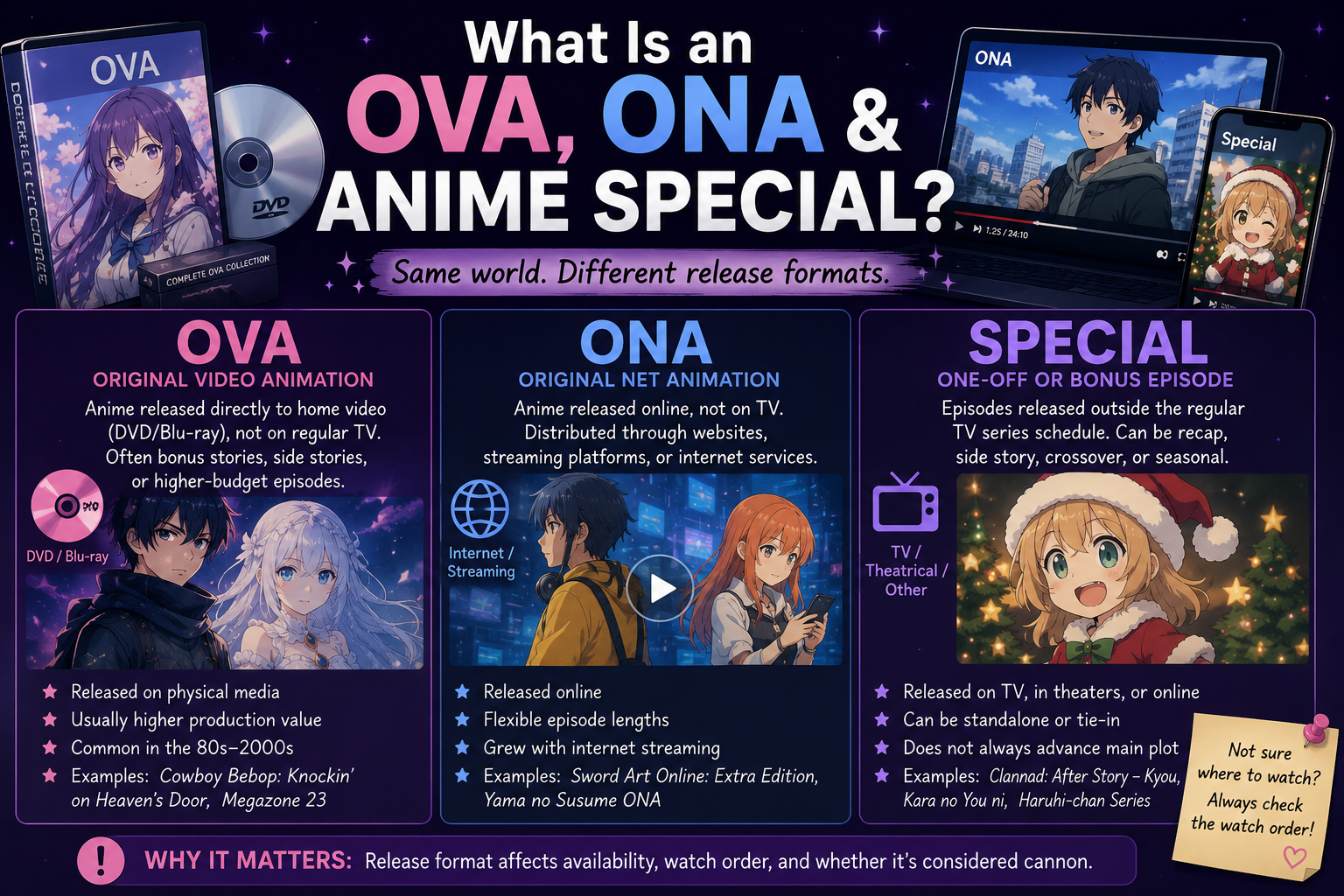
What Is an OVA, ONA & Anime Special?
You finish twelve episodes, feel reasonably confident that you watched the season correctly, and then discover an OVA, an ONA, two Specials, an unaired Episode 13, a recap nobody agrees about, and something bundled with Volume 7 of the manga six years ago. Welcome to anime release formats, where “extra episode” can describe several completely different things and the place an anime originally appeared may matter more to its label than what the story actually contains.
- Release format is not story genre
- What is an OVA?
- Why OVAs became such a big deal
- What kinds of stories become OVAs?
- What is an OAD?
- What is an ONA?
- How streaming changed the ONA
- What is an anime Special?
- Why bonus episodes get confusing
- OVA vs. anime movie
- OVA and ONA vs. TV anime
- Does release format determine runtime?
- Are OVAs and Specials canon?
- Source-material side stories
- The vacation and hot-spring problem
- Recaps and compilation Specials
- Where do I watch the extra episode?
- Episode 0, 12.5, 13 and other numbering crimes
- Why anime databases disagree
- Why streaming services may not have the OVA
- Are OVAs really higher quality?
- Why modern streaming blurs the categories
- How to identify what you found
- Common OVA, ONA & Special myths
- Why any of this matters
- Sources and deeper reading
1. OVA and ONA are release-format labels, not genres
This is the first thing I needed somebody to explain because anime databases routinely place format words beside genre words until they all begin to look interchangeable. “OVA” does not tell me whether I am about to watch romance, horror, action, comedy, or thirty minutes of characters arguing over dinner. It tells me something about the production’s original distribution path. “ONA” works the same way. The story could be almost anything, while the label tells me that its original route to the audience was online.
A Special is fuzzier because it is often a cataloging or marketing label rather than one rigid industrial format. One Special might be a new story broadcast on television between seasons, another might be a five-minute bonus included with a Blu-ray, and another may simply recap the season so viewers remember which emotionally damaged teenager owns which sword. That looseness explains why the word “Special” becomes nearly useless unless we also check what the actual release was.
| Label | What It Primarily Describes | What It Does NOT Automatically Tell You |
|---|---|---|
| OVA | Direct-to-video origin | Genre, canon status, runtime, quality, or importance |
| ONA | Internet-first distribution | Episode length, production scale, quality, or whether it later airs on TV |
| Special | Content outside or separate from the standard episode run | One standardized distribution method or story function |
| Movie | Theatrical or feature-film presentation | Canon status or whether it adapts original source material |
| TV Series | Regular television-series release structure | Whether every episode advances the source plot |
Once I separated “how it was released” from “what story it tells,” most of the vocabulary stopped fighting me. The remaining problem is that decades of changing technology have made the original distinctions much messier than the neat definitions suggest, which is exactly why the rest of this guide exists.
↑ Return to top2. What is an OVA?
An OVA is anime originally produced for release on home-video formats rather than beginning life as a normal television broadcast or theatrical feature. In earlier eras that meant formats such as videocassette and LaserDisc, while later releases moved through DVD and Blu-ray. The key word is not “video” in the modern sense that everything on your phone is technically a video. It refers to a direct-to-home-video distribution model that gave anime producers another path besides television schedules and movie theaters.
That freedom meant an OVA could be one episode, several episodes, or an entire series released volume by volume. Some were original projects built specifically for the home-video market, while others extended television franchises, adapted material that never fit inside a broadcast season, or offered fans additional stories after a series ended. The format itself never guaranteed one particular kind of content, which is why the word “OVA” covers everything from ambitious standalone productions to bonus comedy episodes attached to familiar franchises.
You may also encounter the older abbreviation OAV, meaning Original Animation Video. The terminology has varied, but OVA became the more familiar English-language fandom label. If an old catalog, DVD listing, or magazine refers to an OAV, you have not discovered a fourth secret format designed specifically to ruin your watch-order spreadsheet.
3. Why OVAs became such a huge part of anime history
The OVA format emerged during the growth of Japan’s home-video market in the early 1980s. Dallos, released beginning in 1983, is commonly credited as the first commercial OVA, and the format expanded dramatically through the 1980s and into the 1990s. Home-video buyers created a market for animation that did not have to fit ordinary television programming in exactly the same way, opening space for projects aimed directly at dedicated anime consumers.
This mattered creatively because television and theatrical distribution had their own commercial expectations, programming needs, runtime structures, and audience considerations. Direct video created another lane. Producers could attempt science fiction, fantasy, horror, experimental work, adaptations, and niche projects that might have been difficult to justify as a full television season. That does not mean every OVA was a daring masterpiece produced by moonlight and artistic freedom, but the format became associated with a particularly interesting period of anime experimentation.
The economics of physical media also shaped the experience for fans. Instead of receiving an episode every week as part of a television schedule, viewers might buy or rent individual OVA volumes over time. A multi-episode project could therefore arrive piece by piece, sometimes with substantial gaps between releases. Watching anime this way feels very different from opening a streaming service today and discovering twelve episodes waiting in a neat row.
4. An OVA can be the main story, a sequel, a missing chapter, or complete nonsense
Modern fans often encounter OVAs as bonus episodes connected to television series, which can create the impression that “OVA” means “optional extra.” Historically, that is far too narrow. Entire anime productions were made as OVAs without a television series existing first, and some were substantial multi-episode works intended to stand on their own. The format describes distribution, so a direct-to-video release can be the main adaptation rather than an appendix to something else.
Franchise OVAs, however, are where watch-order confusion really begins. A television anime can receive a later OVA that adapts a source chapter skipped during broadcast, tells a story between two existing episodes, continues the plot after the finale, or simply gives the cast a comedy adventure that would have disrupted the main season. The same label can therefore contain material ranging from “you genuinely should watch this before Season 2” to “everyone went to the beach and nothing that happens here will ever be acknowledged again.”
This is why I would never recommend skipping every OVA simply because the word looks optional. The correct question is what that specific OVA contains and where it sits relative to the main story. Format gives us the first clue. It does not make the watch-order decision for us.
↑ Return to top5. What is an OAD, and why did anime need another acronym?
You may also encounter OAD, commonly expanded as Original Animation DVD or Original Animation Disc depending on usage. The term became particularly associated with anime released on a disc bundled with a manga, light novel, or other publication rather than sold as an ordinary standalone video release. From a viewer’s perspective, an OAD often behaves much like the franchise bonus OVAs we have already discussed: it may adapt a side chapter, provide a bonus story, or fill in material surrounding the main adaptation.
The useful thing to remember is that OAD is another distribution and packaging distinction, not a separate story genre. Databases may categorize an OAD under OVA because both belong to the broader direct-to-video family, while Japanese marketing may use the specific OAD terminology for the bundled release. This is one of our first examples of why two perfectly competent databases can display different labels without one of them necessarily having lost its mind.
6. What is an ONA?
An ONA is anime originally released through the internet rather than first appearing through ordinary television broadcast, theatrical release, or direct physical video. You may also see Japanese-language discussion use terms equivalent to “web anime.” The concept became increasingly important as internet distribution developed from small web releases into the enormous global streaming ecosystem we now treat as completely normal.
This definition makes ONA sound straightforward until you remember that “released online” now describes an absurd range of productions. An ONA can be a tiny promotional short uploaded to a website, a series of five-minute comedy episodes, a polished streaming-exclusive production with standard television-length episodes, or a major international release backed by a global platform. The distribution category tells you where it premiered, while production scale, runtime, genre, and ambition remain separate questions.
An ONA can later appear on television or physical media without changing the fact that its original distribution was online. That distinction matters because databases usually classify format by the work’s original release context rather than every place it eventually becomes available. Otherwise a series would become a new format every time another distributor picked it up, and our taxonomy would collapse into a screaming pile of Blu-rays.
↑ Return to top7. Streaming made ONA both more important and more confusing
Early internet animation could feel obviously different from television: shorter episodes, experimental releases, website exclusives, promotional material, or projects built around the limits of web distribution. Modern streaming destroyed that visual shortcut. A platform-exclusive anime can now have full television-length episodes, major studios, large budgets, famous staff, international marketing, and the same visual polish viewers expect from prestigious broadcast productions. If you watched it without reading the release history, nothing about the finished episode necessarily screams ONA.
Global platforms complicate things further because international viewers often experience almost all anime through the internet anyway. A Japanese TV anime appears on Crunchyroll or another service, while an ONA also appears on a streaming service, and both are watched through the same laptop. From the viewer’s perspective they look identical: click thumbnail, episode begins. The classification only makes sense when we ask about the original distribution model, not the device you personally used to watch it.
8. “Anime Special” is the loosest label of the three
“Special” does not describe one standardized distribution pipeline the way OVA and ONA attempt to do. It is a flexible umbrella used for anime content that sits outside the regular numbered series in some meaningful way. A Special might be a longer television broadcast celebrating an anniversary, a short bonus episode included with physical media, a side story, a holiday episode, a recap, a promotional animation, a parody, or additional material produced between seasons.
That flexibility is exactly why “Special” tells me the least by itself. If a database says a franchise has three Specials, I still need to open the entries and find out what they actually are. One may be ten minutes of comedy, another could summarize an entire season, and the third might contain story material that explains why two characters suddenly behave differently at the beginning of the sequel. Same database label, wildly different value to the viewer.
A television special can also be far more substantial than the word “bonus” suggests. Japanese television has a long history of special programming, and anime can receive one-off broadcasts that do not fit the ordinary weekly episode model. Meanwhile, streaming-era databases may use “Special” to categorize anything they do not want sitting inside the main episode count. The label is therefore useful as a warning that something exists outside the normal run, but it is not enough information to tell you what that thing is.
↑ Return to top9. Why bonus episodes become watch-order landmines
A franchise may produce bonus animation for buyers of a manga volume, collector’s edition, DVD, Blu-ray, game, or other product. These episodes can reward existing fans without occupying a regular broadcast slot, which makes them commercially useful and creatively convenient. The problem for later viewers is that the episode can become separated from the product that originally explained what it was. Years later, the internet simply tells you that an unexplained Episode 13 exists somewhere.
Bonus distribution also helps explain why some extras are harder to license internationally. The main television season may have a straightforward streaming agreement, while a separate disc-bundled episode involves different rights, materials, or contracts. The result is the deeply annoying situation where a legal streaming service carries Seasons 1 and 2 but not the perfectly real episode that sits between them.
This does not automatically mean the missing episode is important. Plenty of bonus releases are intentionally lightweight. The point is that availability and narrative importance are separate questions, and streaming completeness is not a reliable measure of either one.
↑ Return to top10. OVA vs. anime movie: runtime is not the deciding factor
It is tempting to assume a long OVA becomes a movie, but release context matters more than minutes. A theatrical anime film is produced and released as a film for cinemas, even if it later appears on streaming and Blu-ray. An OVA was originally produced for home-video distribution, even if one installment runs close to feature length. Runtime can overlap, which means length alone is a terrible classification tool.
This distinction becomes especially confusing when older OVAs receive later theatrical screenings or compilation releases. An OVA can be shown in a theater after its original release without erasing its original format, just as a television episode screened at a special event does not magically become a movie. If you are trying to classify the original work, chronology matters: where was this animation actually released first, and what kind of production was it created to be?
| Question | OVA | Anime Movie |
|---|---|---|
| Original release | Home video | Theatrical exhibition |
| Can it be feature length? | Yes | Yes |
| Can it later stream? | Yes | Yes |
| Can it be part of a franchise? | Yes | Yes |
| Automatically canon? | No | No |
11. OVA and ONA vs. normal TV anime
Television anime is built around a broadcast schedule, which connects it to cours, network programming, episode slots, and the larger calendar of Japanese television. OVAs historically escaped that weekly structure because viewers bought or rented the physical release, while ONAs escape it by using direct online distribution. That freedom can affect episode length and release timing, but it does not mean the project has no schedule or production constraints of its own.
The modern distinction can feel almost invisible because a streaming-exclusive ONA may deliberately use twelve roughly television-length episodes and release them in what looks like a season. Meanwhile, a normal Japanese TV anime may be watched internationally through a streaming platform within hours of broadcast. The finished products converge while their original distribution systems remain different.
This is why Anime 101 needs both the cour explanation and this page. “Cour” helps explain the broadcast structure behind television anime, while OVA and ONA describe ways animation can exist outside that standard route.
↑ Return to top12. Does an OVA or ONA have a standard episode length?
No, and that flexibility is one of the reasons these formats are useful. A standard television slot creates practical expectations about episode length, while direct video and internet distribution can support work that is shorter or longer. An OVA episode might resemble a television episode, run much longer, or be part of a series where individual installments vary. ONAs can range from tiny web shorts to full television-length productions.
Specials are even less predictable because the label covers so many different things. A Blu-ray bonus might last several minutes, while a television Special can occupy a much larger broadcast window. Therefore “it is 45 minutes long” cannot tell you whether something is an OVA, ONA, film, or Special. Runtime is useful metadata, but original release context remains the better clue.
13. Are OVAs, ONAs, and Specials canon?
There is no universal answer because format and continuity are different questions. An OVA can adapt a canonical manga chapter that the television season skipped, which makes the story part of the original source continuity. Another OVA can contain a completely anime-original comedy adventure that never affects anything again. An ONA can be the main canonical adaptation of a property, while a Special can either continue the plot or spend fifteen minutes making the cast compete in a cooking contest.
“Canon” itself also becomes complicated when a franchise has multiple continuities. Manga canon, light-novel canon, television-anime continuity, movie continuity, game continuity, and later retcons can overlap without being identical. Asking “is the OVA canon?” therefore may require a second question: canon to which version of the story?
| Type of Extra | Possible Continuity Status |
|---|---|
| OVA adapting a manga side chapter | May directly adapt source-canon material. |
| Anime-original OVA | May belong only to the anime continuity or function as optional bonus material. |
| ONA main series | Can absolutely be the primary canonical adaptation. |
| Comedy Special | May be loosely connected, exaggerated, parody-like, or completely nonessential. |
| Recap Special | Usually retells existing events rather than adding continuity. |
The only safe method is to investigate the individual release. Check whether it adapts source material, where it sits in the anime timeline, whether later episodes reference it, and how official franchise materials describe it. Anyone who tells you “OVAs are never canon” has confused a distribution format with a continuity rule.
↑ Return to top14. Sometimes the “bonus episode” contains source material the TV anime simply had no room for
Manga and light novels often contain side chapters, bonus stories, character interludes, or smaller adventures that are difficult to fit into a cour without damaging the main pacing. Those stories become perfect candidates for OVAs or bundled episodes because existing fans already know the cast and do not need another full television slot devoted to setup. The production can preserve material that otherwise would disappear from the adaptation entirely.
This is why source readers sometimes treat a supposedly optional OVA as much more important than anime-only viewers expect. The episode may contain character development that was genuinely part of the manga, even if the main plot can technically continue without it. A friendship, joke, backstory, or relationship can feel richer after watching the extra because the source story was doing emotional work that the television adaptation skipped.
It is also why “not required to understand the plot” is a very low bar for deciding whether something is worth watching. Plenty of wonderful character material is not required to understand who punches the villain next.
↑ Return to top15. Yes, sometimes everyone really does just go to the beach
Bonus formats are perfect places for stories that would feel disruptive inside the main season. A serious fantasy can temporarily become a school comedy. A war story can send the cast to a hot spring. Characters who barely have time to breathe between disasters can suddenly spend twenty minutes shopping, cooking, celebrating a holiday, or participating in a competition nobody will mention again. These episodes can be shameless fanservice, but they can also provide something the main narrative lacks: time to watch the characters exist when the world is not ending.
Fanservice itself does not only mean sexual content. The broader idea can include material produced primarily because existing fans enjoy the cast, relationships, jokes, references, costumes, or scenarios. A bonus episode may therefore be “for the fans” because it lets two popular characters interact, adapts a beloved gag chapter, or resurrects a running joke the main plot has no room to revisit.
16. Some Specials exist because apparently we have forgotten everything
Recap episodes and compilation Specials summarize material viewers have already seen, sometimes with narration, a framing device, limited new animation, or a small amount of additional content. They can appear between cours, before a sequel, around a broadcast break, or as promotional preparation for a new release. From a franchise-management perspective, this makes sense because a returning audience may genuinely need a reminder after months or years away.
From a binge viewer’s perspective, however, a recap can feel deeply unnecessary when you finished the previous episode thirty seconds ago and remember the plot perfectly well. That difference in viewing context matters. Anime was not always designed for the future person consuming thirteen episodes in one weekend. A recap that feels redundant on streaming may have served a perfectly reasonable purpose when the original audience experienced the series according to a broadcast or release schedule.
Recaps can occasionally include enough new material that completionists still care, which is why I would check before automatically skipping one. Usually, however, the purpose is remembering rather than advancing.
↑ Return to top17. Where am I actually supposed to watch the OVA?
The format cannot answer this by itself because OVAs and Specials can occur before, during, or after the main series. Some are prequels. Some happen between specific numbered episodes. Some belong after the season finale. Others were released years later but take place much earlier in the chronology. Release order and story chronology are therefore separate pieces of information, and fandom watch guides often choose between them depending on what produces the best first-time experience.
When I am watching a franchise for the first time, I generally care most about whether the extra assumes knowledge I do not have yet or reveals information earlier than the main series intended. An OVA that technically takes place after Episode 6 may have been written after Season 1 and casually reference characters introduced much later. Chronological order would put it earlier, while release order may preserve the intended reveal structure.
| Question | Why It Matters |
|---|---|
| When was it originally released? | Shows what existing knowledge the creators could assume viewers already had. |
| When does the story occur? | Helps place the episode in the fictional chronology. |
| Does it adapt source material? | Can reveal whether it fills material omitted from the main anime. |
| Does it spoil later characters or reveals? | Chronological placement may not be the best first-watch order. |
| Is it referenced later? | May indicate whether the anime continuity expects you to know it. |
The answer is franchise-specific, which is why CVM Sekai series hubs should eventually include watch-order information instead of forcing readers to solve the same archaeological problem every time they find an OVA hiding under “Related Anime.”
18. Episode 0, 12.5, 13, 13.5, EX, Special 1 and other crimes against peaceful navigation
Anime extras are numbered according to several different logics, and sometimes no logic visible to the innocent viewer. “Episode 0” may be a prequel, preview, promotional piece, character introduction, or later-produced story set before Episode 1. “Episode 13” may be an unaired continuation of a twelve-episode TV season, while another database lists the exact same thing separately as an OVA. Decimal numbering such as 12.5 often signals something between episodes, but even that can refer to a recap rather than new story content.
Labels such as EX, Extra, Special, Bonus, Prologue, Episode XX, and unaired episode add another layer because official marketing does not need to follow the clean taxonomy a global database would prefer. Japanese packaging can use one title, a streaming service can simplify it, and fans can invent a convenient number so everyone knows what they are discussing. Years later, three names for the same twenty-four minutes circulate online.
| Label You See | What It Might Mean |
|---|---|
| Episode 0 | Prequel, preview, prologue, promotional episode, or later extra placed before Episode 1. |
| Episode 12.5 | Interlude, recap, side story, or content positioned between numbered episodes. |
| Episode 13 | Could be a normal continuation released outside TV, or simply the next numbered episode. |
| EX / Extra | Bonus material whose exact format needs further investigation. |
| Unaired Episode | Episode not included in the normal broadcast run, often released later through physical media. |
The number is therefore a clue, not proof. If a watch order looks suspicious, investigate the actual title and release instead of trusting that 12.5 mathematically belongs between Episodes 12 and 13. Anime has never shown much respect for our spreadsheets.
↑ Return to top19. Anime databases are trying to impose clean boxes on messy release history
Databases need categories because users need search filters, episode counts, related-title links, and consistent metadata. Real productions, however, do not always arrive in forms designed to make database administrators happy. A manga-bundled anime might be marketed as an OAD in Japan while a database places it under OVA. A web episode later included on Blu-ray remains an ONA by original distribution, but another catalog may emphasize the physical release. A television Special can be cataloged separately from the parent series even when official materials treat it as part of the same project.
Translation makes this even messier because English-language databases may normalize Japanese marketing terminology into categories familiar to their own users. Fan databases can also inherit classifications from older sources, change rules over time, or disagree about whether a particular release counts as an independent title. Therefore two sites displaying different format labels does not automatically mean one is incompetent. Sometimes the anime genuinely sits at the edge between the systems they use.
When classifications conflict, I care about the underlying receipt: original release date, original distribution method, official Japanese title, packaging, broadcaster or platform, and whether the work was sold independently or bundled with another product. Once those facts are clear, the database label becomes much easier to understand even if different sites still file it differently.
↑ Return to top20. Why can I stream the entire series but not the stupid OVA?
Licensing is one of the least glamorous answers and one of the most useful. The main television series, a theatrical film, a manga-bundled OAD, and a Blu-ray bonus episode can be separate pieces of media with different rights arrangements. A streaming distributor that licenses the television series does not necessarily receive every extra ever created under the franchise name. Physical-media bonuses can be particularly awkward because they were originally designed as value for purchasers rather than as ordinary standalone episodes.
Older material creates additional problems. Original contracts may predate modern global streaming, materials may sit with different rights holders, and a distributor may decide that licensing one obscure bonus episode is not worth the expense. The episode still exists, and it may even be available legally in Japan, while international viewers stare at a gap in the franchise catalog and wonder whether they hallucinated it.
This is also why piracy-era watch lists sometimes look more complete than official streaming menus. That does not make unauthorized copies the proper answer, but it does explain the user frustration. Franchise completeness and legal international availability are unfortunately not the same thing.
21. Are OVAs really higher quality than television anime?
OVAs developed a reputation for higher production values partly because direct-to-video projects were not locked into exactly the same weekly broadcast structure and could target dedicated buyers willing to pay for physical releases. Some famous OVAs absolutely used that model to deliver ambitious animation, detailed art, niche subject matter, or content that felt more luxurious than ordinary television production of the same era. That historical pattern is real enough to explain the reputation.
The mistake is turning the reputation into a rule. “OVA” does not mean “bigger budget,” and it definitely does not guarantee better animation. Production quality depends on resources, schedule, staff, scope, management, and the individual project. A cheap bonus OVA can look cheaper than the television series, while an exceptional TV episode can look better than many direct-video releases. Format can influence production conditions without becoming a quality score.
22. The old categories made more obvious sense when the delivery systems looked physically different
In the VHS and LaserDisc era, the distinction between television and direct video was visible. One anime arrived through a broadcast schedule, while another arrived as a physical product you bought or rented. The internet added another clearly different lane when web animation began appearing online. Today, nearly everything eventually reaches the same screen through streaming, and that convergence makes release-format vocabulary feel increasingly historical.
A modern viewer may watch a TV anime, an ONA, an old OVA, and a theatrical film through the exact same app on the exact same couch. Their present viewing method is identical even though their original production and distribution histories were completely different. That is why the labels remain useful for understanding anime history while sometimes feeling bizarre as descriptions of how fans actually consume media now.
Streaming also creates new hybrid situations. A project can premiere online globally, later receive television broadcasts in Japan, appear on physical media, and be marketed differently across territories. The work has moved through several channels, but its original release is still the anchor most format classifications use.
23. How to figure out what the random extra episode actually is
When a franchise page throws an unfamiliar title at me, I start with release history instead of guessing from runtime or content. Where did it premiere? Was it sold on its own disc, bundled with a manga volume, streamed through an official website, broadcast as a television event, or included as bonus material with a home-video release? That information usually explains why a database calls it an OVA, ONA, OAD, or Special.
Then I investigate story function separately. Does it adapt source material? Does it happen between episodes? Was it produced after the season but set earlier? Does it contain new plot information, or is it a recap? Those questions answer whether I should watch it and where it belongs, which is ultimately much more useful than winning an argument over whether “Special” should technically be capitalized.
24. OVA, ONA & Special myths that create unnecessary chaos
25. Why learning these formats saves you from accidentally skipping part of the story
The practical reason to understand OVA, ONA, and Special is that anime franchises do not always place every piece of story inside the clean numbered television season. A side chapter can become an OVA, an internet prologue can become an ONA, and an important bridge between seasons can appear under “Special” where a viewer understandably assumes it is optional fluff. Once you understand that these labels describe release context rather than narrative importance, you stop using the acronym itself as the skip button.
The historical reason is even more interesting. OVAs reveal how strongly physical media once shaped anime production, while ONAs show the industry’s transition into internet distribution and global streaming. The format tells us something about what kinds of business models and technologies were available when the animation was made. A 1980s OVA and a modern streaming-exclusive ONA may both sit outside normal television, yet they represent completely different moments in how anime reached its audience.
The terminology also teaches us to stop expecting one metadata label to answer every question. Format does not equal genre. Format does not equal canon. Format does not equal quality. Format does not tell us watch order. Those are separate layers, and anime becomes much easier to navigate once we stop making three letters carry an entire franchise on their back.
Most importantly, it changes how I build a series hub. I do not want a page that simply lists “TV, OVA, Movie” and assumes the reader already understands what those entries mean. I want somebody to know whether the extra contains a missing source chapter, when to watch it, whether it advances the anime continuity, and why it may be absent from the streaming service carrying the rest of the franchise. That turns a database listing into something actually useful.
Anime watch order should not require the investigative skills of a tax auditor
I understand why this vocabulary exists once I look at the history. OVA made perfect sense when an anime literally arrived as a video you bought instead of something that aired on television. ONA makes sense when the internet becomes another original distribution route. “Special” is where everyone apparently shrugged, threw several unrelated forms of extra content into a basket, and trusted future viewers to figure it out.
The problem is that streaming flattened all those delivery systems into the same interface. I click Episode 1 regardless of whether the production began on Japanese television, a website, Netflix, VHS, or a ceremonial stone tablet discovered behind Studio Pierrot. The old distinctions are still useful for understanding what was made, but they are no longer visually obvious to the person watching. That is how you end up discovering three years later that the “bonus OVA” was an adaptation of an actual manga chapter you would have loved.
I also think fandom made this harder by turning “OVA” into shorthand for “probably non-canon bonus thing.” Sometimes that happens. Sometimes the OVA is exactly that. Then another series uses an OVA to continue the story or adapt material cut from television, and suddenly the shortcut falls apart. The acronym was innocent. We assigned it a personality.
So my rule is simple now: I never decide whether an extra is worth watching from the format label alone. I want to know what it adapts, when it was released, where it fits, and whether the main series expects me to have seen it. If the answer is “none of this matters, but everybody wears ridiculous costumes for twenty minutes,” I may watch that too. I contain multitudes.
OVA, ONA, and Special tell you how anime escaped the normal episode box. They do not tell you whether what escaped is important.
Sources and deeper reading
Format terminology has evolved alongside physical media, television, web distribution, and modern streaming, so specific anime can sit awkwardly between simplified definitions. For individual titles, I prefer original Japanese release information, official studio or franchise pages, packaging, broadcaster records, and platform announcements over guessing from runtime or story content.
- Anime! Anime! · OVA 30th Anniversary / Dallos and the Early OVA Era · Japanese industry coverage identifying the 1983 release of Dallos with the beginning of commercial OVA history.
- Anime! Anime! · Japanese OVA Retrospective · Discussion of the direct-video OVA market from the 1980s through the early 2000s and the kinds of projects the format supported.
- Studio Pierrot · Official OVA Archive · Primary studio examples of OVA productions across multiple franchises.
- Official anime franchise sites and Japanese home-video listings · Best sources for checking whether a specific extra originated as OVA, bundled OAD, TV Special, or another release.
- Official streaming-platform and production announcements · Useful for confirming internet-first releases and modern streaming distribution.
- CVM Sekai Anime 101 · What Is a Cour? · Japanese television scheduling and why regular anime seasons so often land around twelve or thirteen episodes.
- CVM Sekai Anime 101 · How Manga & Light Novels Become Anime · How source material is selected, compressed, moved, expanded, and sometimes adapted outside the main television run.