
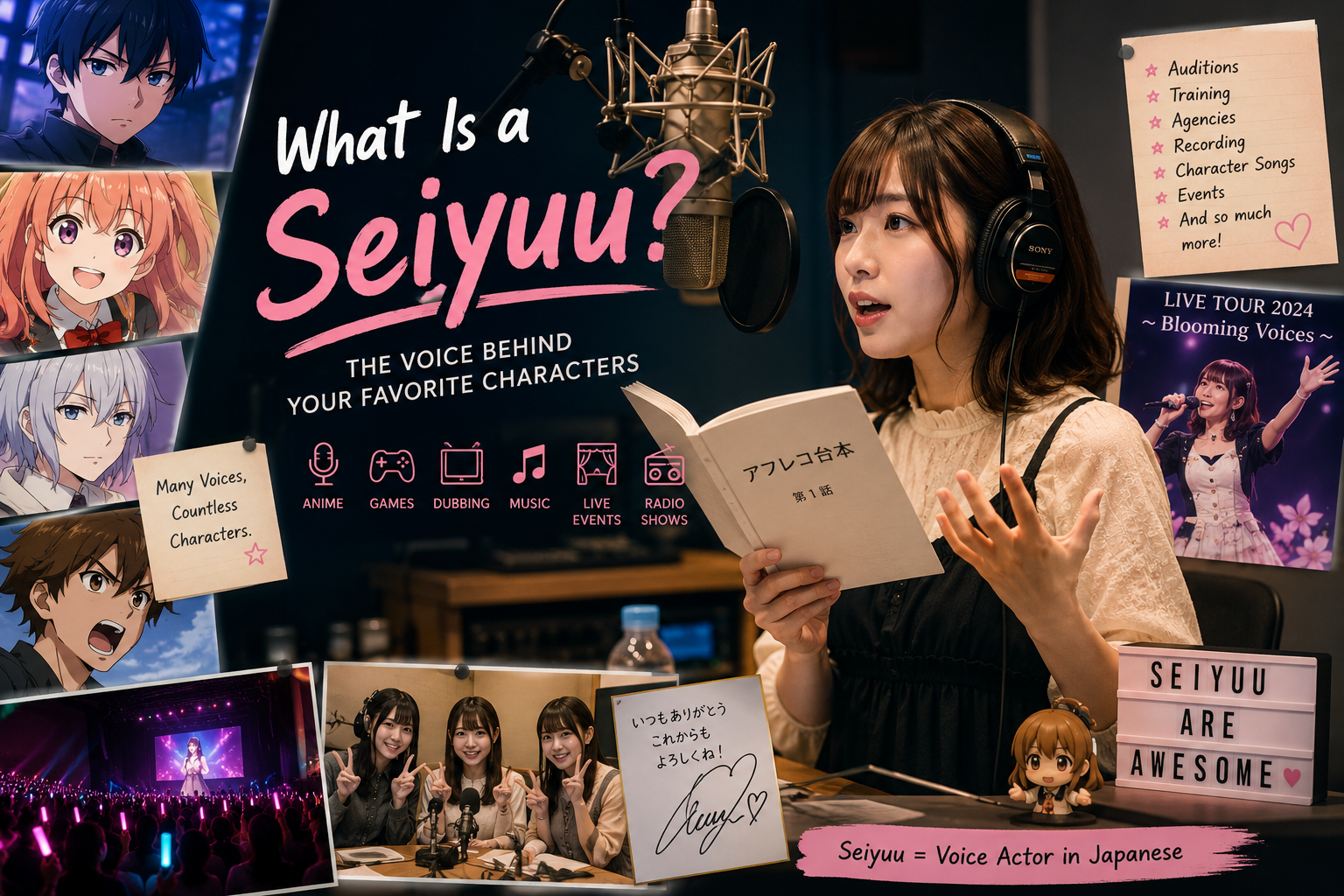
What Is a Seiyuu?
“Seiyuu” usually gets translated as “Japanese voice actor,” which is correct enough to get you through the door and nowhere near enough to show you the whole room. In Japan, voice performers can work across anime, games, foreign-film dubbing, narration, radio, music, character songs, promotional programs, and live events. Some remain primarily actors behind the microphone, while others build public careers with fandoms that follow the performer almost as closely as the characters they play.
- What does seiyuu mean?
- Is a seiyuu just a Japanese voice actor?
- What kind of work do seiyuu actually do?
- How are anime roles cast?
- What happens during anime recording?
- Why voice acting is still acting
- How do people become seiyuu?
- Why agencies matter
- Seiyuu in video games
- Foreign-film and television dubbing
- Character songs and music careers
- Radio, streams, and promotional programs
- Live events and stage appearances
- When the performer becomes a celebrity
- How one voice becomes many characters
- Why learning seiyuu credits changes how you watch
- Seiyuu fandom
- Common seiyuu myths
- Why any of this matters
- Sources and deeper reading
1. What does “seiyuu” actually mean?
The Japanese word 声優 is commonly romanized as seiyuu or seiyū. The first character, 声, relates to voice, while 優 appears in words connected to performers and actors. In normal English-language anime fandom, “seiyuu” generally means a Japanese voice actor or voice performer, especially someone working in anime, games, dubbing, and related entertainment.
That sounds simple, but the cultural baggage surrounding the word can be much larger than the English phrase “voice actor” suggests to a casual viewer. Japanese voice performers can build careers that cross several entertainment industries, and some develop a recognizable public identity outside the recording booth. A fan may first notice a performer because of one anime character, then follow that person’s game roles, radio appearances, concerts, interviews, live events, music releases, and later characters. At that point, the fandom is no longer only following the fictional role. It is following the actor.
2. Is a seiyuu just a Japanese voice actor?
Yes in the basic sense, but that translation can make international fans underestimate how visible the profession can become. English-speaking viewers may think of voice acting primarily as a job where an actor performs a character and then disappears behind the finished animation. Japan certainly has performers whose careers remain focused on acting work, but the broader seiyuu industry also contains performers who are marketed publicly, appear in magazines, host programs, release music, attend fan events, perform on stage, and build personal fandoms.
The difference is not that Japan invented celebrity voice actors. Other entertainment industries have famous voice performers too. The useful point is that anime, games, music, character marketing, and promotional culture can overlap heavily enough that the seiyuu becomes part of the way a franchise is sold and experienced. A viewer can recognize a performer’s name before even knowing the new character they are playing, and casting announcements can generate attention because of the actor attached to the role.
3. What kind of work does a seiyuu actually do?
Anime is the most obvious answer for anime fans, but a professional voice career can be much broader. A performer may record recurring television characters, one-off guests, theatrical animation, games, commercials, narration, audio dramas, educational content, promotional videos, and Japanese dubs of foreign media. Some jobs are highly visible to fans, while others may be ordinary professional voice work that never produces a character poster or screaming convention audience.
The workload also differs enormously from project to project. A supporting character in a television episode might require relatively limited dialogue, while a major game character can involve an enormous library of battle lines, emotional scenes, event dialogue, alternate interactions, menu voices, and future updates recorded across long periods of time. A performer therefore is not simply showing up once, saying the lines, and permanently becoming “the voice of that character.” Maintaining a role can become an ongoing acting job.
4. How does an anime role get cast?
There is no single casting process that applies identically to every anime, but auditions and production-side selection are common parts of the industry. Producers, directors, sound directors, agencies, and other people involved with the project can participate in finding a performer whose voice and acting fit the character. The production may already have a very specific vocal idea in mind, or the audition itself may reveal a version of the character nobody expected.
This is where “voice type” and acting ability separate. A performer may have a naturally recognizable voice, but casting is not simply matching a pitch to a drawing. The actor has to understand timing, intention, emotional shifts, comedy, breath, physical effort, and the relationship between the character and everyone else in the scene. A voice that sounds perfect in an isolated audition line may not necessarily create the right chemistry inside the larger cast.
Famous performers can obviously bring name recognition to a project, but a recognizable name does not mean every casting decision is based on celebrity. Anime regularly introduces newer actors alongside veterans, and one role can become the performance that suddenly makes a previously less familiar name visible to a much wider audience. That is part of what makes following credits interesting: you can sometimes watch a career change in real time because one character hits much harder than anyone expected.
↑ Return to top5. What actually happens during anime recording?
Anime voice recording is not the same thing as reading a finished comic aloud. Performers work with scripts, visual material, timing cues, direction, and other actors while trying to create a performance that fits animation that may be at different stages of completion. Depending on the production schedule, the visual material available during recording can range from more complete animation to rougher timing references, storyboards, or incomplete imagery. The actor still has to sell the scene even when what is on the screen is not the polished episode viewers eventually receive.
Ensemble interaction matters too. Anime dialogue often depends on how actors respond to one another rather than performing every line as an isolated clip. Comedy can depend on interruption and timing. Arguments need escalation. Emotional scenes require characters to react to each other’s energy. A good performance therefore is not merely producing a beautiful voice on command. The actor has to listen, adjust, and understand where the scene is going.
| What Viewers Hear | What the Actor Is Actually Managing |
|---|---|
| A simple conversation | Timing, intention, relationship, pacing, emotional subtext, and reaction to other actors. |
| A battle scream | Physical effort, vocal safety, character state, intensity, and consistency across takes. |
| A quiet “I’m fine” | Whether the character means it, lies about it, wants someone to challenge it, or is trying not to cry. |
| A comedy reaction | Pause length, volume, speed, exaggeration, and how the line lands against the previous performance. |
| A recurring catchphrase | Consistency with the character while keeping repeated dialogue alive rather than mechanical. |
6. Voice acting is acting, and the absence of a visible body does not make it easier
One of the weirdest misconceptions about voice work is the idea that the actor is simply choosing a funny or attractive voice and keeping it consistent. Character voice is only the surface. Underneath it, the performer still has to create intention, emotion, rhythm, hesitation, fear, attraction, irritation, exhaustion, embarrassment, confidence, and everything else an on-screen actor communicates through face and body.
The challenge is that many of those tools have to be translated into sound. A character cannot rely on the actor’s facial expression because the audience never sees the actor. Breath becomes acting. Silence becomes acting. The difference between speaking directly and looking away has to be suggested through performance that matches the animated body. Physical effort during a fight has to sound as though the character is actually moving, falling, straining, or taking a hit rather than standing comfortably in a booth.
This is also why talented seiyuu can be difficult to recognize between roles. Some performers have highly distinctive natural voices, but acting choices still allow them to change age, energy, rhythm, posture, emotional temperature, and personality so dramatically that two characters may sound unrelated until the credits expose the trick.
7. How do people become seiyuu?
There is no single path. Aspiring performers may attend specialized voice acting schools, vocational programs, training academies connected with talent agencies, universities, theater programs, or other performance training. Some come from acting backgrounds, while others enter specifically because they want to work in animation or games. Training can involve acting, vocal technique, pronunciation, microphone technique, script interpretation, movement, singing, narration, and the practical skills needed to work inside a recording environment.
The glamorous version of the story is that somebody attends school, auditions, lands a beloved protagonist, and becomes famous. Real entertainment careers are less cooperative. New performers compete for roles, build credits slowly, work smaller jobs, maintain relationships with agencies and production staff, and may spend years before receiving a role that makes general anime fans recognize their name. Even talented performers can have unstable or uneven career trajectories because acting work is still acting work, complete with competition, timing, luck, networking, and the eternal problem that there are more people who want major roles than major roles available.
↑ Return to top8. Why do seiyuu agencies matter?
Talent agencies represent many Japanese voice performers and can play a major role in career management, auditions, professional relationships, scheduling, promotion, and the business side of employment. Agencies differ in size, history, training systems, specialties, and the performers they represent. For fans, agency information can look like trivia until you start following careers and notice how much professional infrastructure sits behind the name in the anime credits.
Agency affiliation can also change over time. Performers may move between agencies, become freelance, or alter how they manage their careers. This is another reason an individual seiyuu profile can be much more interesting than a simple role list. The person behind the character has a professional career with representation, auditions, job transitions, training history, and industry relationships that continue long after one anime ends.
9. Games can turn one character into years of recording
Video games are a massive part of modern voice work, especially because a game character can require far more recorded dialogue than an anime viewer might expect. A role can include main-story scenes, battle shouts, damage reactions, menu lines, seasonal events, alternate costumes, special interactions, promotional material, updates, and entirely new story chapters added years after release. One character may therefore return to the studio repeatedly rather than being recorded during one tidy production window.
Games also create acting problems that television does not. Dialogue may be recorded in pieces that players encounter in different orders. Battle lines have to remain energetic even after repetition. A character may need several emotional variations of the same basic action because gameplay can trigger them under different conditions. Branching stories and player choices create additional continuity challenges because the actor may be performing scenes whose final sequence depends on what the player does.
This is one reason anime fans who start following seiyuu often discover that a performer’s career is much larger than their MyAnimeList-shaped mental map. The actor may have major game characters with enormous fandoms that anime-only viewers barely know, while game fans recognize the same voice instantly and have an entirely different list of iconic roles.
↑ Return to top10. Seiyuu also dub foreign films, television, and animation into Japanese
Japanese voice performers are not limited to Japanese-created characters. Foreign films, television series, and animated productions released in Japan may receive Japanese-language dubs, creating another major area of professional voice work. A performer known internationally for anime can therefore have an extensive dubbing career attached to Hollywood actors, foreign television characters, or overseas animation.
Dubbing creates a different technical problem because the original performance already exists. The Japanese actor has to create a believable interpretation while working around timing, mouth movement, the meaning of the translated dialogue, and the emotional choices visible in another actor’s performance. The goal is not necessarily to imitate the original voice exactly. The Japanese performance still has to function naturally for the target audience while fitting a piece of visual acting that has already been filmed or animated.
↑ Return to top11. Why are some seiyuu also singers?
This is where the industry starts becoming gloriously tangled. Some voice actors pursue music careers under their own names, while others perform songs as their characters. Anime franchises may release character songs, image songs, theme music, group tracks, albums, concert performances, or other projects that connect the fictional character with the real performer’s singing ability. A seiyuu can therefore move from acting a character in a studio to performing music associated with that same character in front of a live audience.
Not every seiyuu is a singer, and singing is not a universal requirement for voice acting. The overlap becomes especially visible in idol franchises, rhythm games, multimedia projects, and series where music is part of the characters’ identity. In those spaces, casting may involve more than acting ability because the performer may also be expected to sing, appear at events, participate in promotional content, or perform alongside the rest of a character group.
This distinction matters because fans can conflate the performer and the character. A character song belongs to the fictional project even though a real actor performs it. A personal single belongs to the performer’s own music career. The same voice may be singing both, but the artistic identity being presented is different.
↑ Return to top12. Radio shows, streams, and promotional programs let fans meet the performer instead of the character
Anime and game franchises frequently use talk programs, livestreams, radio shows, interviews, behind-the-scenes segments, and promotional broadcasts to keep fans engaged outside the main story. Seiyuu are natural participants because they already embody the characters publicly and can discuss recording, perform games or challenges, promote new episodes, react to fan messages, and build chemistry with castmates in ways the fictional characters never could.
This is where fans start learning personalities. The frightening villain’s voice actor may turn out to be hilariously soft-spoken. Two characters who hate each other on screen may have actors who cannot stop laughing together. A performer with an elegant character voice may be chaos in every promotional program. Those contrasts create another layer of fandom because viewers begin separating the fictional persona from the actor and enjoying both.
13. Live events make seiyuu part of the public face of a franchise
Voice performers may appear at anime conventions, franchise events, stage programs, screenings, anniversary celebrations, concerts, game promotions, and other live productions. These appearances can range from ordinary cast discussion panels to elaborate events where performers read scenes live, sing character songs, recreate famous dialogue, play games, or interact with thousands of fans.
The interesting part is that the seiyuu becomes a bridge between fiction and reality. Fans cannot meet the animated character, but they can cheer when the actor delivers that character’s famous line on stage. The performer is still a real person with their own identity, yet the audience’s emotional connection often arrived through the fictional role first. Franchises can use that connection very effectively because the actor carries part of the character’s emotional recognition into the live space.
14. When does a seiyuu become a celebrity?
There is no magical line where a professional actor suddenly becomes “celebrity seiyuu,” but visibility can build through major roles, repeated successful casting, music, media appearances, awards, concerts, social media, magazines, radio, and a fanbase that follows the performer across projects. At a certain point, the seiyuu’s name itself can become promotional value. A new casting announcement gets attention because fans already know the actor and have expectations about what they might bring to the character.
That recognition can also change the way viewers encounter new anime. Instead of meeting a character with no expectations, the audience may hear the voice and immediately remember three previous roles. Sometimes that is part of the fun. A familiar performer can create excitement before the character has even done anything important. The downside is that extremely recognizable voices can make viewers struggle to separate the new role from an iconic older one, especially when the vocal register is similar.
Fame also means seiyuu fandom can become separate from anime fandom. Some fans watch shows primarily because a favorite performer is cast. Others follow live events, music, radio, or games without caring deeply about every anime role. Once you reach that stage, the seiyuu is no longer simply a credit attached to the character. They are an entertainer with a career of their own.
↑ Return to top15. How can one person sound like completely different characters?
Vocal range helps, but the bigger answer is acting. A performer can change pitch, rhythm, breath, resonance, energy, pronunciation, emotional restraint, physical effort, and the speed with which a character responds to other people. An elderly character is not simply “lower voice.” A child is not just “higher voice.” Personality lives in how the character thinks and reacts, and the actor has to make those choices audible.
Some seiyuu are famous for enormous vocal range, while others build careers around a highly recognizable sound that remains distinct even when the character changes. Neither approach is inherently better. A recognizable voice can be an asset because audiences love hearing it, while a transformative performer can create the delightful experience of discovering that two characters you never connected were played by the same person.
| Performance Tool | What It Can Change |
|---|---|
| Pitch | Apparent age, energy, vocal size, and character impression. |
| Rhythm | Confidence, awkwardness, intelligence, impulsiveness, or emotional control. |
| Breath | Fear, exhaustion, attraction, physical effort, illness, or hesitation. |
| Volume | Power, restraint, insecurity, anger, or intimacy. |
| Speech style | Personality, social position, politeness, roughness, age, or regional flavor. |
| Emotional timing | Whether the audience hears a thought forming, a lie beginning, or a feeling being suppressed. |
16. Learning seiyuu names changes the way you watch anime
Before you recognize voice actors, the voice feels like it belongs entirely to the character. Once you start recognizing performers, another layer appears. You notice casting patterns, recurring partnerships, dramatic range, unusual vocal choices, and the way one performer handles completely different kinds of characters. Credits stop being administrative text and start becoming part of how you understand the production.
This is one reason I wanted a voice-actor directory inside CVM Sekai rather than treating seiyuu as tiny facts buried at the bottom of character pages. A character belongs to one world, but the actor travels across dozens of worlds. Following the performer connects franchises that otherwise have absolutely nothing to do with each other. The same person may be a ninja in one series, a salaryman in another, a villain in a game, and the Japanese dub voice of a foreign movie character somewhere else.
17. Seiyuu fandom is its own ecosystem
Some fans follow performers with the same energy other people follow singers, actors, athletes, or idols. They watch casting announcements, collect magazines, follow social media, attend events, buy music, watch radio clips, discuss agencies, celebrate birthdays, recognize recurring cast combinations, and keep track of upcoming roles. That fandom overlaps with anime fandom but is not identical to it.
This can also influence how franchises are promoted. A cast full of popular performers gives marketing teams recognizable names to use in trailers, interviews, event posters, and announcements. Fans may become interested in a new project before they understand the plot simply because several actors they already love are involved. That does not mean star casting replaces the character, but it shows how the real performer can become part of the franchise’s appeal.
The relationship can become especially strong in music-heavy multimedia projects because audiences are asked to care about both the fictional group and the real performers. A character may have an animated concert while the seiyuu performs the song live at an event, creating two parallel versions of the same entertainment property. At that point, trying to separate “anime fandom” from “seiyuu fandom” with a clean knife becomes almost impossible.
↑ Return to top18. Seiyuu myths that flatten a much more interesting profession
19. Why knowing what a seiyuu does makes anime more interesting
Once you stop treating the voice as something that simply comes attached to the character, you begin hearing performance choices. The tiny pause before a confession becomes intentional. The difference between a villain sounding calm and sounding emotionally empty becomes acting rather than “cool voice.” A character’s breathing during a fight starts carrying physical information. You notice when a comedy line works because the actor waits half a second longer than expected, or when a supposedly confident character keeps swallowing words whenever one specific person enters the scene.
You also start understanding why casting announcements matter. The actor brings a professional history, vocal identity, skill set, and audience with them. A veteran performer being cast against type can become interesting before the anime even airs. A newcomer landing a major protagonist can become a career moment. A franchise built around music may need actors who can sustain live performance as well as studio acting. The cast list is not decoration sitting under the production credits. It is part of how the characters will exist.
The biggest payoff for me is that it connects anime to the people actually making it. We spend so much time talking about fictional characters that it is easy to forget the emotional performance came from a human being standing in front of a microphone, interpreting words, reacting to direction, and trying to make us believe the animated person on screen is alive. Once you hear that layer, you cannot completely unhear it.
Voice actors are one of the fastest ways anime turns into a giant interconnected universe
I used to look at voice-actor credits as useful information, which is apparently the gateway drug. Then you start recognizing voices. Suddenly one character opens their mouth and your brain goes, “I KNOW YOU,” even though the person on screen is a completely different age, species, moral alignment, and possibly not even human. Then you check the cast list, confirm you were right, and receive a tiny unnecessary dopamine reward for identifying a stranger from three syllables.
The fun part is that following seiyuu completely destroys franchise walls. Characters live inside their own worlds, but actors do not. One performer can connect Naruto to another anime, that anime to a game, the game to another cast member, and suddenly your neat little fandom database has become a web. That is exactly why I like the idea of having seiyuu profiles as their own layer instead of burying them as trivia inside character pages.
It also changes how I think about scenes. If a character is supposed to sound angry but the actor leaves a tiny shake underneath the line, maybe the character is actually scared. If somebody says a perfectly polite sentence with enough venom to sterilize a room, that is performance. The animation gives us the face and body, the script gives us the words, and the seiyuu helps decide what those words feel like when they finally reach us.
A seiyuu does not merely give a character a voice. The performance helps decide who that character becomes in our head.
Sources and deeper reading
Seiyuu careers vary enormously. Some performers focus heavily on animation, others build large game or dubbing careers, and some expand into music or public entertainment work. For individual performers, agency biographies, official profiles, production credits, and franchise announcements are the best receipts for current representation and specific roles.
- Japanese talent-agency profiles · Useful primary sources for current agency affiliation, official biography information, and professional credits.
- Official anime and game cast pages · Primary sources for confirming performers attached to specific characters and productions.
- Franchise event and music pages · Useful for confirming character songs, concerts, live appearances, and promotional participation.
- Japanese-language dubbing credits · Useful for tracing seiyuu careers outside anime into foreign film, television, and animation.
- CVM Sekai · Anime Voice Actors Directory · Individual performer profiles and cross-franchise role connections.
- CVM Sekai Anime 101 · How Manga & Light Novels Become Anime · How source stories move into animation and where acting enters the process.
- CVM Sekai Anime 101 · What Is a Japanese Anime Production Committee? · The business structure behind many Japanese anime productions.