
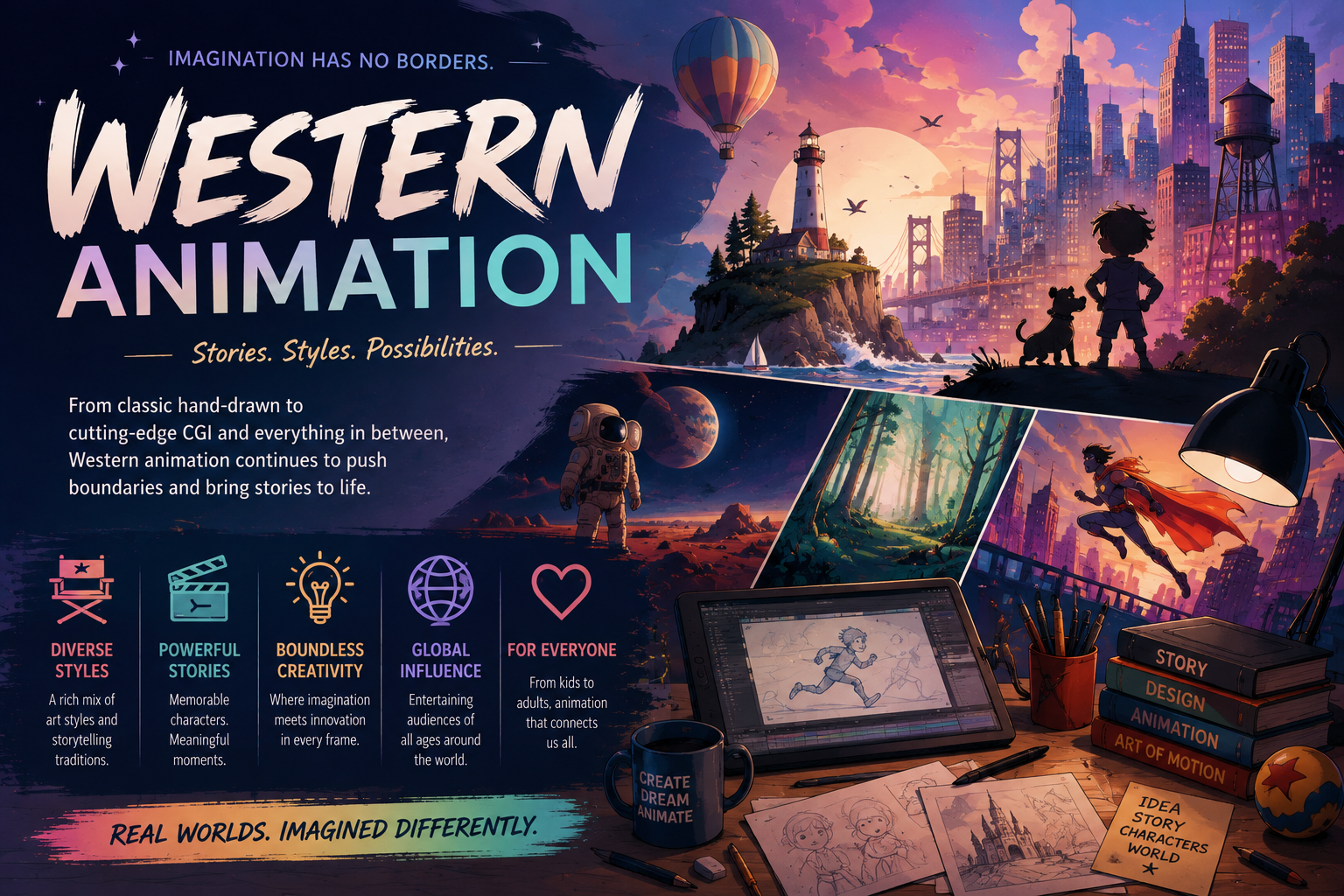
Western Animation
Western animation is much larger than one studio, one country, or the idea that cartoons are supposed to keep children quiet before dinner. The tradition includes theatrical shorts, family features, adult comedy, political satire, superhero stories, experimental films, preschool television, music videos, stop motion, independent work, streaming series, and animation made across the Americas, Europe, Australia, and other connected production markets.
This hub follows the art, labor, technology, business, and cultural arguments behind those productions. CVM Sekai will add individual films, series, franchises, reviews, and Rants as the library grows. The larger history belongs here first, because Disney is important and still does not own the entire idea of Western animation.
What counts as Western animation?
Western animation generally refers to animated work developed in Europe, North America, Latin America, Australia, and related production traditions. The label is convenient when a reader needs to distinguish those histories from Japanese anime, Chinese donghua, or Korean animation. Convenience should not turn dozens of countries into one culture. French animation does not carry the same industrial history as American network television. British stop motion does not behave like a Hollywood computer-animated feature. Canadian public broadcasting, Irish studio work, Czech puppet animation, Mexican filmmaking, and Brazilian television cannot be flattened into one American family-cartoon shelf.
The border also becomes blurry the moment the credits roll. A series conceived in California may be animated by teams in South Korea, the Philippines, Canada, Japan, France, Ireland, or several countries at once. A European company may co-produce with an American distributor. A streaming platform may fund a project led by artists whose influences cross anime, comics, games, fine art, and internet animation. “Western” describes a production and market history better than a guaranteed visual style.
Animation is a medium, not a genre. The same tools can create a preschool lesson, a brutal war story, a quiet romance, an abstract short, a superhero fight, a workplace comedy, or a musical fantasy. The belief that live action is the normal adult form and animation is a colorful children’s category has damaged criticism, marketing, awards, financing, and the willingness of audiences to try work outside familiar brands.
Western animation did not begin with one mouse
Artists experimented with moving images long before synchronized sound or feature-length cartoons became standard. Optical toys, projected drawings, stop-motion experiments, trick films, and hand-drawn shorts helped establish the basic idea that still images could create life through timing. Early animation was tied to vaudeville, newspaper comics, stage performance, advertising, and the broader invention of cinema. The medium grew through many artists and companies rather than waiting for one studio to switch on the lights.
Silent-era creators tested character animation, transformation, visual comedy, and the relationship between a drawn figure and the artist’s hand. Winsor McCay’s work demonstrated expressive movement and personality while also revealing how labor-intensive animation could become. European artists pushed silhouette animation, abstraction, puppetry, and experimental form. Lotte Reiniger’s The Adventures of Prince Achmed showed that a feature-length animated world could be built through intricate cut-paper silhouettes years before American theatrical features became dominant.
American studios industrialized short animation through departments, recurring characters, theatrical distribution, and tightly organized production pipelines. Disney changed the field through sound, character acting, color, multiplane photography, feature production, and aggressive control of intellectual property. Warner Bros., Fleischer Studios, MGM, UPA, and other companies developed different comic rhythms, designs, audiences, and attitudes. Treating every achievement as one studio’s invention erases competition and makes animation history read like corporate mythology.
The theatrical short eventually lost its regular place before feature films, while television created a new need for large amounts of affordable weekly material. Limited animation became an economic strategy and a visual language. Fewer drawings did not automatically mean less creativity. Strong posing, graphic design, reusable cycles, expressive voices, sharp writing, and careful timing could carry a show when feature-level movement was impossible on a television budget.
Television changed how cartoons were made, sold, repeated, and remembered
Television animation entered homes on a schedule. Characters returned every week, episodes repeated for years, and children could build deep familiarity with a series long after production ended. The format encouraged recognizable silhouettes, reusable locations, strong voice casts, theme songs, commercial breaks, and stories that could survive reruns shown out of order.
Broadcast rules and advertising shaped the work. Some shows existed partly to support toys. Educational requirements encouraged specific kinds of programming. Standards departments controlled violence, language, and behavior. Saturday morning became a powerful American viewing habit, but syndication, cable channels, public broadcasting, and weekday blocks mattered just as much. Television created shared childhood memories while also teaching generations of viewers that animation belonged in a narrow age box.
Cable and creator-driven television widened that box. Networks devoted to cartoons needed more material and became willing to support stranger voices, serialized stories, visual experiments, and comedy that addressed older viewers. The result was not one clean revolution. Corporate ownership, branding, ratings, merchandise, censorship, and cancellation still controlled which ideas survived. Creator recognition grew, but the network logo often remained more famous than the artists and production crews.
Feature animation keeps reinventing the audience
American feature animation spent decades wrestling with the financial shadow of Disney. Other studios could succeed, but distributors and audiences often treated one company’s musical family fantasy as the default definition of an animated film. Don Bluth’s work, stop-motion features, independent productions, and international releases kept challenging that assumption. The market expanded again when computer animation proved that audiences would follow a different surface style, although the new technology soon created its own formulas.
Pixar helped popularize fully computer-animated features through films built around clear emotional structures, comic ensemble casts, technological craft, and stories designed to work for children and adults at once. DreamWorks developed a more openly sarcastic personality before stretching into action, fantasy, and stylized visual approaches. Laika treated stop motion as a physical performance medium rather than a nostalgic trick. Sony Pictures Animation’s more recent work helped push mainstream computer animation away from polished sameness through graphic textures, stepped movement, comic-book language, and visible design choices.
European feature animation often survives through co-production, public funding, broadcasters, cultural programs, and distribution networks that differ from Hollywood’s blockbuster system. Those structures can support unusual subjects and visual styles, but funding across several partners may create its own long negotiations. Independent American features face a different wall: animation costs time and labor before a distributor knows whether the finished film can find an audience.
The rise of streaming created more buyers and more uncertainty. Platforms can expose viewers to animation they would never find in a local theater. Platforms can also remove titles, hide viewing data, cancel work quickly, and treat finished productions as disposable catalog pieces. Availability is not preservation. A film that exists only inside one company’s library can vanish from public reach when a contract changes.
Drawn animation can be lush, limited, graphic, realistic, elastic, or deliberately rough. The technique does not dictate the audience.
Puppets, sets, replacement faces, lighting, and frame-by-frame physical movement create a presence computer images imitate differently.
CGI can support realism, painterly surfaces, graphic exaggeration, hybrid movement, or bland sameness. Artistic choices still decide the result.
Animation is global labor hidden behind familiar brands
A finished production may involve directors, storyboard artists, designers, layout teams, animators, riggers, modelers, texture artists, lighters, compositors, editors, writers, voice performers, sound crews, musicians, production coordinators, technical directors, and support staff across several countries. The public often talks about a movie as if a studio logo drew the whole picture. Credits tell a less convenient story.
Outsourcing became central to many Western television pipelines. Overseas studios handled substantial animation work while the commissioning company retained ownership, public recognition, and final control. That structure helped make weekly television possible and supported major animation industries abroad. The structure also encouraged audiences to ignore the workers outside the country named in the marketing campaign.
Labor disputes repeatedly expose the gap between animation’s cultural value and the conditions offered to artists. Long hours, unstable contracts, production crunch, layoffs, canceled projects, residuals, artificial-intelligence concerns, and the disappearance of completed work all affect the people behind the characters. Loving animation should include caring whether artists can build a life while making the stories audiences claim to treasure.
Technology changes jobs without removing the need for judgment. Computer tools changed drawing, coloring, camera work, modeling, compositing, and editing. New tools can reduce repetitive work, but corporate promises about efficiency often become excuses to cut time, staff, and pay. Faster production does not automatically create better movement, stronger acting, or a story worth watching.
Adult animation can do more than repeat the sitcom with fewer limits
American prime-time animation proved that cartoons could hold large adult audiences, but success created another narrow formula. Family sitcom structures, cynical humor, shock, and celebrity voices became easy signals that a cartoon was “not for kids.” Those tools can work. The problem arrives when adult animation mistakes permission to swear for a complete artistic identity.
Animation can approach memory, sex, grief, politics, addiction, war, class, religion, disability, aging, and identity with images that live action cannot reproduce in the same way. European and independent traditions have explored adult subjects for decades through satire, surrealism, documentary, graphic novels, fine art, and personal filmmaking. A serious subject does not require photorealism, and a funny drawing does not erase emotional weight.
The strongest adult animation uses form as part of the argument. Distorted bodies can express fear. Repeated movement can expose routine. A painted environment can turn memory into a place. Stop-motion materials can make a household feel fragile or trapped. When the visual approach only decorates dialogue that could have been filmed cheaply in a room, the production leaves most of animation’s power unused.
Western films, series, and franchises belong to the same animation library
CVM Sekai organizes animation by the work, not by a fake wall between theatrical movies, television series, shorts, specials, and mixed franchises. A property with several series, films, books, games, or shorts can lead to a franchise hub. A standalone film can lead directly to its review until enough related coverage exists to justify a mini-hub. Every card must use the linked page’s featured image as its card, hero, and social image.
Browse the live library
The Animation Library contains the finished pages currently available across animation traditions. Western coverage will grow title by title instead of using empty promotional cards to pretend the shelf is fuller than the published work.
Open the Animation Library Browse Animated MoviesWhere to keep learning
The Academy Museum of Motion Pictures presents film and animation history through exhibitions and collections. The Library of Congress preserves moving-image materials and documents American film history. The British Film Institute covers British and international animation, while the Annecy International Animation Film Festival remains a major meeting point for animation from around the world. Individual film credits, union records, studio archives, artist interviews, and preservation organizations are necessary when corporate histories leave workers outside the frame.
Western animation does not need another speech about cartoons growing up
Animation was never born childish and finally rescued by one edgy series. Adults kept deciding which productions received money, distribution, criticism, preservation, and shelf space. Then the same adults acted surprised whenever an animated story handled grief, politics, violence, desire, or class with more honesty than a prestige drama.
The better question is not whether animation can be serious. The better question is why audiences and executives keep demanding proof from a medium that has already answered them for more than a century. Western animation contains an enormous range of work. My library needs to respect that range without letting the most famous American companies swallow everybody else’s history.