
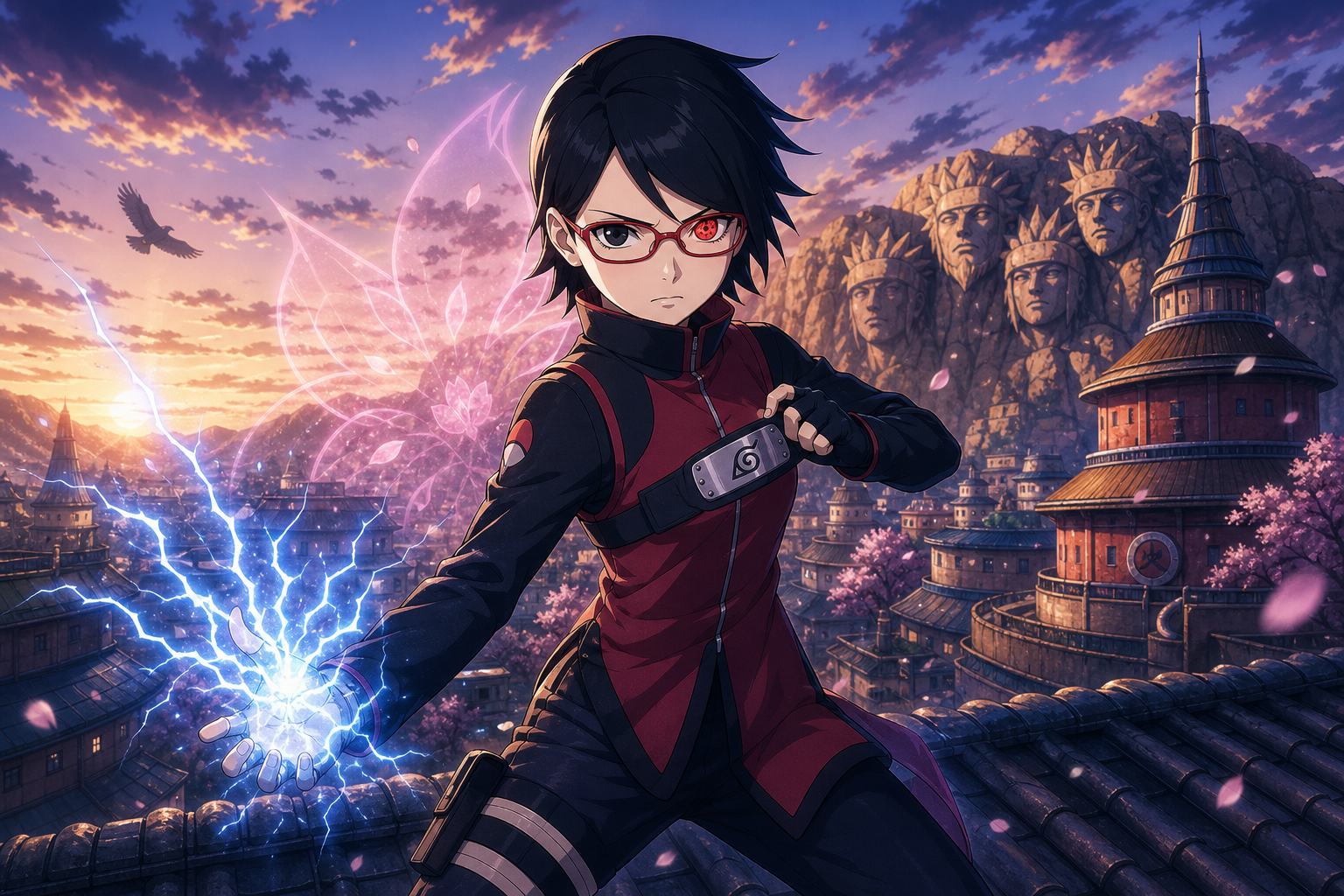
CVM SEKAI CHARACTER FILE
Sarada Uchiha
The girl who inherited the Uchiha name, Sakura’s fists, Sasuke’s eyes and absolutely none of the patience required to let Konoha rewrite the truth.
RaeRae’s bottom line: Sarada works because her dream is political before it is powerful. She wants to become Hokage, yet her first great test is not winning a tournament or collecting a bigger eye. Her test is whether she will defend an innocent person when her whole village remembers the wrong story. She does. Loudly. Repeatedly. That stubborn moral spine is the character.
THE SHINOBI FILE
Who Sarada Uchiha actually is
Sarada Uchiha is the daughter of Sasuke Uchiha and Sakura Haruno. She grows up in Konoha, graduates from the Academy and joins a new Team 7 with Boruto Uzumaki and Mitsuki under Konohamaru Sarutobi. Her birthday is March 31. The official Naruto site describes tea-flavored food as a favorite and frames her as a core member of Team 7 who intends to change fate beside Boruto.
That clean family sentence took the story an exhausting amount of pain to earn. Sasuke spends much of Sarada’s childhood away on a mission connected to threats beyond the village. Sakura raises her. Sarada has almost no personal memory of her father, no ordinary family photograph and no satisfying explanation for his absence. When a photograph suggests Karin might be her mother, Sarada does what a smart child does when adults leave a crater where an answer should be. She investigates.
The investigation does not reveal a secret mother. Sakura is Sarada’s biological mother. Karin helped with Sarada’s birth while Sasuke and Sakura were traveling, and the preserved umbilical cord used in Suigetsu’s rushed test belonged to Sakura. The plot is not a paternity twist. The plot is a trust failure. Sarada’s family loves her, but the adults let secrecy do the talking until a child has to chase the truth herself.
Name, appearance and the problem with looking “Uchiha enough”
Sarada’s name is written サラダ. The series does not hand readers a profound official kanji meaning, so forcing a grand symbolic translation onto the name would be fan decoration. Her visual identity is much clearer. Black hair, red rectangular glasses, the Uchiha crest and a red-centered wardrobe make her readable as both a child of Sasuke’s line and a person with her own silhouette.
The glasses become a cheap fandom argument far too often. Eyesight and Sharingan symbolism do not require every Uchiha to walk around with perfect unassisted vision. The glasses also connect Sarada visually to Karin without turning Karin into her mother. More importantly, Sarada’s eyes are never the only thing doing intellectual work. She observes patterns, questions testimony and notices when institutions are asking her to accept nonsense.
Her Two Blue Vortex design presents an older teenager in a sharper red-and-black outfit. That era deserves an age-appropriate reading. Sarada is still a young shinobi living under wartime pressure, not an invitation for the camera or fandom to treat her as adult glamour merchandise. Good design analysis can discuss Ikemoto’s fashion language and the arguments around it without sexualizing the girl wearing the clothes.
THE FULL CHRONOLOGY
Childhood, absence and the Naruto Gaiden family crisis
Sarada’s earliest defining wound is ordinary by ninja standards and devastating by human standards. Her father is alive, yet absent. Sakura is present, loving and overworked, yet visibly uncomfortable with the questions. Sarada sees other children place themselves inside family stories that make sense. Her own household gives her love without a usable history.
She leaves the village hoping to meet Sasuke and find the truth. Anticipation and emotional strain awaken her Sharingan. The reunion is brutal. Sasuke fails to recognize his own daughter and points a weapon at her because he assumes she may be an enemy. The scene is not funny once the shock wears off. Sarada arrives hungry for proof that she belongs and receives suspicion from the person whose absence created the hunger.
Shin Uchiha’s attack turns the family crisis into a rescue mission. Sakura is taken. Sasuke, Sarada, Naruto and Chōchō move after her. Sarada watches her parents fight as partners and sees that their bond exists in conduct, not in the domestic evidence she had wanted. She also confirms Sakura’s motherhood. By the end, Sarada chooses her family with fuller knowledge, but the story should not be used to excuse Sasuke’s absence. Love explains why reconciliation is possible. Love does not retroactively make the neglect harmless.
Why Naruto becomes her model for Hokage
Sarada does not dream of becoming Hokage because the Uchiha need a consolation trophy. She looks at Naruto Uzumaki and sees a leader who makes belonging visible. Naruto treats the village as family and meets frightened children at eye level. Sarada has spent years living with affection that adults refuse to explain. Of course transparent, relational leadership appeals to her.
Her dream also answers the old Uchiha tragedy. The clan’s political alienation helped produce secrecy, surveillance, resentment and catastrophe. Sarada’s answer is not to restore clan dominance. She wants the office responsible for the whole village. That makes her ambition bigger than lineage pride. She intends to make an Uchiha name synonymous with public trust.
The dream is still unfinished. Wanting the hat is not the same as understanding administration, village budgets, diplomacy, civilian protection or the moral cost of the shinobi system. Sarada’s best material comes whenever the story lets leadership mean judgment and accountability, not a promotional speech before the next lightning attack.
New Team 7 and the Chūnin Exams
After Academy graduation, Sarada joins Boruto and Mitsuki under Konohamaru. The team deliberately echoes the old Team 7 without copying its emotional geometry. Sarada is often the practical center. Boruto improvises, Mitsuki watches with unnerving calm and Sarada tries to keep the mission attached to reality.
During the Chūnin Exams, she uses knowledge and Sharingan analysis to move her team through the early rounds. In the individual contest, her chakra-enhanced strength delivers the kind of clean physical punctuation Sakura fans had been waiting to see inherited. The Ōtsutsuki invasion interrupts the exam before ordinary promotion can become the main point.
Anime and manga continuity do not handle every rank beat identically. The anime later gives Sarada a second Chūnin Exam path and promotion, while the manga places its emphasis on her field command during the Boro battle. A complete profile has to keep those records labeled instead of smashing them together and pretending the timeline never blinks.
The Boro battle proves she can lead under pressure
Boro surrounds the team with a dark mist produced by a scientific ninja tool. Sarada uses Sharingan observation while Mitsuki develops antibodies. When brute force fails because Boro regenerates, Sarada identifies the mobile core sustaining that regeneration. The team needs someone to process information, choose the opening and commit before the enemy shifts the target again.
Captain Sarada does exactly that. Boruto and Kawaki create damage and distraction. Sarada accelerates with Chidori, reaches the core and destroys it. The official Naruto site calls the strike triumphant for good reason, but the leadership matters more than the pose. She wins through shared information. Mitsuki’s medical preparation, Boruto and Kawaki’s pressure and Sarada’s visual judgment form one solution.
The aftermath also limits the victory. Boro’s body goes out of control, Momoshiki takes Boruto and the rescue becomes another warning that this generation is fighting enemies embedded inside teammates as often as enemies standing across a battlefield.
Omnipotence turns her dream into a real political test
Sarada and Sumire are not captured by Eida’s charm, though the reason remains unresolved. Then Kawaki’s desire and Eida’s Omnipotence alter the world’s memories. Boruto and Kawaki’s positions are reversed in collective memory. The village reads Boruto as the outsider who killed Naruto and reads Kawaki as Naruto’s son.
Sarada knows the remembered consensus is false. That immunity does not give her the power to make everybody else reasonable. She argues with authority, warns Sasuke and runs toward Boruto’s danger. When despair awakens her Mangekyō Sharingan, her first decisive act is not an attack. She asks Sasuke to save Boruto.
Sasuke’s memories tell him she is wrong. His trust in his daughter tells him to move anyway. That moment may be Sarada’s clearest leadership win. She cannot command the village. She persuades one of its strongest men to act against his own altered certainty because her conviction carries moral weight.
Two Blue Vortex: the girl who keeps the unpopular record
Roughly three years later, Sarada is still in Konoha and still challenging the official story. She argues with Shikamaru and refuses to soften Boruto’s innocence to make authority more comfortable. Her position costs her credibility with people who believe their memories are evidence. She keeps speaking anyway.
When Code and the Claw Grimes attack, Sarada protects civilians and fights the new threat. Boruto returns, but reunion sentiment has to wait behind emergency work. The evolved Divine Trees create a more personal danger when Hidari emerges from Sasuke’s absorbed chakra and identifies Sarada as his target. Hidari is not simply “evil Sasuke.” He is a new being whose instincts and borrowed source make Sarada central to his search for knowledge and consumption.
The Land of Wind battle finally brings Sarada’s Mangekyō technique onto the page in full. The current story remains serialized, so victories, injuries, loyalties and final power ceilings are provisional. A fan guide should update with the manga, not turn the newest chapter into an ending that has not happened.
POWERS WITH RECEIPTS AND LIMITS
Sharingan, Mangekyō and Ohirume
Sarada’s Sharingan supports perception, movement reading and combat analysis. Its growth is tied to intense emotion, but “emotion” should not be reduced to hysterics. Her eye develops through longing, fear, attachment and moral crisis. Those feelings produce action because Sarada keeps choosing what to do with them.
Her Mangekyō Sharingan awakens as she begs Sasuke to save Boruto after Omnipotence. The official Boruto Database identifies the ability as Mangekyō Sharingan: Ohirume. Ohirume creates as many as four black spheres, ranging from roughly five to 250 centimeters. Sarada controls their gravitational pull, can select targets in her field of vision and can detonate the spheres.
The technique has sharp costs. When she targets a living being, the gravitational force also acts on her. She can balance the spheres to levitate and move at high speed, but the control problem is part of the power. Ohirume consumes an overwhelming amount of chakra. Like other Mangekyō abilities, continued use damages eyesight and can lead to blindness. The ability makes Sarada formidable. The bill keeps the ability from becoming a free plot coupon.
Chidori, strength, Fire Release and field intelligence
Chidori concentrates lightning chakra into a high-speed thrust. The official database lists Sasuke and Sarada as wielders and stresses that Sharingan is required because the attack’s speed otherwise leaves the user dangerously open to counters. Sarada’s strike against Boro succeeds because perception, timing and team preparation arrive together.
From Sakura, Sarada inherits chakra control and devastating close-range strength. She can turn a punch into terrain damage, but raw force does not make her Sakura 2.0. Sarada’s combat language mixes Uchiha fire techniques, shuriken work, ocular analysis, lightning and physical power. That combination suits a child trying to inherit two legacies without disappearing inside either one.
Anime material expands her mission record, medical exposure and Sharingan development. Those additions can be valuable, especially for team relationships, but they need an anime label when the manga does not show the same milestone. Sarada has not been confirmed as a Byakugō user. Fans can speculate about future training. A profile should not promote speculation into a technique list.
What she cannot do
Sarada has limited chakra compared with the monsters driving the current power scale. Ohirume drains her heavily. Mangekyō use threatens her sight. Chidori requires a readable line and ocular control. Enhanced strength requires precise chakra use and range. None of these tools substitutes for information or teammates.
Her greatest current weakness is institutional. Sarada knows the truth but cannot prove the mechanism to people whose memories resist her. Punching harder cannot solve that. Becoming Hokage will require alliances, credibility, policy judgment and the ability to protect a community that may distrust her.
THE RELATIONSHIP ATLAS
Sakura Haruno: the parent who stayed
Sakura raises Sarada while maintaining medical and village responsibilities. She provides affection, training and a model of earned competence. She also contributes to the family secrecy that wounds Sarada. Both facts belong in the same paragraph. Parenting should not be graded on whether the absent father was worse.
Sarada’s strength echoes Sakura, but the deeper inheritance is refusal. Sakura survived being underestimated and built authority through study and work. Sarada carries that same refusal into political spaces where people expect a teenager to accept the official memory and hush.
Sasuke Uchiha: love cannot erase absence
Sasuke loves Sarada and eventually shows faith in her judgment strong enough to override his altered memories. That trust matters. His long absence also matters. Their bond is moving because repair requires choices after failure, not because the failure was secretly harmless.
Sasuke gives Sarada Chidori training and an Uchiha combat inheritance. Sarada gives Sasuke a moral instruction during Omnipotence. “Help Boruto because I am asking” becomes a reversal of the old clan pattern. The child does not obey inherited certainty. The parent follows the child’s ethical clarity.
Boruto Uzumaki: trust under pressure
Boruto and Sarada bicker, compete and repeatedly save one another. He respects her Hokage dream. She sees past his early resentment of Naruto and recognizes his capacity to protect people. Their bond may support romantic readings, but the published story does not need a fandom ship verdict inserted into every act of loyalty.
After Omnipotence, Sarada’s defense of Boruto is not proof that she has stopped thinking. She has retained the relevant memory and observed Kawaki’s conduct. Loyalty follows evidence. Her task now is harder than believing one friend. She must help expose a reality that the whole political order experiences as false.
Mitsuki, Konohamaru and the team that keeps changing
Mitsuki’s calm analysis complements Sarada’s command instincts. Omnipotence turns his attachment toward Kawaki and directs his rage at Boruto, leaving Sarada unable to reach a teammate through ordinary explanation. Their broken alignment shows how memory manipulation damages relationships without erasing the history those people truly lived.
Konohamaru is Sarada’s first team leader and one of the adults who should help translate talent into judgment. The franchise sometimes sidelines that mentorship in favor of larger threats. Still, New Team 7’s best battles depend on the lesson a squad structure is supposed to teach: no inheritance, eye or vessel replaces coordinated work.
Naruto, Kawaki, Sumire, Chōchō and Hidari
Naruto
Her model for Hokage because his leadership makes belonging visible. She admires his public care, not merely his power.
Kawaki
A former teammate whose fear of Momoshiki drives lethal choices, confinement and the reality swap. Sarada refuses to rename those choices as protection.
Sumire
The other known girl untouched by Eida’s charm. Their shared position gives Sarada an essential witness, not a romantic rival.
Chōchō
A close friend whose presence gives Sarada ordinary peer intimacy outside Team 7’s catastrophe machine.
Hidari
A Divine Tree born from Sasuke’s absorbed chakra. His fixation on Sarada turns lineage into predation rather than a simple father reunion.
Eida
The person through whom Omnipotence manifests, but not a flat mastermind controlling every consequence. Sarada must distinguish power, intent and responsibility.
WHY SARADA MATTERS
The Uchiha story changes when a girl wants public office
The Uchiha story once centered a clan trapped between village service and village suspicion. Sarada inherits the surname after the clan’s collapse. Her answer is not revenge, isolation or restoration of a private dynasty. She wants the village’s most public obligation.
That choice carries a Confucian tension between family duty and civic duty. Sarada honors her parents without treating obedience as virtue. She questions Sakura, confronts Sasuke and resists village authority when their answers fail the moral test. Filial respect becomes active responsibility, not silence.
A Buddhist reading finds another useful tension in attachment. Sasuke once treated bonds as chains he had to cut. Sarada’s bonds keep her from accepting a manufactured reality. Attachment produces suffering, certainly. The story also shows compassionate attachment giving her a reason to protect someone the world has abandoned.
Memory, propaganda and the courage to sound unreasonable
Omnipotence turns consensus into a weapon. Everyone around Sarada feels certain. Documents, habits and emotional history begin bending around that certainty. Sarada therefore occupies the least comfortable political position: the person with the correct record and no easy way to make truth feel true to other people.
The storyline asks whether leadership means reflecting public belief or protecting the public from a false belief that feels natural. Sarada chooses the second. That does not automatically make every tactic wise, but it proves her Hokage dream has moved beyond branding.
Her resistance also exposes the village’s weakness. Konoha trains children to detect genjutsu, gather intelligence and interrogate contradictions, yet senior leadership can still punish dissent when a supernatural lie arrives wearing familiar emotion. A village that calls skepticism disloyal is begging to be managed by whoever controls the memory.
Fandom arguments that flatten her
“She is only a love interest.” No. Her family investigation, Hokage ambition, Boro command, Omnipotence resistance and Ohirume development belong to her political and shinobi arc. Possible romance does not cancel narrative agency.
“Her Mangekyō came from crying.” That insult misunderstands the entire Uchiha mechanism and the scene. She awakens the eye during catastrophic moral distress, then uses the moment to move Sasuke into action.
“Glasses make no sense for an Uchiha.” Sharingan is a chakra-driven ocular ability, not a warranty against every ordinary vision issue. The complaint is aesthetic policing dressed as lore.
“She should already be stronger than every adult.” Power scaling has eaten enough character discussion. Sarada’s limits, team reliance and political isolation create the pressure that makes her choices matter.
“Sakura or Karin must be her real mother depending on which woman I like.” The canon resolves the biology. Sakura is her mother. Karin assisted the birth. Turning Sarada into ammunition for an old ship war is fandom refusing to let the child own her own story.
Japanese performance and adaptation record
Kokoro Kikuchi performs Sarada in the original Japanese anime. Kikuchi carries the character across domestic frustration, competitive team rhythm and high-stakes command. This profile credits the verified performer without inventing scene-by-scene vocal technique that has not been directly rewatched for this edition.
Sarada appears across the Boruto manga line, Naruto Gaiden, the Boruto anime, Boruto: Naruto the Movie and related game adaptations. The anime adds Academy life, friendships, missions and a different promotion path. Games translate her Sharingan, strength and Chidori into combat systems built for spectacle. Those versions belong on the media shelf, but none should overwrite manga continuity by accident.
CANON AND CURRENT STATUS
What is confirmed, what differs and what remains open
Confirmed core facts include Sarada’s parentage, March 31 birthday, Team 7 membership, Hokage dream, Sharingan, chakra-enhanced strength, Chidori, Mangekyō awakening, immunity to Eida’s charm and Omnipotence’s memory rewrite, and her continued defense of Boruto. The official database confirms Ohirume’s spheres, selective gravitational pull, detonation, levitation use, chakra cost and eyesight danger.
Anime-only or anime-expanded material should remain labeled, especially Academy missions, some Sharingan milestones, medical activity and the later Chūnin promotion route. The Two Blue Vortex manga is ongoing. Sarada’s final rank, endgame relationships, ultimate eyesight solution, complete Ohirume ceiling and Hokage outcome are not finished facts.
The responsible way to love a living story is to keep the file alive without pretending prediction equals canon. Sarada deserves better than a profile that stops before her biggest power reveal. She also deserves better than one that writes her ending for her.
LEADERSHIP BEFORE THE TITLE
Sarada practices the office before anybody gives her the hat
Sarada’s Hokage dream matters because it keeps getting tested by situations where popularity and truth point in opposite directions. A future leader does not only protect people when the village agrees about who deserves protection. She has to keep looking at evidence when the room prefers a comfortable lie.
Omnipotence makes that test brutally literal. Sarada cannot win by shouting louder than everybody’s memory. She argues, acts, and accepts that being correct will not immediately make her trusted. Her resistance is not glamorous. It is the slow political labor of refusing to let consensus replace fact.
That choice also separates her from the worst Uchiha inheritance without asking her to reject the clan. Sarada keeps the eyes, grief, love, and force. She refuses the conclusion that pain grants permission to own everybody else’s future. Her Mangekyō awakens through desperate care, and the power enters a life already organized around public responsibility.
The story remains ongoing, so the final outcome is not available for this profile to manufacture. What is already clear is enough: Sarada wants the office and keeps choosing its hardest obligation before she has its protection. She stands beside an accused person when doing so damages her own credibility. That is leadership with an invoice attached.
RAERAE’S FINAL TAKE
Sarada is already doing the hardest part of becoming Hokage
The hat is easy to draw. The office is easy to romanticize. The hard part is standing in a room where every powerful adult believes a lie and refusing to trade truth for comfort. Sarada has been practicing that leadership since she was a child asking why her father never came home.
She inherits extraordinary tools, but inheritance is not her conclusion. Sarada takes Uchiha sight and points it toward public responsibility. She takes Sakura’s control and uses it to break more than stone. She takes Naruto’s idea of the village as family and asks whether family still counts when the family thinks you are wrong.
That is why she matters. Sarada Uchiha is not waiting to become a leader. She is learning, painfully and in public, what leadership costs.
Sources and continuity boundary
The Boruto manga and Boruto: Two Blue Vortex manga control the continuing chronology. Anime-original arcs, novels, games, films, and adaptation expansions are identified instead of being blended into one false record. Ongoing developments should be dated and revised when later chapters change the evidence.
Primary franchise references: Naruto Official and VIZ Media Boruto: Two Blue Vortex. CVM Sekai’s conclusions about Sarada’s family, Hokage goal, Sharingan, Mangekyō, Omnipotence resistance, leadership, and accountability are editorial analysis, not invented creator quotations.