
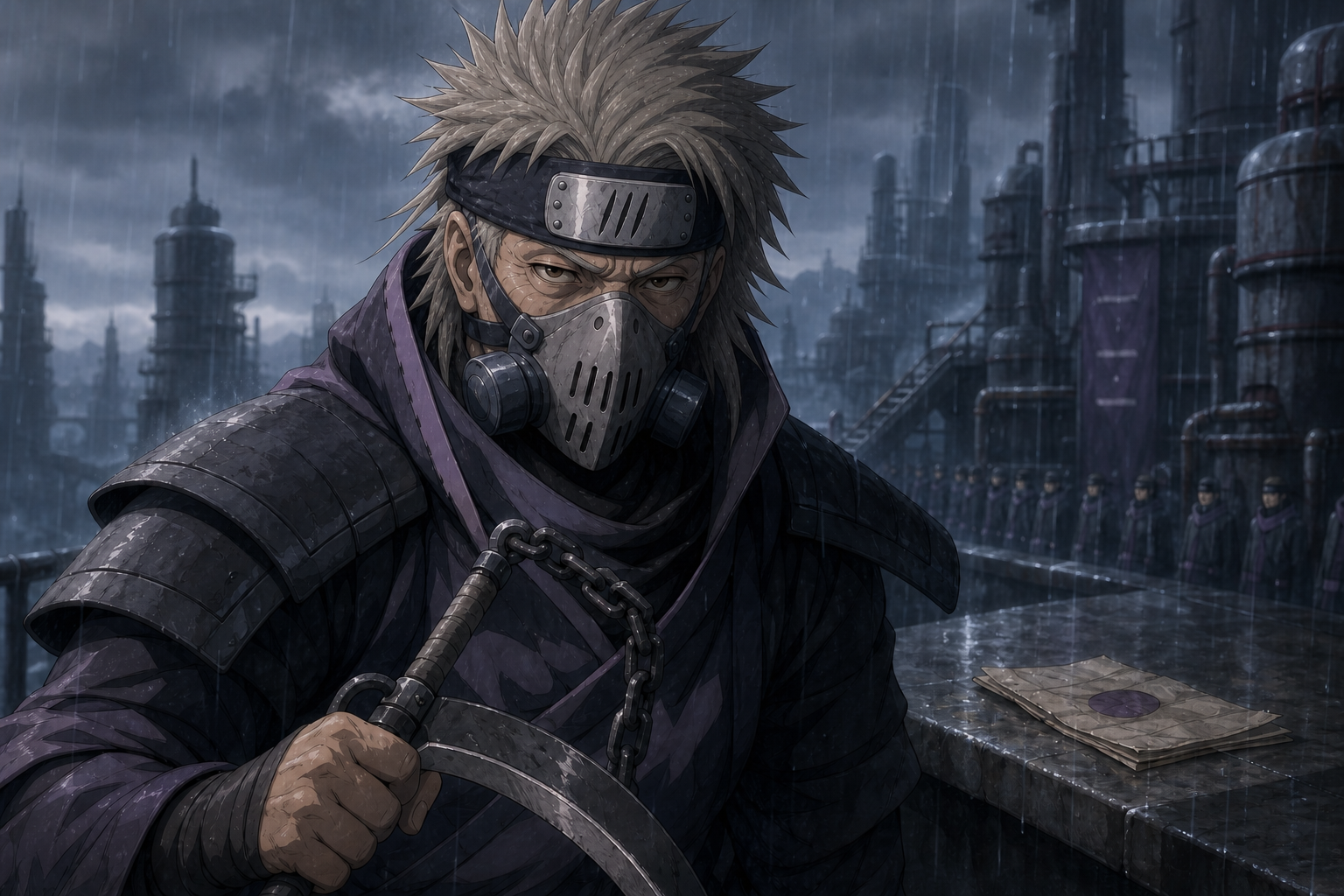
Naruto character dossier
Hanzō of the Salamander
The Rain legend earns his name through conviction, keeps power through fear and proves that a leader can survive every battlefield except his own moral collapse. Hanzō remains dangerous because the courage that built his authority is real, even after fear hollows out its purpose.
Who Hanzō is, before “legendary” becomes an excuse
Hanzō is the longtime ruler of Amegakure and one of the most feared shinobi of his generation. His name carries enough weight that trained fighters retreat when they realize who stands across the field. He commands poison, Fire Release, a kusarigama, explosive tags, Body Flicker movement, and the giant salamander Ibuse. He survives battles that turn other ninja into stories.
He is also the man who gives Jiraiya, Tsunade, and Orochimaru the title that becomes “the Legendary Sannin.” That single act often freezes Hanzō inside fandom as a power-scaling yardstick. If three famous Leaf ninja survive him, then he must have been terrifying. True. Boring. The more important question is what a warrior that powerful does with political authority.
Hanzō’s story divides into two moral lives. The first man recognizes courage in enemies, respects conviction, and believes strength should carry a purpose. The second man grows suspicious, protects his position, collaborates with Danzō, and destroys a local peace movement. Naruto does not reveal that he was secretly weak. Naruto reveals that power without renewed principle becomes cowardice with better weapons.
The Rain leader built by poison and permanent war
Amegakure grows inside the pressure of larger nations. Fire, Wind, and Earth can fight across Rain territory while their own capitals remain symbols of sovereignty. Rain civilians inherit damaged streets, missing family members, surveillance, scarcity, and rulers who promise that harsher control will keep the next invasion out.
Hanzō rises in that environment. The record gives more detail about the legend than about the exact steps of his political ascent. He becomes village leader, military symbol, and international threat. Those roles should not be blended into an imaginary clean election story. Amegakure under Hanzō behaves like a closed security state. Visitors are monitored. Internal opposition is dangerous. His authority rests on battlefield reputation and enforcement.
That does not mean every early action is cynical. Hanzō understands that a small country needs deterrence. The great villages respect what can hurt them. His poison makes Amegakure expensive to invade. His reputation gives Rain leverage that sympathy never did. The tragedy is that deterrence hardens into personal rule, and personal rule begins treating every alternative leader as an enemy.
The salamander poison inside his body
Hanzō’s title is physical before it is poetic. A black salamander with lethal venom is tied to his childhood history. Its venom sac is implanted into his body in an attempt to create a poisonous shinobi with resistance to the toxin. The experiment works well enough to make Hanzō dangerous to everyone around him.
His breath can expose nearby people to poison, so he wears a respirator. The mask is not cosmetic villain design. The mask is workplace safety, weapon control, and the visible cost of turning a child into military infrastructure. Hanzō becomes difficult to poison, but immunity is not absolute. Damage to the implanted sac can release enough toxin to endanger him too.
The body modification creates a sharp political symbol. Amegakure puts poison inside a person to protect itself from war. The protector then becomes a ruler whose presence requires everybody else to guard their breathing. Security and contamination become the same body.
Ibuse: summon, partner, and area-control nightmare
Ibuse is Hanzō’s giant salamander summon. The creature can release poison mist over a wide area, burrow underground, reposition, and force entire units to make decisions around air rather than blades. Hanzō can fight from Ibuse’s head while combining the summon with his own weapon and mobility.
The partnership changes a battlefield. Opponents cannot simply charge. They need masks, antidotes, wind movement, distance, or a way to stop the poison before exposure. A fighter can be stronger in a duel and still lose because the air becomes hostile.
Ibuse is not proof that Hanzō belongs to a salamander sage tradition. The series gives him a summoning partnership and a title. Fans should not fill every unanswered contract with invented sacred geography.
How Hanzō creates the legend of the Sannin
During the Second Shinobi World War, Hanzō fights Jiraiya, Tsunade, and Orochimaru. The three survive when other Leaf forces do not. Hanzō acknowledges their endurance and names them the Sannin of Konoha. The title follows them for the rest of their lives.
This scene does two jobs. First, Hanzō’s reputation establishes the scale of the trio’s achievement. Surviving him is enough to become history. Second, Hanzō demonstrates the moral quality he later loses. He can recognize worth in an enemy. He does not need to erase everyone who might challenge his image.
Tsunade’s medical ability, Orochimaru’s survival tools, Jiraiya’s persistence, and their team experience all matter. The scene should not become a math equation where “Hanzō equals three Sannin” under every later condition. Wars involve exhaustion, terrain, objectives, support, poison exposure, and incomplete information. The canonical conclusion is simpler: he defeats them, respects them, and lets them carry the title.
Mifune and the promise Hanzō forgets
Hanzō once battles Mifune, the samurai leader of the Land of Iron. Hanzō wins and poisons him. Mifune’s conviction impresses him, so Hanzō provides an antidote and spares his life. Mercy is not softness here. Hanzō believes a person who keeps faith under death deserves to continue.
The encounter plants the standard that later condemns him. Mifune remembers the warrior who respected principle. Hanzō eventually becomes a ruler who bends his own principle to protect office and survival. When they meet again during the Fourth Shinobi World War, the gap is not mainly about age or technique. Mifune has kept the reason he fights. Hanzō has spent years trading his away.
That is why their rematch works better as a moral duel than a power-scaling contest. Mifune is not magically stronger because he gives a speech. Hanzō hesitates because the speech names the part of him he buried.
Hanzō’s Amegakure: deterrence becomes surveillance
Long rule changes the man. Hanzō grows fearful of losing authority. A leader who once judged courage begins judging loyalty. A village that needs protection becomes a reason to crush challengers before they can prove their intentions.
Authoritarian politics often uses the same sentence: “I am doing this for the people.” The sentence can describe real duty or convenient ownership. Hanzō reaches the point where protecting Amegakure and protecting Hanzō’s position become indistinguishable in his decisions.
The original Akatsuki exposes that confusion. Yahiko’s group is local, popular, organized, and committed to peace. If Hanzō truly wants only Rain stability, a credible grassroots movement could become an ally. If he wants monopoly over Rain politics, their popularity becomes intolerable.
The Akatsuki trap: peace talks with a hostage behind them
Yahiko, Nagato, and Konan build the original Akatsuki to give the Rain its own voice. Hanzō approaches the movement under the language of cooperation and peace. Danzō helps turn that contact into a trap.
The manga establishes the betrayal, Konan’s capture, Yahiko’s forced choice, and the destruction that follows. The anime expands the political manipulation. Danzō deliberately tells Hanzō that Akatsuki plans to sabotage Rain and Stone peace talks. Hanzō believes the story and acts as if destroying the movement protects his people. That adaptation detail matters, but it should remain labeled as anime expansion rather than quietly converted into manga dialogue.
At the meeting, Konan is held hostage. Nagato is ordered to kill Yahiko. Yahiko throws himself onto Nagato’s kunai. Hanzō’s forces then attack anyway. The setup is not negotiation gone wrong. The hostage makes honest negotiation impossible before the first demand is spoken.
Hanzō’s fear creates the enemy he claims to prevent. Nagato survives, unleashes the Rinnegan, and turns grief toward the ideology of Pain. The original Akatsuki dies. The later Akatsuki eventually helps destabilize every great village. Hanzō protects his office for a while and destroys Rain’s best chance to build another form of power.
Danzō and the great-village hand inside Rain politics
Danzō Shimura works from Konoha’s shadows while Hanzō rules the Rain openly. Their alliance shows how internal authoritarianism and external interference feed each other. Danzō gets influence over a neighboring country’s peace process. Hanzō gets intelligence, forces, and confirmation for his suspicion.
Hanzō remains responsible. Manipulation explains the information environment. That pressure does not erase the hostage, the false meeting or his decision to kill local organizers. A ruler with enough power to command poison armies also carries enough responsibility to verify a claim before destroying a movement.
Danzō’s involvement also ruins the comforting idea that Konoha is automatically the ethical center of the world. Leaf policy helped produce the conditions that later return as Pain’s attack. Naruto wins the moral argument with Nagato. Konoha’s institutions still owe the Rain a reckoning.
Pain’s revenge and Hanzō’s last living failure
Nagato later returns as Pain and overthrows Hanzō. The revenge extends beyond the ruler. Pain kills Hanzō and pursues relatives, associates, and supporters to erase the old regime’s network. The purge shows how Hanzō’s violence reproduces itself through the survivor he traumatized.
Hanzō has become so cautious that he surrounds himself with security and avoids risk. The behavior makes sense for a ruler with enemies. The choice also confirms Mifune’s later judgment. The warrior who once spared conviction now protects his body after abandoning his own.
Pain’s victory does not restore Yahiko’s movement. Amegakure trades one closed regime for a theocratic one built around controlled bodies, secrecy, and mass fear. Hanzō’s removal solves who rules. The final act does not repair the political culture that made individual rulers more important than durable institutions.
Reanimation: one final chance to remember his own name
Kabuto reanimates Hanzō during the Fourth Shinobi World War and deploys him against the Allied Shinobi Forces. The legendary poison user returns as somebody else’s weapon. Kankurō’s commando unit is pushed toward defeat until Mifune and the Fifth Company intervene.
Mifune defeats him in the rematch and tells him the truth: Hanzō lost his conviction. The words reach the older warrior beneath the decayed ruler. Memories of their first duel return. Hanzō chooses to rupture his own venom sac with his weapon, immobilizing himself through poison and creating the opening for the sealing team.
The act does not erase Yahiko, Konan, Nagato, or the Rain citizens harmed under his rule. Redemption is not a coupon that cancels the bill. The act matters because he finally stops using survival as the highest good. He gives Mifune the antidote in their first encounter. In the last one, he gives Mifune the battlefield and asks the surviving man to carry their conviction forward.
Abilities, mechanics, and limits
Poison warfare
Hanzō can release poisonous breath connected to the implanted venom sac, carry poison on his weapon, use antidotes, and coordinate with Ibuse’s mist. Poison changes movement, rescue priorities, and time. Exposure does not always mean instant death, but delay can make treatment impossible.
Kusarigama
His chain-and-sickle weapon supports slashing, entangling, ranged pressure and delivery of poison or explosive-tag setups. The chain creates unusual angles that punish straightforward melee approaches, forcing opponents to track both the blade and the space Hanzō can suddenly control.
Fire Release and explosive tags
Hanzō uses Fire Release with paper explosives to create a trap beneath or around an opponent. The combination suits his battlefield style: control space, restrict escape, then make the environment lethal.
Body Flicker and battlefield movement
He can reposition himself and Ibuse quickly enough to surprise experienced fighters. That speed matters most when paired with poison zones. Running from the mist becomes harder when the summoner can change the center of danger.
Medical preparation
Hanzō carries antidote knowledge because his own tactics can affect allies, enemies and himself. Prepared medicine is part of his combat system rather than an unrelated kindness, showing that poison warfare depends on logistics and risk management as much as toxicity.
Limits
The venom sac can be damaged. The poison can be countered by distance, wind, masks, rapid treatment, or an antidote. Ibuse can be separated from the ideal attack position. A fast close-range fighter can reduce Hanzō’s time to deploy large-area poison. Reanimation repairs his body, but sealing still ends the battle.
Relationship and accountability atlas
Mifune
Mifune remembers the best version of Hanzō and becomes the witness who forces him to confront the worst. Their relationship is built on combat, mercy, and a promise about conviction that only one of them keeps continuously.
Yahiko
Yahiko offers Hanzō a local peace movement with public support. Hanzō answers with a hostage trap. Yahiko’s death becomes the hinge between the original Akatsuki and Pain, turning a possible partner in Rain’s future into proof that negotiation is merely another weapon.
Nagato
Hanzō forces Nagato into an impossible choice and helps destroy his political family. Nagato later kills Hanzō and purges his network. Each man uses fear to prevent future threats, and each creates new suffering.
Konan
Hanzō treats Konan’s body as leverage. That choice is gendered in method even if the political target is the whole trio. Konan survives, becomes Pain’s partner, and helps govern the regime that replaces him.
Danzō
Danzō feeds Hanzō suspicion and supplies covert power. Hanzō accepts because the lie suits his fear. Shared responsibility does not become diluted responsibility, and outside manipulation cannot excuse a ruler who chooses local organizers as disposable targets.
The Sannin
Jiraiya, Tsunade and Orochimaru receive a legendary title because Hanzō can once recognize courage beyond village loyalty. Their fame preserves evidence of the man he used to be, which makes his later inability to tolerate independent courage inside Rain more damning.
Ibuse
Ibuse makes Hanzō’s title operational. The summon expands poison across the field and represents the partnership behind his greatest reputation. Hanzō’s legend therefore depends on coordinated battlefield control, not merely a poisonous body or intimidating name.
Amegakure
The Rain is not his property. Hanzō protects its sovereignty, then narrows that duty until his own rule stands in for the entire population. That substitution is his central political failure.
Design: a ruler who has to filter his own breath
Hanzō’s respirator is the central visual cue. The mask protects other people from the weapon implanted inside him, but it also gives him distance from ordinary faces. Armor, covered clothing, Rain metal, chain, and hard eyes make him look prepared for a war that never ends.
The Amegakure symbol and wet industrial skyline place him inside the village rather than above a generic battlefield. His kusarigama keeps the design rooted in shinobi tools, not modern military hardware. Long weathered hair separates the older ruler from younger masked characters.
The design also carries irony. Hanzō fears contamination from enemies while he is literally the person who can poison the room. Authoritarian leaders often describe danger as something outside. Naruto puts the toxin inside the ruler.
What Hanzō means in Naruto
Personal: survival can become a bad god
Hanzō survives experiments, wars, famous opponents, and political threats. Survival begins as strength. Once survival becomes the highest value, he sacrifices principle, trust, and other people’s futures to keep breathing.
Interpersonal: recognition creates obligations
He recognizes Mifune and the Sannin, which proves he knows what conviction looks like. That knowledge makes the Akatsuki betrayal worse. He cannot claim ignorance. He sees courage and chooses fear anyway.
Political: a state is not its ruler
Hanzō speaks as if his security equals Amegakure’s security. Yahiko’s movement proves the village contains other voices. Crushing those voices weakens the country even when the ruler remains in office.
Confucian lens: authority without virtue loses legitimacy
A Confucian reading places reciprocal duty inside hierarchy. The ruler owes moral conduct, protection, and correction to the people. Hanzō’s later rule keeps hierarchy and abandons virtue. Yahiko behaves more like a legitimate moral leader despite lacking office.
Buddhist lens: attachment to power multiplies suffering
Hanzō clings to office, reputation, and survival. The attachment narrows perception until alternatives look like threats. His final war act becomes meaningful because he releases the body he spent years protecting. This is an interpretive lens, not a claim that the story teaches formal doctrine.
Creative lens: the title survives the man
The Sannin remain legendary after Hanzō’s decline. Mifune remembers his old promise. Yahiko’s death remakes the world. Hanzō loses control of every legacy he helps create. Reputation can outlive the person and testify against him.
Ikuya Sawaki’s original Japanese Hanzō
Ikuya Sawaki voices Hanzō in the original Japanese anime. The credit covers the legendary ruler, the Akatsuki-era betrayer and the reanimated warrior confronted by Mifune. That continuity helps the audience hear one life instead of three disconnected villain functions.
The continuity of one credited performer across Hanzō’s moral chronology gives the adaptation a stable identity linking respect, paranoia, defeat and final recollection. Specific vocal judgments belong beside specific Japanese-audio scenes, while the casting record already shows how one voice must carry every stage of the fall.
Manga, anime expansion, games, and continuity boundaries
The manga establishes Hanzō’s Sannin battle, leadership, Akatsuki betrayal, death under Pain, poison system, Mifune history, reanimation, and final sealing. Naruto Shippuden expands several periods, especially the politics surrounding Danzō’s deception and the early Akatsuki. Official episode 568 states that Danzō misleads Hanzō about Akatsuki sabotaging Rain and Stone peace talks. That motive belongs to the anime’s expanded presentation.
Hanzō appears in licensed games including Ultimate Ninja Impact and the Storm era, where combat systems turn poison, Ibuse, and kusarigama mechanics into playable moves. Game balance and cinematic attacks do not automatically expand manga canon. His media shelf should show where fans can encounter him without pretending every special move happened in one timeline.
Seven fandom misreads that let Hanzō off too easily
1. “Hanzō is only important because he named the Sannin.”
That moment establishes Hanzō’s strength and early ethics. His rule of Rain, betrayal of Akatsuki, death under Pain and rematch with Mifune form a full political tragedy, so the Sannin title is the beginning of the file rather than his only relevance.
2. “Danzō tricked him, so the trap is Danzō’s fault.”
Danzō manipulates. Hanzō chooses the hostage, false meeting and attack. Explanation is not acquittal, especially when Hanzō already controls the local state and can decide whether foreign intelligence becomes evidence or convenient permission.
3. “Pain kills him because Pain is stronger.”
Strength matters, but Pain’s revenge is political and personal. Hanzō helps create Pain by destroying Yahiko’s movement, then discovers that killing a peaceful alternative does not remove the grievance or the survivors who carry it.
4. “He became weak with age.”
The Mifune rematch centers lost conviction. Physical condition is not presented as the whole answer, because the confrontation measures whether Hanzō still possesses the principles that once made his dangerous power worthy of respect.
5. “His final act redeems everything.”
Hanzō’s final act restores a piece of honor. Dead people stay dead, and Amegakure still carries the consequences. The choice matters as a last boundary against further harm rather than a magical repair of his rule.
6. “Poison makes him unbeatable.”
Poison is devastating rather than absolute. Delivery, terrain, antidotes, wind, equipment, timing and damage to Hanzō’s sac create limits. A frightening ability becomes more believable when the story preserves the practical conditions that let opponents survive or counter it.
7. “The original Akatsuki threatened the village.”
The original Akatsuki threatens Hanzō’s monopoly over village politics, not Amegakure’s survival. Those are not the same thing, and confusing a ruler’s office with the state is exactly how political competition becomes framed as treason.
Consequence ledger
What he earns
Hanzō earns international fear, leadership of Rain, the Salamander title and the authority to name the Sannin. Those achievements establish genuine military and symbolic power, which later makes his retreat into surveillance and hostage politics a fall rather than a revelation.
What he protects
Hanzō protects Amegakure’s deterrence at first, then increasingly protects his own office, network and survival. The shift matters because public security becomes rhetoric for preserving one ruler’s control over every possible alternative.
What he destroys
Hanzō destroys the original Akatsuki’s peaceful path, Yahiko’s life, Nagato’s remaining trust in negotiation and Rain’s chance at plural leadership. The damage spreads because one frightened decision changes both a village’s politics and the moral direction of future war.
What destroys him
Pain’s revenge destroys Hanzō, born from the survivor of his hostage trap. The ending is not a neutral power ranking, because Nagato returns as the political consequence of the movement Hanzō tried to erase.
What returns
Hanzō’s reanimated body, old poison and the memory of the warrior Mifune once respected return during the war. Reanimation forces the legend to confront the gap between the principle that built his name and the fear that consumed it.
What remains
Hanzō leaves a warning that strength without moral renewal becomes fear defending a chair. A leader can keep the weapons, title and intimidating reputation while losing the judgment that once made authority more than organized survival.
Final verdict: Hanzō loses the moment power becomes his only principle
Hanzō is not a fraud. He really is that dangerous. He defeats great fighters, controls lethal poison, commands a summon that can lock down a battlefield, and shapes the reputations of people who become legends.
That truth makes his collapse worth studying. A weak man becoming cruel is ordinary. A principled warrior becoming a frightened ruler is a warning about how institutions decay when nobody can challenge the person who once saved them.
Hanzō learns that strength can protect a small nation from being ignored. Then he stops separating the nation from himself. Yahiko’s popularity becomes treason. Konan becomes leverage. Nagato becomes a hand holding a knife. Danzō’s lie becomes believable because fear has already prepared the room.
Years later, Mifune does not defeat him by discovering that the legend was fake. Mifune defeats him by remembering the legend accurately. He holds Hanzō against his own earlier standard. For one final moment, Hanzō chooses conviction over survival and stops his reanimated body from poisoning more people.
That last act deserves recognition. The final act does not deserve amnesia. The complete Hanzō file has to hold both men at once: the warrior who could honor courage in an enemy, and the ruler who murdered courage in his own village because he was scared of losing control.
Sources and canon boundary
Manga chronology controls this profile. Anime expansions, databook material, games, films, and reanimation staging are labeled instead of being blended into one false continuity.
Primary franchise references: Naruto Official and VIZ Media Naruto. CVM Sekai’s conclusions about Hanzō’s leadership, poison warfare, fear, Amegakure rule, the original Akatsuki, Mifune, and accountability are editorial analysis, not invented creator quotations.