
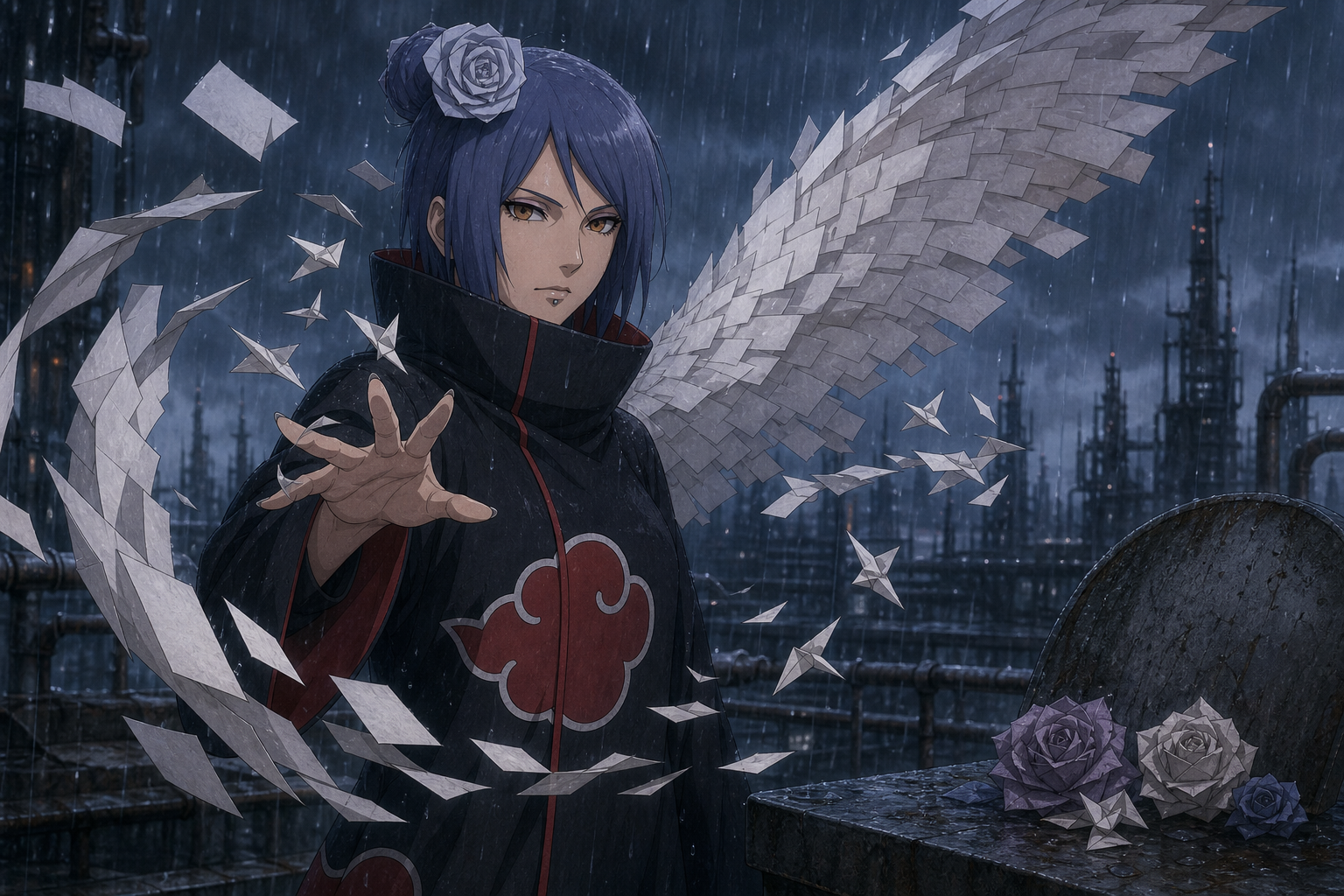
Konan
Bottom line
Konan keeps the paper trail when the men around her keep rewriting the mission. Her work matters because messages, institutions, battle plans and memorial objects all pass through the same hands, while fandom keeps trying to file her under somebody else’s dream. She begins as a Rain war orphan who folds a flower as thanks for food and shelter. She helps Yahiko build the original Akatsuki as a peace movement. She stays beside Nagato after Yahiko dies, serves the violent organization Pain creates, participates in Akatsuki operations and becomes Amegakure’s public “Angel.” Then Naruto reaches Nagato, Nagato dies restoring Konoha’s victims, and Konan makes a choice of her own. She leaves Obito’s project, places her faith in Naruto and defends Nagato’s Rinnegan with a trap prepared so carefully that Obito survives only through a forbidden reality rewrite. Her loyalty is beautiful. Her loyalty is also the place where her accountability lives. Konan is not wallpaper beside two tragic men. She chooses, plans, fights, supports and finally refuses.
Konan Essential File
Identity. Konan is an Amegakure kunoichi, war orphan, student of Jiraiya, founding member of the original Akatsuki, later S-rank Akatsuki operative, partner and protector of Nagato, and leader within the Hidden Rain. Villagers revere her as “Lady Angel” while they revere Pain as a god. Birthday and physical record. Reference guides give Konan a birthday of February 20 and place her at thirty-five during her final living arc. Her blue-violet hair, paper flower and lip piercing create one of Akatsuki’s clearest silhouettes without exposing her body for easy fan service.
Debut boundary. Konan first appears through Akatsuki’s leader material before Jiraiya’s Amegakure infiltration reveals her identity and history. The anime expands parts of the Rain trio’s childhood and organizational life. Those additions should be labeled rather than quietly treated as manga panels. Original Japanese performance. Atsuko Tanaka performs adult Konan in the original Japanese anime. Kaori Mine performs Konan as a child. The credited performances separate childhood tenderness from adult authority while keeping both stages tied to the same political and emotional history.
A Paper Flower Before Paper Weapons
Konan meets Yahiko and Nagato as an orphan in a country used as a battlefield by larger nations. Hunger, rain and military traffic define the environment before ideology does. She folds paper into a flower as an act of thanks. The gesture matters because paper begins as care. Before wings, shuriken, clones or bombs, the material carries gratitude between people who have almost nothing. That origin keeps her technique from becoming a random aesthetic. Konan spends the rest of her life asking paper to hold messages bodies cannot safely carry.
Yahiko and Nagato Become Family. Yahiko gives the trio outward momentum. Nagato carries immense power and deep fear of losing another family. Konan provides steadiness, practical intelligence and emotional continuity. Fans flatten the triangle when they make Konan only Yahiko’s implied love interest or only Nagato’s caretaker. She is their peer. The three survive together, train together and build a political movement together. Romantic feeling may be part of her bond with Yahiko, but grief does not reduce her life to a ship label.
Jiraiya’s Student. Jiraiya remains in Amegakure to train the orphans after the war. Konan learns shinobi skills while developing her paper technique. Jiraiya gives them food, structure and a vision of peace. He also eventually leaves. The students become capable enough to survive, but capability does not remove the political conditions surrounding them. When Konan later faces Jiraiya as Pain’s messenger, teacher and student stand on opposite sides of an organization whose original mission he might have recognized.
The Original Akatsuki
Yahiko leads the first Akatsuki as an Amegakure peace organization. Konan is a founder, not a late recruit. The movement gains influence because people are tired of great nations using Rain territory as expendable space. Konan’s paper becomes communication, reconnaissance and force in service of collective action. The red-cloud identity later associated with missing-nin begins with people trying to stop war from passing through their homes. The name survives after the method changes. Konan survives too, which means she has to live inside that contradiction.
Hanzo, Danzō and the Hostage Trap
Hanzo fears Akatsuki’s growing influence. Danzō supports a trap that turns Konan into a hostage and forces Yahiko and Nagato into an impossible choice. Yahiko drives himself onto Nagato’s weapon to save her. Nagato’s grief erupts through the Demonic Statue, killing attackers and permanently damaging his body. Konan experiences the event from the hostage position. Men make political calculations around her body, Yahiko dies to release her, and Nagato converts the loss into a new theory of peace through pain.
Staying Beside Nagato
Konan remains with Nagato after Yahiko’s death. Loyalty has understandable roots. Nagato is the surviving member of her family, physically devastated and psychologically transformed. Staying is also a political choice. Konan supports the Pain system, helps rule Amegakure and participates in the Akatsuki that hunts jinchūriki. Care work does not cancel organizational responsibility. Her profile becomes richer when we allow both truths. She protects a traumatized friend. She helps that friend operate a machine that traumatizes others.
Lady Angel and the God of Rain. Amegakure citizens worship Pain as a god and recognize Konan as his angel. Her paper wings make the title visually convincing, while constant rain and restricted borders support an atmosphere of divine surveillance. The arrangement gives Konan authority without transparent accountability. Residents see a sacred hierarchy rather than a wounded controller directing corpses from hiding. Konan can care about the village and still participate in a structure that keeps villagers away from the truth.
Sacred Paper Emissary Jutsu
Konan transforms her body into sheets of paper, controls paper at range and assembles it into tools, wings, clones and attacks. The technique supports flight, infiltration, concealment, restraint and explosive delivery. Paper looks fragile because ordinary paper tears and burns. Chakra control changes the material’s behavior. Konan can harden edges, multiply sheets and rebuild a dispersed form. The elegance comes from modularity. One sheet is negligible. Thousands become a body, a storm or a landscape trap.
Paper Wings Are Mobility, Not Decoration. Konan forms large paper wings to fly. The image supports Amegakure’s “Angel” mythology, but the wings function as transport and attack platform. She can scatter sheets, change direction and attack from angles ordinary ground movement cannot reach. Rain and oil can interfere with paper behavior, and chakra demand limits indefinite transformation. The wings are not proof of divine nature. They are skilled engineering made legible as religious iconography.
Paper Clones and Dispersal. Paper clones let Konan place a convincing body where the original does not need to remain. A clone can conceal explosive tags and punish close contact. Her ability to disperse into sheets makes ordinary strikes less reliable. The defense is not automatic intangibility. Adhesive liquids, fire conditions, chakra depletion and surprise remain relevant. Jiraiya’s Oil Counter. During Jiraiya’s infiltration, Konan attacks her former teacher. Jiraiya uses oil to stick the paper together and restrict her transformation.
The counter demonstrates history. A teacher understands the material logic behind the student’s technique. Familiarity becomes tactical advantage. Pain intervenes, and the larger confrontation moves toward Jiraiya’s death. Konan does not personally land the final attack, but she is part of the operation against him. The Konoha Assault. Konan accompanies the Six Paths during the invasion of Konoha. She searches for Naruto and confronts defenders while Pain destroys the village.
Her participation cannot be filed under “Nagato made her.” Konan is not a corpse receiver. She retains judgment and agency. Understanding loyalty does not require erasing the people harmed by that loyalty. Watching Naruto Reach Nagato. After Naruto defeats the Paths, he confronts Nagato and listens to the Rain trio’s history. Konan stands beside Nagato during the conversation. Naruto refuses revenge and refuses to abandon Jiraiya’s search for peace. Nagato uses Rinne Rebirth to restore many victims of the Konoha attack and dies.
Konan loses the final member of her childhood family. She also witnesses Nagato choose a future outside Obito’s plan. Leaving Obito’s Akatsuki. Konan withdraws from the criminal Akatsuki and returns her allegiance to Amegakure. She entrusts Yahiko and Nagato’s hope to Naruto. The choice is not passive bereavement. She breaks with the masked man whose project depended on Nagato’s eyes and organization. Konan’s loyalty changes direction because she recognizes that honoring the dead does not mean obeying the machinery built after they lost their way.
Protecting Nagato’s Body and Rinnegan. Obito comes to Amegakure for Nagato’s Rinnegan. Konan refuses to hand over the body or eyes. Burial becomes political. Nagato’s body is not only the remains of her friend. The Rinnegan is a strategic asset connected to Obito’s war plan. Konan defends both memory and material power. She knows grief without security planning will become somebody else’s weapon.
The Six Hundred Billion Paper Bomb Trap
Konan studies Obito’s space-time technique and prepares a vast sea of explosive tags designed to detonate longer than his continuous intangibility can last. The scale is spectacular, but preparation is the real achievement. She observes the limit, controls location, hides the trap in the environment and plans duration around the opening. This is not random power inflation dropped into one fight. Konan has had time, motive and home-ground control. She turns Amegakure itself into the weapon.
Why Obito Survives. Konan’s analysis is correct. Obito survives by sacrificing a Sharingan to use Izanagi, rewriting the fatal result for a limited interval. He then attacks from behind, interrogates her and kills her. Victory depends on a hidden resource she could not fully account for. The fight proves Konan was not weaker because she was “only support.” She forces one of the series’ most protected manipulators to spend a forbidden eye technique.
The Rainbow and the Paper Card. As Konan dies, the rain over Amegakure clears and a rainbow appears. A bloodstained paper card returns to the old hideout, joining the childhood symbols of the trio. The image is not subtle, and subtle would be stingy here. The woman whose body becomes paper leaves a final message through paper. Yahiko, Nagato and Konan do not achieve the future they imagined. Their hope survives by moving to somebody they once would have called an outsider.
Technique and Ability Shelf
Paper transformation. Konan converts her body into many sheets, improving evasion, infiltration and mobility. Material counters and chakra limits remain real. Paper shuriken and blades. She hardens and shapes sheets into cutting weapons. Quantity and angle create pressure, while strong defenses can still block them. Paper clones. Clones support deception and can carry explosive tags. A clone’s destruction does not equal harm to the original unless the trap reaches her.
Paper wings. Wings provide sustained aerial movement and visual command. They require maintained chakra and functional paper control. Explosive tags. Konan integrates tags into clones, storms and prepared terrain. Large plans require extraordinary time and material. Intelligence preparation. Her Obito trap is as much research as ninjutsu. Correct information turns a basic material into a near-fatal counter. What Konan Cannot Do. Konan cannot keep Yahiko alive. She cannot support Nagato without sharing responsibility for the organization he leads. She cannot honor her friends by surrendering their future to Obito. She cannot know every forbidden Sharingan escape. Her limitations make the final fight tragic rather than pointless. She plans well. The enemy has one hidden rule left.
Design and Visual Language
Blue-violet hair, amber eyes, lip piercing and the paper flower distinguish Konan within Akatsuki’s uniform. The flower protects a piece of softness without making her childish. Her high collar and full cloak create restraint. Paper wings expand the silhouette without sexualizing her. The design says authority through control, not exposure. White paper against black cloth mirrors her moral record. Care, messages, weapons and death all use the same material.
Original Japanese Performance. Atsuko Tanaka voices adult Konan in the original Japanese anime. Kaori Mine voices the childhood presentation. The role spans orphan tenderness, Akatsuki authority, grief and controlled defiance against Obito. The credited performances give those stages distinct emotional contexts while keeping the adult character’s authority and loss connected. Manga, Anime, Games and Canon Boundaries. The manga establishes Konan’s childhood, original Akatsuki, Hanzo trap, Pain-era role, Naruto allegiance and death against Obito. The anime expands selected childhood, Rain and organizational material.
Games often turn paper storms and tag traps into repeatable combat moves. The six-hundred-billion trap depends on prepared terrain and should not become a casual button in manga analysis. Movies and OVAs may contain cameos or alternate scenarios. They do not replace her central record.
Creative Labor and the Woman Behind the Men
Konan’s technique requires design, folding, multiplication, placement and patient control. Fandom often gives Nagato the politics and Yahiko the dream while giving Konan “support.” That division is lazy. She builds the movement, administers the Rain, fights teachers and invaders, studies Obito, manufactures the trap and chooses Naruto. Support is labor. Leadership that depends on invisible labor is still depending on it. Confucian Duty and Competing Loyalties. Konan carries duties to Yahiko, Nagato, Jiraiya, Amegakure and the peace movement. Those duties stop aligning after Yahiko’s death.
Her tragedy is not excessive loyalty by itself. The problem is treating loyalty to a person as loyalty to every action the person takes. Her final correction separates love for Nagato from obedience to Obito’s use of Nagato. Buddhist Impermanence and Paper. Paper folds, tears, burns and returns to pulp. Konan turns an impermanent material into identity without pretending the form will last forever. She differs from Sasori, who tries to freeze bodies, and from Deidara, who demands a perfect instant. Konan uses temporary forms to carry intention forward. The final paper card matters because transmission survives even when the maker does not.
Fandom Misreadings
“Konan did nothing except follow Pain.”. She founded Akatsuki, fought Jiraiya, participated in Konoha, governed Rain, left Obito, protected Nagato and nearly killed Obito. “She has no responsibility because she loved Nagato.”. Love explains loyalty. That love does not erase participation in Akatsuki violence. “Obito defeated her easily.”. Her trap overcomes his known limit. He survives through Izanagi and a sacrificed eye. “The paper bombs came from nowhere.”. The manga frames them as a prepared home-ground trap based on study. They are not an everyday spontaneous attack.
“She is only Yahiko’s girlfriend.”. Romantic implication does not replace her political, technical and personal record. “Angel means she is morally pure.”. Angel is Amegakure’s public title and visual mythology. Konan’s choices remain mixed. Essential Konan Reading and Viewing Path. Begin with the Rain orphan childhood, Jiraiya’s training and original Akatsuki. Continue through Hanzo’s hostage trap and Yahiko’s death. Read Jiraiya’s Amegakure infiltration, the Konoha assault, Naruto’s meeting with Nagato and Nagato’s death. Finish with Konan’s return to Rain and complete battle against Obito.
Consequence Ledger
War kills Konan’s family and produces three orphans. Jiraiya helps them survive. Hanzo and Danzō destroy their movement. Yahiko dies. Konan supports Nagato’s Pain system and Akatsuki violence. Naruto changes Nagato’s final answer. Konan leaves Obito, protects the Rinnegan and dies. Obito takes Nagato’s eye, but Konan’s entrusted hope moves forward through Naruto.
Why Konan Matters
Konan matters because paper records what power wants forgotten. She records Yahiko before Pain. She records Nagato before godhood. She records Obito’s weakness before he rewrites the result. She records her final allegiance in a small stained card returning home. Her life is not a footnote between two men. Konan is the archive, the weapon and the witness.
Paper is care before it is a weapon
Konan’s first memorable paper object is not a bomb. It is a flower offered in thanks. That origin matters because the series does not hand her a random pretty gimmick and call the job done. Paper begins as a way to answer kindness when hunger has left her with almost nothing else to give. Later, the same material carries messages, builds wings, hides bodies, cuts enemies, and turns an entire landscape into a trap.
Fandom loves the final number attached to her explosive tags because the scale is ridiculous in the best way. The quieter truth is that Konan’s power has always depended on labor. Somebody folds, prepares, places, studies, and waits. Her technique makes that invisible preparation visible for one spectacular fight. Obito walks into a plan built by a woman who spent years being treated like the assistant standing beside more important men.
Calling her the team’s support does not insult her. Treating support as effortless does. The original Akatsuki needs communication and organization, not only Yahiko’s charisma and Nagato’s eyes. Pain’s Amegakure needs administration, intelligence, protection, and a public face people can approach. Nagato’s damaged body needs care. Konan supplies work at every stage, including stages whose politics she should have challenged sooner.
Loyalty does not outsource accountability
Konan’s loyalty makes emotional sense. Yahiko dies in front of her. Nagato is the surviving piece of the family they built from war rubble. Walking away from him would not feel like leaving a political program; it would feel like abandoning the last person who remembers who they were before Hanzo’s trap.
That history explains her choice without making it consequence-free. Konan stands beside Pain while Akatsuki extracts tailed beasts from living hosts. She enters Konoha during an invasion that kills people and destroys homes. Nagato controls corpses. He does not control Konan. She retains the ability to plan, argue, refuse, and act, which means she also retains responsibility.
This is where a thinner profile usually cheats. It either calls her blindly obedient and removes her intelligence, or calls her devoted and removes the victims. Konan deserves the whole record. She is a traumatized woman protecting family, a co-founder watching her movement mutate, a powerful operative helping that mutation function, and eventually the person who says Obito will not own what remains.
The Angel title is government branding
Amegakure’s residents call Konan an angel because the paper wings give Pain’s regime an image people can understand. Pain is the distant god. Konan is the emissary who appears beneath the rain. The religious language turns a hidden command structure into something sacred, and sacred authority discourages ordinary questions about who decides, who watches, and who can object.
Konan is not faking every ounce of care for the village. She grew up in its wars and knows exactly what larger nations do to smaller countries. The problem is that love for Amegakure becomes attached to a system where citizens receive protection without transparency. Nagato’s rain monitors the territory. Borders close. Bodies act as divine enforcers. The village gains security and loses honest access to the people ruling it.
Her angel image therefore carries both protection and propaganda. The paper flower connects her to the orphan she was. The wings connect her to the authority she serves. Naruto does not need us to pick one symbol and throw away the other. Konan can be the child who offered a flower and the adult who helped maintain a god performance.
Her final battle is research with an explosion at the end
Konan does not nearly kill Obito because the plot suddenly hands her a bigger attack. She studies the operating limit of his space-time technique, chooses terrain she controls, prepares enough explosive material to outlast the known window, and makes him commit to the trap. Her strongest weapon is not paper. It is the decision to observe a man who survived by keeping everybody else confused.
Obito escapes through Izanagi, a resource outside the model Konan built. That does not make the model foolish. A plan can be correct against verified information and still fail because the opponent burns a hidden eye to rewrite death. He pays a real price to survive her. The fight exposes how much of his invincibility depends on secrets, spare bodies, stolen power, and rules his victims do not know exist.
Konan dies, but the scene is not written as punishment for stepping out of line. It is the cost of refusing the man who expects Nagato’s body to remain useful after Nagato’s death. She protects a grave, a friend’s remains, a dangerous pair of eyes, and the future Nagato placed in Naruto. For once, loyalty to Nagato means disobeying the machinery built around him.
The paper card returning to the old hideout completes the idea without pretending she won. Paper cannot keep the trio alive. It can still carry a decision beyond the person who made it. Konan’s final message is not that devotion makes every earlier choice pure. It is that a person can stop letting grief choose the same side forever.
Sources and canon boundary
Manga chronology controls this profile. Anime expansions, databook material, novels, games, films, and alternate appearances are identified instead of being blended into one false continuity.
Primary franchise references: Naruto Official and VIZ Media Naruto. CVM Sekai’s conclusions about Konan’s creative labor, the Angel title, political responsibility, Obito research, grief, loyalty, and consent are editorial analysis, not invented creator quotations.