
Meredy
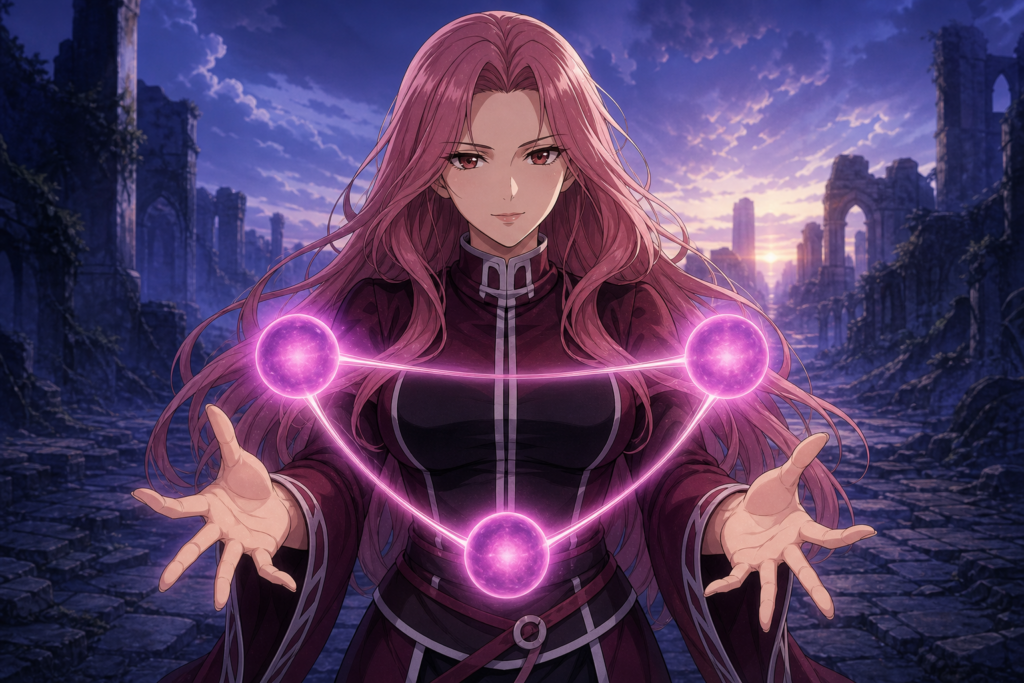
Fairy Tail Character Profile
Meredy can make people share sensation, pain and fatal consequence. Her story works because Fairy Tail refuses to pretend connection is automatically kindness.
Meredy can make people share sensation, pain and even fatal consequence. Fairy Tail’s smartest choice is refusing to call that power empathy by default. Connection is not kindness when nobody consented. At Tenrou Island, Meredy uses Maguilty Sense to link herself, Juvia and Gray so one death can kill all three. She turns shared feeling into a weapon because Grimoire Heart taught her that grief needs a target. Juvia does not defeat that logic by being stronger. She reaches Meredy through the very connection designed to coerce her.
That moment does not magically cure Meredy. The confrontation proves another use for the same power exists. Meredy is also not Ultear’s redemption receipt. Ultear rescues and raises her. The care is real. So is the power imbalance, the withheld truth and the ideology surrounding their home. Meredy’s later decision to save Ultear and join Crime Sorcière belongs to Meredy. Love can survive the truth without declaring the earlier structure harmless. Her complete arc is about agency after inherited vengeance. She begins with a ranking system telling her whose life matters most. She ends up using connection to help people coordinate and survive. Same emotional sensitivity. Different ethics.
Fast facts and canon boundaries
- *Name:* Meredy
- *Japanese name:* メルディ
- *Primary affiliations:* Grimoire Heart’s Seven Kin of Purgatory; later Crime Sorcière
- *Magic:* Maguilty Sense and related Maguilty techniques
- *Important relationships:* Ultear Milkovich, Juvia Lockser, Gray Fullbuster, Jellal Fernandes, Hades and Crime Sorcière
- *Japanese performer:* Saori Gotō
- *Primary continuity: Hiro Mashima’s Fairy Tail* manga and its television adaptation
Official TV Tokyo cast material credits Saori Gotō as Meredy. Its episode summary for `Tears of Love and Vitality` confirms the crucial Maguilty Sense condition: Meredy, Juvia and Gray become linked so the death of one would kill all three. That receipt gives us the mechanism without granting unlimited powers. Meredy does not automatically read minds, connect every person at any distance or create universal emotional understanding. Targets, conditions, concentration and later scale must follow primary scenes. The licensed English volumes and official episode archive do not provide a tidy public age, height or birthday in the material used here. Those fields stay unlisted. A profile does not become more complete by laundering a fan-wiki number into a fact box.
Design: the child soldier and the adult she becomes
Meredy’s Tenrou design presents a young, pink-haired mage shaped by Grimoire Heart. Her later appearance lengthens the hair and gives her a more mature silhouette associated with Crime Sorcière. Meredy begins as a child inside a violent hierarchy, with short pink hair, a compact dress-and-boots silhouette and the severe expression of somebody trained to rank lives. Later appearances give her longer hair and a more mature outfit. The design ages her without turning her body into proof that she has become morally softer or more available.
Pink is also not innocence shorthand. Her color palette sits beside magic capable of linking death. That contrast supports the character. Maguilty Sense often appears luminous and beautiful. The effect can still be coercive. Fairy Tail repeatedly asks viewers to separate magical aesthetics from ethical use, and Meredy may be the cleanest example. Her later visual language centers her hands and the geometry of a link. She is not a passive empath absorbing everybody’s feelings. She selects, builds and maintains connections.
A destroyed home and a borrowed explanation
Meredy survives the destruction of her childhood community. Ultear rescues her and becomes the central adult in her life. The manga eventually identifies Ultear as the person who destroyed Meredy’s hometown before taking the surviving child with her. That fact is ugly on purpose. Meredy grows up with loss, incomplete knowledge and a new institution offering certainty, while the person she loves most withholds her own place in the disaster.
Grimoire Heart turns grief into hierarchy. The ranking system teaches her that Zeref’s world, Hades’s project and assigned enemies can explain why she hurts. That framework is attractive because grief without certainty is terrifying. A target makes pain feel organized. Revenge creates a task for tomorrow. The ranking system also stops Meredy from asking who designed the story she has been given. Her childhood resembles Ultear’s in one important way: an adult controls the information through which a child understands abandonment and violence. Ultear does not need to be lying every second for the structure to remain unequal. She decides what Meredy knows, what training she receives and which loyalties define safety. The cycle is not identical. The pattern remains recognizable.
Ultear: rescue, love, authority and withheld truth
Ultear saves Meredy’s life and raises her. Meredy loves her. We do not need to call that love fake in order to examine the power. Ultear is caregiver, teacher, commander and gatekeeper to Meredy’s past. Meredy’s emotional world is built around one person who has both protected her and participated in systems connected to her harm. That creates dependence more complicated than a villain manipulating a disposable minion. Ultear cares. Meredy feels cared for. The relationship still limits Meredy’s informed choice.
When truth breaks through, Meredy is allowed to respond as a person. She can feel betrayal, rage, grief and love without selecting one emotion as the official answer. Her choice to prevent Ultear’s death matters because it comes after knowledge. Forgiveness is not automatic. Saving someone is not the same as declaring the record clean. This is where the relationship grows beyond hierarchy. Ultear has to live with Meredy knowing.
Hades and the ranking of lives
Grimoire Heart does not only give Meredy power. Grimoire Heart teaches her how to value people. Hades’s structure ranks members, goals and enemies through usefulness to a project. Meredy develops her own priority logic around targets. A human life becomes a position on a list. That is the opposite of real connection. The ranking system reduces relationship to calculation. The contradiction fits her magic. Meredy can directly share sensation while holding a worldview that abstracts people into targets. Feeling another person’s pain does not guarantee moral behavior if the ideology has already labeled that pain acceptable. This is why “empathy solves everything” is lazy. People can recognize suffering and still justify it. Ethics requires what we do with the recognition.
Tenrou Island and the Gray target
Meredy arrives on Tenrou Island as one of Grimoire Heart’s elite young fighters. Gray becomes central to her revenge logic. Gray is first on Meredy’s personal kill list because Ultear’s pain and her grievance over Ur have made him symbolically important inside Meredy’s borrowed worldview. Gray did not destroy Meredy’s town. The story is showing how an institution can redirect a child’s grief toward a convenient body. Meredy links herself, Juvia and Gray through Maguilty Sense. Official TV Tokyo material states the fatal consequence clearly: if one dies, all die.
This is coercion through intimacy. The targets cannot retreat into private bodies. Pain and death become shared infrastructure. Meredy uses connection to remove choice. The self-destructive element must not be romanticized. Her willingness to die is not proof that her love or vengeance is purer. The suicide link shows how thoroughly Grimoire Heart taught her to treat her own life as usable material.
Juvia changes the ethical meaning of connection
Juvia enters the fight with her own intense attachment to Gray. That could have produced a shallow contest over which girl cares more. Instead, the shared sensation allows Juvia to reach Meredy as a person. Juvia does not agree that Meredy’s revenge is justified. She refuses the fatal setup while responding to the grief inside it. Her care is not passive softness. Juvia’s empathy resists a system that wants everybody reduced to targets.
Meredy experiences a connection she did not design for domination. The magic carries more than pain. This does not mean Juvia cures her with one hug-shaped emotion. Meredy still needs truth, choice and later conduct. Juvia creates an interruption. She proves the ideology is not the only way to interpret shared feeling. The scene also gives Juvia agency beyond romance. Her love for Gray motivates her, but her moral act reaches another young woman. She protects Gray without treating Meredy as disposable. That is interpersonal intelligence in combat form.
Maguilty Sense: intimacy as weapon, warning and tool
Maguilty Sense links selected people’s senses and consequences. Depending on the scene, shared pain, injury and fatal stakes can travel across the connection. The magic is powerful because it turns relationship into mechanics. Consent is the dividing line. A forced link can be torture or hostage-taking. A chosen tactical link can share information and coordinate allies. Same spell family. Different moral structure. Meredy’s later large-group connections show growth because the participants’ agency and the shared purpose differ from her Tenrou trap. A bigger network is not automatically kinder. This one is built to coordinate survival, not enforce a private kill list.
Limits matter. Linking many people creates cognitive and magical burden. Distance, concentration and interruption must follow the primary material. Maguilty Sense is not telepathy with a pink filter. Maguilty Sodom gives her sensory magic a blade-like offensive form, while Maguilty Rays expands the attack pattern. Those named attacks belong to her Tenrou combat kit, but neither should replace Maguilty Sense as the power that defines her character. Floating blades photograph well. They do not explain her.
The truth about Ultear and the choice to keep her alive
After Tenrou’s conflict, Meredy confronts information that changes how she understands Ultear and her own past. This is the point where a weaker story would demand immediate absolution because Ultear looks remorseful. Meredy instead has to make a choice under emotional contradiction. The person she loves helped structure the life that harmed her. The rescuer and source of withheld truth are the same person. She prevents Ultear from disappearing into self-destruction.
That choice is compassionate, but it is also accountable. Death would allow Ultear to decide the final meaning of the relationship alone. Keeping her alive leaves room for Meredy’s judgment and for work that cannot happen after a dramatic exit. Meredy does not owe permanent closeness. Her later partnership shows she chooses it.
Crime Sorcière: her atonement is not borrowed
Meredy joins Jellal and Ultear in Crime Sorcière, an independent guild working against dark guilds and Zeref-linked threats. A weaker story could frame Meredy as the least guilty member who follows two damaged adults out of loyalty. That strips her agency again. Meredy was an active Grimoire Heart fighter. She used coercive magic and accepted a revenge ideology. Her age and upbringing matter. So do her choices. Crime Sorcière gives her a structure for repeated conduct. She can use connection to support investigation and survival rather than forced death.
The group is not a family because everyone agrees the past is finished. Crime Sorcière becomes a family because people with overlapping harm remain answerable while doing different work. Meredy also changes the group’s emotional balance. Jellal and Ultear lean toward self-punishment. Meredy has direct evidence that somebody wanting to die from guilt can still be making the decision about everyone else. She knows survival can be the more accountable demand.
Grand Magic Games, Tartaros and Alvarez
Crime Sorcière operates around later crises, including investigation during the Grand Magic Games period and alliance work against larger threats. Meredy’s value is often connective rather than flashy. She can share information, sensation or awareness across people. That support should be credited without turning it into a solo win. Tartaros and Alvarez require exact scene tracing. War arcs love wide reaction panels and combined magic. Presence is not identical to decisive authorship.
During large battles, Maguilty Sense can transform scattered fighters into a network. The structural theme becomes literal: survival improves when pain and information stop being private. The risk remains. A network can distribute support or distribute harm. Meredy’s maturity is shown through how she builds it and why.
Relationship atlas
Ultear Milkovich: Ultear is rescuer, guardian, authority, loved family and the person who withholds the truth about Meredy’s destroyed home. Meredy’s later loyalty becomes an informed choice after confrontation, not retroactive approval of manipulation or the violence committed under Grimoire Heart.
Juvia Lockser: Juvia is the opponent whose empathy interrupts revenge and self-destruction. She recognizes Meredy’s grief without accepting coercion, then proves that a magical connection can carry care in both directions. Their Tenrou encounter changes Maguilty Sense from punishment into a possible language of solidarity.
Gray Fullbuster: Meredy links Gray through Maguilty Sense and treats him as the highest-priority target in the worldview inherited from Ultear. Gray is not responsible for the destruction of her childhood home. The false blame shows how an authority can give grief a convenient enemy and call the result purpose.
Jellal Fernandes: Jellal becomes Meredy’s Crime Sorcière partner, and his history is also shaped by coercion, guilt and Ultear’s choices. Their shared work does not make their victimization identical. Partnership allows accountability to become collective without flattening the specific harm each person caused or survived.
Hades: Hades is the leader who turns grief into rank, target and ideology. His Lost Magic hierarchy rewards usefulness while treating damaged children as tools for a grand design. Meredy’s escape from that system requires more than defeating him because his categories already live inside her decisions.
Crime Sorcière: The independent guild becomes an atonement collective where Meredy’s connection magic supports protection rather than coercion. Shared missions give her work beyond Ultear’s approval, while the group’s secrecy and fugitive status prevent redemption from becoming easy public absolution.
100 Years Quest boundary
In Fairy Tail: 100 Years Quest, Meredy remains part of the wider world established around Crime Sorcière, but she is not a lead Dragon God combatant. This profile does not award her off-panel importance simply because her magic would be useful. Reputation is not appearance, and a relationship to Jellal is not a substitute for Meredy receiving her own scene. Do not promote her into Dragon God strategy because Maguilty Sense would be useful. Potential is not canon.
The child soldier problem Fairy Tail refuses to name neatly
Grimoire Heart calls its elite the Seven Kin of Purgatory. That title sounds grand enough to sell merchandise. In practice, it gives young people a mystical job title while adults point them at enemies. Meredy’s ranking list is the giveaway. She has converted a messy emotional history into numbered targets because numbers feel cleaner than grief. That is not the same as saying she has no agency. She makes tactical choices, attacks Juvia and builds a fatal three-person link. Harm does not become harmless because the person causing it was groomed. The more honest reading holds two facts at once: Meredy is responsible for what she does at Tenrou, and the adults who trained her built the conditions that made self-destruction look like loyalty.
Hades benefits from that confusion. If a child believes dying for the mission proves devotion, the institution gets a weapon that disciplines itself. No supervisor has to say, “Your life is disposable,” every morning. The ranking system says it for him. This is where Fairy Tail’s guild argument gets interesting. The series loves chosen family, but it also knows a group name can hide wildly different power structures. Fairy Tail is chaotic, nosy and often irresponsible. Grimoire Heart is orderly, secretive and ideologically neat. Only one of them leaves meaningful room for a member to be more than useful.
From Tenrou to the Grand Magic Games
Seven years pass for the outside world while Fairy Tail’s Tenrou team is sealed away. Meredy does not spend that time waiting in narrative storage. She joins Jellal and Ultear in Crime Sorcière, an independent guild built around confronting dark guilds and atoning for crimes the law, prison and public reputation do not settle by themselves. During the Grand Magic Games period, Crime Sorcière investigates the strange magical presence around the tournament. Meredy also participates in the work that helps Fairy Tail’s returning members access their Second Origin. That support matters because it shows a change in method. At Tenrou, she imposes a link to force shared fatal stakes. Later, she lends her power toward somebody else’s preparation and survival.
That does not make Crime Sorcière morally spotless. Atonement groups can become little private courts where members congratulate one another for feeling guilty. Meredy’s growth works because the story keeps giving her jobs outside Ultear’s emotional orbit. She collaborates with Jellal. She deals with the consequences of Ultear’s choices. She supports people who are not extensions of her original target list.
Tartaros, Alvarez and support magic that actually changes a war
Meredy’s later battle value is connective. That sentence may sound less exciting than “she punches a god,” but Fairy Tail repeatedly wins because somebody makes separate people function like a group. Around the Tartaros conflict, Crime Sorcière’s path intersects with the former Oración Seis. Meredy is part of a guild trying to stop dark-guild violence while carrying its own record of violence. The point is not that every former antagonist becomes trustworthy because the logo changed. The point is that later conduct has to keep answering earlier harm.
The Alvarez war gives Maguilty Sense its largest ethical test. Meredy helps connect many mages so their magic and feeling can be coordinated in the final struggle against Acnologia. The scale echoes Tenrou, but the purpose is different. Her first major link traps three people inside a death threat. Her later network helps people act together against a threat none can stop alone. Fans are right to credit that work. They should also resist turning Meredy into the sole author of the victory. Lucy’s plan, Levy’s calculation, the gathered mages and the people maintaining Fairy Sphere all matter. Support magic is not lesser magic, but collaboration stops being collaboration when fandom erases everybody except its favorite.
Maguilty Sense is not empathy with sparkles
The anime’s pink lines make Maguilty Sense easy to read in motion. They also risk making it look gentle. That reading is false. The magic can connect sensation and injury, and its Three Spread Sensory Link makes Meredy, Juvia and Gray share lethal consequence. Her Maguilty attacks give that sensory magic an offensive edge. The rules are conditional, scene-bound and strategically exploitable. She is not reading every thought in Fiore because the plot needs a shortcut.
The ethical line is consent. A forced link can become torture. A chosen link can become coordination, warning or rescue. Same magic. Different relationship. That distinction is very RaeRae simple: access is not intimacy. Knowing what somebody feels does not mean they gave you permission to enter. Families get this wrong. Fandoms get it wrong. Institutions get it wrong while printing “community” on the banner. Meredy’s best material asks who built the connection, who benefits from it and whether the person inside it can leave.
What the adaptation adds
The manga can place Meredy’s targets, expressions and link geometry on the page at the reader’s pace. Television has to control timing. The anime stretches the terrible pause between Juvia receiving Meredy’s pain and deciding what to do with that information. Reaction shots let the audience watch a combatant realize the person attacking her is also a child carrying somebody else’s grievance. Color does useful labor too. Meredy’s rose palette and bright sensory effects clash with the cruelty of the mechanism. That contrast is stronger than dressing her in visual evil. She looks emotionally vivid because she is. The problem is that Grimoire Heart taught her to turn that sensitivity into enforcement.
The adaptation does not need extra tragic monologues to make the point. Gotō’s shift from hard attack rhythm to disrupted, less certain speech gives the change a body. The series is at its best when direction trusts that fracture instead of polishing it into instant redemption.
Final verdict
Meredy begins in a world where connection is something powerful people control. Ultear controls the story of her past. Hades controls the ideology. Meredy controls pain through Maguilty Sense. The person with the link decides whose body becomes leverage. Juvia breaks that logic by using connection to recognize rather than dominate. Meredy later chooses truth, keeps Ultear alive and joins Crime Sorcière on her own moral record. Her growth is not becoming nicer. Her arc learns that shared feeling creates responsibility, not ownership.
That lesson matters far beyond magic. Families, fandoms and institutions love to say “we are connected” when they really mean “you must feel what we authorize.” Meredy’s story asks who built the link, who consented and who can leave. Connection can carry death. Shared pain can also carry the warning that keeps somebody alive. The difference is agency.
Source ledger and publication boundaries
- TV Tokyo official 2014 staff/cast page: Saori Gotō credit.
- TV Tokyo official `Tears of Love and Vitality` page: fatal Maguilty Sense link among Meredy, Juvia and Gray.
- Kodansha official Fairy Tail and sequel catalogs.
- Primary narrative record: Hiro Mashima’s Fairy Tail volumes and published sequel volumes.
Publication boundaries: no unsourced age; no simplified town-destruction blame without primary support; no Ultear relationship used as absolution; no Gray assigned false responsibility; no self-harm aestheticized as devotion; no Maguilty Sense described as unlimited telepathy or automatic empathy; no team support inflated into solo victory; no English-dub performer; and no anime-original, film, OVA, game or sequel material without official receipts.
Primary receipts and continuity shelf
TV Tokyo, “Tears of Love and Vitality” confirms the three-person Maguilty Sense death link. TV Tokyo’s official staff and cast page credits Saori Gotō. The chronology and mechanics are cross-checked against Hiro Mashima’s licensed Fairy Tail volumes, including Kodansha’s official Volume 27 catalog record. Anime-only, promotional and sequel material is labeled rather than folded into the main manga as if every continuity were one pot.