
RaeRae Rants · Anime Housing, Orphans, and Chosen-Family File
Anime Keeps Treating Child Homelessness Like Character Development
The lonely apartment, abandoned warehouse, borrowed couch, and endless road make beautiful stories. They also reveal how quickly fictional societies turn a child without stable housing into an inspiring personality trait.
The room nobody helped make safe
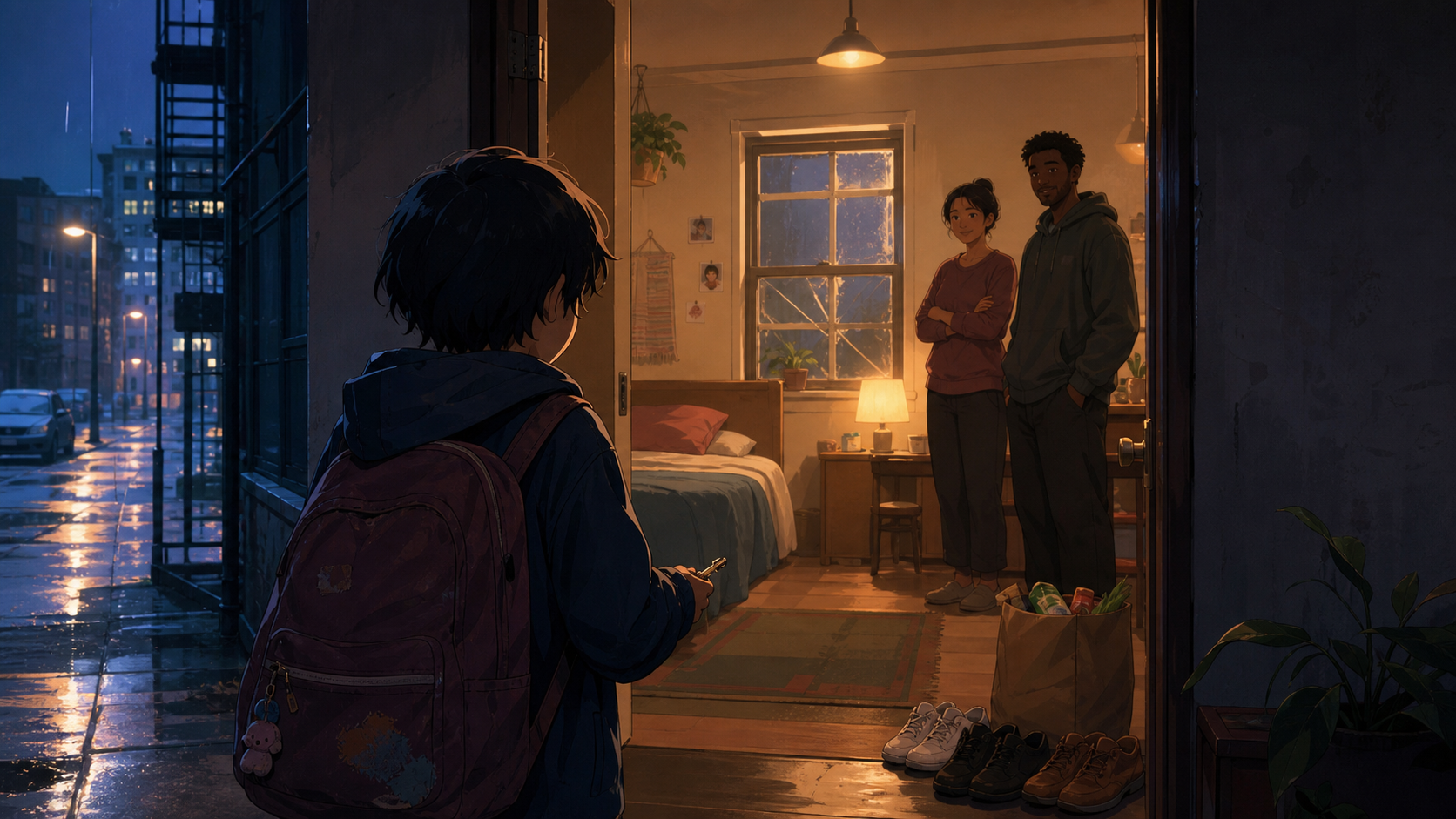
A child unlocks a small apartment after school. Nobody asks how the rent gets paid, who signed the lease, whether the refrigerator works, or which adult notices when the child never comes home. The scene often reads as freedom. No parents, no curfew, no embarrassing questions. The protagonist can train at midnight, hide a supernatural visitor, or invite friends over without explanation. Narrative convenience turns institutional neglect into privacy. Then the camera lingers on one cup, one toothbrush, and one place set at the table. Loneliness becomes visible enough for emotion but not concrete enough for policy. The audience feels sad and moves toward the next episode. Children need more than a roof. Stable housing includes utilities, food, maintenance, transportation, legal protection, adult supervision, privacy, and a realistic plan when something breaks. A monthly allowance does not become a family because the payment arrives on schedule.
Some young people genuinely prefer distance from unsafe relatives or institutions. Autonomy matters. Supportive housing can respect independence while providing trusted adults, financial security, and emergency help. The rant is not demanding that every protagonist move into a cheerful foster home by episode two. The rant asks stories to recognize housing as a social structure rather than a personality quiz.
Why stories romanticize instability
Unstable housing creates movement. A character travels, meets strangers, accepts temporary work, and enters conflicts that a settled child might avoid. Writers gain plot flexibility from the absence of adults and addresses. The wandering hero also carries cultural prestige. Pilgrims, ronin, adventurers, exiles, and traveling performers appear across storytelling traditions. Mobility can represent spiritual freedom, rejection of corrupt authority, or a search for identity. A child on the road changes the moral meaning. Adults may choose hardship with some understanding of risk. Children often move because war, abuse, death, poverty, discrimination, or institutional decisions removed safer options.
Anime sometimes blurs those categories. A young hero appears independent because the narrative never shows the paperwork, hunger, vulnerability, and exhaustion surrounding displacement. The child gains cool competence while adults disappear from responsibility. Poverty becomes an aesthetic. A cracked wall, dim lamp, instant noodles, and rain outside can create a memorable mood. Beauty does not cancel deprivation. Strong visual storytelling can hold both truths by showing how environment limits choices. The problem appears when hardship proves authenticity. Wealthy characters become shallow while the poor protagonist becomes morally pure because suffering supposedly taught gratitude. Poverty does not manufacture virtue. Poverty limits time, health, privacy, and options.
Competence hides need. A child who manages money, repairs clothes, or finds shelter may look less vulnerable than a child who cries. Competence can delay help because adults assume the young person has everything handled. Reliable children often become invisible to systems. They arrive on time, avoid complaints, and solve crises quietly. Nobody notices how much energy survival consumes.
Anime case files
Naruto Uzumaki and the apartment treated as proof of independence. Naruto grows up alone while carrying a burden created by village leadership. His apartment gives privacy and a place to return, but domestic independence does not answer who provided daily care, taught routines, responded to illness, or noticed loneliness. The village can organize ninja missions across borders. The same village relies on scattered kindness to reach one orphan. That contrast turns housing into a political question. Naruto has an address without receiving a dependable home.
Iruka’s care matters precisely because Iruka chooses to see him. One teacher cannot retroactively become an entire child-welfare system. Praising Iruka should not erase the officials and neighbors who left the gap for Iruka to fill. Fruits Basket understands that a tent is not whimsical independence. Tohru Honda lives in a tent after losing her mother and facing an unstable family arrangement. Her cheerfulness makes the situation easy for others to underestimate. She works, attends school, and avoids burdening people.
The series understands that competence and danger can coexist. A landslide does not become the first problem. The first problem was a grieving teenager believing that secret homelessness was kinder than asking adults for help. Tohru’s eventual household offers belonging, but chosen family arrives through chance. The emotional rescue should not excuse the social conditions that allowed a student to disappear into the woods. Tokyo Godfathers looks directly at the people respectable society edits out. Satoshi Kon’s film follows three homeless adults who find an abandoned baby. The story uses coincidence and holiday melodrama while refusing to make homelessness one simple moral category.
Each person carries history, conflict, shame, love, and unfinished relationships. Housing instability does not erase individuality. The baby forces encounters with institutions and families that prefer clean narratives about deserving and undeserving people. The film finds humor without treating deprivation as a joke. Characters remain funny because they are full human beings, not because homelessness serves as visual shorthand for failure. Banana Fish places street survival inside exploitation. Ash Lynx commands extraordinary intelligence and tactical ability. Those skills developed within violence, trafficking, criminal power, and institutional betrayal. Competence protects him while also making adults and organizations eager to use him.
The story does not offer a comforting claim that hardship made him stronger for a good reason. Survival skills carry costs. Safe housing alone could not solve every danger, but housing connected to trustworthy protection would change the range of available choices. Kotaro Lives Alone turns the cute premise back on the adults. A small child living alone sounds like a comedy setup. Kotaro’s formal speech, careful routines, and unusual self-sufficiency create humor because he behaves like a miniature adult.
The series gradually reveals that those habits developed around neglect and abuse. Kotaro plans for danger because danger was once ordinary. He interprets care through the logic available to him, sometimes misunderstanding kindness because reliable kindness remains unfamiliar. His neighbors become a protective community. Their growth matters because they learn to respond without demanding that Kotaro perform helplessness first. They respect his dignity while recognizing that competence does not remove his age.
The story also understands that affection alone cannot resolve legal and family uncertainty. Adults need boundaries, patience, and support. Kotaro should not become the neighborhood project whose charm repairs everyone else while his own needs remain secondary. Grave of the Fireflies destroys the fantasy that determination can replace a social net. Seita and Setsuko lose home, family protection, and material security during war. Seita’s pride and conflict with their aunt influence later choices, but personal flaws unfold inside mass destruction, scarcity, and institutional collapse.
The film refuses the comforting rhythm of an adventure where ingenuity steadily improves survival. A shelter can look like independence while food disappears. Love between siblings cannot manufacture nutrition or public stability. Viewers sometimes turn the tragedy into a lesson about Seita making better decisions. Accountability for choices matters, but focusing only on one adolescent’s pride shrinks the world around him. Adults, war policy, rationing, community judgment, and destroyed infrastructure shaped the narrowing path.
Setsuko’s death should not become proof that the children lacked resilience. The children had already been asked to survive conditions no child should face. Dororo makes the road both freedom and evidence of abandonment. Hyakkimaru and Dororo travel through a landscape damaged by war, exploitation, famine, and political ambition. Movement creates encounters and allows both characters to resist ownership. The road also exposes how few safe institutions exist. Dororo’s wit and resourcefulness support survival. Those abilities attract admiration while reminding viewers that adults repeatedly failed to provide lasting protection. A child thief may be clever. Theft may also reveal exclusion from food, family, and lawful work.
The series connects bodily autonomy to political prosperity. Hyakkimaru’s stolen body supports a domain’s fortune. The moral argument resembles the housing question: collective benefit cannot justify assigning one child the cost without consent. One Piece fills the sea with children displaced by adult power. The Straw Hat crew offers chosen family and movement. Many members carry histories shaped by destroyed homes, abusive authority, persecution, trafficking, or political violence. Adventure allows them to build belonging beyond institutions that failed.
The ship becomes home because routines, roles, food, conflict, repair, and return transform a vehicle into a stable social place. Mobility does not automatically mean homelessness when people control the journey and trust the group. That distinction matters. Chosen movement can create freedom. Forced movement creates displacement. The same ocean can hold both conditions depending on power, resources, and the ability to stop.
Housing changes every other problem
A stable home affects sleep, school attendance, nutrition, medical care, friendships, privacy, and the ability to plan. Housing does not sit beside those issues as one item on a list. Housing shapes all of them. A student moving between temporary places may lose transportation, documents, medication, uniforms, and reliable internet. Teachers may interpret lateness or missing work as indifference. Friends may never learn the real reason because disclosure risks shame or intervention.
Young heroes face additional barriers. Powers can damage buildings. Enemies can target known addresses. Agencies may require secure locations. Those unusual risks increase public responsibility rather than eliminating responsibility. Emergency shelters matter, but temporary beds cannot replace long-term housing. Constant relocation interrupts community and creates new danger. Programs should keep siblings together when safe, protect identity, support education, and provide a route toward permanence.
School may be the only stable address in a child’s week
Students without stable housing often spend the day protecting a secret. A teacher sees unfinished homework, sleepiness, missing supplies, or the same clothes. Classmates notice that invitations never lead to the student’s home. Every ordinary question can demand a new explanation. Anime schools frequently respond to visible performance. Grades, attendance, combat scores, club participation, and behavior determine whether a student appears responsible. Housing instability remains outside the frame until a dramatic reveal.
A humane school asks what changed before deciding what the change means. Flexible deadlines, transportation help, meals, laundry access, secure storage, counseling, and help replacing documents can keep a temporary crisis from destroying education. Privacy still matters. Staff should share information only with people who need access. Public charity can humiliate the student or expose a family to danger. Support should reduce the burden of disclosure rather than turning hardship into school gossip.
Boarding academies create another complication. A dorm can provide housing, community, and regular meals. The same dorm can make education, employment, medical care, and shelter depend on one institution. Expulsion then becomes a housing crisis as well as an academic consequence. Stories about elite hero schools and military academies should acknowledge that dependence. A student may tolerate abuse or conceal injury because leaving means losing the only safe bed.
A stable home is part of health care
Medication needs storage. Wounds need clean space. Sleep needs safety. Recovery after surgery needs reliable water, food, and somebody who can respond when symptoms worsen. Anime healers can close a spectacular wound in minutes, then send a child back to an empty room. Medical care becomes a scene rather than a continuing condition. The body survives while recovery remains unsupported. Housing instability also increases stress. Constant planning around food, transport, belongings, and personal safety consumes attention. A character may look distracted because the mind remains busy solving tonight before considering next month.
Trauma can make group housing difficult. Crowded shelters, strict rules, noise, and lack of privacy may recreate danger. Programs need multiple options rather than one model presented as universal rescue. Disability adds further barriers. Stairs, inaccessible bathrooms, medication needs, sensory overload, and transportation can make an available room unusable. Safe housing must fit the person rather than simply exist on paper.
Home is also an address inside every bureaucracy
Applications ask for a permanent address. Schools need proof of residence. Employers want identification. Clinics send notices. Banks, benefit offices, and courts assume mail reaches the same place each week. A child can lose access to services because the absence of housing makes documentation harder. Missing documents then make housing harder to obtain. The loop turns administrative order into exclusion. Fantasy worlds reproduce the same barrier through clan records, village registration, guild papers, citizenship marks, and magical identification. A young person without recognized lineage may exist socially while remaining invisible legally.
Stories often solve the problem when a powerful mentor vouches for the protagonist. Personal sponsorship can help, but rights should not depend on knowing a respected adult. Institutions need alternatives for people without permanent addresses, safe document storage, fee waivers, and help replacing lost records. A bureaucracy should not demand proof that only stability could provide before offering stability.
Gender changes the dangers a displaced child faces
Homeless children face exploitation, violence, and coercion across genders. Risks take different forms depending on social expectations, identity, disability, and who controls available shelter. Girls in anime may receive protection only when a male character claims responsibility. That trope can create romance while turning safety into personal ownership. A secure home should not require emotional or sexual obligation. Boys may receive less sympathy because competence and toughness hide vulnerability. A teenage boy sleeping in a station can be treated as delinquent rather than endangered. Masculine expectations punish help-seeking and reward dangerous independence.
LGBTQ young people may avoid relatives or shelters where identity brings rejection. Fictional worlds with clans, arranged roles, or rigid gender systems can explore that conflict without reducing identity to tragedy. Trans and gender-nonconforming characters need housing that respects names, privacy, safety, and medical care. Placement based only on official documents can create danger. An intersectional story asks which options remain available to this particular child, not to an abstract homeless protagonist.
The wandering child belongs to a larger cultural history
Folklore and literature across cultures contain abandoned children, hidden heirs, street urchins, traveling apprentices, and orphans who enter extraordinary worlds. Removing parents gives young protagonists freedom to act and creates immediate emotional stakes. Modern animation inherits that tradition alongside histories of war, displacement, urban poverty, disaster, and changing family structures. An orphan may symbolize national loss, social rupture, or a generation forced to rebuild. Historical context can deepen interpretation without turning every fictional child into a direct symbol for one event. Creators combine genre convention, personal memory, commercial storytelling, and social observation.
Viewers should also resist a simple cultural contrast in which one country supposedly values collective care while another values independence. Every society contains public systems, family expectations, charity, exclusion, and political conflict over responsibility. The repeated image of a child alone matters because audiences recognize both fear and freedom. The empty room offers control after chaos. The same room exposes how little support remains when the door closes.
Housing scarcity is not a personal backstory
Stories frequently explain homelessness through one death, one abusive relative, or one individual mistake. Personal events matter. Wider conditions determine whether a crisis becomes a night away or years of instability. Rent levels, wages, discrimination, disaster recovery, public housing, health costs, legal status, and availability of services shape every option. A caring neighbor cannot create an affordable apartment when none exists. Anime cities often display extreme wealth beside crowded districts, abandoned buildings, and informal settlements. Those backgrounds contain political information even when the script never comments directly.
A vacant building does not automatically become safe housing. Repairs, utilities, accessibility, legal protection, and community support matter. Still, visible vacancy beside child homelessness should provoke questions about property and public priorities. Economic analysis does not make a story cold. Material details explain why love succeeds or fails. A guardian with stable income can offer more than a guardian working three jobs under threat of eviction.
Bad institutions do not make no institution the answer
Anime has good reasons to distrust orphanages, detention centers, military dormitories, and corrupt welfare officials. Institutional care can become abusive, impersonal, and controlling. A child may reasonably flee. The failure of one institution does not prove that public responsibility should disappear. The answer requires safer options, independent oversight, smaller settings, family support, and real complaint channels. Children need multiple routes. Kinship care may work when relatives receive resources and the home remains safe. Foster care may work with careful matching, training, support, and accountability. Supportive independent living may fit older teenagers. Emergency shelters remain necessary during immediate danger.
No placement should depend on gratitude. Children need ways to report harm without losing shelter overnight. Advocates should remain independent from the agency or household being challenged. Siblings and important relationships deserve protection. Moving a child to safety while severing every familiar bond can create another loss. Contact decisions should consider individual circumstances rather than one automatic rule. Anime can show institutional complexity through one competent caseworker inside a flawed system, one family receiving meaningful support, or one complaint that leads to change. Corruption creates drama, but ordinary public competence can carry emotional weight too.
Respectability decides who audiences think deserves a home
Fiction often presents one unhoused character as clean, polite, hardworking, and secretly talented. Another character appears loud, addicted, angry, mentally ill, or involved in crime. The contrast invites viewers to divide deserving people from disposable people. Housing should not function as a prize for pleasant behavior. Safety can make recovery possible. Demanding recovery before housing reverses the order for people whose instability worsens every condition. Children may respond to trauma through aggression, withdrawal, lying, hoarding, or difficulty following rules. Those behaviors can challenge caregivers and still communicate unmet needs.
A good story does not excuse every harmful action. A good story separates accountability from abandonment. Consequences can protect others while preserving food, shelter, education, and a route back into community. Humor deserves similar care. A character fighting over leftovers may be funny within a relationship. Repeated jokes about hunger can make deprivation feel harmless when the story never allows consequences.
Scenes that make housing real without turning the story into paperwork
The key handoff. A key represents access, privacy, and permission to return. The emotional power comes from reliability. The giver should explain whether the key lasts one night, one season, or as long as needed. Clear terms reduce the fear that one mistake will end shelter. The first stocked refrigerator. Food reveals whether a place supports daily life. A full refrigerator can overwhelm someone accustomed to scarcity. The character may save food, ask permission repeatedly, or avoid taking the last portion.
Those details show history without a speech. Caregivers can respond by making access predictable rather than forcing gratitude. The address line on a form. A simple school or job application can expose instability. The character pauses, invents an address, or leaves the box blank. Bureaucratic design becomes visible through one pen hovering over paper. The bag that never gets unpacked. A child may keep belongings ready because previous placements ended suddenly. Adults can misread the packed bag as rejection. The bag may represent preparation learned through experience.
A powerful homecoming scene does not require the child to unpack immediately. Safety becomes believable after enough mornings prove that the room remains available. The repair nobody turns into a favor. A landlord, guardian, or neighbor fixes a lock, heater, or broken window without demanding emotional payment. Ordinary maintenance becomes a declaration that the resident deserves safe conditions.
The honest criticism: solitude can be chosen and meaningful
Not every character living alone represents neglect. Some adults and older adolescents choose solitude, travel, or communal arrangements outside a conventional household. Independence can support healing and identity. A critique of homelessness should not become a demand that every person enter a traditional nuclear family. Family homes can be dangerous. Institutions can erase culture and autonomy. Shared housing can create conflict. The relevant question concerns meaningful choice supported by safe alternatives. Stories should show whether the character can stay, leave, return, and ask for help. Control over movement distinguishes adventure from displacement. Some narratives also use domestic realism selectively. A fantasy series may omit rent and groceries because the genre focuses elsewhere. Omission becomes troubling when the story repeatedly uses loneliness for emotion while refusing to examine the adults who benefit from looking away.
Weather turns unstable housing into an emergency
Rain looks beautiful in animation. Snow creates silence. Summer heat bends the skyline. For a child without reliable shelter, weather changes safety, sleep, food, transportation, and health. A tent that works during a mild week may flood during a storm. A station that stays open during the day may close overnight. Heat can spoil medication and food. Cold makes charging a phone or drying clothing harder. Seasonal episodes can reveal whether a community sees displaced people. Public buildings may open during dangerous temperatures. Transit workers may connect a child to services rather than remove the child for appearing out of place. Schools may keep facilities available after hours.
Disaster stories deserve special care. An earthquake, flood, fire, or attack can displace thousands at once. Emergency shelters must address disability, medication, family separation, privacy, and protection from violence. Recovery lasts longer than the rescue scene. Temporary housing can continue for months or years. Children may change schools repeatedly while adults discuss reconstruction through budgets and maps.
Why audiences forgive the adults so quickly
A child protagonist needs room to act. Viewers accept missing adults because active guardians could stop the adventure before the opening theme ends. Genre logic explains the absence without removing moral consequences inside the world. A writer can preserve narrative freedom and still let characters question why help arrived late. Audiences also admire self-reliance. Many viewers remember wanting a private apartment, unlimited snacks, and freedom from family rules. The fantasy lands differently when the character never had a dependable adult to reject.
Success rewrites the past. Once the homeless child becomes a hero, leader, or genius, earlier neglect starts to look like training. People credit hardship for the outcome and ignore children who faced similar hardship without extraordinary powers or luck. That logic appears outside fiction whenever survival becomes evidence that support was unnecessary. The adult survivor may feel proud of skills developed through crisis and still wish that childhood had required fewer of them.
What a village, city, or kingdom actually owes
First, prevent avoidable separation. Families may need rent assistance, medical care, food, childcare, legal help, or protection from violence. Removing a child without addressing material hardship can punish poverty rather than improve safety. Second, provide immediate housing without demanding perfect documents or behavior. Emergency access should be simple enough for a frightened teenager to use. Third, assign a trustworthy adult who remains reachable. Contact should continue after placement because stability needs follow-through.
Fourth, protect education and health care during moves. Records should transfer quickly, and transportation should preserve school continuity when possible. Fifth, support caregivers materially. Relatives and chosen-family households cannot pay rent with affection. Funding, respite care, counseling, and legal authority can keep a good arrangement from collapsing. Sixth, create real oversight. Children need confidential complaint channels, independent advocates, and protection from retaliation. Seventh, plan for adulthood before a deadline arrives. Young people leaving care need housing, income, education, identification, health coverage, and relationships that do not expire on a birthday.
Children without homes become easy labor to exploit
A young person who needs food and a bed has less power to refuse dangerous work. Anime guilds, gangs, militaries, hero agencies, and wealthy households often recruit children by offering shelter alongside employment. The arrangement can look generous. The child receives meals, training, and belonging. The employer receives loyalty strengthened by the knowledge that dismissal may mean homelessness. Work can build skill and dignity. Exploitation begins when housing depends on obedience, wages remain unclear, hours ignore education, and leaving becomes unsafe. A bed should not erase labor rights.
Live-in arrangements need boundaries. Domestic workers, apprentices, performers, and trainees deserve privacy, rest, payment, schooling, and outside contacts. Employers should not control every relationship merely because work and housing share an address. Combat work raises the stakes. A village that houses an orphan through military training may claim to provide opportunity. The village also benefits from converting a vulnerable child into state capacity. Characters can love their teams and still deserve criticism of the system that made enlistment the most reliable route to food, status, and family.
Society punishes the survival behavior society created
Sleeping in public, taking food, entering abandoned buildings, missing school, and using informal work may violate rules. Enforcement often removes people from visible spaces without creating a safe place to go. Anime authorities label displaced children thieves, delinquents, runaways, or gang members. Those labels focus attention on conduct while hiding the conditions surrounding conduct. Accountability remains necessary when another person gets harmed. A housing-centered response asks what consequence protects the victim, addresses the behavior, and reduces the chance of repetition without returning the child to the same danger.
Fines make little sense for someone without money. Detention may interrupt school and expose the child to more violence. A criminal record can later block employment and housing, deepening the original problem. Diversion, restorative processes, legal advocacy, and immediate housing can respond more effectively. Services should not require a child to accept blame for being poor before receiving help. Public space belongs to everyone, yet communities need rules for safety and access. The fair solution creates enough private safety that sidewalks and stations do not become default bedrooms.
A birthday should not become an eviction notice
Young people leaving foster care, institutional care, military programs, or school dormitories can face sudden independence. The calendar declares adulthood while income, housing, education, health care, and dependable relationships remain unsettled. Anime loves the ceremonial graduation. Students receive uniforms, titles, or licenses and step into the world. The ceremony rarely asks whether graduates have deposits, furniture, identification, or somewhere to recover after the first bad week. Transition planning should begin early and follow the young person beyond one deadline. Housing subsidies, continued education, employment support, health coverage, financial counseling, and legal help can prevent a predictable crisis.
Relationships should not expire either. Mentors and caregivers need support to remain present without controlling the adult’s life. A young person should be able to call after making a mistake without losing dignity. Extended care should remain an option rather than a punishment for insufficient independence. Some people need more time, especially after disability, trauma, disrupted education, or repeated placements. Adulthood means increasing agency. Adulthood does not mean society stops owing fair conditions.
Fans should stop using the tragic apartment as an intelligence test
Discussion often asks why a child did not make the optimal choice. Why not call a teacher? Why not stay with a relative? Why not save money, follow the rule, or accept the offered room? Those questions can illuminate character. They become unfair when viewers assume every option felt safe, available, and understandable. Children make decisions with limited information and histories that shape trust. A child who refuses help may fear conditions attached to help. Previous adults may have broken promises. A relative may be unsafe. An authority may threaten separation from siblings. Pride can matter alongside those realities.
Fans also compare suffering as though only the saddest character deserves concern. One child sleeps outside, another lives alone with money, and another remains in an abusive mansion. Housing quality includes emotional and physical safety, not only possession of walls. Analysis becomes stronger when viewers ask what each environment allows and prevents. Can the child rest? Can friends visit? Can the door lock? Can the child leave? Does an adult answer during an emergency?
Repair means more than finding a room after the finale
Housing after long instability can feel unfamiliar. Quiet may make sleep difficult. A stocked kitchen may trigger hoarding. A closed door may feel dangerous. Support should continue after move-in. Tenancy rights matter. A young person needs clear rules, notice before entry, protection from sudden removal, and a process for resolving conflict. Informal generosity can disappear during an argument. Material setup also matters. Deposits, bedding, cookware, transportation, school supplies, identification, and utility costs can overwhelm a person receiving an empty room.
Community should grow without becoming mandatory gratitude. The resident may need privacy before joining shared meals or celebrations. Belonging cannot be forced on a schedule. Repair also asks the institutions that failed to acknowledge harm. Records may need correction. Benefits may require restoration. Adults who ignored warnings may need accountability and training. A key changes one night. Stability develops through months of the key continuing to work.
The household details that reveal the whole backstory
Watch the shoes by the entrance. One pair signals solitude. Shoes kept ready may suggest frequent moves. A character who never removes shoes may not trust the stay. Food behavior offers another record. Saving packets, eating quickly, hiding snacks, and refusing the final portion can reflect scarcity. A caregiver who keeps favorite food available without comment communicates reliability. Look at personal decoration. Posters, photographs, and small collections require confidence that belongings can remain. Blank walls may reflect taste, but blank walls can also reveal a life prepared for departure.
Sound design matters. Pipes, neighboring voices, traffic, and keys in a lock determine whether a room feels safe. Silence can offer peace or confirm isolation. Finally, notice who knows the address. Sharing an address can represent trust. Hiding an address may protect the child from enemies, abusive relatives, shame, or intervention. The reason changes the meaning.
Success should mean stability, not silence
Programs often count a placement as success once a child receives a bed. The number matters, but placement cannot reveal whether the home remains safe, whether school continues, or whether the young person feels able to report problems. Better measures include housing retention, educational continuity, health access, family and community connection, personal safety, and the young person’s own assessment. Data should follow people long enough to identify repeated disruption without turning support into another surveillance system.
Anime institutions use simpler measures. The child attends class, completes missions, and avoids arrest, therefore leaders assume the arrangement works. Performance can hide crisis because losing housing may depend on appearing compliant. Success also needs room for ordinary adolescence. A housed child should be allowed to argue, fail a test, change friends, and make an inconvenient choice without facing removal. Stability becomes meaningful when support survives imperfection. Communities should examine who returns to homelessness and why. Repeated failure may reveal inaccessible rules, discrimination, insufficient income, unsafe placements, or services that end too early.
The home should not depend on the child saving everyone first
Anime frequently gives abandoned children a home after they defeat the villain, protect the village, heal the family, or prove exceptional loyalty. The ending feels earned because the character completed an enormous journey. Housing should not be the trophy waiting after heroism. The child needed safety before the final battle. Safety might have made the battle less destructive, the training less desperate, and the relationships less afraid. A protagonist can still earn trust, friendship, and responsibility. The basic right to a secure place should not depend on entertaining the audience or rescuing the adults.
Stories become more radical when care arrives before proof. Somebody offers a key because the child exists and needs a door. The child may distrust the offer, test the boundary, or leave and return. The home remains available. That persistence does not remove conflict. Persistence changes the conflict from survival against abandonment to growth inside a relationship strong enough to withstand mistakes.
Chosen family cannot replace public duty
Anime excels at chosen family. Teammates cook together, mentors provide keys, shopkeepers offer spare rooms, and strangers slowly become relatives. Those relationships can save lives. Chosen family works because care becomes personal. Someone remembers a favorite food, recognizes silence, and notices when the front door never opens. Public systems struggle to reproduce intimacy. That difference does not excuse public withdrawal. A chosen family may lack money, legal authority, accessible housing, medical knowledge, or protection from an abusive institution. Love needs material support.
Stories should resist making one generous household responsible for every abandoned child. Governments and communities can fund kinship care, supportive housing, counseling, food, transportation, and legal help without trying to control the relationships. Children should not need exceptional charm to earn a couch. Tohru’s kindness, Naruto’s persistence, or Ash’s brilliance should not become eligibility criteria for safety.
How writers can do better without killing the adventure
Give the child a believable support arrangement. A guardian may be imperfect, a stipend may exist, and a caseworker may struggle. Specific details make the world richer without removing conflict. Show administrative choices. Who approved the apartment? Which agency pays rent? What happens during illness? Why did school staff miss warning signs? Those questions can create plot rather than interrupt plot. Let help preserve autonomy. A teenager can accept housing without surrendering every decision. Support should expand choices rather than trade shelter for obedience.
Show the cost of mobility. Travel affects sleep, belongings, documents, and relationships. A wandering arc becomes more meaningful when the character chooses movement instead of merely lacking alternatives. Avoid treating domestic skill as proof that adults are unnecessary. Cooking and budgeting deserve praise. Children can be capable and still deserve dependable care. Finally, remember the ordinary days. The strongest home scene may involve medicine during a fever, a repaired lock, a stocked refrigerator, or somebody waiting after a late train. Safety becomes real through repetition.
A stronger version of the trope would also let responsible adults disagree about the right help. One teacher may want emergency placement tonight, while another worries about separating the child from the only neighborhood and school the child trusts. A relative may offer a room but lack money, legal authority, or emotional readiness. A housing worker may know that a technically available bed sits two hours away from friends, work, and medical care. Those conflicts create believable stakes without pretending that homelessness becomes interesting only when a villain caused the eviction. The story gains tension because good intentions still require money, coordination, patience, and choices that affect a real child.
The journey should lead somewhere more demanding than a final key handed over after the hero proves worthy. A believable ending would show whether the rent remains paid, the guardian receives support, the child has privacy, and the arrangement survives an argument. Stability does not mean perfect happiness or the end of adventure. Stability means one bad grade, one panic attack, or one slammed door does not send a child back onto the street. Anime can keep the found-family meal, the tearful welcome, and the small apartment full of mismatched furniture. The story should also show the boring systems that allow those beautiful moments to continue after the ending theme starts.
Final take
The next time an anime introduces a twelve-year-old with a perfect attendance record and nobody waiting at home, I want the story to remain curious after the sad music ends. Who signed the lease? Who checks the utilities? Who brings medicine? Who notices a missed meal? Those questions do not weaken the character’s strength. They locate strength inside a world that made unreasonable demands. Children can develop pride in independence while grieving the care they never received. Both feelings can remain true. Support does not need to erase survival skills or force reconciliation with unsafe adults. Support can give those skills somewhere safer to rest.
A society reveals priorities through ordinary maintenance. Grand memorials for dead heroes mean less when living orphans return to broken locks and empty cupboards. The village that celebrates sacrifice should budget for rent, heat, food, and an adult who answers the phone. Anime can find beauty in a small room and dignity in survival. The story should still name the failure that made survival necessary. A lonely apartment is not freedom when a child had no safer choice. A tent is not independence when asking for help felt impossible. A borrowed couch is not a housing policy.
Chosen family may become home. Public responsibility should help that home remain safe, stable, and affordable. The child already carried the plot. Somebody else can carry the groceries. That somebody should not need wealth, sainthood, or a lucky meeting with the protagonist. Good housing policy turns dependable care from a rare act of personal rescue into an ordinary promise that survives staff changes, bad moods, and difficult weeks.