
RaeRae Rants · Anime Education and Abuse File
Success Does Not Prove the Training Was Worth the Damage
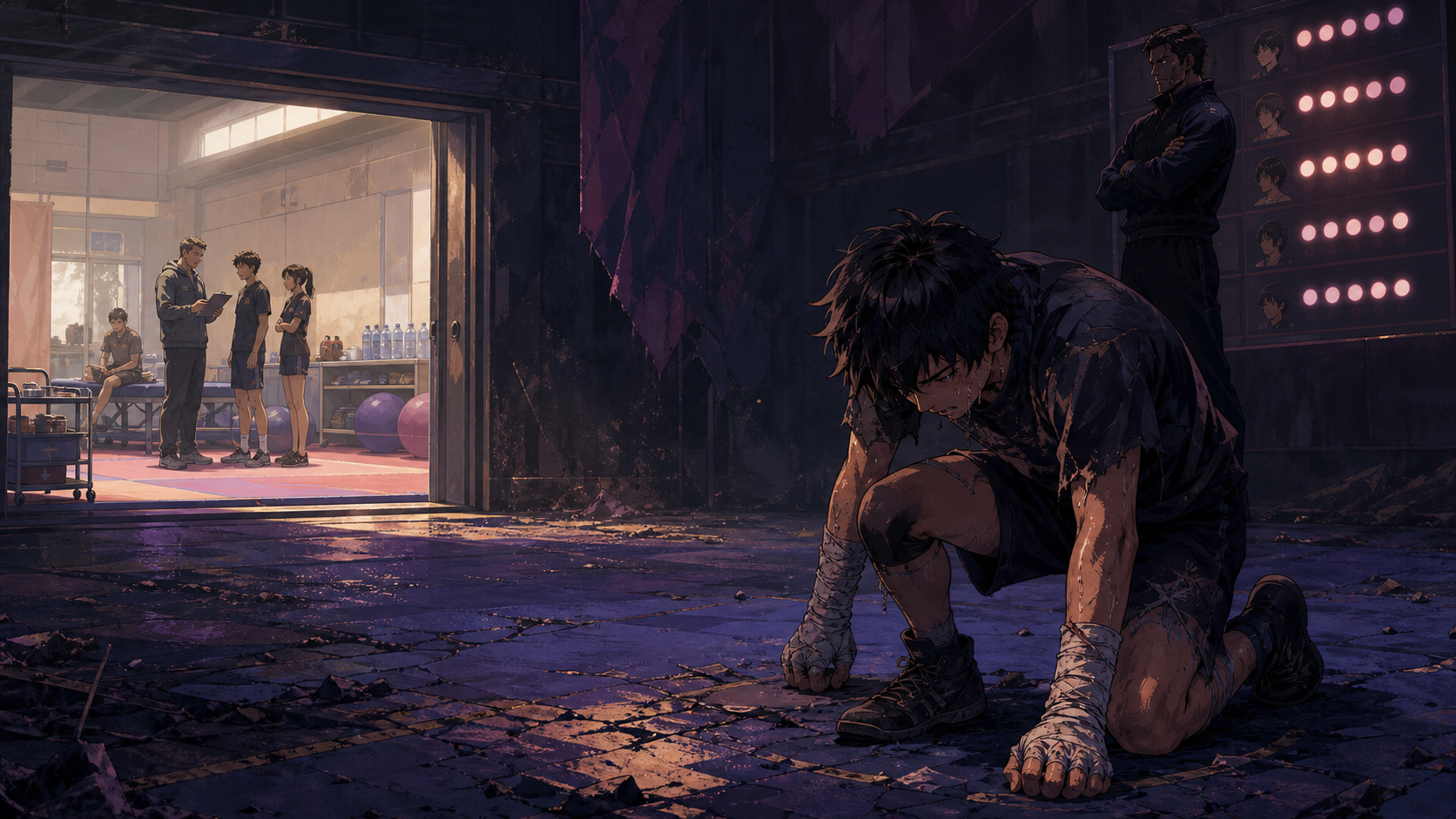
Anime keeps handing medals to traumatized children and asking viewers to call every bruise part of the lesson.
The survivor-bias problem
A gifted student enters a dangerous school, dojo, military program, or secret training ground. The instructor mocks weakness, withholds information, manufactures fear, and pushes the student beyond any reasonable limit. The student survives. Later, the student wins. That victory becomes retroactive permission. Viewers point to the championship, rescued city, mastered technique, or defeated villain and say the training worked. The sentence sounds practical. The sentence also confuses an outcome with an ethical evaluation.
Success proves that the student succeeded. Success does not prove that every method contributed to the result. Success does not count the students who left, broke, died, or learned to hide pain. Success rarely reveals how much better the same student might have performed under demanding instruction without humiliation or preventable injury. Anime loves exceptional survivors because exceptional survivors generate stories. Nobody builds a tournament arc around the child who developed chronic pain and stopped attending class. Nobody follows the minor recruit who concluded that fear meant talent and spent adulthood repeating the same cruelty. The camera chooses the survivor, then audiences mistake the camera’s selection for evidence about the system.
My complaint is not that fictional training should become comfortable. Physical disciplines require repetition, fatigue, correction, and risk. Hero work, martial arts, magic, and military defense may carry consequences that ordinary classrooms never face. Difficulty is not cruelty. A demanding teacher and an abusive teacher are not synonyms. The difference appears in purpose, proportionality, informed consent, safety, feedback, and the student’s freedom to stop. Training should develop a learner. Abuse uses the learner to satisfy the teacher’s ego, ideology, fear, or need for control.
Why anime loves brutal teachers
The brutal mentor solves several storytelling problems at once. A harsh instructor creates conflict without introducing a villain. Extreme drills make progress visible. Pain compresses time. A student who once collapsed after ten repetitions completes one hundred by the end of an episode, and the body becomes a scoreboard. Such stories also inherit older traditions of disciplined apprenticeship, martial hierarchy, athletic endurance, military preparation, and spiritual austerity. The teacher may appear eccentric or cruel because wisdom remains hidden until the student earns access. Obedience becomes a test of seriousness.
That tradition can produce excellent drama. A learner confronts limits, sheds vanity, and discovers that talent without discipline is fragile. The problem begins when narrative mystery protects the teacher from scrutiny. If every harmful action later receives a secret strategic explanation, authority becomes automatically correct. The audience receives information from the student’s perspective. Confusion and fear build suspense. Later revelation converts distress into genius: the teacher knew the student would survive, the impossible task concealed a lesson, or humiliation removed arrogance. Such explanations may fit one case while encouraging a broader fantasy that good outcomes prove wise intent.
Comedy supplies another shield. Mentors strike students, abandon them in danger, invade privacy, steal money, or assign lethal work, and exaggerated reactions signal that viewers should laugh. Slapstick has its own language. Repetition can still normalize the belief that authority deserves broad permission when the student eventually becomes strong. Finally, harsh mentorship flatters audiences who endured harsh systems. If suffering created greatness, suffering gains meaning. Questioning the method can feel like questioning the survivor’s accomplishment. A better critique separates the two. The student’s strength deserves admiration even when the institution failed.
Four kinds of harmful instruction anime keeps rewarding
The ordeal teacher. The ordeal teacher places a learner in danger and trusts necessity to produce growth. Survival becomes the lesson plan. The method can create dramatic breakthroughs because fiction controls the outcome. Real learners do not receive narrative protection, and even fictional students often survive through luck, outside rescue, or abilities the instructor could not fully predict. Ordeal teaching also hides poor diagnosis. A skilled teacher identifies which capacity needs development and designs a challenge near that edge. An ordeal teacher throws the whole person into crisis and credits himself for anything the learner discovers.
The humiliator. The humiliator uses shame as fuel. Insults supposedly destroy complacency, expose weakness, or build toughness. Some students respond by overperforming. Others narrow attention toward avoiding embarrassment, conceal mistakes, and lose the willingness to ask questions. Humiliation can create compliance that resembles discipline. The student practices obsessively because failure threatens belonging. High output does not erase the cost. Fear may remain attached to the skill long after the teacher disappears. The body owner. The body owner treats injury as proof of commitment. Pain becomes a moral test, rest becomes laziness, and medical caution becomes betrayal. Sports anime, action series, and hero schools regularly praise students who continue through damage.
Competitive environments need discomfort tolerance. They also need recovery, technique, and honest injury reporting. A culture that rewards concealment cannot manage risk because the data vanish. The toughest student becomes the student best able to hide. The destiny engineer. The destiny engineer decides who a child must become. Training begins with a fixed identity: successor, weapon, clan heir, savior, champion, perfect host, or number-one hero. The instructor may provide extraordinary resources while removing meaningful choice. Endeavor’s treatment of Shoto represents the family version. Institutions across anime repeat the pattern at scale. Children receive education only because adults need a future function. Gratitude becomes mandatory because opportunity and exploitation arrive in the same package.
What learning science changes about the argument
Learning requires challenge. Skills develop when students practice beyond current comfort, receive useful feedback, correct errors, and repeat the process. None of those principles requires degradation. A hard task and a hostile environment create different cognitive demands. Threat can sharpen immediate attention while reducing flexible thinking. A frightened student may focus intensely on the cue linked to punishment and miss broader patterns. Such narrowing can help during a simple emergency. Complex judgment, creativity, memory integration, and honest communication need enough safety for the learner to think rather than merely react.
Feedback works best when the learner can use the information. “You are weak” describes an identity and supplies no route forward. “Your stance collapses when you rotate because your rear foot loses contact” identifies a behavior and invites correction. Harsh mentors often deliver intensity in place of precision. Motivation also matters. External pressure can generate short bursts of effort, especially when rewards and punishments remain immediate. Durable expertise usually needs internal ownership: curiosity, purpose, mastery, community, or a chosen goal. A student trained only through fear may perform while the authority remains present and collapse after the structure disappears.
Rest belongs inside learning rather than outside commitment. Bodies adapt during recovery. Memory consolidates after practice. Fatigue increases error and injury. Anime sometimes acknowledges those principles through meals, sleep, and healing scenes, then treats rest as a reward earned after reckless overload. Expert teachers manage load. They know when a mistake reflects insufficient effort, unclear explanation, missing prerequisite knowledge, fear, fatigue, or an inaccessible environment. Cruel teachers simplify every problem into character. The student fails because the student lacks resolve, and the teacher never needs to revise the lesson.
Power, consent, and the right to leave
Consent in training means more than a student saying yes once. Learners need accurate information about risks, real alternatives, continuing opportunities to refuse, and protection from retaliation. A child selected by a clan, government, family, or elite school rarely possesses equal bargaining power. The right to leave reveals the true relationship. A mentor may call the student free while making departure equal shame, exile, poverty, family disgrace, or the loss of all professional opportunity. Formal choice without a viable alternative functions as coercion.
Anime frequently makes coercion invisible by giving the student the same dream as the institution. A child wants to become a hero, so every demand seems chosen. Wanting a career does not equal consenting to every unsafe practice attached to career access. Age deepens the imbalance. Young prodigies understand goals but cannot reliably calculate long-term medical, psychological, and social consequences. Adults hold a duty to create boundaries that talent cannot waive. Exceptional ability increases the need for protection because institutions gain more incentive to exploit the child.
Secrecy also protects abusive instruction. The mentor claims outsiders would misunderstand. Special knowledge supposedly requires special methods. Students become loyal to the person controlling both danger and rescue. Independent oversight threatens that bond, which explains why credible programs need supervision beyond the celebrated teacher. Selection can feel like love when a child has been overlooked. Many anime students begin lonely, poor, stigmatized, powerless, or desperate to prove worth. A famous mentor notices them. Selection supplies identity before the first lesson begins. The child becomes chosen.
That emotional context makes refusal harder. Rejecting the method can feel like rejecting the first adult who recognized potential. The mentor may never state such a condition. The student supplies the condition through fear of becoming invisible again. Ethical teachers understand that vulnerability and avoid exploiting devotion. They praise effort without manufacturing dependence. They connect students to peers and other adults. They make clear that disagreement will not end care. Institutional prestige can erase informed choice. An elite academy or legendary master carries presumed legitimacy. Families and students may accept danger because selection appears rare. Scarcity encourages silence: thousands would take your place, so complaint looks ungrateful. Prestige should increase scrutiny rather than reduce scrutiny. Powerful programs possess more resources, expertise, and influence. They can afford medical staff, safeguarding, transparent standards, and independent reporting. When an institution claims excellence while refusing basic oversight, the refusal deserves more attention than the trophy cabinet.
How the pattern changes across anime genres
Battle shonen turns pain into visible progression. Battle series need readers to believe a young fighter can confront stronger opponents within a limited publication timeline. Training converts time into proof. Sweat, wounds, weighted clothing, isolation, and repeated failure communicate advancement faster than lectures about biomechanics or strategy. The visual grammar encourages escalation. If one hundred repetitions marked seriousness last season, one thousand must mark greater seriousness now. The body becomes the easiest place to raise stakes. Teachers who refuse escalation can appear less committed than rivals who risk students’ lives.
Yet many memorable breakthroughs arrive through conceptual understanding rather than punishment. A student changes breathing, timing, attention, teamwork, or relationship to fear. Such moments show that learning can remain cinematic without confusing injury with depth. Sports anime inherits real coaching myths. Sports stories draw from recognizable cultures of practice, hierarchy, competition, and sacrifice. Playing through pain becomes loyalty. Benching an injured athlete becomes weakness. A coach who shouts may be portrayed as the only adult willing to demand excellence.
Real athletic achievement does require discomfort, repetition, and temporary sacrifice. The ethical question concerns who evaluates risk and who benefits. A teenage player may risk lifelong health for a school title that advances an adult coach’s reputation. The same decision looks different from each side of the whistle. Good sports storytelling can show load management, rehabilitation, technical correction, nutrition, sleep, and the emotional difficulty of returning after injury. Those details do not drain excitement. They reveal mastery beyond reckless endurance.
Military and mecha anime turn children into strategic resources. Mecha pilots and young soldiers often receive almost no meaningful choice. Adults describe catastrophe, identify a compatible child, and frame deployment as necessity. Training may be rushed because the enemy will not wait. Emergency explains the pressure. Emergency does not erase adult responsibility. Leaders still choose what truth to disclose, what support to provide, and whether a child may refuse. When adults rely on minors for survival, gratitude should flow toward the child. Too many stories reverse that direction and demand that the child feel honored.
Psychological collapse then appears as a failure of resolve rather than a predictable response to combat. The institution asks why the pilot will not get back inside the machine. A better question asks why every contingency plan depended on one frightened teenager. Idol and performance anime can hide harm behind polish. Performance training appears less violent than combat, but control can reach sleep, food, appearance, speech, relationships, and identity. Success makes the system look glamorous. The finished stage conceals repetitive labor and the cost of remaining marketable. A demanding choreographer may improve precision. A manager may protect a schedule. Harm begins when the learner’s body becomes company property, criticism becomes humiliation, and rest threatens replacement. The same ethical framework applies: purpose, proportionality, informed choice, safety, and exit.
Trauma is not a premium training resource
Fiction regularly converts trauma into heightened perception, determination, special power, or emotional depth. Characters become formidable because terrible events forced adaptation. Such adaptations can feel authentic. People do develop skills while surviving dangerous environments. The mistake comes from treating adaptation as evidence that danger was useful. Hypervigilance may help a fighter notice threats while making sleep, trust, and ordinary relationships harder. Emotional detachment may support action during crisis while reducing access to joy. A survival skill can carry a bill.
Teachers who deliberately recreate trauma because trauma once produced strength confuse a person’s resilience with approval of the original harm. The student may turn pain into ability. The teacher did not therefore discover a legitimate curriculum. Stories can respect resilience by showing both function and cost. A character may perform brilliantly under pressure and struggle when pressure ends. Healing need not remove competence. Safety can widen the range of situations where competence remains available.
Post-traumatic growth needs careful language. Some people report changed priorities, deeper relationships, new purpose, or increased confidence after trauma. Those developments are real and valuable. Growth after trauma does not mean trauma was necessary, deserved, or beneficial overall. The phrase “what does not kill you makes you stronger” erases people who survive and remain injured. The phrase also pressures survivors to convert suffering into an inspirational product. A person has no duty to find a gift inside harm. Anime protagonists often transform suffering because transformation drives plot. Viewers should admire the transformation without sending a thank-you note to the cause.
The missing students are part of the evidence
Every training institution selects which outcomes become visible. Graduates appear in promotional material. Champions return for speeches. Students who leave quietly disappear from the story the institution tells about itself. Dropout does not automatically prove abuse. People change goals, discover poor fit, face financial barriers, or choose other lives. A credible program still tracks why students leave. Patterns can reveal inaccessible teaching, unsafe environments, discrimination, injury, or a mentor whose reputation protects misconduct.
Anime academies rarely perform that audit. Entrance exams eliminate children through danger. Classes lose students through tournaments or combat. The survivors become an elite cohort, and elite status provides the explanation: only the strongest belonged. That logic creates circular proof. The program defines strength as surviving the program, then points to survivors as evidence that the program identifies strength. Students with different abilities, resources, learning styles, or support needs vanish before anyone asks whether the curriculum measured the stated skill.
Near misses deserve more attention than victories. A student completes a dangerous exercise by seconds, receives last-minute rescue, or awakens an unknown power. The teacher claims success. A safety review would classify the same event as a near miss. Near misses reveal hazards before a death occurs. Treating luck as validation prevents learning. Instructors should ask what would have happened without the unexpected rescue, hidden ability, or opponent’s hesitation. Fiction often protects mentors with protagonist luck. Ethical analysis should temporarily remove that protection. If the plan depended on a miracle the teacher could not predict, the plan was not wise.
Why audiences defend the mentor
Viewers know the student survives. That knowledge changes every earlier risk. A lethal exercise becomes thrilling rather than negligent because the ending has already guaranteed a protagonist. Characters inside the story lack that guarantee. Fans also love the mentor. Charisma, competence, humor, sacrifice, and later affection create emotional credit. Criticism can sound like a demand to hate a beloved character. Moral analysis does not require emotional purity. A mentor can be funny, brave, insightful, and harmful.
Nostalgia adds protection. Older series introduced many viewers to anime, and iconic training scenes became personal memories. Revisiting the ethics may feel like flattening art through modern standards. A strong reading can preserve historical context, genre convention, and affection while still asking what the story teaches about authority. Then comes the fantasy of certainty. The brutal mentor never doubts the student’s hidden potential. His cruelty appears as extreme faith. For viewers who felt overlooked, such attention can look like love. The fantasy says somebody sees greatness and will force greatness into daylight.
Being seen matters. Being controlled is not the same experience. A teacher who believes in a student can offer challenge, resources, honesty, and patience without claiming ownership of the result. Effort justification changes how suffering feels. People tend to value outcomes more when reaching those outcomes required sacrifice. The pattern makes intuitive sense. Hard work can create competence and attachment. Problems arise when the mind treats unnecessary suffering as proof that the destination must be valuable.
Fans can perform the same calculation for characters. We watched a student bleed, fail, and return. Declaring the method abusive may feel like declaring the journey meaningless. Yet meaning belongs to the student’s choices, relationships, and growth. The mentor’s worst decisions do not own the meaning. Former athletes, students, soldiers, performers, and workers may recognize their own history in the arc. Acknowledging harm can threaten a personal story built around endurance. Compassionate criticism leaves room for pride. A person can treasure skills gained in a harsh environment while wishing the environment had been safer.
Competence creates moral halo. A brilliant fighter or coach often receives trust beyond the field of expertise. Tactical success becomes evidence of wisdom about motivation, childhood, medicine, relationships, and ethics. Such expansion is rarely justified. A mentor may understand technique and misunderstand people. A teacher may produce champions while producing fear. Expertise deserves respect within its boundaries. Students need other adults precisely because no master should control every dimension of development. The apology episode can arrive too easily. Some mentors reveal a tragic past or admit that affection motivated the cruelty. The disclosure encourages viewers to reinterpret earlier scenes. Hidden love becomes the answer. Love explains investment. Love does not guarantee safe behavior. Adults can care deeply and still harm children through fear, ego, inherited practice, or untreated trauma. A sincere apology should begin accountability, not rewrite the method as secretly kind.
What accountability looks like for a mentor
A mentor who recognizes harm should first stop the harmful practice. Reflection without behavioral change protects self-image. The teacher must then name the conduct clearly, report injuries honestly, and invite independent review. Students need choices about continued contact. A mentor may offer an apology without arranging a private meeting that pressures acceptance. Written communication, a support person, institutional mediation, or no response may fit different students. Repair can include medical care, counseling, refunded fees, restored eligibility, corrected records, public acknowledgment, and professional discipline. None of those actions guarantee forgiveness. They address concrete consequences and reduce future risk.
Accountability also requires questioning the success story. If a champion emerged, the mentor should not use that champion as a shield. Ask what the student contributed, which supports helped, which methods caused harm, and whether safer alternatives could have produced equal or better development. Finally, the institution must protect future learners. A celebrated teacher may need supervision, retraining, restricted duties, or removal. Personal remorse does not substitute for safeguarding. Students arriving tomorrow cannot depend on promises made after yesterday’s injury.
The student does not owe gratitude for basic safety. Mentors sometimes provide food, housing, protection, equipment, or access that a vulnerable student lacked. Those supports matter. When support becomes evidence that the student owes obedience, care turns into leverage. Children deserve safety without a service contract. Poor students deserve education without surrendering boundaries. A teacher may feel affection and still build dependency. Ethical programs separate basic support from performance demands and create routes for students to seek help outside the mentor relationship.
Tradition cannot serve as the whole defense. “My teacher trained me this way” explains transmission. The sentence does not evaluate the practice. Every generation inherits useful knowledge and harmful habits. Respect for a lineage should include enough confidence to improve the lineage. Mentors who survived severe training may genuinely believe severity created them. Their memory contains no alternate version of their life for comparison. Institutions need evidence beyond autobiography. One survivor’s pride cannot establish safety for every student.
How anime can write the brutal mentor without endorsing him
A story may include abusive instruction without becoming propaganda for abuse. Framing matters. Other characters can name the danger. Consequences can persist beyond the triumphant result. The mentor can be wrong about some students even when right about one. The narrative can also show alternatives. A second teacher might achieve progress through explanation, trust, adapted practice, or collaboration. Comparison prevents cruelty from looking like the only route to excellence. Students should retain interior lives beyond gratitude. They may love a mentor and resent the training. They may use the skills and reject the philosophy. They may forgive without returning. Mixed responses create better characters and more honest education stories.
Humor can remain while consequences stay visible. A ridiculous drill may be funny. An injury should not disappear because the soundtrack changed. Comedy and critique can share a scene when the story remembers who holds power. Make the teacher revise the lesson. Fiction usually measures student growth. The student becomes faster, calmer, wiser, or more disciplined. Mentor growth often means revealing affection. A stronger arc requires pedagogical change. Let the teacher admit that a drill was poorly designed. Let a student’s refusal lead to a better plan. Let medical advice overrule tradition. Let the mentor learn that two talented students require different methods. Revision demonstrates expertise because genuine experts update practice when evidence changes.
Show life after the training montage. Training scenes end at mastery, but bodies and habits continue. Does the student sleep? Can the student rest without guilt? Can the student accept help? Does practice still trigger fear? Does the student repeat the mentor’s methods with younger learners? Follow-up turns an abstract ethical debate into character development. Healing can include preserving discipline while discarding shame. The student decides which lessons deserve inheritance.
A simple test for the next training arc
When a mentor assigns an extreme task, ask whether the goal is specific. “Become stronger” gives the teacher unlimited authority. “Maintain this technique for three minutes without losing form” creates a measurable objective. Ask whether risk matches benefit. A lethal fall should not teach a skill available through controlled progression. Dramatic danger may serve the episode more than the student. Ask what information the learner received. Surprise can test adaptation, but permanent secrecy prevents informed participation. A teacher should not hide hazards merely to prove dominance.
Ask whether stopping is possible. A student who can pause, report pain, request clarification, or refuse maintains agency. A student threatened with abandonment or disgrace does not. Ask who receives credit. If success belongs to the mentor while failure belongs to the student, the evaluation system is rigged. Teachers share responsibility for both outcomes. Ask who remains outside the frame. The protagonist’s survival cannot represent every learner exposed to the method.
Adults do not get to outsource courage to children
Anime institutions frequently praise young people for accepting burdens adults created. A village failed to prevent war, a hero agency lacks staff, a clan preserved a curse, or a school built an unsafe admissions system. The child who endures the result receives a speech about courage. Courage matters. Praise becomes manipulative when courage replaces institutional responsibility. Adults can admire a student’s bravery and still reduce the danger, provide care, and investigate why bravery became necessary.
The distinction resembles emergency work. A rescuer may perform heroically during a preventable disaster. Celebration should never end the safety review. Otherwise heroism becomes a budget line that allows broken systems to continue. Training stories often skip that review because victory supplies emotional closure. The school wins. The village survives. The student graduates. A serious ending asks who changes the policy before the next class arrives.
Protection is not softness. Characters who request safeguards are often framed as timid bureaucrats. The bold mentor ignores rules and produces results. Such framing mistakes risk management for fear. Protection enables sustained difficulty. Medical screening lets instructors distinguish productive strain from danger. Progressive loading lets students practice more often. Psychological safety encourages early reporting before a small problem becomes a crisis. Good safeguards preserve training rather than dilute training. The opposite of abuse is not indulgence. The opposite is accountable rigor.
Talent does not cancel childhood. A prodigy may speak with confidence, perform at an adult level, and understand technical concepts beyond peers. Adults then begin treating competence in one domain as global maturity. A child fighter can read an opponent and still lack power to negotiate with a revered teacher. A young pilot can operate complex machinery and still need help processing death. An idol trainee can command a stage and still require sleep, education, privacy, and protection from exploitation. Exceptional skill should expand educational opportunity. Exceptional skill should not shrink human rights.
When students become teachers, the real legacy appears
A training philosophy reveals its deepest influence when former students gain authority. Some repeat every harsh method because repetition validates their own suffering. Others overcorrect and avoid necessary challenge. The healthiest successors examine which practices built skill and which practices merely built fear. Anime frequently gives protagonists a chance to teach younger characters. Those scenes can resolve the mentor debate more honestly than an apology. The former student keeps discipline, precision, and courage while refusing humiliation. The revised method proves that cruelty was never inseparable from excellence.
Breaking a harmful tradition does not insult every teacher in the lineage. Revision honors the stated goal by improving the route. A martial school devoted to strength should welcome evidence about safer strength development. A hero academy devoted to protection should protect students. A village devoted to survival should stop consuming children. Tradition deserves memory, not immunity.
Survivors may repeat harm without becoming monsters. People often teach as they were taught because familiar behavior feels normal under stress. A former student may believe harshness communicates care. Recognizing that pattern permits intervention before condemnation becomes the only response. Explanation must not become permission. Once harm becomes visible, the new teacher holds responsibility to learn another method. Institutions should provide training, observation, feedback, and clear boundaries rather than relying on personal insight. A story that shows this transition can be both compassionate and demanding. The former student understands the old mentor’s fear while declining to inherit the fear as curriculum.
Where my argument needs restraint
Fictional worlds contain threats beyond ordinary education. A demon attack, alien invasion, superpowered war, or magical catastrophe may leave little time for ideal instruction. Characters sometimes face a genuine choice between dangerous preparation and unprepared death. That context changes proportionality. Emergency drills may be severe. Secrecy may protect lives. Young people may possess unique abilities adults cannot replace. A blanket rule that every risky exercise equals abuse would flatten the genre and ignore the story’s conditions.
Urgency still does not remove judgment. Ask whether adults created alternatives, shared accurate information, monitored harm, and accepted responsibility. Ask whether leaders experienced the same risks they assigned. Ask whether the emergency became a permanent excuse after immediate danger passed. Students also possess agency. Some choose difficult paths with clear eyes and find meaning there. Respecting young people means taking those choices seriously rather than treating every demanding commitment as exploitation. Agency and safeguarding can coexist. A student may choose risk. Adults still owe preparation, honest limits, and support after the choice.
Not every stern mentor is abusive. Direct criticism, enforced standards, consequences, and disciplined repetition can frustrate students without violating them. A teacher does not need constant warmth to teach ethically. Evaluation should focus on patterns and power. Does the mentor degrade identity, create avoidable danger, punish questions, isolate the learner, or demand loyalty beyond the educational goal? Does the student gain skill and independence, or become more dependent on the teacher’s approval? Calling every unpleasant interaction abusive weakens useful language. Refusing the label whenever a student succeeds weakens the language more.
The modern workplace already knows this trick
“High performance” can hide dysfunctional management. An employee meets impossible deadlines, so chronic understaffing looks efficient. A junior worker learns quickly under humiliation, so the manager claims a talent for development. A team wins awards while burnout and turnover disappear from the presentation. The logic matches the anime training arc. One visible success becomes evidence that pressure was necessary. Invisible losses become personal failures. The institution keeps the reward and assigns the cost to individuals.
Workplaces sometimes call this resilience. Resilience should describe a person’s capacity, not an organization’s permission to create preventable hardship. Praising endurance without changing conditions turns admiration into extraction. Schools use similar language when disadvantaged students succeed despite missing support. The student becomes inspirational, and inspiration lets adults avoid discussing why basic resources required extraordinary perseverance. That is why the anime trope matters beyond fiction. Stories train emotional reflexes. If audiences repeatedly learn that suffering becomes justified through achievement, exploitation gains a ready-made ending: look how strong you became.
Parents and guardians cannot hand over the whole child
Many training arrangements begin with adult approval. A parent signs papers, a clan elder makes a promise, or a village assigns a master. Stories sometimes treat that approval as complete consent. Guardians possess authority to choose education and care, but authority carries duties. A parent cannot reasonably approve unlimited injury, humiliation, isolation, or exploitation. The child remains a person whose developing views should gain weight with age and understanding. Guardians also need accurate information. Legendary instructors may use reputation to avoid disclosure. Families hear about outcomes and traditions, not dropout, injury, or complaint. Meaningful oversight requires records that do not depend on the mentor’s own story.
When families face poverty or danger, choice narrows. A prestigious apprenticeship may include food, housing, or protection unavailable elsewhere. Institutions should respond by strengthening independent safeguards, not by treating desperation as enthusiasm. The found-family excuse has limits. Anime mentors often become substitute parents. The relationship can provide belonging, protection, and love. Found family deserves celebration because chosen bonds can repair abandonment. Parental affection does not remove educational ethics. A mentor who loves a student still needs boundaries. Love can make control feel righteous, especially when the adult believes danger demands obedience. The healthiest found families permit disagreement and departure. Belonging survives a failed test, a changed dream, or a refusal. A home that exists only while the child performs remains an institution with sentimental lighting.
The body keeps a record the trophy cannot display
Action stories move quickly from injury to recovery. Bandages vanish. Magical healing restores function. A determined character returns before the next round. Such conventions preserve pacing, but they can make bodily consequence look optional. Repetition changes tissue. Sleep loss changes judgment. Concussions can accumulate. Malnutrition affects development. Stress can alter attention, mood, and immune function. Even a world with healing powers must decide whether healing restores experience, memory, and trust. A mentor who treats the body as disposable teaches more than combat. The student learns to distrust pain signals, hide weakness, and value usefulness above health. Those lessons can outlast the original injury.
Some students later wear scars proudly. Pride belongs to them. An instructor cannot point to survivor pride as advance consent for causing the scar. Recovery should count as training. Rehabilitation requires patience, accurate feedback, and gradual return. Those qualities are forms of discipline. Stories that show recovery can expand the meaning of strength beyond endurance during crisis. A student who stops before permanent damage demonstrates judgment. A teammate who reports an injury demonstrates loyalty. A coach who changes the season plan demonstrates competence. None of those decisions needs to feel less heroic.
Grades, rankings, and tournaments can reward the wrong lesson
Competitive structures simplify evaluation. A bracket produces a winner. A ranking produces order. An exam produces pass or fail. The clarity serves viewers and institutions, but learning rarely fits one number. A student can win through raw power while using poor technique. Another can lose after making excellent decisions against a stronger opponent. A third may withdraw to protect a teammate. If only victory counts, the system teaches that judgment, ethics, and safety matter until they interfere with results.
Mentors then train toward the metric. When exams reward survival under chaos, teachers manufacture chaos. When agencies recruit from televised tournaments, schools prepare children for spectacle. The evaluation system quietly writes the curriculum. Better evaluation combines performance with decision quality, collaboration, improvement, preparation, and recovery. A hero school should assess rescue choices, not merely combat dominance. A martial program should assess control, not merely damage.
The little visual clues that tell viewers what training means
Training montages contain a visual language worth watching. Broken equipment suggests force beyond design. Empty beds suggest sleep sacrificed. Uneaten food suggests discipline becoming deprivation. A row of former students’ names may reveal how many people the master lost before finding the protagonist. Camera position matters too. A mentor filmed from below appears monumental. A student filmed alone from above appears small. When the final victory repeats the mentor’s framing, the story may signal inheritance. When the student steps outside that frame, the story may signal independence.
Sound can change moral interpretation. Cheerful music turns a dangerous drill into comedy. Silence restores the weight of breathing and injury. Triumphant music over collapse asks viewers to celebrate endurance before considering cost. Food scenes frequently reveal the healthier alternative. Teammates cook, share, argue, and rest. Progress follows community rather than solitary punishment. The series may understand care more clearly in quiet scenes than in speeches about toughness.
Reframing the famous line: the teacher believed in me
Students often defend a harsh mentor by saying the mentor believed in them. Belief can be transformative. A person who sees capacity before the learner sees capacity may change a life. Belief should increase patience. If a teacher truly trusts a student’s potential, the teacher does not need to manufacture worth through terror. The potential can survive questions, rest, adaptation, and a slower route. Sometimes “belief” means certainty about a preferred destiny. The mentor believes the student will become a particular kind of warrior, hero, athlete, or leader. Such certainty can erase the student standing in front of him. Better belief remains curious. The teacher sees ability and asks what the learner wants to build. Guidance becomes collaboration rather than prophecy.
What demanding teaching could look like
Demanding teachers set high standards and explain those standards. They distinguish discomfort from danger. They adjust instruction when evidence shows that a method is failing. They criticize behavior with enough precision for improvement. They also welcome questions. Authority that cannot survive inquiry lacks confidence. A student should be able to ask why a drill exists, what risk the drill carries, and how success will be measured. Explanation does not weaken discipline. Explanation turns obedience into learning.
Good mentors build independence rather than dependence. Their students gradually diagnose problems, design practice, seek diverse feedback, and decide when rest or medical care is necessary. The final proof of teaching is not lifelong loyalty. The final proof is a learner capable of continuing without the teacher. Strong programs track more than winners. They notice dropout, injury, fear, stalled development, and unequal access. A system that celebrates one champion while losing twenty students cannot use the champion as complete evaluation. Narratively, humane rigor still creates conflict. Students resist honest feedback. Progress stalls. Safety rules frustrate impatient prodigies. Teachers make mistakes and repair them. Team members disagree about risk. A story does not need abuse to make education dramatic.
Final take
The student who survives brutal training deserves credit for strength, adaptability, luck, support, and work. The teacher deserves credit only for methods that genuinely developed the student without avoidable harm. Anime can honor discipline without worshiping suffering. A difficult path may be necessary. Humiliation, coercion, preventable injury, and control remain choices made by adults and institutions. Whenever a story points to the hero and says, “See, the training worked,” look beyond the center of the frame. Count the students who left. Count the injuries nobody recorded. Ask whether the winner succeeded because of the cruelty, alongside the cruelty, or despite the cruelty. A medal cannot answer those questions. The teacher still has to.