
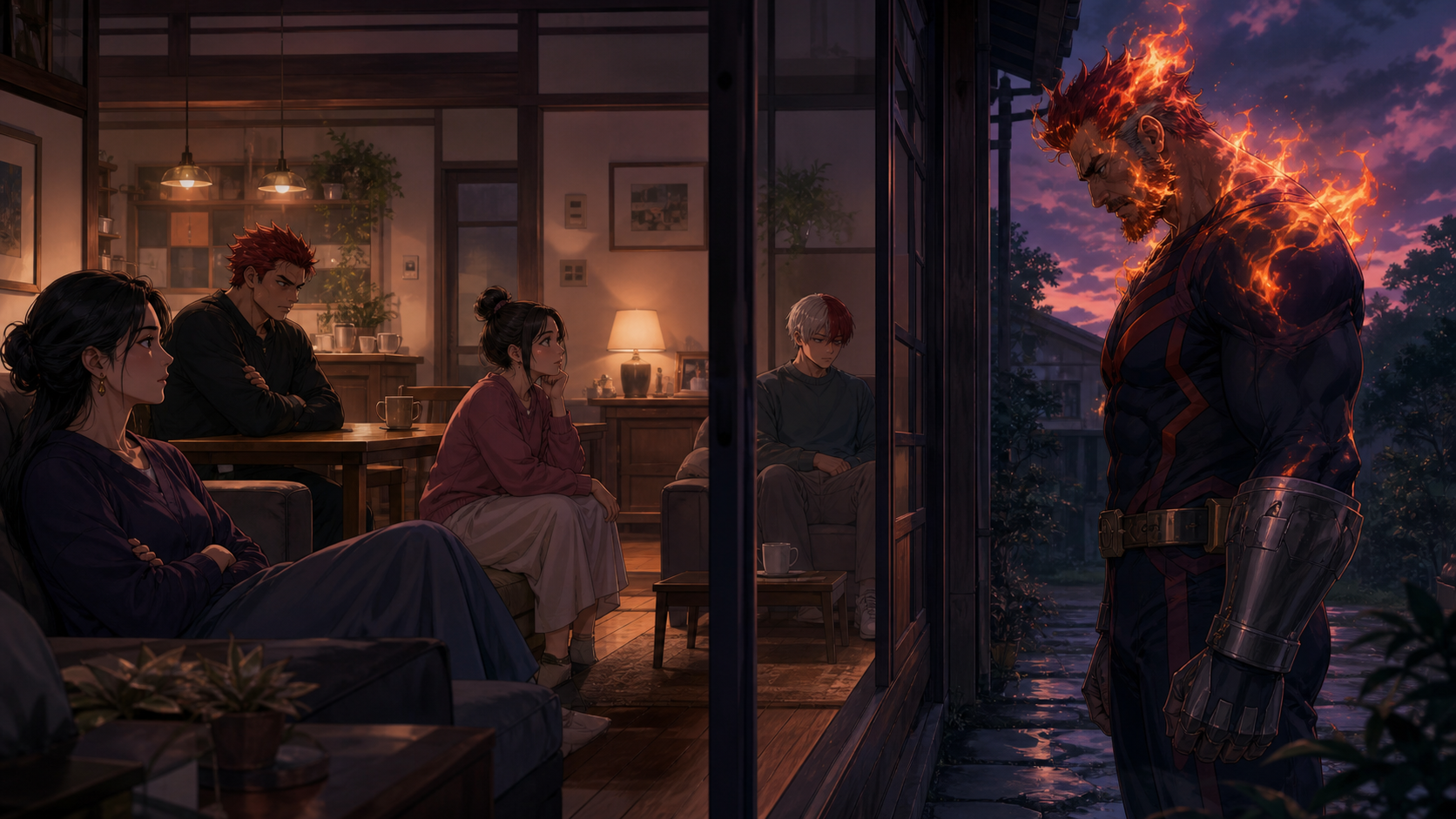
RaeRae Rants · My Hero Academia · Family Accountability File
Endeavor’s Redemption Is Not His Family’s Assignment
A man can become sorry. His wife and children still get to decide whether his apology belongs anywhere near their lives.
Spoilers: This editorial discusses the Todoroki family story through the final arc of My Hero Academia.
The rant: Endeavor’s remorse matters, but remorse does not turn Rei, Fuyumi, Natsuo, Shoto, or Toya into supporting characters in his rehabilitation story. The larger question: Why do audiences so often measure an abuser’s growth by the amount of access survivors eventually give him?
The redemption problem
Endeavor becomes more interesting when My Hero Academia stops asking whether he can surpass All Might and starts asking whether professional success has hidden a rotten private life. Enji Todoroki built his household around a ranking. He selected a marriage for power, treated children as possible solutions to his own frustrated ambition, and punished the child who failed to become the exact weapon he wanted. His family lived inside a long experiment whose stated goal belonged to him alone.
Then All Might retires, Endeavor inherits the number-one position, and victory tastes like ash. The rank cannot repair a marriage, restore a childhood, or make his children admire him. The story gives him the humiliation he deserves: he finally receives the prize and discovers that the prize cannot answer the damage required to win. That realization begins redemption. The realization does not complete redemption. Popular storytelling often treats remorse as a dramatic finish line because remorse photographs well. A hard man cries. A proud man bows. A father finally says the sentence his family needed years earlier. Viewers feel movement, and movement can resemble repair from a distance.
Survivors live much closer to the damage. They remember ordinary mornings, doors closing, meals eaten under pressure, and the quiet calculations required to stay safe. One sincere apology cannot reach backward and give those years another shape. A changed person may deserve recognition for changing. Nobody harmed by that person owes proximity as proof.
Those ideas overlap only when every person involved wants the overlap. Natsuo can refuse. Shoto can remain uncertain. Rei can decide what contact protects her health. Fuyumi can desire a shared table without gaining authority over her siblings’ boundaries. Toya can remain furious. None of those responses cancels Endeavor’s responsibility to keep changing. That distinction supplies my rant. Too many viewers treat the Todoroki family like a jury assigned to deliver a final verdict on Enji’s soul. If they forgive him, he has grown. If they stay angry, they become obstacles. Such framing quietly transfers the emotional workload back onto the people who already carried the consequences.
A great hero can still be a terrible father
Hero society rewards visible rescue. Rankings count public victories, approval, and professional output. A household has no billboard. Children cannot issue performance reviews with enough power to threaten a famous parent’s career. Rei’s fear remains private while Endeavor’s competence remains spectacularly public. The contradiction feels painfully modern. Institutions regularly mistake job performance for character. A surgeon can save patients and terrorize nurses. A celebrated coach can produce championships while humiliating teenagers. A beloved entertainer can inspire millions while family members learn to measure every footstep in the hallway. Public usefulness does not erase private cruelty. Fame often supplies camouflage.
Endeavor’s heroism therefore complicates judgment without defeating judgment. Civilians saved by him are truly alive because of his work. His children are truly harmed because of his choices. Both facts can occupy the same biography. Moral maturity begins when nobody demands that one truth swallow the other. My Hero Academia understands that contradiction better than many redemption stories. Enji does not discover a secret innocence. The narrative does not reveal that his family misunderstood him. He did what they remember. He wanted an heir capable of overtaking All Might, and he organized human lives around that desire. Later courage cannot turn earlier abuse into a misunderstanding.
Still, professional heroism gives Endeavor a familiar escape route. Work offers crises with clear objectives. A villain appears. A building burns. A body needs rescue. Family repair has no clean scoreboard. The injured person controls the pace. Progress may never produce reunion. A man accustomed to winning must learn that accountability includes outcomes he cannot command.
The family labor nobody names
Fuyumi’s dinner table may be the most recognizable battleground in the entire Todoroki story. She wants one ordinary meal. She wants siblings in the same room, food passing between them, and a father behaving like somebody who knows how families work. Her hope deserves tenderness because hope became her survival strategy. Her hope also creates labor. Somebody plans the meal. Somebody manages the mood. Somebody anticipates Natsuo’s anger, Shoto’s silence, Enji’s discomfort, and the possibility that one sentence will ruin the evening. Families shaped by abuse often contain one person who becomes the unpaid coordinator of peace. That person may look cheerful because cheerfulness became a practical skill.
Fuyumi is not wrong for wanting reunion. Natsuo is not wrong for finding reunion unbearable. Their disagreement shows how one household can distribute the same trauma into different coping patterns. One child tries to rebuild the room. Another refuses to pretend the room was ever safe. Neither sibling should become responsible for proving the other’s method morally superior. Rei carries another kind of labor. Discussions of Endeavor’s redemption sometimes turn her recovery into evidence for his improvement. If Rei can speak to him, perhaps viewers may relax. If she recognizes his change, perhaps the case can close. That reasoning uses her emotional response as a certificate he receives.
Rei deserves a story centered on Rei. Her choices may include compassion, anger, distance, contact, or several of those at once. A survivor-centered reading asks what supports her safety and agency. An offender-centered reading asks what her response says about him. The difference looks small in a plot summary and enormous in a life. Shoto also spends years performing emotional work that adults should have handled. He must separate his own power from his father’s ambition. He must decide whether using fire means surrendering to Enji. He must confront Toya, understand Rei, negotiate with Natsuo, and still become a hero. People praise Shoto’s maturity while rarely asking why a teenager needed so much maturity so early.
Five survivors, five different answers
Rei: recovery does not belong to the man who caused the wound. Rei’s institutionalization demonstrates the scale of family collapse, but the story sometimes leaves her interior life outside the frame. Her later resolve is powerful because she returns as an active participant in the family crisis. Even so, viewers should resist converting her bravery into absolution for Enji. She can help stop Toya and still define her relationship with Enji on her own terms.
Fuyumi: wanting a family is not the same as excusing a father. Fuyumi’s desire for connection can look naïve only when audiences underestimate the grief beneath her hospitality. She remembers the family that never formed. Every dinner represents an attempt to build one ordinary memory before more years disappear. Her longing is not consent on behalf of anyone else. Natsuo: refusal can be an honest boundary. Natsuo receives some of the ugliest audience judgment because he does not reward Enji’s growth quickly enough. That complaint reveals how easily viewers prioritize narrative satisfaction over survivor autonomy. Natsuo knows Enji may be changing. He also knows that recognition does not manufacture affection. His refusal to perform warmth is not cruelty. His refusal is information.
Shoto: contact does not equal closure. Shoto approaches his father with a careful openness shaped by his own values. He wants to become a hero independent of hatred, and that goal sometimes places him beside Enji. Their cooperation matters. Their cooperation does not erase the history between them. A relationship can improve without becoming simple. Toya: harm can explain rage without making murder acceptable. Toya forces the story into its hardest moral territory. Enji’s obsession helped create the conditions surrounding his collapse. Toya later chooses mass violence and murder. Explanation cannot become acquittal for either man. Enji bears responsibility for abuse and neglect. Dabi bears responsibility for the people he harms. Adult accountability does not require choosing only one guilty person.
Toya also exposes the limits of redemption fantasies built around private apologies. The Todoroki damage becomes public because the original family system never received honest public accountability. Dabi weaponizes disclosure, mixing truth with vengeance. The spectacle is horrifying, but the underlying accusation survives the spectacle: hero society crowned a man without asking what happened inside his home.
What accountability would actually require
Accountability begins with accurate language. Endeavor cannot describe his behavior as strict parenting, excessive ambition, or a series of mistakes. A mistake is forgetting a birthday. A sustained household system built around control requires stronger words. Naming abuse does not trap a person forever. Naming abuse prevents reform from becoming a public-relations exercise. Next comes acceptance of consequence. Enji may become safer and still lose relationships. He may apologize and receive silence. He may offer practical support and never regain a place at the table. Growth that depends on reward remains another form of control. Genuine change continues when the hoped-for reunion never arrives.
Material repair matters too. Emotional speeches dominate fiction because dialogue creates climaxes. Real accountability also looks administrative and unglamorous: separate housing, financial support without strings, medical care, privacy, truthful records, and patient respect for boundaries. Endeavor’s decision to create distance and provide a home points toward this form of repair. Such choices matter precisely because they do not demand gratitude. Accountability also means ending the family’s role as his conscience. Fuyumi should not need to coach him. Shoto should not need to reassure him. Rei should not need to validate his progress. Natsuo should not need to explain anger in language gentle enough for Enji to hear. An adult who caused harm must build his own structure for remembering what he did.
Professional consequences remain the missing piece. Hero society learns about Enji’s private conduct during a national crisis, when institutions already face collapse. The timing complicates any response, but complication should not become silence. A system that markets heroes as moral symbols has a duty to confront abuse by its highest-ranking figure. Otherwise hero branding becomes reputation laundering with rescue statistics. An apology cannot assign homework to the harmed person. A bad apology asks for immediate relief. The speaker confesses, watches the listener’s face, and waits for a sign that normal life may resume. The emotional center remains the person who caused the harm. His discomfort becomes the emergency. His courage in admitting wrongdoing becomes the achievement everybody must honor.
A useful apology works differently. The speaker names his conduct without shrinking the language. He accepts that the listener may not answer. He does not request secrecy, comfort, or a timeline for trust. He offers repair that the other person can refuse. Most importantly, he does not behave as though his confession created a new debt. Endeavor gradually learns that difference. Early attempts at family contact still carry the confidence of a man accustomed to setting the agenda. Later choices become less theatrical and more respectful. He begins to understand that protecting his family may require removing himself from the picture he wants. That development is meaningful because control, not anger alone, shaped the original household.
Anger received the most visible scenes, but control supplied the architecture. Enji chose the purpose of the marriage, the desired traits of the children, the training schedule, and the standard for success. Everyone else lived inside his plan. Real reform therefore requires more than calmer behavior. He must surrender the right to design the family’s future.
Restitution must survive rejection. People often imagine restitution as a bargain: the offender provides something valuable, and the survivor responds with forgiveness. That exchange can become another purchase of access. Financial support, housing, medical care, and public truth-telling should not function as tickets back into family life. Repair addresses needs created by the harm. Repair does not buy ownership of the outcome. The Todoroki family has practical injuries as well as emotional ones. Rei lost years of ordinary life. The children grew around fear and absence. Their careers, relationships, and sense of safety developed under pressure. No amount of money can restore those years, but impossibility does not excuse passivity. An offender can provide resources while recognizing that resources and reconciliation answer different questions.
This point matters outside fiction because abusers sometimes present financial provision as proof of goodness. A parent paid tuition, maintained a house, or funded treatment, so the family supposedly owes loyalty. Provision does not cancel terror. Support offered with conditions remains leverage. The cleanest repair gives survivors more freedom, including freedom to leave.
Public truth has a cost, and the cost belongs to Enji. Dabi’s broadcast forces the Todoroki history into public view through a weaponized confession. Enji loses control over timing and framing. The disclosure arrives beside accusations meant to destroy public faith during a national disaster. Under those conditions, denial would have been easy to rationalize as crisis management. Enji cannot honestly deny the central facts. His public acknowledgment matters because fame helped conceal the abuse. A private apology alone would leave the public myth intact. When professional status protected a person from scrutiny, accountability must reach the professional identity too.
Public truth still creates collateral exposure for survivors. Rei and the children lose privacy because their pain becomes national evidence. That consequence shows why disclosure should normally remain under survivor control. Dabi does not grant them that control. Enji’s duty afterward is not to turn the press conference into another performance of anguish. His duty is to absorb public consequence without asking his family to defend him.
Why audiences keep making forgiveness the test
Redemption arcs arrive with an invisible contract. A character falls, recognizes wrongdoing, suffers, and changes. Audiences expect the narrative to pay that effort back. Forgiveness becomes the most convenient receipt because viewers can see forgiveness on screen. A hug, shared meal, or use of the word “Dad” confirms that the emotional account has balanced. That structure works beautifully for many kinds of conflict. A selfish friend can learn generosity. A rival can admit jealousy. A frightened person can return after abandoning a team. Abuse creates a different problem because the offender’s desire for closure may conflict with the survivor’s need for distance. A standard redemption payoff can therefore repeat the original entitlement in softer language.
We also confuse understanding with obligation. Once a story shows Enji’s shame, loneliness, and fear, viewers understand him more fully. Empathy follows. Empathy is useful because flat monsters teach little about how harm operates. Yet understanding why a person changed does not create a duty for somebody else to resume a relationship. Another cultural habit praises family unity as an unquestioned good. Estrangement looks like failure, while reunion looks like health. Such assumptions ignore families where contact remains dangerous, coercive, or simply exhausting. A peaceful life apart may represent success. A holiday table with every chair filled may represent fear wearing formal clothes.
The Todoroki arc gains power when the siblings refuse a single family answer. The narrative permits argument about dinner, contact, anger, and hope. Their disagreement prevents “the family” from becoming one fictional person with one emotional vote. Real families contain separate people. Shared DNA does not merge their boundaries.
The burden of the changed man. Stories often become fascinated with the suffering of a powerful man who finally sees himself clearly. His shame appears profound because the audience remembers his former certainty. Every quiet expression signals growth. Meanwhile, the people he harmed may appear repetitive because their anger began before his revelation and continues afterward. That imbalance rewards late awareness. The offender receives dramatic novelty, while survivors carry emotions the plot considers old. Natsuo has heard enough explanations. His lack of surprise makes sense. Enji’s awakening may be the most important event in Enji’s moral life, but Natsuo has lived with the facts for years.
A survivor should not need to refresh grief so an offender can experience every stage of accountability in real time. Natsuo does not owe Enji a guided tour through his childhood. Rei does not owe a complete explanation of every frightened day. Shoto does not owe a list of training memories. The absence of testimony does not create reasonable doubt inside the family. Endeavor’s burden is to believe what their behavior already communicates. He must take anger seriously without demanding evidence packaged for his comfort. He must accept that some details may never be shared with him. Accountability includes respecting knowledge one has forfeited the right to receive.
The scenes that make the argument
The number-one ranking gives Enji nowhere left to hide. All Might’s retirement destroys Endeavor’s favorite excuse. For years he can imagine that one more achievement will justify the household built around ambition. When the ranking finally arrives through All Might’s absence, Enji confronts the emptiness of inherited victory. His family does not celebrate. The title exposes rather than repairs him. The scene works because professional ascent and personal collapse occupy the same moment. Hero society sees a successor. Enji sees a house where nobody trusts the man beneath the flames. He cannot train harder against that truth. No rival stands between him and the family he wanted. His own conduct stands there.
The dinner scene refuses comfortable progress. Fuyumi prepares a meal with the care of somebody arranging delicate glass. Natsuo’s anger breaks through the polite surface because politeness would lie. Shoto watches and answers in measured fragments. Enji occupies the table physically without possessing a secure role there. Many family dramas use dinner to prove reconciliation. This dinner proves how far reconciliation remains. Shared space allows honesty, and honesty sounds worse before anything feels better. The scene respects Natsuo enough to let him be unpleasant. Trauma does not always produce eloquent speeches calibrated to encourage the person who caused the trauma.
Fuyumi’s disappointment also deserves attention. Her plan fails, but failure does not make her foolish. She reaches for an ordinary ritual because ordinary rituals were stolen from the siblings. The tragedy comes from incompatible needs. Her hope cannot override Natsuo’s boundary, and his boundary cannot erase her grief.
Ending’s attack reveals the danger of forced proximity. When the villain Ending targets Natsuo, Endeavor faces a grotesque version of his private wish. He wants a chance to save his son, and suddenly a criminal places Natsuo in danger. Rescue becomes possible only because harm appears. The scenario exposes why an offender cannot wait for a heroic crisis to repair a relationship. Endeavor’s hesitation matters. Bakugo and the students act while Enji confronts fear and guilt. Professional reflex, usually his safest identity, becomes tangled with fatherhood. Saving Natsuo would not settle the past anyway. A rescue can preserve a future without purchasing affection. Natsuo’s response after survival remains crucial. Gratitude for being alive does not transform into forgiveness. He can acknowledge action and keep his emotional position. The series allows a saved person to remain angry at the rescuer, which may be one of the clearest statements in the arc.
The separate house is more important than a speech. Enji’s plan to provide a home where the family can live without him demonstrates practical understanding. He recognizes that his presence changes the emotional climate. Rather than demanding a place in their recovery, he prepares to remove a source of pressure. That choice lacks the visual glory of a finishing move. No crowd cheers. The family may never reward him. Precisely for those reasons, the decision resembles accountability. He uses power and money to expand their choices while reducing his own access.
Dabi’s reveal destroys the private settlement fantasy. Toya refuses to let Enji handle the family history quietly. His public revelation carries manipulation, cruelty, and truth. The nation learns that its leading hero built a reputation while his household broke. Enji can no longer divide public service from private conduct. Dabi’s crimes do not make the disclosure false. Enji’s abuse does not make Dabi’s murders justified. The scene forces viewers to resist moral accounting where one crime cancels another. Two people can hold responsibility at the same time, even when their responsibilities differ in origin, scale, and power.
A survivor-centered reading changes the camera angle
Survivor-centered practice begins with safety, choice, dignity, and control. Those principles come from real work with people affected by violence, not from a demand that fiction become a clinical manual. Applied carefully, the principles reveal where a story places moral attention. Ask a simple question during every Endeavor scene: whose need controls the moment? When Enji wants to apologize, does the family receive a genuine option to decline? When Fuyumi arranges dinner, can Natsuo leave without becoming the villain of the episode? When Rei speaks, does the narrative care about her future or mainly about the effect of her words on Enji?
Choice cannot exist only as dialogue. Power shapes choice. Enji possesses money, fame, professional authority, physical strength, and years of household dominance. A polite request from him may carry pressure even when he intends none. Repair requires awareness of that imbalance. Distance can help restore choice. Separate housing, independent support, and contact initiated by survivors reduce the force surrounding family decisions. Enji’s later behavior moves in that direction. His growth becomes most convincing when he stops asking whether the family sees his growth.
Dignity also requires allowing survivors to remain complicated. Rei need not become a saint of forgiveness. Natsuo need not become a permanent embodiment of rage. Fuyumi need not serve as family therapist. Shoto need not become a symbol of perfect healing. Toya need not be reduced to either innocent child or irredeemable villain. Their humanity exceeds the roles Enji’s redemption arc assigns them.
Children do not exist to complete a parent’s character development. Parents sometimes receive praise for learning lessons their children paid to teach. The parent becomes more patient after frightening one child, more attentive after neglecting another, or more honest after a family collapse. Growth is better than repetition, but applause should remain proportional. The Todoroki children are not workshops where Enji practices becoming decent. Shoto’s pain is not a necessary chapter in the making of a better number-one hero. Toya’s collapse is not a useful warning delivered at an acceptable cost. Fuyumi and Natsuo are not supporting evidence that Enji eventually understood love. A mature redemption story remembers the asymmetry. Enji gains wisdom. His family loses years. Wisdom cannot reimburse childhood. The best he can do is prevent more loss, tell the truth about the earlier loss, and respect whatever lives they build beyond him.
Forgiveness is not a family assignment
People use forgiveness to mean several different things: releasing revenge, recognizing change, restoring contact, rebuilding trust, or declaring a debt paid. Those meanings should not be bundled together. A survivor may stop organizing life around anger while maintaining permanent distance. Another survivor may reconcile without forgetting. Another may never forgive and still build a full, generous life. No single response proves greater maturity. Pressure to forgive can reproduce the original power imbalance by telling the harmed person which emotion would make everyone else more comfortable. Families often call that pressure healing. Sometimes the requested healing mainly benefits relatives who want conflict to disappear from view.
Endeavor’s children therefore owe no synchronized ending. Fuyumi may invite him. Natsuo may leave. Shoto may speak with him. Rei may choose limited contact. Their different answers can coexist. Family unity should never require emotional uniformity. The strongest version of Endeavor’s redemption accepts that fact. He must become better because better behavior is right, not because better behavior purchases forgiveness. He must protect people who may never love him. He must tell the truth even when truth damages his reputation. He must respect doors that remain closed.
Forgiveness, trust, and contact are three separate decisions. Public conversations about family harm frequently collapse three decisions into one. Forgiveness concerns how a person carries the moral injury. Trust concerns expectations about future behavior. Contact concerns access. A survivor can forgive while declining trust. A survivor can believe an offender has changed while declining contact. A survivor can maintain limited contact without forgiving. Keeping those decisions separate protects honest choice. Otherwise every small gesture becomes evidence in a case the survivor never agreed to litigate. Shoto speaks to his father, so viewers declare forgiveness. Rei appears beside Enji, so viewers declare reconciliation. Natsuo refuses warmth, so viewers declare immaturity. Each conclusion steals complexity from the person whose complexity should matter most.
Trust also develops through repetition rather than revelation. Endeavor’s realization happens during a dramatic turning point. His family cannot experience years of reliable behavior in one episode. They need time, and time may confirm change without creating closeness. A repaired reputation is not the same as a repaired nervous system.
Forgiveness can become a demand for silence. Families sometimes treat continued discussion as proof that forgiveness failed. The harmed person may be told to stop bringing up the past, especially after an apology. Such rules protect the household’s preferred story. Memory becomes impolite because memory interrupts the celebration of change. Natsuo’s anger keeps the family history audible. His words are uncomfortable, but comfort was never distributed fairly in that home. Demanding quiet from him would recreate the old arrangement, where Enji’s needs determined which feelings could occupy the room. Reconciliation worthy of the name must tolerate memory. Enji cannot ask the family to recognize his present while denying their right to describe his past. Growth should expand the truth a room can hold, not replace one enforced narrative with a kinder-looking version.
The Todoroki household was a system, not a bad afternoon
Individual scenes of violence matter, but focusing only on explosive incidents can obscure the system surrounding them. Enji’s ambition shaped marriage, reproduction, training, attention, and rejection. Children were sorted according to usefulness. Success meant proximity to his goal. Failure meant neglect, disappointment, or pressure. Systems teach rules even when nobody states those rules aloud. Toya learns that exceptional power earns attention. Fuyumi learns to preserve connection. Natsuo learns that anger protects truth. Shoto learns that his body has become contested territory. Rei learns that resistance carries danger. Every person adapts to the same controlling structure in a different way.
That framework explains why one apology cannot repair everyone equally. The harm did not arrive as one event shared in identical form. Each child occupied a different position in the household. Toya was first elevated and then abandoned. Fuyumi lived as a daughter and later acted like a caretaker. Natsuo experienced emotional absence and the loss of his brother. Shoto became the chosen project. Their needs diverge because their histories diverge. A systemic reading also prevents the comforting belief that Enji’s temper was the only problem. If rage vanished while entitlement remained, the family would still lack freedom. He could speak softly and continue deciding their futures. Accountability must dismantle the belief that fatherhood grants ownership.
Hero culture provided the excuse. Enji’s obsession does not emerge from nowhere. Hero society converts public service into competition, celebrity, merchandise, and rank. The number-one position becomes a moral crown. A man already inclined toward control receives a cultural language that makes obsession sound noble. Context explains the shape of his ambition without excusing his decisions. Thousands of heroes live under the same ranking system without engineering children to surpass a rival. Enji repeatedly chooses the household system. Hero culture rewards and conceals him, but culture does not move his hands like a puppet. The distinction matters because social criticism can accidentally dissolve personal responsibility. Institutions create incentives. Individuals still make choices within those incentives. Reform needs both levels: a hero system less addicted to celebrity and a father willing to name his own abuse without blaming the charts.
The family image served professional mythology. A powerful hero with an accomplished household fits the image of disciplined success. The public sees lineage, talent, and order. Private suffering remains illegible because the family photographs can look respectable. Social status turns signs of control into signs of high standards. That pattern appears in many institutions. Wealth can make coercion look like opportunity. Prestige can make neglect look like sacrifice for excellence. A child’s achievement can become evidence that harsh treatment worked. Shoto’s power may confirm Enji’s breeding plan to outsiders even while Shoto experiences the plan as violation. The story’s critique becomes sharpest when Shoto succeeds through relationships and values his father did not design. Friends help him integrate fire with ice. Compassion reshapes his idea of strength. His growth does not vindicate Enji’s methods. Shoto becomes admirable by reclaiming what Enji tried to own.
Boundaries are not revenge with better vocabulary
People who dislike a boundary often describe the boundary as punishment. Natsuo’s distance becomes cruelty toward a remorseful father. Rei’s separation can be framed as denial of redemption. Such language assumes access is the default and must be removed only for disciplinary reasons. Access is not an entitlement. A boundary may exist because conversation causes stress, because trust remains absent, because recovery needs space, or because the survivor simply prefers life without the relationship. None of those reasons requires a courtroom argument.
Revenge seeks to injure. A boundary defines participation. The distinction rests in purpose and control. Natsuo does not need Enji to suffer in order to choose distance. He may know distance hurts Enji and still decide that contact costs too much. Protecting oneself does not become vengeance merely because somebody else dislikes the result. Healthy accountability respects a boundary before understanding every reason behind the boundary. Enji may want a complete explanation, but requests for explanation can become negotiations. The survivor states a limit, and the offender searches for a loophole. Acceptance means stopping the search.
Changed behavior does not create retroactive consent. Enji’s later patience cannot make the original marriage freely chosen in retrospect. His support cannot make Shoto’s training consensual. His grief cannot make Toya’s childhood safe. Present reform changes the present. Past violations remain part of the record. That truth does not make change pointless. Prevention has moral value even when restoration remains impossible. One fewer controlling conversation matters. One respected refusal matters. One child spared pressure matters. Redemption should be measured partly by harm no longer produced.
Distance can be loving without becoming reunion. Families sometimes maintain care across distance. Natsuo can want Enji alive without wanting him close. Shoto can cooperate during danger without offering unrestricted intimacy. Rei can acknowledge change while protecting her own peace. Love, concern, duty, and access do not always travel together. The demand for a neat label makes these relationships look contradictory. Human attachment often remains contradictory. Survivors may grieve a person they avoid, miss a parent they cannot trust, or hope for reform they never plan to witness closely. Fiction becomes more honest when such mixed positions remain unresolved.
Why this arc feels different from a villain redemption
Superhero stories regularly redeem former enemies through a larger threat. A villain joins the heroes, saves the world, and earns belonging. Shared danger compresses moral time. Courage during one battle proves a new allegiance, and the team needs every available fighter. Family abuse cannot be solved through combat because combat was never the central relationship. Enji can save Natsuo, fight beside Shoto, and risk his life against Toya. Those actions reveal courage and care. The family’s injuries still concern years of control inside ordinary rooms.
A climactic sacrifice may prove that Enji values his family more than himself. A sacrifice cannot prove that daily contact feels safe. Heroic self-destruction can even become another burden if family members must save him, mourn him, or forgive him because he suffered enough. The series mostly avoids that shortcut. Enji’s battles matter, but the quieter decisions carry the moral arc: listening without defense, providing space, accepting anger, and refusing to demand reunion. Those choices lack spectacle, which makes them easier for viewers to overlook.
Suffering is not a payment system. Endeavor suffers physically and emotionally. He faces public disgrace, grievous injury, and the horror of confronting Toya. Some viewers treat that suffering as a completed sentence. He has hurt enough, so the family should release him. Pain does not move between people like money. Enji’s burns do not heal Rei. His guilt does not return Toya’s childhood. His public humiliation does not erase Shoto’s scars. Consequences may be deserved and narratively meaningful without functioning as compensation. Atonement becomes dangerous when the offender chooses suffering as a substitute for repair. Dramatic punishment can center him again. Patient responsibility requires less theatrical endurance and more respect for what survivors request.
Questions a serious redemption arc should answer
Has the offender named the conduct accurately?. Vague regret protects self-image. “I pushed too hard” sounds different from “I abused my wife and children while pursuing my ambition.” Accurate language establishes a shared reality and prevents nostalgia from sanding down the harm. Can the offender hear anger without retaliating?. Change appears when Enji listens to Natsuo without using authority, intimidation, or guilt to end the conversation. Calm acceptance matters more than a perfect response. The family must be able to tell the truth without managing his reaction.
Does support come without conditions?. Housing, money, and protection count as repair only when survivors keep control. A gift tied to contact becomes leverage. A home designed to give the family space demonstrates progress because Enji accepts less access. Who controls the pace?. The person who caused harm usually wants resolution faster. Shame is uncomfortable. Survivors may need years, limited contact, or permanent distance. A credible arc lets their schedule outrank his desire for relief. What happens when forgiveness never arrives?. This question separates transformation from transaction. If Enji remains accountable without receiving affection, his growth has moral substance. If good behavior collapses when the reward disappears, the behavior was another strategy for control.
Where the story succeeds and where I still argue with the writing
My Hero Academia deserves credit for refusing an easy reversal. Endeavor does not transform into a cuddly father after one battle. Natsuo’s anger remains present. Shoto’s progress remains his own. The family gathers during crisis without pretending crisis has cured them. That restraint gives the arc unusual weight for a blockbuster superhero series. The story also risks centering Enji’s pain too often. His guilt receives dramatic close-ups, while years of daily survival for Rei and the children receive less narrative space. Remorse is visually legible. Recovery is slower and less cinematic. A fuller version of the arc would spend more time on lives built beyond him, especially Rei’s interior world and Fuyumi’s cost of maintaining peace.
Toya’s extreme violence creates another risk. Once a harmed child becomes a mass murderer, audiences can use his crimes to minimize the original abuse. The safer reading holds both histories at once. Dabi’s victims deserve justice. Toya deserved protection long before he became Dabi. One sentence does not cancel the other. The final family response may also tempt viewers to read collective action as restored unity. Shared action during catastrophe proves shared concern, not necessarily reconciliation. People can cooperate to stop a loved one from dying without agreeing about the future. Emergency solidarity should not be confused with consent to resume family life.
Final take
Endeavor’s redemption works best when nobody treats his family as the prize. His remorse matters because power rarely admits harm without excuses. His later choices matter because changed behavior can reduce future damage. His sacrifices matter because accountability should cost something. Rei and the children still own their answers. They may forgive, refuse, reconsider, or keep changing their minds. Their boundaries are not punishments inflicted on Enji. Their boundaries are decisions about their own lives.
That principle reaches far beyond one anime family. Society loves a redemption story because redemption promises a clean emotional ending. Survivors often live with messier truths. A person can change after causing irreversible harm. The change can be sincere. The harm can remain irreversible. Enji Todoroki’s hardest heroic act is not defeating another villain. His hardest task is becoming safer without demanding applause from the people who paid for the lesson. Their forgiveness was never his assignment to collect. His assignment was accountability.