
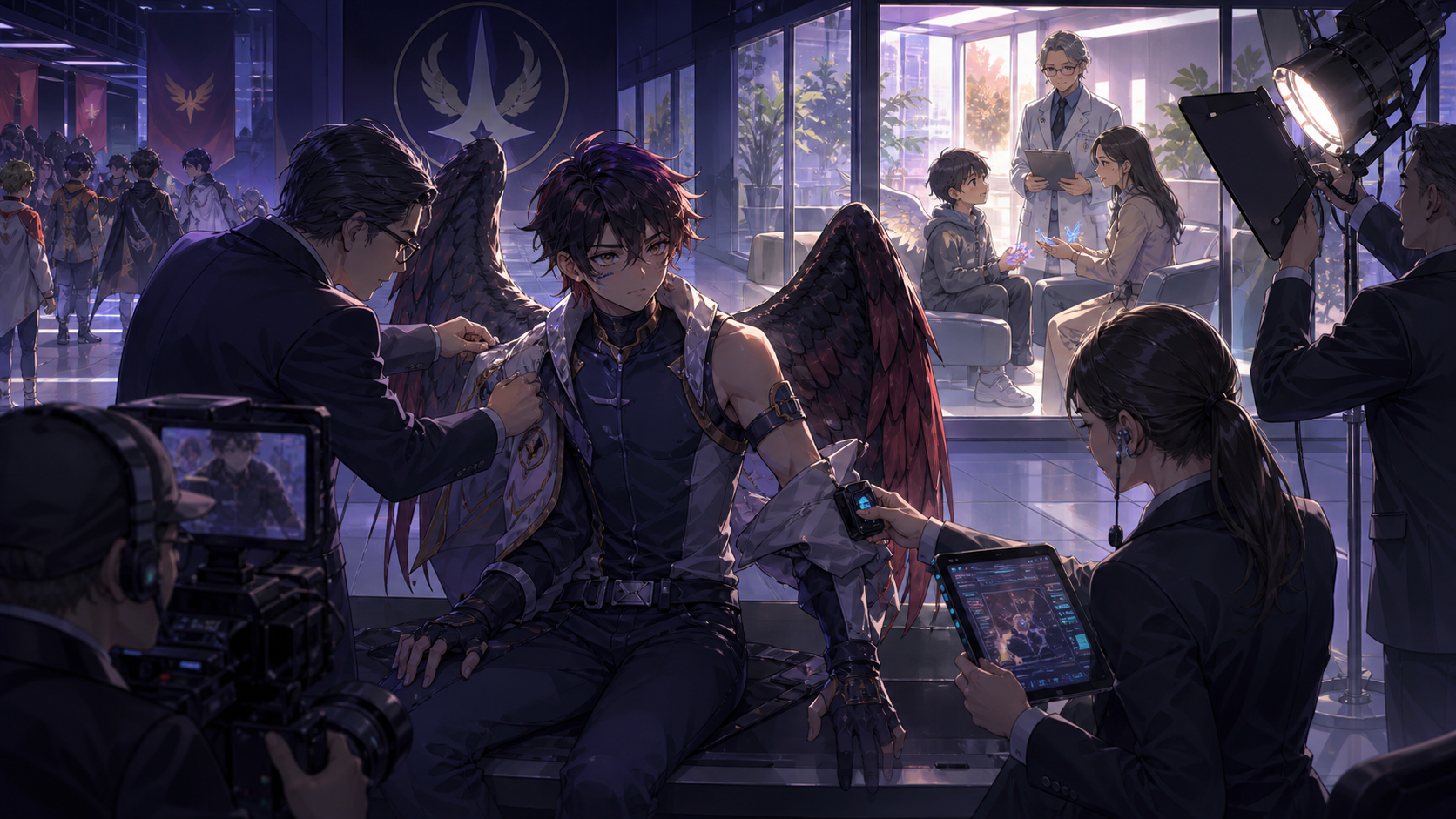
The Hero Commission Raised Child Celebrities and Called Them Public Servants
Hawks was recruited for talent, trained for obedience, branded for trust, and deployed wherever government needed a smiling weapon. Hero society merges emergency work, policing, advertising, entertainment, and celebrity into one labor market. The costume has sponsor value. The ranking becomes programming. A public servant signs autographs between disasters. Children grow up watching the chart and learn that moral worth has a market position. Hawks enters that system before he can meaningfully understand the contract. The Hero Public Safety Commission identifies a gifted child living in poverty and family violence. Officials offer rescue, training, and a future. Every benefit arrives through the institution that now controls his identity.
The Commission sees Keigo Takami’s wings, speed, perception, and desperate circumstances. Officials do not meet a whole child and later discover professional aptitude. Aptitude organizes the relationship from the beginning. Material rescue matters. Removing a child from danger, providing housing, food, education, and safety can change a life. Care becomes coercive when support depends on surrendering name, privacy, labor, and future choice. Hawks receives opportunity and loses an ordinary childhood. The institution can describe sacrifice as gratitude because officials supplied what every child should receive without a service debt.
The smile is part of the uniform. Hawks performs ease. He appears lazy, irreverent, approachable, and naturally brilliant. The persona lowers suspicion and makes speed look effortless. Public charm becomes operational equipment. Emotional labor means managing feeling and expression as part of work. Heroes reassure civilians, calm crowds, court press attention, preserve agency reputations, and maintain symbols during fear. Hawks performs those demands while conducting covert intelligence. The gap between public ease and private vigilance protects operations. The gap also isolates the worker. A person trained to make control look natural may struggle to ask for help without breaking the product.
Child performer protections reveal what hero society ignores
Real child-entertainment rules vary, but recurring protections include permits, limits on hours, rest, supervision, education, health and safety, and preservation of earnings. The underlying principle recognizes that talent and parental consent do not erase childhood. Hero society offers students publicity through tournaments and internships before building comparable boundaries around exposure. Combat adds danger beyond ordinary performance labor. Hawks needs an independent guardian, limited hours, protected education, private earnings, health oversight, and a right to refuse assignments. Commission officials cannot supervise safeguards impartially when operational success depends on his compliance.
Poverty makes “choice” do too much work. A child leaving abuse may accept any condition attached to safety. Agreement under such circumstances reflects survival intelligence. Agreement does not prove equal bargaining power. The Commission offers a route unavailable through ordinary public support. That design converts social failure into recruitment leverage. A family should not need a prodigy before receiving housing and protection. Gratitude can silence complaint. Hawks knows what life looked like before intervention, so institutional demands can appear preferable even when harmful. “Better than before” becomes a dangerously low labor standard.
Lady Nagant shows the career after the poster
Lady Nagant performs covert killings to preserve hero society’s clean public image. The Commission separates visible legality from hidden violence, then expects one operative to absorb the moral contradiction. Her collapse is treated as betrayal because institutions often medicalize or criminalize the person who can no longer perform the contradiction. The system protects coherence by describing conscience as instability. Hawks inherits a refined version of the same role. He infiltrates, deceives, gathers intelligence, and makes lethal decisions while remaining a public favorite. His charm does not make the work cleaner.
The hero ranking turns public safety into programming. Rankings combine cases, approval, visibility, and narrative. Citizens receive a simple chart. Agencies receive incentives to produce recognizable success. Heroes become competitors inside a shared public duty. Metrics can support accountability. Public popularity can also reward spectacle, branding, geography, media access, and powers that photograph well. Prevention rarely trends because no disaster provides footage. Endeavor’s pursuit of the top rank distorts family life. Hawks’ rapid rise serves Commission strategy. All Might’s symbolic dominance concentrates trust in one body. The chart measures outcomes and manufactures them.
The Commission does not merely train Hawks. The Commission authors him. Keigo’s family name carries danger because his father is a criminal. The Commission separates the child from that history and builds Hawks as a clean public identity. A new name offers protection and gives the agency narrative ownership. Identity management becomes deeper than witness protection. Officials teach speech, posture, response time, intelligence work, and the version of ease citizens should see. The agency turns biography into a controlled asset. Children need privacy from parental wrongdoing. They also need access to their own history, records, and choices about disclosure. Erasing stigma should not require surrendering memory to government custody.
Hawks later performs fragments of himself through the brand. Humor, laziness, ambition, and sincerity overlap until even viewers must ask where strategy ends. Such ambiguity makes him compelling and shows the cost of professional identity beginning before adult identity can form.
A hero costume is safety equipment, uniform, and advertisement. Hero costumes support quirks, protect bodies, make workers recognizable, and create merchandise-ready silhouettes. Those functions pull design in different directions. Safety equipment should respond to hazard assessment and worker input. Branding responds to audience memory and agency position. When visual appeal wins, the worker’s body carries marketing decisions into combat. Students design hero identities during school. Early creative ownership can be empowering. Public exposure can also freeze a teenager’s self-concept into a marketable package before adulthood. Hawks’ wings already make him visible. The Commission amplifies visibility into a persona. Every rescue becomes evidence for the brand, and every private deviation threatens public trust.
The Sports Festival turns student development into broadcast content.
U.A. uses the Sports Festival to showcase students to agencies. The event supports recruitment and gives young heroes opportunity. The same cameras expose powers, injuries, family conflict, and emotional pressure to a mass audience. Todoroki confronts abuse history during a televised fight. Midoriya destroys his fingers while spectators evaluate potential. Bakugo’s restraint and rage become public narrative. Shinso must use the spectacle to correct an admissions system. A school event can celebrate talent without treating private trauma as bonus content. Broadcast consent needs limits, delay options, mental-health support, and the ability to withdraw from publicity without losing professional access. Hero society presents visibility as unavoidable career preparation. A public occupation still permits privacy. Firefighters and emergency workers do not owe citizens ownership of childhood.
Internships blur education and productive labor. Internships promise supervision, skill development, and exposure to professional settings. Hero students also perform patrol, rescue, investigation, and combat that agencies would otherwise assign to paid staff. Education and labor can coexist. The difference depends on who benefits, who bears risk, whether learning objectives are clear, and whether students can refuse unsafe work. Hero agencies gain prestige and capacity from interns. Students compete for placements because access shapes careers. That imbalance can make complaint feel professionally dangerous. Independent school coordinators should monitor placements, review hours and injuries, protect academic time, and remove students without allowing agencies to retaliate through references.
Hawks’ speed becomes an argument for giving him more work. Efficient workers often receive additional assignments because they appear capable. Their competence solves staffing problems and creates personal overload. Hawks resolves incidents quickly, manages a large information field, and cultivates public approval. The Commission then adds covert infiltration to an already visible hero career. High capacity does not remove human limits. Rapid wings, perception, and intelligence cannot create unlimited sleep, emotional processing, or moral certainty. A sustainable system treats speed as a reason to protect recovery rather than an invitation to fill every saved minute.
Surveillance changes the meaning of friendship. During infiltration, Hawks builds relationships while collecting intelligence. Twice offers trust and receives deception. Hawks recognizes Twice’s humanity and remains responsible for an operation that makes honest friendship impossible. Undercover work may serve urgent public safety. Such work carries moral injury because ordinary relational behaviors become tools. The operative must listen sincerely and strategically at once. Commission training prepares performance more clearly than recovery. After an operation, a worker needs confidential space to examine grief, guilt, fear, and disputed choices without immediate concern for public messaging. When surveillance agencies celebrate successful infiltration without naming the relational cost, workers learn to treat emotional damage as evidence of professionalism.
Twice is not only a target. He is a test of the system’s imagination. Twice presents catastrophic risk because his power can multiply force rapidly. He is also a traumatized man who found belonging among villains after social failure. Hawks tries persuasion and recognizes another path might have existed. Operational time narrows that path. Escalation, loyalty, and immediate danger produce a lethal conclusion. The scene resists a clean answer, which makes institutional preparation more important. Officers need de-escalation options, capture resources, mental-health expertise, and rules for force decided before one operative faces impossible seconds. Public narrative prefers hero versus villain. Prevention asks how society allowed a vulnerable person’s only stable community to become a criminal organization.
Hero agencies profit from parasocial trust. Citizens know heroes through names, costumes, interviews, rankings, rescues, and products. Repeated exposure creates a sense of familiarity without mutual relationship. Parasocial trust can support public instructions during emergencies. Citizens may follow a known hero quickly. The same trust can discourage scrutiny because criticism feels like betrayal of someone personally admired. Agencies and media benefit financially from attention. Workers bear reputational volatility. One edited clip or hidden fact can transform admiration into hostility. Public communication should distinguish emergency credibility from celebrity affection. Accountability cannot depend on whether the hero remains likable.
All Might shows the danger of making one body national infrastructure. All Might’s Symbol of Peace reduces crime through visible deterrence and emotional reassurance. The achievement is real. Dependence becomes dangerous when a nation organizes confidence around one worker’s health. He hides injury to preserve stability, converting private pain into public policy. Colleagues and institutions delay adaptation because the symbol appears intact. Young heroes inherit a culture where smiling through damage looks socially necessary. Midoriya imitates sacrifice. Hawks performs ease. Endeavor tries to fill a role designed around another person’s impossible output. Resilient public safety requires teams, prevention, social services, transparent succession, and trust distributed across institutions.
Endeavor exposes the family cost of ranking. Endeavor turns the number-one position into a family project. He treats marriage and children as routes toward producing superior power. Public ambition becomes domestic coercion. Hero society celebrates professional results while family harm remains private. Rankings count solved cases more readily than abuse connected to the career. Workplace accountability cannot stop at the agency door when an employee uses professional status, wealth, and power to control a household. Survivors need independent access to safety and justice. Endeavor’s later remorse may matter. His family members do not become staff in his redemption campaign. The institution that rewarded him also owes scrutiny.
Public approval is a labor demand without an off switch. Traditional shifts end. A celebrity identity continues through phones, gossip, fan encounters, surveillance, and online commentary. Rest in public still becomes content. Young heroes need boundaries around interviews, social media, location disclosure, fan access, and the commercial use of images. Guardians and agents can share conflicts of interest when income depends on exposure. Hawks’ professional advantage comes partly from accessibility. His relaxed manner invites closeness. Constant accessibility makes privacy seem inconsistent with the brand. A right to private life should not depend on becoming unpopular enough for people to stop looking.
The Commission treats secrecy as supervision. Officials know more about Hawks’ assignments than the public, agencies, and perhaps colleagues. Information control can support security. Supervision requires concern for worker welfare, legal limits, and independent review. A secret order is not oversight merely because a superior approved the order. Oversight asks whether the superior has conflicts, whether conduct follows law, whether alternatives existed, and whether affected people can seek remedy. Hawks receives direction from the institution invested in operational success. He needs a separate advocate empowered to challenge assignments, demand rest, and preserve confidential concerns. Government cannot grade its own secrecy using only secret criteria.
What informed consent would require. A child recruit would need age-appropriate explanation of duties, risks, publicity, data collection, compensation, education, discipline, and exit. Independent counsel would represent the child rather than the Commission or family. Consent would be revisited as the child matures. Agreement at one age would not authorize every future mission. Refusal would not trigger loss of housing, identity protection, or essential care. Some work should remain prohibited regardless of consent. Covert killing, high-risk infiltration, and uncontrolled combat exceed a defensible childhood role. Adults often praise mature children for understanding consequences. Maturity does not remove the power difference between a homeless child and a national agency.
Training can educate and condition at the same time. Hawks receives technical mastery, situational awareness, intelligence skills, and control. Those lessons expand capacity. Training also shapes which questions feel permissible. Conditioning does not require a hypnotic command. Repetition, reward, isolation, secrecy, gratitude, and professional identity can narrow choices while preserving the feeling of agency. The most effective institutional worker may sincerely believe in the mission. Belief does not prove the institution respected the path toward belief. Education teaches how to perform work and how to evaluate the authority assigning work. A curriculum without ethics, labor rights, and protected dissent produces obedience with excellent technique.
Rest becomes suspicious inside a crisis economy. Hero agencies depend on emergencies. Rest can feel selfish when somebody may need rescue. Public praise reinforces permanent availability. Workers who internalize that duty may volunteer beyond safe limits. Managers benefit without issuing an explicit coercive order. Culture completes the order. Protected rest requires staffing, maximum hours, mandatory recovery after critical incidents, and leaders who do not reward quiet rule-breaking. Hawks dreams of a world where heroes have too much free time. The dream sounds lazy only within a system that mistakes constant crisis for proof of purpose. Public safety should aim to reduce demand.
The fastest hero wants a slower society. Hawks’ stated hope for a peaceful future contains a labor critique. Success should make his occupation less necessary. A healthy safety institution works toward conditions that shrink emergency workload. Rankings create the opposite incentive. Agencies need cases, visibility, and public relevance. Prevention may reduce the events that justify budgets and celebrity. This conflict exists beyond fiction. Organizations can become attached to managing a problem rather than eliminating causes. Staff may care deeply while funding structures reward volume. Hawks’ speed therefore carries irony. He resolves immediate danger quickly while serving a system slow to address poverty, discrimination, villain reintegration, and social abandonment.
Public trust collapses because officials treated trust as image control. After revelations and mass destruction, citizens lose faith in heroes. The collapse does not begin with one public-relations mistake. Trust had been concentrated in symbols, rankings, and hidden operations. Image control can postpone scrutiny. Delayed scrutiny becomes more destructive because citizens discover both the original harm and the concealment. Trustworthy institutions publish standards, failures, discipline, use-of-force data, conflicts of interest, and corrective action. Some operational details remain restricted temporarily, but secrecy receives independent review. Citizens do not need flawless heroes. Citizens need systems capable of admitting when a hero, agency, or Commission caused harm.
Villain labels simplify social policy. Hero society distinguishes licensed heroes from villains through law and conduct. The distinction matters when people commit violence. The label can also compress poverty, mental illness, discrimination, coercion, ideology, and crime into one enemy category. Once a person becomes a villain, surveillance and force feel like complete policy. Prevention, treatment, housing, employment, and reintegration become softer concerns for another department. Hawks meets people whose danger is real and whose abandonment is also real. Recognizing context does not require ignoring victims. Context improves prevention and proportionate response. A government that funds covert operatives more reliably than community support has chosen where intervention begins.
The Commission’s conflict of interest is built into the job. The Commission promotes hero legitimacy, regulates aspects of hero work, conducts secret operations, manages political risk, and directs operatives. Promotion and oversight pull in opposite directions. An agency invested in public confidence may hide misconduct to protect confidence. An agency controlling covert action may grade legality around operational need. Independent inspectorates, courts, legislative review, labor representation, and public reporting divide power. No single office should recruit a child, design his brand, assign his mission, evaluate his conduct, control his records, and decide his remedy. Efficiency is not the only value in government design. Friction can protect people when friction forces another institution to ask why.
A hero union would change the conversation. Heroes negotiate individually through agencies and reputation. Collective representation could address hours, hazard pay, health care, injury, privacy, disciplinary procedure, trainee protections, and refusal of unlawful assignments. Celebrity weakens solidarity when top-ranked workers imagine individual success protects them. Hawks’ history shows exceptional status can increase government control rather than reduce control. Unions can also reproduce hierarchy and require democratic oversight. Representation should include sidekicks, support workers, interns, lower-ranked heroes, and workers whose quirks receive less media attention. A worker facing a secret order needs counsel not employed by the person issuing the order.
Agency sidekicks reveal the workers outside the ranking headline. Hero offices rely on teams handling patrol, evacuation, logistics, intelligence, equipment, administration, communication, and recovery. Rankings center lead heroes while collective labor disappears. Celebrity encourages the public to attribute every success to one face. Invisible staff absorb workload and may receive less power to challenge unsafe choices. Public reporting should credit teams and examine working conditions across agencies. A safe lead hero cannot rest if every sidekick remains understaffed. Hawks’ ability to control many feathers resembles a fantasy of perfect managerial reach. Real organizations need distributed judgment rather than one person sensing everything.
Children in hero society learn branding before labor rights. Students choose names, costumes, signature moves, and public identities. Those lessons prepare them for the market. The curriculum shows less interest in contracts, taxes, collective bargaining, insurance, intellectual property, harassment, data rights, and retirement. Professional education should teach how institutions can exploit enthusiasm. Young workers need vocabulary for unsafe orders and conflicts of interest before prestige makes refusal difficult. Media training should include the right not to answer, correction procedures, crisis support, and boundaries around family exposure. A student who can defeat a villain but cannot read an agency contract remains professionally vulnerable.
Keigo needed a guardian who did not need Hawks. An independent guardian would prioritize the child’s welfare without benefiting from his assignments or fame. The guardian could preserve family records, monitor education, review medical care, and challenge Commission decisions. Independence requires funding protected from retaliation and a legal duty owed to the child. A friendly Commission employee would still face organizational pressure. The guardian should help create alternatives. Keigo could pursue hero work, another public-service role, private education, or a life outside government branding. Choice becomes real when saying no does not mean returning to danger.
What the Commission owes Hawks now. Adult achievement does not erase childhood claims. The Commission would owe full records, independent investigation, compensation, health care, privacy support, and authority over the continued use of his image. He would need access to unedited training files and mission orders. Public history should acknowledge recruitment without exposing private details he chooses to keep. Any investigation should include Lady Nagant and other operatives. Treating Hawks as one exceptional case would protect the program that produced him. Repair also means accepting anger, ambivalence, loyalty, and grief without demanding one clean survivor narrative.
What reform would look like
Separate promotion from regulation. Create independent oversight for covert operations. Prohibit recruitment of children into intelligence or lethal work. Protect education, rest, earnings, privacy, and exit for all young performers and trainees. Limit student broadcasting and require informed, renewable consent. Review internships as labor and education. Publish ranking methodology and reduce popularity incentives. Fund prevention outside hero agencies: housing, mental health, disability access, family support, community violence prevention, and reintegration. Public safety begins before a costume arrives. Build a culture where heroes can report injury, refuse unlawful orders, criticize leadership, organize collectively, and retire without becoming failed symbols.
Hero society privatizes public safety through agencies. Heroes operate through named offices that compete for talent, visibility, and cases while performing public functions. Such a structure can support specialization and local responsiveness. Competition also fragments standards. Agencies may differ in supervision, pay, training, safety, and complaint handling. A prestigious student placement can depend on brand reputation more than independently verified working conditions. Government remains responsible when private or semi-private agencies exercise coercive authority. Licensing cannot become delegation without accountability. National standards should establish minimum staffing, insurance, reporting, use-of-force review, trainee protection, and access to remedy. Agencies can exceed the floor. Agencies should not decide whether a floor exists.
Merchandise turns identity into an asset class. Hero names and images appear on products, events, broadcasts, and agency promotions. Revenue can compensate labor and support public outreach. Commercial rights become complicated when a hero identity was developed during childhood under institutional control. Young performers need transparent accounting, independent review, protected savings, and authority over uses that continue into adulthood. A government agency should not own lifelong rights because officials financed training. Merchandise also shapes which heroes receive attention. Marketable design and simple narratives sell more easily than prevention, teamwork, or morally complicated work. A hero can consent to commercial partnership. Consent needs real negotiation and the ability to decline without losing public-service opportunity.
Female heroes carry a different publicity contract. Hero society evaluates costumes, bodies, likability, and power through gendered expectations. Women may receive pressure to appear attractive, approachable, tough, maternal, or nonthreatening in combinations no worker can satisfy consistently. Sexualized branding can be framed as personal choice while agencies and audiences reward particular choices. Autonomy requires alternatives that do not punish refusal. Young trainees need strong boundaries around costume approval, photography, harassment, fan contact, and media questions. Complaint systems should not route through managers invested in campaigns. Public-service legitimacy never requires public ownership of a worker’s body.
Mutation and appearance bias shape the celebrity market. Hero society includes people whose bodies differ visibly because of quirks. Public approval may reward familiar beauty, dramatic power, or a reassuring silhouette while treating other bodies as frightening. Such bias affects recruitment, branding, assignments, and civilian response. A hero may perform extra warmth to overcome prejudice, adding emotional labor unrelated to skill. Commission policy should audit outcome differences by appearance and quirk type. Anti-discrimination rules need enforcement across licensing, agencies, media access, and public accommodations. Diversity campaigns cannot substitute for fair work when featured heroes remain responsible for correcting society’s prejudice through perfect behavior.
Retirement should not feel like social death. Celebrity public servants can become fused with the role. Injury, aging, scandal, disability, or choice may end field work. A society that knows only the symbol can treat the person afterward as absence. Retirement needs pension, health care, retraining, privacy transition, and meaningful work beyond combat. Workers should control farewell narratives and continued commercial use. All Might struggles with the loss of physical capacity because identity and national reassurance had become inseparable. A healthier institution would prepare transition before collapse. Children choosing hero work need evidence that adulthood contains more than permanent performance or public disappointment.
Whistleblowers should not need to become fugitives. Lady Nagant’s knowledge of covert abuse leaves no trustworthy internal route. When institutions punish disclosure and conceal operations, truth emerges through breakdown, defection, or enemy exploitation. Protected reporting requires confidential channels outside command, legal representation, anti-retaliation enforcement, evidence preservation, and public-interest disclosure rules. Some information must remain restricted during active operations. Classification should receive deadlines and independent appeal. Leaders cannot classify misconduct merely because disclosure would embarrass government. A worker who reports abuse should not have to destroy her career to prove loyalty to the public.
Moral injury deserves a name before a villain offers one. Moral injury can arise when a person perpetrates, witnesses, or cannot prevent actions violating deeply held beliefs. The concept differs from a formal diagnosis and helps describe why technically successful missions can damage identity. Hawks faces choices where every option carries harm. Lady Nagant performs killings framed as necessary. Students encounter death before professional values settle. Support should allow criticism of orders rather than treating distress solely as a symptom inside the worker. Sometimes anguish reflects a policy requiring review. Confidential peer programs, independent clinicians, chaplaincy or ethical consultation, leave, and transparent investigation can help. Returning somebody to duty cannot be the only treatment goal.
Public inquiries should examine the whole pipeline. After institutional collapse, leaders may investigate one operation or one official. A serious inquiry would trace recruitment, training, licensing, ranking, agency finance, media relationships, covert authority, student labor, use of force, injury, and exit. Children and former trainees would testify with privacy options. Sidekicks, support workers, families, civilians, villains harmed by unlawful conduct, and lower-ranked heroes would receive standing. Findings would distinguish individual wrongdoing from systemic incentives. Recommendations would carry deadlines and public monitoring. The inquiry should not rely on Hawks to explain the Commission alone. Making the most visible survivor narrate an entire system repeats the extraction.
Hawks deserves complexity beyond victim and weapon. He makes strategic choices, values speed, enjoys parts of fame, cares about people, deceives effectively, and participates in harmful operations. Childhood coercion does not eliminate adult agency. Agency and victimization can coexist. A person shaped by an institution can still believe in parts of the mission and remain responsible for choices within available power. Simple innocence would flatten him. Simple blame would protect the Commission. Complexity allows accountability to reach every level. His humor deserves recognition as personality, not only mask. Institutions do not manufacture every trait they exploit.
The public has responsibilities too. Citizens consume rankings, merchandise, interviews, and dramatic rescues. Media demand helps finance the system. Individual fans do not control Commission operations, but collective appetite shapes incentives. Audiences can support privacy, reject harassment, value team labor, question unsafe spectacle, and demand reporting beyond popularity charts. Journalists can investigate institutions without treating trauma as entertainment. Public-interest reporting explains policy, budgets, and outcomes while limiting unnecessary exposure of minors. Trust becomes healthier when citizens admire heroes without demanding access to every private wound.
Scene analysis: Hawks entering the Commission pipeline. The childhood recruitment sequence works because rescue and capture occupy the same frame. Material safety improves. Institutional control closes around the improvement. Adults speak with the authority of people offering the only credible future. The child’s power becomes the reason help arrives. Viewers can feel relief and unease simultaneously. The scene refuses an easy kidnapping narrative. Nobody needs to drag him away. Structural desperation delivers compliance more efficiently. That ambiguity belongs at the center of labor analysis. Exploitation often survives because the arrangement offers something genuinely better than the available alternative.
Scene analysis: the casual hero in public. Hawks’ relaxed introductions establish a worker who controls pace socially even while moving faster than almost anyone physically. He disrupts formal expectations and becomes more memorable. Casualness also protects against scrutiny. People interpret apparent openness as proof nothing remains hidden. Humor becomes counter-surveillance. The performance may feel enjoyable because professional masks can contain authentic preferences. The danger comes when neither worker nor audience can safely request the face underneath.
Scene analysis: Twice and the breaking point. The confrontation condenses surveillance, friendship, public danger, personal grief, and institutional urgency. Hawks wants surrender. Twice experiences surrender as betrayal of the only community that accepted him. The scene denies Hawks a clean heroic emotion. He acts under risk and carries sorrow. Viewers debate the choice because the story gives both operational stakes and human loss. A systemic reading asks why one young operative faces the final decision without enough nonlethal capacity, time, or social alternatives. Heroism cannot repair every earlier policy failure inside one room.
What the story gets right
My Hero Academia understands that symbols stabilize society and conceal fragility. The Commission’s clean image depends on hidden labor and violence. Public trust collapses after contradiction becomes visible. Hawks embodies the merger of celebrity and intelligence work without becoming a lecture. His speed, charm, wings, and history all serve the theme. Lady Nagant widens the timeline, showing the system preceded him. Twice keeps the analysis from treating targets as abstract threats. The series also shows that individual goodness inside a compromised institution remains meaningful and insufficient.
The Commission receives less administrative detail than the thematic argument deserves. Budgets, oversight, legal authority, recruitment rules, and internal dissent remain thin compared with character drama. Recovery focuses on immediate conflict. Former operatives, families, trainees, and civilians would need long-term repair after exposure. Labor rights remain background. Agencies and sidekicks create an opportunity to explore contracts, organizing, insurance, and workplace governance more fully. Such omissions do not erase the critique. They leave room for readers to follow the institutional questions past the final battle.
Education should prepare heroes to question the profession. Professional schools often teach identity alongside skill. Students learn what counts as courage, loyalty, competence, and success. Hero education should make those values available for examination. Courses could cover history of hero regulation, civil rights, labor law, media ethics, use of force, disability, social services, corruption, and institutional failure. Students would study cases where lawful orders caused harm and where dissent protected the public. Critical education does not make workers cynical. Critical education gives commitment an informed foundation. A hero who understands limits can protect legitimacy better than a hero trained to defend every institution automatically. Hawks receives enough education to read enemies. He needed education that helped him read his employer.
Compensation should reflect control over risk and image. Dangerous work deserves transparent pay, insurance, disability coverage, survivor benefits, and compensation for long-term health effects. Celebrity work adds licensing and image revenue. Young heroes should receive protected accounts and independent financial advice. Families and agencies may share incentives to maximize exposure before a child understands future privacy costs. Covert assignments require additional protections because public recognition may be impossible. Government cannot replace compensation with secret gratitude. Money never settles coercion. Fair compensation remains one part of labor justice rather than evidence every risk was acceptable.
Family rescue must not become family replacement by an agency. Keigo needs protection from his home. The Commission fills the vacuum with institutional belonging. An agency can provide stability and still discourage relationships outside agency control. Children leaving unsafe families need carefully screened guardians, education, peers, community, and contact choices not organized around future labor. Dependence on one institution makes complaint dangerous. Chosen family can develop later, but government should not manufacture isolation and call the resulting loyalty gratitude. A safe childhood includes adults who value the child when his power rests, fails, changes, or disappears.
The hero name should belong to the person. A professional name can provide privacy, creative expression, and separation between work and home. Ownership matters when agencies invest in promotion. Contracts should state who controls the name, costume design, archived footage, merchandise, and post-retirement use. Childhood agreements should become reviewable at adulthood. Government cannot claim a public-interest exception broad enough to preserve commercial control forever. Historical archives may retain records while commercial exploitation requires separate consent. Keigo should be able to keep Hawks, change Hawks, or leave Hawks behind.
Public safety needs boring workers too. Celebrity culture centers dramatic rescues and memorable powers. Inspectors, dispatchers, analysts, counselors, engineers, trainers, archivists, and community workers prevent harm without ranking spectacle. Funding follows attention when leaders confuse visibility with value. Hero agencies expand while social supports remain weak, creating more emergencies for heroes to manage. Hawks’ dream of idle heroes requires investment in boring prevention. Housing assistance may prevent villain recruitment more effectively than another camera-ready patrol. A healthy society can admire spectacular courage and fund uneventful competence.
The Commission trained secrecy across generations. Lady Nagant and Hawks show continuity. Methods evolve from hidden execution toward sophisticated infiltration and branding, but secrecy remains the bridge. Institutional knowledge passes through files, trainers, norms, and leaders. Removing one director does not remove curriculum. Reform therefore requires record preservation, personnel review, training replacement, survivor testimony, and monitoring of informal practice. Employees may follow old expectations after formal policy changes. Organizations remember through habit. Accountability must reach habit.
A truth commission for hero society would be messy and useful. Operatives would describe recruitment and orders. Families would describe loss. Civilians would describe rescue and abuse. Former villains would describe pathways into crime without receiving automatic immunity for harm. Agency leaders, school officials, media companies, sponsors, and Commission staff would explain incentives and information. Records would test memory. The final account would not identify heroes as wholly good or corrupt. The account would show where public service succeeded, where secrecy distorted service, and which structures need replacement. Messy truth can support trust because citizens no longer have to choose between propaganda and total cynicism.
Hawks’ humor should not become evidence that he was fine. People under pressure laugh, flirt, tease, enjoy work, and form ambitions. Suffering does not produce one permanent expression. Observers often use functionality to dismiss harm. A worker who performs brilliantly, jokes naturally, and chooses continued service may still have experienced coercion. Recovery should not require adopting a visibly solemn identity to appear credible. Joy belongs to survivors without becoming evidence against them. Hawks can love flying and hate the cage built around flight.
Accountability for the Twice operation needs more than a fan verdict. Fans argue whether Hawks had alternatives. A formal review would reconstruct timing, intelligence, available capture tools, backup, orders, de-escalation attempts, risk to civilians, and the moment lethal force became likely. The review would separate legal judgment, policy judgment, and moral injury. One decision can satisfy policy while revealing deficient resources or planning. Findings should protect necessary private details without reducing the public report to “trust us.” Families and affected communities deserve understandable reasoning. Hawks should receive representation during review. Accountability cannot reproduce the Commission’s habit of using him as the only available body for institutional choices.
The reform test is the next talented child
After scandal, institutions often promise that past methods belonged to another era. The promise becomes measurable when another vulnerable child with a powerful quirk appears. Does the family receive unconditional support? Does an independent guardian arrive? Does education include broad options? Are recruiters prohibited from attaching covert service to safety? Can the child decline publicity? If leaders still see talent before need, the system has changed vocabulary rather than values. Hawks’ story should close the pipeline, not improve the brochure.
The tunnel has to lead beyond exposure. A stronger hero society would not solve exploitation by replacing one secret commission with a nicer secret commission. The new system would separate child welfare, education, public safety, licensing, and media promotion so no agency could control a young hero’s home, income, training, public image, and mission assignments at the same time. Guardians would receive independent legal advice. Students would have confidential advocates who could challenge placements without ending a career. Dangerous assignments would require written reasons, medical review, and a real appeal. Public funding would support heroes without turning every rescue into a branding opportunity. Those changes would create conflict for the story because safety, speed, privacy, and public trust would still compete. The difference would be that talented children would no longer enter the argument as property.
A believable reform arc would also follow one ordinary student through the new pipeline. The student could refuse a television interview, report an unsafe internship, change a hero name, or ask for counseling without losing a license. Senior heroes might resent rules that did not protect them when they were young. Agencies might argue that stricter protections slow emergency response. Families might disagree about exposure, money, and risk. Those tensions would show whether hero society learned anything after Hawks and Lady Nagant. The test is not whether leaders give a better speech after a scandal. The test is whether the next frightened, gifted child can say no to an adult with power and still keep a future.
Final take
Hawks is not proof that the Commission saved a child correctly. He is proof that a gifted child can become excellent inside an arrangement built around extraction. Public service should protect people. Celebrity can help communicate trust. Neither purpose grants government ownership over a child’s name, image, body, conscience, or future. The Commission gave Hawks wings a job before giving Keigo a life.