
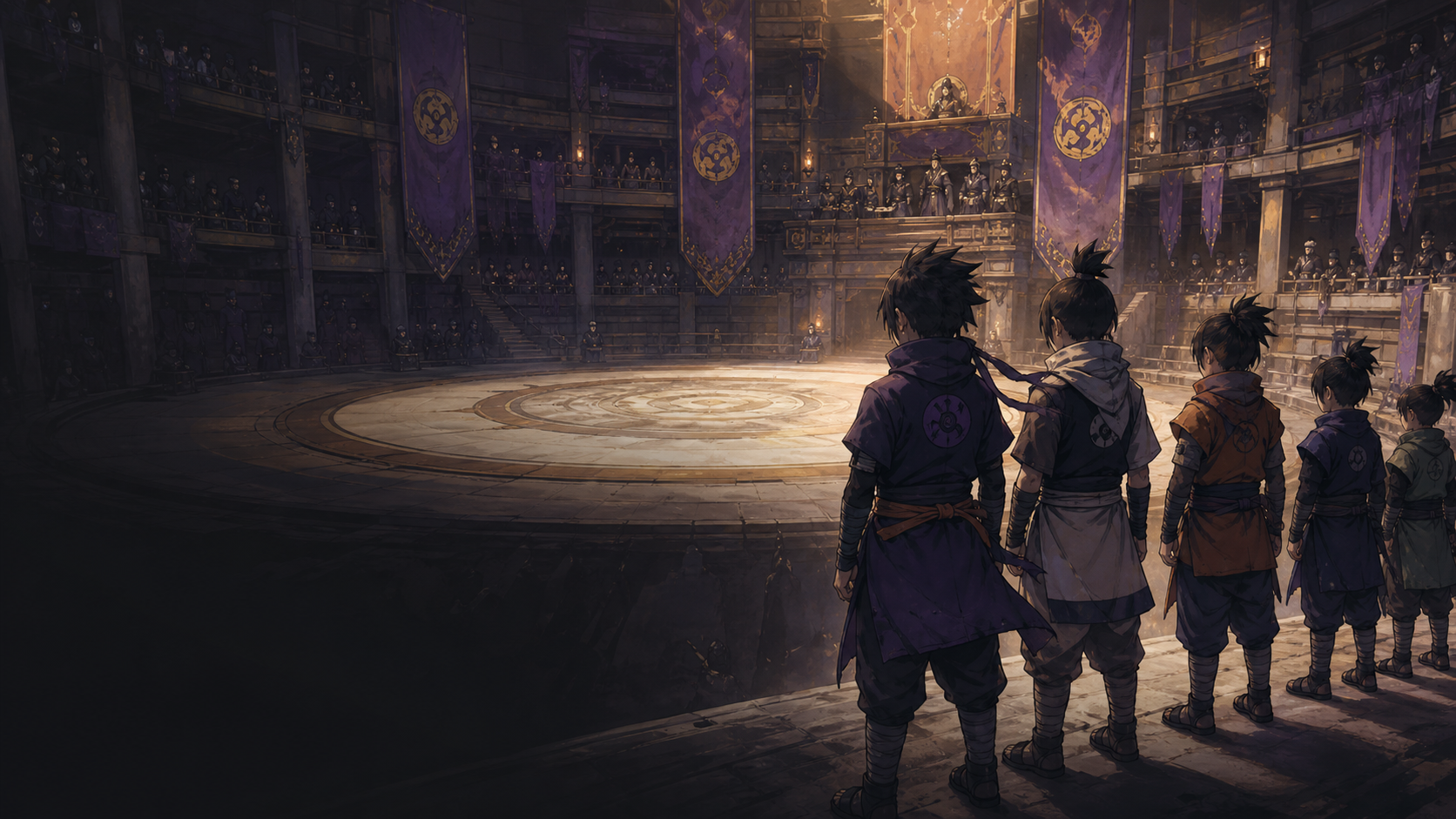
The Chunin Exams Were a Child-Soldier Recruitment Fair
Konoha put twelve-year-olds through surveillance, deprivation, attempted murder, and public combat, then called the whole production a promotion exam.
I love the Chunin Exams. I also need every adult in charge of the Chunin Exams to sit down for a very long meeting with somebody from child protective services.
The arc works because Masashi Kishimoto understands competition television before competition television completely swallowed modern culture. We get rivalries, confessionals, seeded favorites, shocking eliminations, a written test with a trick, a survival round designed by a smiling sadist, and a stadium finale attended by political leaders. The children arrive with personal tragedies and marketable fighting styles. The adults turn those children into a program.
Calling the event an exam makes the danger sound educational. Calling successful candidates chunin makes the danger sound like professional development. Neither label changes the underlying arrangement. Hidden villages recruit children, train them for state violence, assign missions with lethal consequences, and evaluate promotion through an event where death remains an accepted outcome. Konoha does not merely tolerate child soldiers. Konoha built a school-to-military pipeline, added bleachers, and sold the pipeline as meritocracy.
Contents
- My actual rant
- Konoha calls a military academy a school
- The written test rewards surveillance
- The Forest of Death removes adult responsibility
- The preliminaries turn injury into scheduling
- The finals are a weapons exhibition
- Meritocracy after unequal childhoods
- Naruto enters without a safety net
- Gaara is what militarization looks like without manners
- Neji understands the rigged system
- Hinata fights family governance in public
- Rock Lee and the cruelty of inspirational labor
- The adults who normalize the danger
- What real child-protection law clarifies
- Why audiences enjoy the spectacle
- What a defensible promotion system would require
- Final take
My actual rant: an exam does not become fair because everybody gets hurt
The Chunin Exams ask a question that school systems, workplaces, and governments keep asking in less cinematic language: who can perform competence while carrying damage nobody plans to repair? The event never measures talent alone. The event measures talent plus bloodline, teaching quality, food, housing, family stability, political protection, prior mission exposure, medical luck, and a child’s willingness to hide pain from adults.
The winners receive praise for resilience, which sounds generous until we remember who made resilience an entrance requirement. Konoha praises children for carrying burdens that Konoha assigned, then treats endurance as proof that the arrangement works. Survival becomes the institution’s favorite evaluation because survival lets adults congratulate the child without repairing the conditions that demanded so much from that child.
Real schools do not send students into forests where hostile adults can brand them with curse marks. Still, the institutional habit feels familiar. A child struggles after housing instability, grief, hunger, disability, violence, or neglect. Adults record a performance problem. The report describes attention, attendance, attitude, and achievement. The conditions producing those numbers disappear behind the numbers. The child becomes the defect because fixing a child looks cheaper than fixing the structure around him.
The Chunin Exams exaggerate that habit until nobody can miss the violence. Naruto has spent years isolated by the village. Gaara has been converted into a state weapon by his father. Neji lives under a hereditary control system. Hinata has been judged disposable by her clan. Rock Lee trains beyond safe limits because the institution offers one narrow route to dignity. Every contestant arrives with a different institutional wound. The exam calls the resulting contest neutral.
Konoha calls a military academy a school
The Academy teaches literacy, tactics, chakra control, weapons use, concealment, and obedience to mission structures. Graduation does not lead to a protected apprenticeship. Graduates become genin and begin state-assigned labor under a jonin leader. Some early missions look harmless, but the mission economy always sits behind the classroom. Villages earn money and political standing by selling trained force.
That distinction matters because school carries moral expectations. Schools owe children development, care, reasonable safety, and room to fail without permanent bodily consequences. Military organizations prioritize readiness, hierarchy, secrecy, and mission completion. Konoha blends both institutions, then lets the language of education soften the reality of deployment.
Iruka represents the Academy at its best. He sees Naruto as a child before seeing him as a container, a nuisance, or a potential weapon. His care matters because Konoha’s design makes humane treatment depend on individual decency. A decent teacher can protect one student during one crisis. A functioning child-welfare system should not depend on finding an unusually compassionate employee.
Kakashi faces the same impossible job after graduation. He serves as teacher, commander, evaluator, therapist, emergency guardian, and field medic without being prepared for every role. Kakashi is a young man carrying his own losses. He cares about Team 7, but affection cannot give one overworked jonin the capacity of a school counselor, social worker, family advocate, and trauma specialist. Konoha saves money by assigning all those duties to the nearest competent fighter.
The bell test teaches teamwork through manufactured scarcity. Two bells for three students force the children to decide whether success means individual advancement or collective responsibility. Kakashi ultimately rewards cooperation. The lesson is humane, but the village still places cooperation inside a career that will demand secrecy, violence, and obedience. Teamwork becomes both protection from the institution and fuel for the institution.
The written test rewards surveillance and calls the lesson information gathering
Ibiki Morino’s written test is not mainly about solving difficult questions. The candidates are expected to cheat without being caught. The official educational objective concerns intelligence gathering under pressure. That objective makes sense for shinobi work. The method also teaches children that institutions may lie about what they are evaluating and punish anyone who cannot decode the hidden curriculum.
Students with specialized perception possess immediate advantages. The Byakugan, Sharingan, insect techniques, puppetry, and other clan knowledge convert inherited or privately taught abilities into test performance. Naruto lacks an information-gathering technique suited to the room. His apparent stupidity during the test reflects a mismatch between the assessment and his preparation, not an absence of courage or tactical intelligence.
Modern testing systems frequently produce a cleaner version of the same error. Scores look objective because every student receives the same paper. Equal paper does not create equal preparation. Families purchase tutoring, time, quiet space, technology, transportation, nutrition, and familiarity with institutional language. Schools then describe the final number as an individual accomplishment.
Ibiki’s tenth question intensifies the hidden curriculum. Candidates can withdraw, protecting teammates but supposedly surrendering future eligibility, or remain and risk permanent failure. The threat is partly theatrical. The test measures commitment under coercive uncertainty. Naruto passes because stubborn refusal happens to match the trait the institution wants.
The scene is exciting because Naruto changes the room without answering a single question. His courage gives frightened candidates permission to stay. The scene is also a terrible model of informed consent. Children cannot evaluate a choice when an adult withholds essential facts, invents consequences, and uses public pressure to shape the answer.
The Forest of Death removes adult responsibility and calls the result realism
Anko Mitarashi explains that teams must acquire two scrolls and reach the tower within five days. Candidates sign consent forms acknowledging death. The paperwork supplies a joke and a warning. The paperwork does not make the arrangement ethical.
Children cannot provide meaningful consent to a state employer when their education, income, identity, and community status all depend on participation. The choice becomes even thinner for clan heirs, orphans, jinchuriki, and children raised from birth to understand service as their purpose. A signature records compliance. A signature does not erase coercion.
The forest creates controlled abandonment. Adults define the perimeter, release teams, restrict intervention, and treat danger as authentic proof of readiness. When Orochimaru enters, the supposedly controlled environment becomes a hunting ground for an adult predator. The security failure is enormous. Sasuke receives a curse mark. Naruto’s seal is disrupted. Multiple children face threats far beyond the announced assessment.
Konoha responds to Orochimaru’s intrusion without stopping the entire exam. That decision exposes the institution’s priorities. Canceling would concede weakness, interrupt international diplomacy, and waste the assembled spectacle. Continuing transfers institutional risk to children who never received enough information to choose that risk.
The forest also reproduces inequality through resources. Teams with sensory skills can locate enemies. Teams with medical knowledge can manage injuries. Clan techniques offer defense, tracking, and communication. A supposedly natural environment becomes another test of accumulated privilege.
Survival exercises can teach planning and cooperation when adults maintain rescue capacity, proportional risk, and transparent rules. The Forest of Death treats rescue as contamination of the result. Suffering authenticates the credential.
The preliminaries turn injury into a scheduling problem
Too many teams survive the forest, so officials add one-on-one preliminary fights. The institutional response to unexpected success is not celebration. The response is a faster elimination mechanism.
Several candidates enter while injured, exhausted, traumatized, or medically compromised. Sasuke carries Orochimaru’s curse mark. Hinata faces a cousin whose grievance is inseparable from clan abuse. Lee fights an opponent whose defensive power makes ordinary contact nearly impossible. Officials monitor the matches and can intervene, but intervention comes late because the contest needs enough danger to reveal character.
Might Guy stops Gaara from killing Lee after Lee has already suffered devastating injuries. Guy loves Lee. His anguish is genuine. His earlier encouragement also helped a child interpret bodily destruction as proof that hard work deserves recognition. The scene does not make Guy cruel. The scene shows how a caring adult can reproduce harmful values when an institution celebrates sacrifice.
Kurenai attempts to stop Hinata after recognizing the danger. Hinata continues because the fight concerns more than promotion. Neji’s contempt, her family’s judgment, and Naruto’s encouragement converge in one public moment. The exam provides a stage where a family conflict becomes acceptable entertainment.
Medical staff standing nearby cannot make the event safe. Emergency care reduces consequences after harm. Prevention asks why children must sustain that harm to demonstrate leadership potential.
The finals are a weapons exhibition with snacks
The stadium changes the meaning of the exam. Feudal lords, clients, village leaders, and crowds watch candidates display military capability. Promotion decisions do not depend solely on victory. Judges assess judgment, strategy, composure, and leadership. The children therefore perform employability before a market of political customers.
The arrangement resembles a trade show more than a school ceremony. Hidden villages compete for contracts. Strong young shinobi advertise training quality. Spectators receive entertainment. Leaders gather intelligence about rival techniques. Children become evidence that a state deserves business.
Naruto versus Neji becomes compelling because both boys argue about destiny while adults watch the consequences of systems those adults maintain. Neji describes hereditary limits from direct experience. Naruto rejects fatalism because rejection has kept him alive. The match resolves their argument emotionally, but victory cannot abolish the Hyuga branch-family seal.
Temari versus Shikamaru reveals another contradiction. Shikamaru demonstrates strategic superiority and withdraws when resources run low. He loses the match and later earns promotion because judges value judgment. That outcome proves the tournament bracket was never a complete measure. The institution could have assessed strategy through simulations, team exercises, mission reviews, and supervised command tasks without requiring children to injure one another for a crowd.
The invasion makes the metaphor literal. A ceremony designed to advertise military readiness becomes cover for war. Spectators fall under genjutsu. Enemy forces attack. Children who came for evaluation become combatants in an actual invasion. The border between exam and deployment disappears because the border was thin from the beginning.
Meritocracy after unequal childhoods is public relations
A meritocratic system claims advancement follows ability and effort. The claim becomes morally attractive because inherited status appears irrelevant. The Chunin Exams include children from prestigious clans, obscure families, and painful backgrounds. Anyone can supposedly prove readiness.
Ability and effort matter. They never arrive alone. Neji receives elite Hyuga training while carrying branch-family oppression. Hinata receives main-family instruction and emotional rejection. Sasuke inherits the Sharingan and survives a massacre. Naruto inherits extraordinary chakra and receives years of neglect. Lee lacks ninjutsu talent and gains Guy’s focused mentorship. Gaara receives a weaponized biju and assassination attempts from his own government.
The exam converts those differences into a ranking without repairing any of them. A child who survives receives evidence of merit. A child who breaks becomes evidence that the standard was necessary. The institution wins either way.
Opportunity is not the same as capacity to use an opportunity. Konoha can point toward the open application and say every genin team received a chance. A chance has value only when candidates possess enough stability to use that chance. Naruto spends the month before the finals trying to repair a seal Orochimaru placed on him during an official exam. Sasuke trains under Kakashi while carrying a curse mark created by the same security breach. Lee faces surgery after an examination injury. Hinata recovers from damage inflicted during a family conflict the bracket made public. Their preparation periods do not resemble one another.
Schools make the same rhetorical move when they advertise an advanced course but ignore transportation, prerequisite quality, disability access, family work schedules, and whether students learned that the course exists. Formal access lets an institution praise openness without funding meaningful participation.
The Chunin Exams also reward candidates whose teachers possess time and status. Kakashi can arrange specialized training. Guy devotes extraordinary attention to Lee. Jiraiya appears and gives Naruto instruction nobody at the Academy could provide. These relationships produce real learning. They also show that mentorship functions like privately distributed public infrastructure.
A fair village would not remove mentors. A fair village would make excellent instruction less dependent on luck. Naruto finding Jiraiya should feel like enrichment, not emergency repair for years of educational neglect.
Standardized systems often confuse consistent procedure with fairness. Fairness requires asking whether the tested skill matters, whether preparation was accessible, whether disability receives accommodation, whether evaluators understand bias, and whether failure causes proportional consequences. Konoha answers almost none of those questions.
The promotion result quietly admits as much. Shikamaru becomes the only chunin despite surrendering. Judges use context and interpretation after presenting the event as direct competition. Human judgment can correct crude metrics. Human judgment can also hide unspoken preferences behind professional discretion.
Naruto enters without a safety net and gets praised for surviving the fall
Naruto Uzumaki begins the series as an orphan whom Konoha fears, avoids, and disciplines more readily than the village supports him. By the Chunin Exams, he has Team 7, Iruka, Kakashi, and growing peer recognition. Those relationships matter. Their late arrival does not erase the years when adults left a child to interpret widespread hostility without honest explanation.
Naruto’s loudness becomes both protest and survival strategy. Negative attention still confirms existence. The exam rewards the same refusal to disappear that adults previously treated as misbehavior. Konoha first punishes the symptom of neglect, then celebrates the symptom after military training makes the behavior useful.
His victory over Neji appears to prove that effort defeats destiny. Naruto also carries the Nine-Tails, receives training from elite mentors, and benefits from lineage he does not yet know. None of those facts cancel his labor. They complicate the lesson. Social mobility stories become dishonest when hidden advantages appear only after success.
Naruto’s greatest strength during the arc is relational. He inspires Hinata, changes Neji, trusts teammates, and refuses isolation. The village reads those traits as leadership potential. A healthier village would have valued those traits before asking him to bleed publicly.
The village discovers his value after somebody else does the caring. Iruka sees Naruto. Team 7 begins relying on him. Konohamaru admires him. Hinata has believed in him quietly for years. Those relationships gradually revise the public story surrounding the village outcast. Konoha benefits from that revision without conducting an honest account of how adults treated him.
Recognition arrives through performance. Naruto defeats powerful opponents, protects teammates, wins over crowds, and becomes useful during crisis. The village therefore learns to love the child after the child supplies proof. Such love feels conditional even when individual affection becomes sincere.
Children should not have to achieve publicly before adults reconsider private cruelty. Naruto’s heroism belongs to him. Konoha cannot retroactively turn his heroism into evidence that neglect was character-building.
Gaara is what militarization looks like after the manners disappear
Gaara terrifies the other candidates because he kills easily and seems emotionally detached. His history reveals deliberate construction. Sunagakure’s leadership sealed Shukaku inside him, treated him as a weapon, isolated him, and authorized assassination attempts when control appeared uncertain. His father created a child around state need, then blamed the child for responding to betrayal.
Konoha’s leaders can view Gaara as evidence that another village is barbaric. The distinction is degree and presentation. Konoha also seals tailed beasts inside children and organizes their value around village security. Naruto receives more humane relationships by the time of the exam, but humane individuals do not transform the underlying policy.
Gaara’s sand defense makes childhood conditioning visible. Protection operates automatically because trust has become impossible. Every approach registers as threat. The shield looks like power and functions like a nervous system unable to stand down.
His fight with Lee thrills because Lee nearly breaks an apparently perfect defense. The crowd experiences underdog excitement. Gaara experiences escalating threat, shame, and loss of control. Adults have placed two damaged children in an arena and taught viewers to call the collision character development.
Naruto later reaches Gaara through shared loneliness. That connection saves both boys from the stories their villages wrote for them. Peer empathy does work the adults should have begun years earlier.
Neji understands the rigged system, then directs his anger toward another child
Neji’s belief in destiny grows from material evidence. The Hyuga clan marks branch-family members with a seal that enforces obedience and protects elite secrets. His father dies within that political arrangement. Neji does not invent structural inequality. He misidentifies where resistance should land.
Hinata becomes the accessible representative of a system that also harmed her. She holds main-family status but lacks authority over the rules. Neji punishes a nearby child because the institution remains harder to confront. Such displacement is painfully common. Hierarchies survive when people below the top fight over relative position.
Naruto’s rebuttal gives Neji emotional permission to imagine change. The fight cannot supply policy. Hiashi’s later explanation changes Neji’s understanding of his father’s choice, yet the branch seal remains part of the clan’s design. Personal revelation softens rage without completing structural reform.
The arc understands that fatalism can protect a wounded person from hope. Believing change is impossible prevents the repeated humiliation of trying. Naruto offers hope through stubborn action. Adults still owe Neji more than an inspirational opponent.
Hinata fights family governance in public
Hinata enters the preliminary match with less confidence than technical potential. Her father has judged her inadequate as an heir. Neji speaks with the authority of someone who knows her habits and understands her shame. The match becomes a family hearing conducted through bodily harm.
Naruto’s encouragement helps because he recognizes effort that other people overlook. His support does not magically remove fear. Hinata chooses to continue while afraid. Courage means action beside fear, not a personality transplant.
Adults praise perseverance easily when a child bears the cost. Kurenai recognizes danger and asks officials to stop the match. That moment distinguishes care from admiration. Care sometimes means refusing to let a child prove worth through further injury.
Hinata’s arc later expands beyond this contest, but the preliminary fight captures the exam’s central dishonesty. Institutional assessment becomes a container for private abuse, and spectators call the result revealing.
Rock Lee and the cruelty of inspirational labor
Rock Lee has no usable ninjutsu or genjutsu, so he develops taijutsu through extraordinary training. His work deserves respect. The culture around him turns that work into a moral test: if effort can overcome limitation, stopping begins to look like failure of character.
Guy gives Lee specialized instruction and sincere love. Their bond offers one of the arc’s warmest relationships. Guy also teaches the Eight Gates, a technique that purchases temporary performance with bodily damage. The method fits a military culture where sacrifice can become evidence of commitment.
When Lee removes his leg weights, the scene delivers pure release. The joke about their impossible mass becomes an announcement that spectators have underestimated him. Speed redraws the arena. For several minutes, effort seems capable of changing every rule.
Gaara’s defense survives. Lee opens more gates. His body begins to fail. The audience admires determination because the direction makes determination magnificent. Guy eventually confronts the cost when Lee remains ready to fight while unconscious.
Inspirational stories about disabled or disadvantaged people can become demands. Society applauds exceptional performance, then withholds ordinary access from everyone who cannot produce a miracle. Lee should not need to destroy his body to prove that his path belongs in the profession.
The adults who normalize danger are not all villains
The arc would be easier if every adult were cruel. Most are not. Kakashi protects his students, Guy loves Lee, Kurenai advocates for Hinata, Asuma guides Team 10, Iruka cares for Naruto, and the Third Hokage speaks about the village as family. Their decency makes the institution believable.
Good people can normalize harmful systems when the system defines responsibility narrowly. A jonin protects assigned students during an authorized stage. A proctor enforces rules. A medic treats injuries. A Hokage balances diplomacy and security. Everyone completes a role. Nobody owns the full question of why children face lethal evaluation.
Hiruzen’s “Will of Fire” frames the village as a family across generations. Family language can inspire mutual care. Family language can also conceal power. Children owe service to the collective, while leaders describe sacrifice as love. A real family does not require a twelve-year-old to become useful before guaranteeing protection.
Orochimaru functions as an obvious predator, but obvious villains can distract from ordinary permission. He violates the exam from outside. The legitimate system already gathers vulnerable children, isolates them, and expects secrecy. Predators thrive where institutions treat suffering as training.
None of this requires calling Kakashi a bad father. Kakashi is not Naruto’s father, and he remains a young adult shaped by war and loss. The problem is Konoha’s expectation that one field commander can cover every unmet need while continuing dangerous missions. The village turns care into unpaid extra labor.
What real child-protection law clarifies
UNICEF describes recruitment and use of children by armed forces or armed groups as a grave violation of child rights and international humanitarian law. Children may serve as fighters, scouts, cooks, porters, guards, or messengers. The broader definition matters because military exploitation does not begin only when a child strikes an enemy.
The Optional Protocol to the Convention on the Rights of the Child requires states to take feasible measures preventing armed-forces members under eighteen from direct participation in hostilities. The protocol prohibits compulsory recruitment below eighteen and requires safeguards for any permitted voluntary recruitment below that age, including genuine voluntariness, informed parental consent, and full information about duties.
Konoha fails that moral test long before a comparison reaches legal details. Genin lack full information about mission risk. Orphans cannot supply parental consent. Clan pressure weakens voluntariness. Economic dependence on village missions narrows alternatives. Children enter direct hostilities.
Real experiences must remain more important than a clever fandom analogy. UNICEF reports that recruited children face injury, disability, violence, hazardous labor, and severe psychological harm. Reintegration requires health care, education, family support, and community acceptance. Naruto often treats peer connection and personal resolve as the main routes to recovery because shonen storytelling centers heroic agency. Real recovery needs institutions willing to provide material repair.
The comparison helps because fiction can reveal normalization. Viewers accept the Chunin Exams because every character recognizes the system as ordinary. Real harmful practices also depend on language that makes recruitment sound traditional, necessary, voluntary, educational, or honorable.
Child labor language belongs in the conversation too. Genin missions exist inside an economy. Clients pay villages. Villages assign teams. Rank influences job difficulty, prestige, and compensation. Training prepares children for productive service, not simply citizenship. That arrangement resembles military recruitment and child labor at the same time.
Hazardous labor standards focus on work likely to harm health, safety, or morals. Carrying weapons, gathering intelligence, confronting criminals, and entering combat plainly create hazard. Konoha responds by ranking danger rather than separating children from danger. A low-ranked mission can also change without warning, as Team 7 discovers during the Land of Waves assignment.
The mission ranking system protects contracts more reliably than children. When information is false, the assigned team absorbs consequences first. Tazuna concealed the true danger because his community could not afford the appropriate mission. His desperation deserves sympathy. The village’s payment structure still turns poverty in one community into danger for children from another.
Naruto therefore links childhood, national security, and labor markets before the Chunin Exams begin. The tournament sorts workers for greater responsibility inside that market. Promotion offers status and autonomy, which makes participation attractive even when the underlying work remains dangerous.
Calling every participant a volunteer avoids the economic question. What alternative profession has Konoha prepared these graduates to pursue? A choice between shinobi service and social marginalization cannot carry the same moral weight as a choice supported by broad education and genuine exit routes.
Why we enjoy the spectacle
I am not standing outside the stadium pretending moral purity. The Chunin Exams remain one of my favorite Naruto arcs. The structure gives secondary characters room, turns power systems into personality, and creates clean dramatic questions. Who prepared? Who adapted? Who misunderstood an opponent? Who grew?
Tournament arcs solve a storytelling problem. Large casts need organized conflict. Brackets promise anticipation and comparison. A match can reveal biography through movement faster than exposition alone. Viewers become analysts, predicting counters and arguing about fairness.
The arc also understands that institutions make excellent drama because rules create pressure. A time limit, scroll requirement, hidden objective, and elimination bracket generate choices. Criticizing the institution does not require rejecting the craft.
Our pleasure becomes worth examining when suffering turns into proof that a story matters. Darker risk can feel more mature. Injury can certify effort. Trauma can make a character seem deep. The market learns those preferences and returns increasingly damaged children for applause.
Naruto frequently challenges the values of the ninja world while relying on their dramatic force. The series wants viewers to admire bonds that resist dehumanization and battles that make those bonds visible. That contradiction supplies much of the franchise’s power.
The bracket gives viewers permission to compare children. Fans debate who should have won, which technique counters another, whether a referee intervened correctly, and how a later power increase changes the result. Such discussion can be playful and technically rich. The bracket invites another habit too: reducing characters to output.
Hinata becomes weaker than Neji. Sakura becomes equal to Ino. Lee becomes almost strong enough for Gaara. Shikamaru becomes smart enough to lose correctly. The shorthand helps conversation while flattening biography. A child’s body becomes a stat sheet.
The series repeatedly pushes back. Sakura and Ino’s draw carries years of friendship and rivalry. Hinata’s loss reveals courage more clearly than a clean victory might. Lee’s defeat changes how every witness understands effort. Shikamaru’s surrender earns promotion. Narrative meaning keeps escaping the bracket even while spectacle tries to contain meaning.
That conflict explains why the arc lasts. A simpler tournament would identify the strongest fighter. The Chunin Exams identify the failure of strength as a complete social measure.
Animation lets the story show a social nightmare without looking like a documentary
Western audiences often inherit the idea that animation belongs mainly to children, even though American television and film have never followed that rule as neatly as people pretend. Japanese animation developed within a broader market where animated work could address war, labor, sexuality, grief, religion, technology, family duty, and political failure for viewers across many ages. Naruto can therefore wrap a military labor system in bright costumes, comic reactions, magical techniques, and an irresistible tournament structure without surrendering the adult questions underneath. The color does not cancel the darkness. The color gives the darkness a form that millions of younger viewers can enter before they have the language to name what they are seeing.
That combination explains why the Chunin Exams can feel like Lord of the Rings on steroids. The arc offers invented nations, inherited powers, clan histories, political alliances, monsters, prophecies, and battlefield ethics, yet the story keeps those enormous systems attached to children whose needs remain painfully ordinary. Naruto wants food, attention, safety, recognition, and a trustworthy adult. Hinata wants dignity outside family ranking. Neji wants freedom from a hereditary cage. Lee wants a future that does not treat natural talent as the price of belonging. Fantasy expands the scale while those basic needs keep the argument grounded.
Japanese history also gives the ninja village a vocabulary that American superhero stories do not always share. Feudal authority, clan obligation, apprenticeship, secrecy, loyalty, and warfare sit behind the fictional shinobi system, but Naruto is not a history lesson and should not be treated as a direct portrait of any period. Kishimoto builds a modern mass-media fantasy from many sources, including ninja folklore, martial arts cinema, manga tournament structures, school drama, and the bureaucratic language of contemporary institutions. The result feels culturally specific and globally familiar because every society knows how adults can rename exploitation as opportunity.
China, Japan, and Korea each have distinct animation industries, histories, censorship systems, and audience traditions, so “Eastern culture” cannot function as one convenient category. Still, many international viewers meet Asian animated storytelling through works that expect adults to take fantasy seriously. Animation becomes a mode rather than a nursery. A painted forest can hold political violence. A joke can sit beside bereavement. A twelve-year-old throwing fire can remain funny, thrilling, and morally disturbing within the same episode. That tonal range is not confusion. The range allows the story to move between how children experience institutions and what adults should understand about those institutions.
The danger arrives when audiences use the bright surface as permission to ignore consequence. A curse mark becomes a cool design. A brutal match becomes a ranking debate. A traumatized child becomes a favorite villain. Merchandising and fandom naturally celebrate memorable images, but the strongest images in Naruto carry institutional evidence. Gaara’s sand protects him because his mother’s love was weaponized after her death. Neji’s forehead mark is a control device hidden inside family tradition. Lee’s bandages document labor that adults admire after his body pays the bill. The Chunin vest represents promotion, but promotion also places a teenager deeper inside the mission economy.
Naruto works because the series never becomes a policy paper. Kishimoto lets comedy, rivalry, friendship, and visual invention keep the world alive. A reform-minded reading should preserve that pleasure instead of scolding viewers for enjoying a well-built fight. The better question asks what the pleasure reveals. We enjoy clear contests because real institutions hide their rules. We enjoy underdogs because real inequality rarely produces a clean arena. We enjoy last-second rescues because prevention feels less cinematic. The tournament gives social problems a beginning bell and an ending bell, even when the lives surrounding the match have neither.
That is why the darker reading does not ruin the arc. The darker reading completes the arc’s own argument. The Chunin Exams show children turning damage into performance while adults convert performance into legitimacy. Viewers can cheer Naruto’s ingenuity and still ask why a lonely twelve-year-old needed to win public combat before the village saw his value. Those reactions belong together. Excitement tells us the storytelling works. Discomfort tells us we were paying attention.
What a defensible promotion system would require
A serious leadership assessment could combine supervised field simulations, mission reviews, team-command exercises, first aid, negotiation, intelligence analysis, ethical decision-making, and instructor evaluation across time. No single tournament should determine readiness.
Candidates would receive transparent criteria. Medical staff could remove a participant without attaching shame. Disability accommodations would evaluate leadership rather than conformity to one combat style. Appeals would exist. Independent child advocates would review coercion and clan pressure.
International participation could emphasize joint rescue, disaster response, and de-escalation. Villages would still learn about one another’s capabilities without requiring children to become weapons advertisements.
Most important, promotion would not substitute for welfare. Naruto would receive stable guardianship and truthful age-appropriate information. Gaara would receive trauma care and protection from his father. Neji would receive legal protection from hereditary control. Hinata would receive support outside clan succession. Lee would receive a medical plan that values his future beyond one match.
A safer system would produce a less explosive tournament arc, but a safer system would produce a better village. The difference matters because Naruto invites viewers to enjoy the tournament while also showing why the tournament exists. Reform does not require removing every challenge or pretending young shinobi need no assessment. Reform requires adults to stop confusing danger with rigor and spectacle with evidence.
Accountability has to survive the emergency. The invasion gives leaders an easy reason to postpone every uncomfortable review. The Third Hokage dies. The village faces casualties, damaged infrastructure, and a leadership transition. Urgent recovery deserves attention. Emergency can also become a permanent excuse for avoiding the decisions that made harm possible.
A credible review would ask how Orochimaru entered, why the exam continued after his presence became known, whether families understood the risks, how proctors decided when to intervene, and why an international weapons showcase shared space with a children’s promotion process. Findings would need public consequences rather than another secret file.
Children affected by the attack would receive follow-up care. Sasuke’s curse mark would be treated as both a medical crisis and a security failure. Lee’s injuries would trigger examination of match rules. Hinata and Neji would receive protection from clan retaliation. Naruto would receive a guardian who answers to his welfare rather than only to village intelligence.
Institutional apologies matter when apology names responsibility, preserves evidence, changes policy, and funds repair. A speech about courage cannot replace those actions. Memorializing sacrifice without preventing repetition turns grief into recruitment material.
Naruto’s world often moves from crisis toward the next crisis because serialized adventure demands momentum. Readers can still pause where the village does not. The pause reveals how easily survival gets mistaken for resolution.
Reform would also change what leadership means. Chunin lead teams and carry greater responsibility. A promotion process should therefore examine whether candidates protect subordinates, share information, recognize limits, challenge unsafe orders, and understand civilians as people rather than mission variables.
Shikamaru’s promotion partly reflects those qualities. He plans carefully, conserves resources, and recognizes when continuing serves no useful purpose. His later leadership during the Sasuke retrieval mission also exposes how little support accompanies promotion. Konoha assigns a newly promoted adolescent to lead other children on a dangerous pursuit because experienced personnel are scarce.
A title cannot manufacture adult capacity. Training, supervision, staffing, and gradual responsibility have to follow the credential. Otherwise promotion simply transfers institutional risk downward.
Konoha could also separate civic honor from combat rank. Children who excel in medicine, logistics, research, diplomacy, teaching, engineering, or community care deserve visible paths that do not treat front-line fighting as the universal measure of worth. A village survives through far more than winning duels.
The most radical reform would be boring by tournament standards: fewer funerals, smaller injuries, transparent records, qualified adults, and children allowed to change their minds. Boring systems keep people alive. Spectacle begins where prevention ends.
Exit routes matter as much as safer entry. A genin should be able to leave combat training without losing housing, education, community standing, or contact with friends. Clan children need advocates outside clan authority. Orphans need guardians whose employment does not depend on extracting military value from them.
Rest also needs protection. A pause after injury should count as medical care, not weakness. Counseling should not threaten clearance or promotion. Confidential reporting should allow young shinobi to describe abuse by teachers, commanders, relatives, and clients without routing every complaint through the same hierarchy.
Finally, villages would have to stop measuring peace by readiness for the next war. A generation trained only to deter enemies still spends childhood serving war’s timetable. Peace needs institutions that reward cooperation before catastrophe makes cooperation heroic.
Final take: Konoha graded the children after adults wrote the conditions
The Chunin Exams remain great television because every stage transforms character into pressure. The written test exposes hidden knowledge. The forest exposes trust. The preliminaries expose private wounds. The stadium exposes ambition before a political audience. The invasion exposes the lie that training and war occupy separate worlds.
The arc becomes more interesting, not less, when we stop accepting the village’s labels. Konoha calls the Academy education, missions work, the tournament assessment, and sacrifice family duty. Naruto and his peers keep revealing the human cost behind each polite word.
Problem children do not arrive from nowhere. Difficult behavior, withdrawal, aggression, perfectionism, and reckless self-sacrifice can all become adaptations to environments adults refuse to name. The Chunin Exams gather those adaptations, rank them, and hand one child a promotion.
Naruto deserves credit for surviving. Gaara deserves accountability for harm and compassion for how adults made harm feel like his only language. Neji deserves freedom beyond a corrected attitude. Hinata deserves worth without a public beating. Lee deserves a future that does not depend on becoming an inspirational medical emergency.
The adults deserve a harder assignment than choosing the toughest child in the arena. They need to decide whether the village deserves the children whose labor, loyalty, bodies, and grief keep the system alive. That question turns the Chunin Exams from a complaint into a standard: a believable village would measure leadership while protecting childhood, and a better story would let reform create new conflicts instead of recycling the same preventable harm.