
Naruto · Complete Character Profile
Chōza Akimichi
The Fifteenth Akimichi clan head can flatten an invasion force, stop a tailed transformation and still understand that his son’s kindness is strength. Naruto gives him a giant body. His real scale is the safety he builds around other people.
The bottom line
Chōza Akimichi’s complete Naruto profile covers Expansion Jutsu, Calorie Control, Ino-Shika-Chō, Chōji, Pain, the war, body politics and legacy.
Chōza is what strength looks like when a grown man refuses to confuse cruelty with discipline. He can make his body large enough to dominate a battlefield, but his most important early act is telling a lonely child that kindness will eventually be recognized. That reassurance does not magically cure Chōji Akimichi’s shame. It gives him a home base while the rest of the world keeps trying to turn his body into a joke.
Chōza also carries the uncomfortable responsibility of a clan head. He inherits techniques that convert calories into combat power, sends the next generation into dangerous missions, and expects his son to become the Sixteenth Head. Love exists inside that pressure, not outside it. RaeRae’s verdict is simple: Chōza is a good father in a bad labor system, and the difference matters.
Chōza Akimichi essential file
The official fourth databook includes Chōza as a featured character, while the earlier profile gives the controlled personal data above. Publicly accessible material does not provide a trustworthy complete mission ledger for him, so this profile will not invent one simply because other jōnin have numbers.
What the record confirms, and what it does not
Chōza enters the manga in chapter 137 and the television anime in episode 59. His profile data places his birthday on April 22, gives him blood type B, lists his Part I height as 183 centimeters and his weight as 120.1 kilograms, and identifies his registration number as 005490. He is 38 during Part I. Later reference material lists him as 42 in Part II. That is a four-year difference on the profile shelf, even though the main story time skip is usually discussed as roughly two and a half years. I am keeping the published character record visible instead of sanding down a continuity wrinkle until it looks convenient.
He is a Konoha jōnin, the Fifteenth Head of the Akimichi clan and a member of the previous Ino-Shika-Chō trio. The record names Chōji as his son, Chōchō as his granddaughter and Chōji’s mother as his wife, but it does not supply the wife with a canonical personal name. No clean Academy graduation age, chūnin promotion age, complete mission ledger or full numerical databook stat grid is publicly documented for Chōza in the reference material used here. Those blanks stay blank. A complete profile is not a permission slip to manufacture numbers.
His listed chakra nature is Yang Release, which fits a clan art built around converting physical energy and calories into chakra-driven changes of size. The hobby record says he visits all-you-can-eat restaurants. That detail can be funny without becoming his entire personality. It also sits beside a combat system that treats stored energy as literal village defense. Appetite is characterization, culture and material preparation at the same time.
Name and design: autumn road, butterfly armor and a body nobody can ignore
Akimichi is commonly rendered through characters associated with an “autumn road.” Chōza’s given name participates in the clan’s butterfly sound pattern and the boar-deer-butterfly formation shared with the Yamanaka and Nara clans. The wordplay is deliberate family architecture, but a careful profile does not pretend one English gloss explains his entire personality.
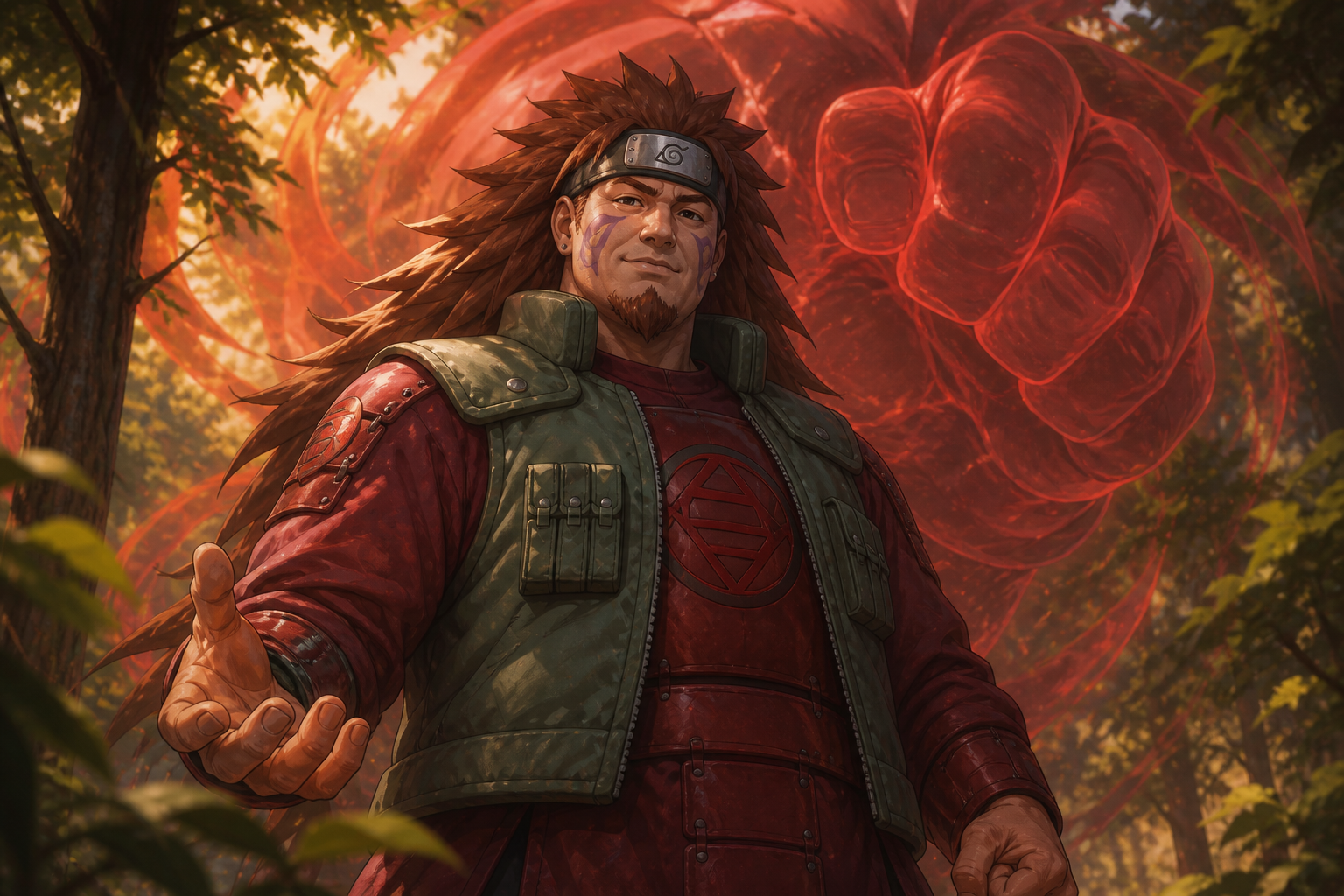
Chōza’s red-brown hair, cheek markings, head cloth, heavy armor and large frame make him immediately legible as an Akimichi elder. His armor displays the clan’s food character rather than treating appetite as an embarrassing secret. That symbol tells the truth about the fighting system. Food becomes stored possibility, clan knowledge and physical survival.
An early concept appears in the first manga chapter with different armor markings and headwear. The finished design is clearer because Chōza no longer looks like a generic large warrior. He looks like the head of a family whose culture has learned to defend a body everyone else underestimates.
Appearance chronology: the food crest, inherited earrings and battlefield scale
Part I Chōza is tall, broad and deliberately impossible to mistake for a background jōnin. Brown hair sits beneath what the anime often colors as a long red, spiked outer section. Purple cheek markings identify the Akimichi family line. A hachimaki circles his head instead of a standard metal forehead protector, and his armor carries the kanji for food. The design refuses shame. The symbol people might use to mock his appetite is placed on his chest as clan authority.
He once wore the silver hoop earrings associated with the Ino-Shika-Chō succession. Chōji receives them during the next generation’s passage into service, then returns them after becoming a chūnin and swearing the clan oath. Chōza is not normally shown putting them back on. The jewelry matters because it turns family memory into a visible contract. Children do not merely inherit techniques. They inherit alliances, duties and adults who expect them to continue a political relationship older than their own friendships.
Expansion changes more than his measurements. When the Multi-Size Technique is active, extra facial markings appear below his eyes and disappear when he returns to normal. His staff can lengthen with his enlarged body, which keeps the weapon useful instead of turning it into a toothpick in a giant hand. The early chapter-one concept used three tomoe on his armor and rope around his head. The final version replaces that generic shorthand with Akimichi-specific signs. Good character design is not random decoration. It tells us who owns the body, who trained it and what history walks into battle with it.
The Akimichi clan turns food into public defense
Akimichi hidden techniques convert calories into chakra and use that energy to alter body size. Expansion increases reach, mass and striking force. It also creates tactical demands. A larger target is easier to see, harder to move around allies, and expensive to maintain. The clan’s apparent simplicity hides serious control over energy, timing and space.
Chōza leads the clan as its Fifteenth Head. Leadership means guarding techniques, training successors and representing the family inside Konoha’s political order. The village benefits from Akimichi bodies in invasions and wars, then casually permits those bodies to remain punch lines in ordinary life. That contradiction is not cute. Konoha celebrates Chōza when he becomes a wall and ignores the insults that teach Chōji to hate the body capable of becoming one.
The clan’s food practices therefore deserve more than a gag. Meals maintain the energy reserve the techniques consume. Communal eating also reinforces family and team relationships. Food can be pleasure, medicine, preparation and cultural memory at once. Reducing every scene to greed is lazy reading wearing a napkin.
Training history and the anime-only Team Chōza assignment
Chōza becomes a genin alongside Shikaku Nara and Inoichi Yamanaka. Their pairing establishes the adult generation of Ino-Shika-Chō before the story asks their children to repeat it. The manga gives us the result more than the childhood process, so a responsible profile does not invent a cozy Academy scrapbook. What matters is that the trio can reunite years later and operate without explaining every movement to one another. That fluency comes from old work, not from matching surnames.
The anime adds a Third Shinobi World War assignment in which Chōza leads a genin team containing Ebisu, Genma Shiranui and Might Guy. Their mission carries a peace-treaty request toward Iwagakure and uses a border location near the Land of Wind as strategic insurance against hostility. This is anime continuity, not a manga event quietly smuggled into the main timeline. It still reveals how the adaptation understands him: not just as a large fighter, but as an adult trusted with young shinobi, diplomacy and the possibility that a meeting could become a battle.
That assignment also complicates the joke version of Chōza. A man responsible for Guy, Genma and Ebisu during wartime needs patience, field judgment and enough authority to keep three very different students moving toward the same objective. The anime does not turn him into their permanent emotional center. It gives him a specific command job. That boundary keeps the credit honest while letting the added material mean something.
Body politics: size is the power system, not the character flaw
Naruto’s comedy repeatedly treats fatness as permission to insult Chōji. Chōza offers the counterargument long before his son can make it for himself. He tells Chōji that a kinder heart will be recognized and that true friendship is possible. The reassurance matters because it refuses the lie that social rejection proves something wrong with the child.
Chōza does not tell Chōji to become thinner, meaner or less sensitive. He understands that the Akimichi body is both ordinary family inheritance and extraordinary combat resource. The body does not need a makeover before becoming heroic. Butterfly Mode later changes silhouette and weight because calories are being consumed, but transformation is a temporary energy event, not the reveal of a “better” person hiding underneath.
The creative problem belongs partly to the franchise. Naruto wants the Akimichi to embody appetite, abundance and strength, but it often borrows cheap fat jokes between serious scenes. Chōza’s steadiness gives the story a better standard than some of its comedy reaches. A fan site can enjoy the humor without pretending every joke aged well.
The original Ino-Shika-Chō makes protection an equal form of intelligence
Chōza serves with Shikaku Nara and Inoichi Yamanaka in the previous Ino-Shika-Chō generation. The formation works because no member performs the others’ role. Shikaku restrains and plans. Inoichi enters or connects minds. Chōza controls physical space, absorbs danger and supplies decisive force.
Calling Chōza “the muscle” becomes insulting when muscle is treated as the absence of thought. He must know where to expand, when allies need cover, how much force the formation can survive and which angle creates room for another technique. Physical protection is tactical judgment performed with a body instead of a diagram.
The trio also creates a family network. Their children inherit compatible arts, shared history and expectations before becoming Team 10. Tradition gives them a head start. Asuma Sarutobi turns that inheritance into chosen trust rather than leaving three clan heirs to perform an old arrangement mechanically.
Chōza sees Chōji’s kindness before the village sees his strength
Chōji’s childhood loneliness is not a motivational montage Chōza can fix with one speech. Other children call the Akimichi useless and treat his size as evidence that friendship should be conditional. Chōza answers with faith grounded in character. He tells his son someone will recognize his kindness and asks him to protect that friendship when it comes.
Shikamaru becomes the person who proves the promise true, but Chōza’s role should not be downgraded. A rejected child needs more than a future friend. He needs an adult who refuses the rejection’s explanation. Chōza gives Chōji a version of himself worth defending before the boy has enough social evidence to believe it.
He also takes Chōji to the memorial shared by the three clans and explains the inherited formation. This is affection and institutional onboarding in the same moment. Chōji learns that he belongs to a history and is expected to become its Sixteenth Head. The expectation can stabilize identity. It can also become pressure when a teenager is asked to represent generations during war.
Complete ability shelf: giant strength has mechanics and a bill
Multi-Size and Super Multi-Size Techniques
Chōza can enlarge his full body to crush enemies, block attacks and dominate terrain. His experience lets him sustain enormous forms longer than younger users. Size increases reach and physical impact, but the technique consumes chakra and makes battlefield placement critical.
Partial Multi-Size Technique
Expanding an arm or another body part concentrates reach without committing the entire body to giant scale. Chōza uses this control against the Asura Path. Partial expansion demonstrates refinement that the comedy-heavy “big punch” summary misses.
Human Bullet Tank and Double Human Bullet Tank
The user curls into a rotating mass that converts body size into momentum. Chōza and Chōji perform a coordinated double version during Pain’s assault. Rotation adds force but needs space, alignment and a plan for what happens when the target redirects them.
Bō staff and physical durability
Chōza wields a staff that can scale with his enlarged body. He uses strength and reach to restrain massive threats, including Kinkaku and the Demonic Statue. Durability lets him shield comrades from attacks, but durability is not invulnerability. Pain leaves him critically injured, and survival depends on Katsuyu and medical care.
Calorie Control boundary
The clan can convert stored calories into chakra, with advanced states producing extraordinary power. Chōza’s profile should not automatically assign every named pill effect or Butterfly technique Chōji demonstrates directly. Clan mastery supports broad knowledge. A clean record separates inherited system from individually shown move.
Part I record: exams, invasion and the hospital door
Chōza’s anime introduction during the Chūnin Exams festival is domestic and funny. He sits with Shikaku and Inoichi, studies the menu and decides that choosing one item is a fake problem. When Shikamaru arrives, Chōza invites him to eat. The scene is small, but it shows the adult trio off duty and makes food an act of welcome. His appetite is not only consumption. It creates a table with room for somebody else’s child.
The Konoha Crush changes the scale immediately. Chōza uses Multi-Size to trample invading Sound shinobi, then regroups with Shikaku and Inoichi as the original formation. Parents who were teasing one another over dinner become part of the village’s emergency response. Naruto loves bloodline talent when it produces a spectacular child, but this scene reminds us that a hidden village also survives because middle-aged specialists still know how to do the job together.
The Sasuke Recovery Mission wounds Chōza without placing him on the battlefield. Chōji uses the Three Colored Pills and nearly dies. Chōza reaches the hospital but cannot see him while treatment is underway. His relief focuses on Tsunade’s return because her medical skill gives Chōji a chance that the village otherwise might not have had. That is a father’s gratitude, but it is also an institutional fact. Heroic children survive when medical knowledge, staffing and leadership exist after the cool fight ends.
The pills expose the ugliest edge of clan inheritance. Akimichi knowledge gives Chōji extraordinary power, yet the emergency route consumes his body so violently that victory almost becomes a funeral. Chōza knows the tradition, the danger and the expectation that his son will one day lead. Love does not erase his participation in that system. It makes his fear at the hospital more painful because he understands exactly what the family taught Chōji to spend.
Konoha Crush: the parents defend the village while children remain inside the target
Chōza’s manga introduction comes during the Konoha Crush era, with the anime placing his debut in episode 59. As Sound and Sand forces attack, he uses expansion against enemy shinobi and reunites with the original formation. The scene establishes him through action rather than a family dinner.
The invasion gives adult clan leaders a role the early series often leaves offscreen. Children take the Chūnin Exams because Konoha turns promotion into public spectacle. When the spectacle becomes an attack, their parents become emergency defense. Chōza’s giant body is suddenly infrastructure: barrier, weapon and visible reassurance.
His presence also complicates the series’ favorite fantasy that exceptional genin carry the village. Naruto and his peers matter. So do working jōnin holding streets, protecting civilians and containing forces that never become named boss fights. Chōza belongs to the battle happening outside the hero camera.
Pain’s assault nearly kills the man built to look unbreakable
Chōza and Chōji reach Kakashi Hatake during the fight against the Deva and Asura Paths. Their arrival changes the field. They damage the Asura Path, observe the Deva Path’s repulsion interval and join Kakashi’s plan. Father and son use Double Human Bullet Tank while Kakashi positions a chain to restrain the enemy.
The plan almost works. The Asura Path intervenes, Deva Path counters, and Chōza is left so badly injured that Chōji believes he has died. Katsuyu confirms he remains alive and directs Chōji toward medical help. This sequence matters because Akimichi durability is allowed to reach a limit. A large body does not make pain symbolic. Damage remains damage.
Chōza urges information about Pain’s ability to reach Tsunade. Chōji must choose between staying beside his father and carrying intelligence that could save the village. The family bond does not disappear. It becomes the reason the duty hurts. Naruto’s shinobi system keeps asking children to convert private terror into useful work.
The Fourth War turns Chōza into a moving fortress
Chōza joins the First Division and uses giant-scale combat against reanimated enemies and battlefield monsters. He helps restrain Kinkaku’s transformed power and opposes the Demonic Statue of the Outer Path with his staff. These feats confirm why Akimichi strength is a strategic asset rather than a novelty.
Scale changes responsibility. A giant ally can protect dozens of soldiers or crush the wrong terrain. Chōza’s experience matters because power must be placed. He works inside division commands, supports formations and creates openings instead of treating size like permission to improvise over everyone else.
War also reunites generations. Chōza fights beside Chōji and watches his son produce butterfly chakra without depending on the fatal progression of the Three Coloured Pills. Chōji’s growth is emotional, technical and institutional. Chōza recognizes him as worthy of becoming the Sixteenth Head. The approval lands because it follows evidence rather than arriving as automatic inheritance.
War operations: Dan, Kinkaku, the Demonic Statue and the body as cover
The First Division sends Chōza to the Land of Lightning border against the Akatsuki coalition. He enlarges himself, confronts reanimated veterans and moves between crises instead of receiving one neat duel. Dan Katō notices how much he has grown since their earlier lives crossed. Chōza distracts Dan while other shinobi prepare the Four Violet Flames Formation that can contain him. Against Kinkaku’s transformed body, Chōza physically blocks an extended tail. These are not interchangeable strong-man shots. One task requires buying time for sealing. The other requires becoming the object that stops disaster from sweeping through everybody behind him.
When reanimated Asuma attacks, Chōza throws himself in front of the explosive reach of Fire Release: Ash Pile Burning. His durability protects Chōji and nearby fighters, but the sequence does not let protection solve the emotional problem. Chōji still has to strike a beloved teacher whose body is being used against his will. Chōza’s harsh reminder about the Sixteenth Head is not gentle parenting. It is wartime triage aimed at a son who will die if grief freezes him in place.
After Chōji masters Calorie Control and Butterfly Mode without relying on the pills, Chōza recognizes him as worthy to become the next clan head. Pride here is not a medal for hitting harder. Chōji finally carries tenderness, power and decision at once. The father steps back enough to see succession happening in front of him.
The Demonic Statue of the Outer Path then makes both men look small again. Chōza and Chōji use Super Multi-Size together and attack it, but the statue defeats them. That loss matters. Akimichi scale can dominate ordinary battle space, stop a transformed limb and break formations, yet it does not make the family immune to the story’s god-tier machinery. Power has a ceiling. Bodies take the bill when spectacle climbs past it.
Reanimated Asuma forces father and son to separate gentleness from paralysis
Kabuto’s Impure World Reincarnation turns Asuma’s body into an enemy weapon. Chōji hesitates because striking a beloved teacher feels like betrayal even when the person inside the body cannot choose the attack. Chōza initially pushes him hard, reminding him of battlefield conditions and future clan leadership.
The scene can sound cruel if reduced to “stop being soft.” Chōza is not rejecting kindness. He is trying to help Chōji act while kindness is being exploited against him. The distinction is delicate, and the father does not deliver it perfectly. War rarely gives parents time to find therapy-approved wording before an immortal corpse attacks the unit.
Chōza later acknowledges the completed growth. Chōji protects friends, controls immense power and acts without surrendering the emotional core Chōza praised in childhood. The son does not become worthy by becoming less gentle. He becomes worthy by learning that gentleness sometimes needs enough force to stop the person causing harm.
Relationship atlas: strength organized around people
Chōji Akimichi
Son, heir and emotional center. Chōza offers belief before achievement, then demands responsibility when war turns inherited power into public duty.
Shikaku Nara
Strategist, teammate and fellow father. Shikaku shapes openings while Chōza supplies the physical control that lets plans survive contact.
Inoichi Yamanaka
Telepathic specialist and lifelong formation partner. Their arts need Chōza’s protection whenever minds leave bodies vulnerable.
Shikamaru and Ino
Children of his closest partners and members of Chōji’s team. He treats their safety as part of the same inter-clan responsibility.
Asuma Sarutobi
Teacher entrusted with the next generation. Asuma’s death and reanimation test whether the inherited formation has become a real family.
Chōchō Akimichi
Granddaughter and New Era heir. Her confidence gives Akimichi body discourse a louder answer than Chōji received as a child.
New Era family life: the grandfather asks for his own holiday
Naruto Shinden: Parent and Child Day gives Chōza one of his most human late-life appearances. After missing time with Chōchō during the official holiday, he joins a crowd outside the Seventh Hokage’s office and asks for a Grandparent and Grandchild Day. Hiashi Hyūga wants the same thing, and Naruto ultimately approves it. Nobody is saving the world. Two powerful clan elders are lobbying municipal government because grandfathers want time with their grandchildren. Honestly, this is what peace is supposed to purchase.
Chōchō’s existence also changes the Akimichi inheritance question. The line continues through a girl who uses the clan’s techniques, argues loudly about her own desires and refuses to behave like gratitude should silence every opinion. Chōza’s gentleness toward Chōji becomes part of the environment she inherits, even though her own body politics and family conflicts are not copies of her father’s childhood.
The novel appearance belongs to the broader New Era shelf and should not be inflated into a secret final arc for Chōza. It confirms survival, family continuity and an appetite for connection outside battlefield command. His ending is not another sacrifice. He gets to become somebody’s impatient grandfather. Naruto has killed enough fathers. Let this one complain to the Hokage about scheduling.
Original Japanese performance: Nobuaki Fukuda
Nobuaki Fukuda is Chōza’s original Japanese performer. CVM Sekai credits the originating performance and does not pad this section with an English-dub sidebar. Chōza’s material spans paternal reassurance, veteran command, battlefield exertion and fear for his son.
This production pass verifies the credit and contexts without pretending a text ledger equals an audio review. I will not invent line-timing or vocal-texture claims without hearing the relevant Japanese scenes lawfully. Honest boundaries are better criticism than confident fan fiction about somebody’s breath control.
Food, reciprocity and the politics of the protective body
A Confucian lens highlights Chōza’s place in intergenerational duty. He receives clan techniques, preserves relationships with the Nara and Yamanaka families, teaches Chōji and recognizes when the heir has earned leadership. Authority becomes ethical when elders prepare successors rather than merely demanding obedience.
A Buddhist lens catches impermanence in the clan’s signature transformation. Giant size and butterfly chakra are temporary states created from stored energy. Power appears, protects and passes. Chōza cannot preserve Chōji as the child he comforted. He must let the son become a leader with a different relationship to the same body.
A cultural food lens sees abundance as connection. Shared meals can mark family, hospitality, celebration and grief. Naruto uses yakiniku as a Team 10 ritual after missions and losses. The table is not decorative. It is where people return after becoming weapons for the village.
A masculinity lens rejects the idea that a large strong man must parent through humiliation. Chōza’s best scene is tender. His weakest moments come when wartime urgency makes him sound as if tenderness is the problem. Chōji’s growth proves the opposite: emotional openness survives and becomes part of reliable strength.
Manga, anime and continuity boundaries
The core manga record covers his introduction, the Konoha Crush response, Chōji’s hospital recovery, the coordinated fight against Pain and the Fourth War. The television anime expands his domestic Chūnin Exams scene, gives him the Third War Team Chōza assignment, adds training and battlefield connective tissue, and occasionally turns appetite into a broader comedy beat. Those additions are labeled here instead of being folded into the manga as if publication order did not matter.
Naruto Shippūden the Movie: The Lost Tower places Chōza on Minato Namikaze’s Rōran mission with Shibi Aburame, with young Kakashi added to the team. That movie role belongs to its film continuity. Road to Ninja: Naruto the Movie also uses him in its alternate-world feature context. The OVA Hidden Leaf Village Grand Sports Festival! includes him on the animation shelf. These appearances confirm franchise use, not extra chapters of the main manga biography.
Chōza is playable in Naruto Shippūden: Ultimate Ninja Blazing, Naruto: Shinobi Collection, Naruto: Shinobi Collection Shippū Ranbu and Naruto: Ultimate Ninja Online. Games translate a supporting character into move sets, stats and collectible systems designed for play. They can show which silhouette and techniques the franchise considers recognizable. They cannot automatically establish new canon feats for his manga body.
The New Era novel Naruto Shinden: Parent and Child Day supplies the grandparent-holiday request. It is useful because it records life after war without pretending every elder needs a final boss. The media shelf therefore has four different jobs: manga establishes the primary spine, anime adds and stages material, films and OVAs create adjacent scenarios, and games convert identity into mechanics. Mixing those jobs produces a longer article, but not a more accurate one.
Eight fandom shortcuts that make Chōza smaller than he is
- “He is only Chōji’s father.” He is also a clan head, jōnin, formation veteran and front-line war asset.
- “Akimichi techniques are simply being fat.” They require Calorie Control, chakra conversion, timing, spatial judgment and clan training.
- “Big means slow and stupid.” Chōza coordinates complex formations and places massive force around allies.
- “He never does anything.” Konoha Crush, Pain and the war all give him consequential battlefield work.
- “Pain killed him.” He is critically injured, but Katsuyu confirms survival and medical care follows.
- “He bullies Chōji into maturity.” He pressures him during war, yet the relationship begins with unusual tenderness and continued faith.
- “Chōji becomes worthy by getting thinner.” He becomes worthy through control, courage, loyalty and leadership. Weight change is a technique cost.
- “The original trio is nostalgia.” Their formation protects Konoha and provides the working model their children inherit.
The final verdict: a giant man makes room for his son
Chōza Akimichi matters because Naruto rarely lets physical power and emotional gentleness remain friends for long. He does. He comforts Chōji without asking for a new body, defends Konoha with the body his clan cultivated, and recognizes when the next generation can carry the name without becoming a copy.
His record is not spotless. Clan expectation is heavy. Wartime pressure makes him speak sharply when Chōji is already grieving. The institution keeps converting family inheritance into battlefield capacity. None of that cancels his care. It explains why care has to work so hard.
Chōza’s best legacy is not being the Fifteenth Head. It is helping the Sixteenth believe that kindness and strength were never opposites. The giant body protects the village. The father protects the person inside it.
Sources and canon boundary
Manga chronology controls this profile. Anime staging, databook material, novels, films, games, and later appearances are labeled instead of being blended into one false continuity.
Primary franchise references: Naruto Official and VIZ Media Naruto. CVM Sekai’s conclusions about Akimichi body techniques, Chōji, Ino-Shika-Chō, leadership, fatherhood, war service, and legacy are editorial analysis, not invented creator quotations.