
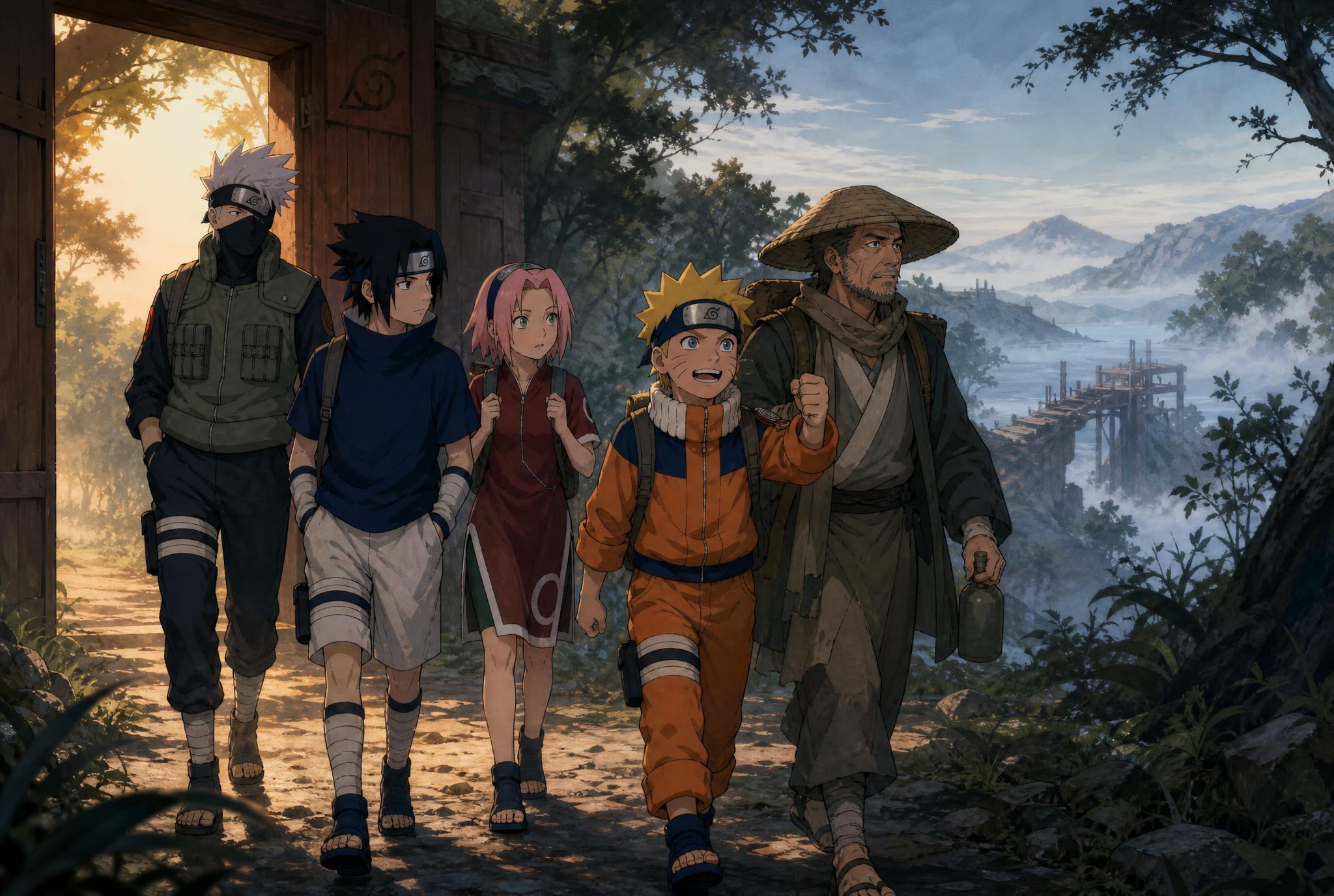
Mission classifications: the paperwork that decides who is expected to risk what
D through S ranks classify an assignment’s anticipated danger, complexity, political sensitivity, and required personnel. They are estimates built from information,not shields against the part the client did not disclose.
A mission rank is a forecast
The village evaluates what the client says they need, what intelligence suggests may happen, what political interests are involved, and what capabilities the assigned team should possess. The letter describes the mission, not the shinobi’s personal rank and not how emotionally important the episode feels.
This is why “C-rank ninja” is the wrong phrase. Kakashi is a jōnin. The escort of Tazuna is filed as a C-rank mission. When missing-nin attack, the team’s people do not change formal rank. The assignment was misclassified because the threat model was false.
A mission rank packages uncertainty into a letter the village can price, staff, and authorize. That is necessary administrative work. It is also a dangerous illusion of control. The desk predicts opposition from incomplete intelligence, and the field team discovers whether the prediction had any business wearing confidence.
Good classification should protect everyone involved. It gives the client realistic cost, gives leaders enough skill and support, gives subordinates a danger level they were trained to face, and tells the village when reinforcement or political permission is required. Bad classification moves uncertainty downward until the youngest body meets it first.
The D-to-S mission scale
| D-rank | Low-danger work generally assigned to genin: chores, deliveries, simple assistance, finding animals, farm labor, babysitting, or other local tasks not expected to involve combat with shinobi. |
|---|---|
| C-rank | Travel, protection, investigation, or possible ordinary violence without an anticipated clash against trained enemy shinobi. Team 7’s declared escort belongs here; its real opposition does not. |
| B-rank | Serious operations expected to involve combat with shinobi or comparable danger, requiring experienced personnel, stronger intelligence, coordination, and contingency planning. |
| A-rank | Highly dangerous military, political, protective, or intelligence work involving elite opposition and consequences beyond the immediate team. |
| S-rank | Exceptional danger and secrecy: national threats, critical intelligence, powerful targets, or missions whose failure could alter village security and international balance. |
The boundaries are administrative categories rather than laws of nature. A calm delivery can conceal an ambush. An A-rank assignment can change as allies arrive or intelligence improves. Emergency orders may be issued before anyone can calculate an elegant letter.
D-rank work is often mocked because Naruto mocks it. Catching Tora, weeding, carrying, cleaning, and helping civilians do not satisfy a twelve-year-old who wants visible greatness. They do teach punctuality, coordination, patience, client interaction, and whether a new team can complete boring work without turning on itself. That is not filler to the village resident whose roof leaks.
C-rank is the hinge where travel and real-world uncertainty enter without planned shinobi combat. A team can face bandits, terrain, illness, weather, or local crime. The category assumes no trained enemy ninja. The Demon Brothers do not merely make Tazuna’s escort “harder than expected.” Their presence destroys the condition that made C-rank appropriate.
B, A, and S categories require more than bigger explosions. Secrecy, intelligence value, political consequence, target identity, and failure cost matter. An assassination, infiltration, recovery, escort, or surveillance mission can rank highly even if the ideal execution avoids a public battle. The cleanest elite operation may look uneventful because preparation prevented the disaster viewers were waiting to rank.
How a village should assign a team
Client statement
What is being protected, delivered, investigated, captured, repaired, or destroyed? Who benefits, who may resist, and what is the client not saying?
Intelligence
Known opponents, terrain, borders, politics, prior incidents, missing-nin activity, local capacity, and the reliability of the request.
Personnel
Formal rank, specialist skills, cohesion, experience, medical support, sensory capacity, and whether a leader can cover foreseeable danger.
Cost and payment
Mission fees fund village operations and shape access. The market becomes dangerous when a poor population cannot afford an honest threat rating.
Rules of engagement
Escort versus capture, lethal force, secrecy, jurisdiction, civilian protection, recovery objectives, and conditions requiring withdrawal.
Contingency
Communication, reinforcement, resupply, evacuation, intelligence updates, and authority to continue once the original forecast fails.
Team composition should answer the work, not reward whoever is available in the hallway. Tracking needs sensory skill. Diplomacy needs cultural and political judgment. Long travel needs logistics. A medical-nin can change the risk a unit survives. Clan techniques can provide an advantage while also exposing secrets the village does not want captured.
Leadership also needs permission to update the plan. A rigid order written before the field changed can become negligence. Kakashi stops after the Demon Brothers and names the problem. He does not silently pretend the mission is still C-rank because the scroll says so. The team and client discuss whether to continue with the new truth visible.
That conversation is better than blind obedience, but it is not pure free consent. Three genin want approval from their jōnin, Naruto is terrified of looking weak, and Tazuna’s community may collapse if they leave. Hierarchy, pride, poverty, and need are sitting at the table with them. Consent can be real while still being pressured.
Land of Waves: the C-rank that was not
What Tazuna declares
Team 7 is asked to escort a bridge builder home. The official Episode 6 page follows Naruto’s frustration with menial work into what appears to be a substantial but appropriate first journey. A jōnin leads three genin; no enemy shinobi are expected.
What Tazuna conceals
Gatō controls the Land of Waves’ shipping and has a financial interest in stopping the bridge. Tazuna is not an old traveler who might encounter random bandits. He is an infrastructure builder targeted by a monopolist willing to hire missing-nin.
Tazuna lies because he cannot pay the rate attached to the real danger. That choice puts children at risk, and he deserves accountability. Gatō’s occupation is still the larger cause. The monopoly impoverishes the country, poverty blocks access to protection, and blocked protection forces a desperate man to falsify the form. Capital has already entered the fight before the first kunai appears.
What exposes the misclassification
The Demon Brothers attack first. Their presence proves trained shinobi opposition and invalidates the C-rank assumption. Zabuza Momochi, an elite missing-nin of the Hidden Mist, makes the gap catastrophic.
The ambush also exposes Team 7. Naruto freezes and is wounded. Sasuke reacts. Sakura protects Tazuna. Kakashi observes before intervening. One bad file becomes an involuntary field examination with poison attached. The children learn about themselves, but growth does not make the assignment ethical in hindsight.
Why Kakashi continues
Kakashi gives the team and client a choice after the deception is exposed. Continuing is no longer blind obedience to the original file; it becomes informed decision under compromised conditions. The choice is compassionate, but compassion does not erase that avoidable danger was transferred onto genin.
Kakashi also judges that returning may not remove risk cleanly after contact with hostile shinobi. Tazuna remains targeted, the enemy knows the team, and the political problem exists whether Konoha invoices it or not. The mission has escaped its category. Leadership now means choosing among harms rather than restoring a form that reality already shredded.
The complete Land of Waves arc file follows the consequences through Episodes 6 to 19.
Missions are also the village economy
Shinobi labor is sold
Hidden villages provide force, intelligence, protection, investigation, and specialized labor to clients. Mission volume and prestige affect revenue, reputation, alliances, and employment. The system professionalizes violence by placing it behind contracts and assignment desks.
The village therefore has two incentives that do not always agree. It must protect shinobi from unsuitable work, and it must attract clients. A reputation for competence brings income. A reputation for weakness sends contracts elsewhere. Children competing in the Chūnin Exams become advertising for the institution that will later sell their skills.
Low-ranked work is not meaningless
Naruto sees animal retrieval and chores as humiliating because he wants dramatic recognition. D-rank work trains reliability, public contact, teamwork, and execution without lethal stakes. It also reveals that a military institution survives through ordinary civic labor, not endless duels.
There is a class lesson inside the comedy. Elite technique receives monuments. Care, delivery, cleaning, and repair are treated as beneath the hero until the hero needs a functioning community. Naruto’s growth includes learning that service is not only glamorous rescue.
Price can become access to safety
Tazuna cannot pay for the mission his country needs. His lie is dangerous, but it is produced by Gatō’s domination. The fee structure treats accurate protection as a purchasable service while oppression has destroyed the client’s ability to purchase it.
This is market failure with weapons. The people most exposed to organized violence may be least able to buy organized defense. Konoha’s compassionate exception helps one bridge, but it does not reform the system that priced survival beyond the community’s reach.
Villages compete for contracts
A village that appears capable attracts work. The Wind Daimyō’s decision to send missions toward Konoha contributes to pressure inside Sunagakure before the invasion. Economic competition does not excuse the Sand’s alliance with Orochimaru. It explains why military leadership can turn a budget crisis into somebody else’s funeral.
The ethical questions hiding inside the form
Who bears bad intelligence?
The client may lie, officials may miss evidence, and leaders may accept pressure, but the assigned team’s bodies absorb the mistake first.
Can consent survive hierarchy?
Genin may receive a choice from a caring leader, yet they are children inside a command structure whose approval and identity they depend upon.
Does duty end at the contract?
Turning back may be administratively justified while leaving civilians to domination. Continuing may be morally compelling while exposing subordinates to unpriced risk.
What does success measure?
Delivering the client, defeating an enemy, protecting civilians, preserving the team, gathering intelligence, and preventing future harm may demand different choices.
Naruto’s world needs mission categories because coordinated institutions cannot operate on vibes. But its best stories begin when the letter stops being an answer and becomes a question: now that the forecast failed, what do these people owe one another?
Confucian duty helps frame the answer if we remember reciprocity. A subordinate owes disciplined service; a leader owes competent care. Kakashi cannot demand obedience while hiding changed danger. Tazuna cannot demand sacrifice while hiding the threat. Konoha cannot celebrate loyalty while treating genin as replaceable inputs. Duty without downward responsibility is hierarchy doing cosplay as virtue.
The Buddhist lens is equally practical. Attachment to reputation can keep a shinobi fighting after withdrawal is wiser. Attachment to rules can make an official protect classification instead of people. Compassion without wisdom can spend a whole team. The ethical leader sees the form, the suffering in front of them, and the consequences that will outlive one heroic choice.
The Land of Waves mission succeeds in ways the original contract could not describe. Tazuna survives. The bridge is completed. Gatō’s domination ends. Team 7 changes. Haku and Zabuza die. A clean “mission accomplished” stamp would be accurate and obscene. Consequence is the part of the report the letter grade cannot hold.
A mission rank is only as honest as the information behind it
The Land of Waves assignment is the franchise’s first serious demonstration of classification failure. Team 7 accepts what appears to be routine protection work. Tazuna hides Gatō’s control, the armed threat, and the likelihood of shinobi attack because his country cannot afford the proper fee. The mission does not become dangerous after departure. It was dangerous before Konoha priced it. The paperwork simply did not know, or was not allowed to know, the truth.
That distinction protects us from blaming the letter beside the mission. A C-rank label cannot stop the Demon Brothers if the client concealed the enemy. Classification is an administrative estimate built from intelligence, disclosure, and institutional judgment. Bad inputs create bad assignments, and children carry the consequence in their bodies.
D-rank work teaches the labor system
Finding pets, helping farms, cleaning, babysitting, and other low-risk jobs can look like comedy beside later battles. They establish something important: hidden villages sell organized service. Genin learn punctuality, client relations, patience, coordination, and the humiliating truth that not every paid task will respect their fantasy of heroism.
Naruto hates the work because he wants recognition through danger. Hiruzen’s lecture reminds him that the village depends on ordinary contracts too. Both positions reveal the system. Young shinobi need controlled practice, while villages need labor and revenue. The cute missing-cat assignment is still part of a military economy.
C-rank and B-rank are where uncertainty gets teeth
C-rank missions may anticipate criminals or armed opposition without expecting hostile shinobi. B-rank work raises the danger, often involving combat with trained ninja. The difference matters operationally, but reality refuses to stay inside tidy boxes. Intelligence can be incomplete. Political conditions can change. An enemy can hire unexpected support. A team may discover that the client’s public story hides a second conflict.
Leadership therefore matters more than memorizing labels. A commander must reassess, report, retreat, request support, or continue only after weighing lives against objectives. Kakashi’s decision to proceed in Land of Waves is emotionally understandable and strategically debatable. Team 7 wants to continue. Tazuna’s country needs help. None of that restores the informed consent lost when the mission was misclassified.
A-rank and S-rank describe stakes the public may never see
Higher-ranked missions can involve elite shinobi, national security, assassination, war-level intelligence, or threats whose political consequences exceed the battlefield. S-rank does not merely mean “the explosion is larger.” It signals exceptional danger, secrecy, scarcity of capable personnel, or consequences that can destabilize villages and countries.
These assignments expose the moral danger of classification itself. The more secret the mission, the fewer people can challenge the premise. ANBU and Root show how easily necessity becomes a shield for abuse. A government can stamp a task urgent, classified, and essential while leaving the operative to carry acts the public is never allowed to judge.
Who pays when the rank is wrong?
Clients can be poor, frightened, dishonest, manipulated, or unable to understand the threat. Villages control expertise and pricing. Team leaders interpret risk. Genin may technically agree to continue while standing inside a hierarchy that trained them to obey and admire sacrifice. Responsibility cannot be dumped onto the least powerful person in that chain.
A fair reading holds multiple truths at once. Tazuna lies and endangers children. Gatō creates the desperation behind that lie. Konoha’s system makes protection unaffordable to a captured country. Kakashi chooses compassion and accepts risk on behalf of students. Team 7 chooses the mission, but their courage does not erase the adults’ duty of care.
Success is not the same thing as a good assignment
A completed objective may still involve preventable harm, corrupt intelligence, exploited operatives, or a client abandoned after the narrow contract ends. Naruto repeatedly celebrates shinobi who go beyond the stated mission to protect people. That moral instinct gives the story heart. It should not become an excuse for institutions to plan badly and rely on exceptional children to repair the damage.
RaeRae’s bottom line is simple: mission ranks help organize work, personnel, and expected danger. They do not absolve anybody. Read the classification, then audit the information, the money, the authority, and the bodies absorbing the risk. That is where the real mission file begins.
The client is part of the danger assessment
Mission files naturally focus on enemies, terrain, and objectives, but the client relationship can create just as much risk. A frightened client may minimize facts. A wealthy client may try to purchase force for an abusive purpose. A political official may define dissent as criminality. A village that accepts payment without examining the objective can become hired muscle with a headband.
The series does not explore that problem as consistently as it should, yet the structure keeps placing it in view. Shinobi are trained to complete contracts, while the most admired characters repeatedly ask whether the contract itself deserves completion. Protecting Tazuna becomes morally meaningful because Team 7 understands the people behind the paperwork. That same instinct can become dangerous if compassion is used without information or accountability.
Returning alive is part of mission success
The franchise loves sacrifice, and sometimes the story gets too comfortable treating death as proof of commitment. A competent mission system should resist that romance. Withdrawal, reinforcement, medical evacuation, and revised objectives are not cowardice when the original plan no longer matches reality. Leaders owe their teams more than an inspiring memorial.
That is the difference between courage and disposability. Courage accepts necessary risk with clear purpose. Disposability assumes another body can be spent because the institution already wrote the assignment. Naruto’s best leaders learn to tell those apart, then make decisions that let their people live with the answer afterward, not merely die for it unnecessarily.
Source shelf and continuity boundary
Team 7’s early work and Tazuna escort use the official Episode 6 page. The official Naruto 20th Anniversary retrospective confirms that the escort becomes a life-or-death encounter with enemy shinobi. The official Volume 4 synopsis confirms the bridge, Gatō, and hired-thug conflict. Analysis and system explanation are original to CVM Sekai.
Exact fee tables and rank examples can vary across guidebooks, translations, and adaptation material. This guide keeps the durable D-to-S logic and labels interpretation. It does not promote anime-only errands into universal law or treat a wiki example list as village policy carved into the Hokage Monument.
Mission rank classifies the work. Shinobi rank classifies the worker.
Keep the two systems separate, then read how they collide when newly graduated genin enter a threat far beyond the original assignment.
Open Shinobi Ranks Explained → · Read Episode 6 → · Return to Naruto 101 →