
XXL Black-and-White Choreography: YOUNG POSSE Removed the Color and Kept the Scale
The city-sized VFX are gone. The color is gone. YOUNG POSSE still walk into the frame like five rookies who ordered ambition three sizes too large and intend to grow into every inch.
Bottom line:
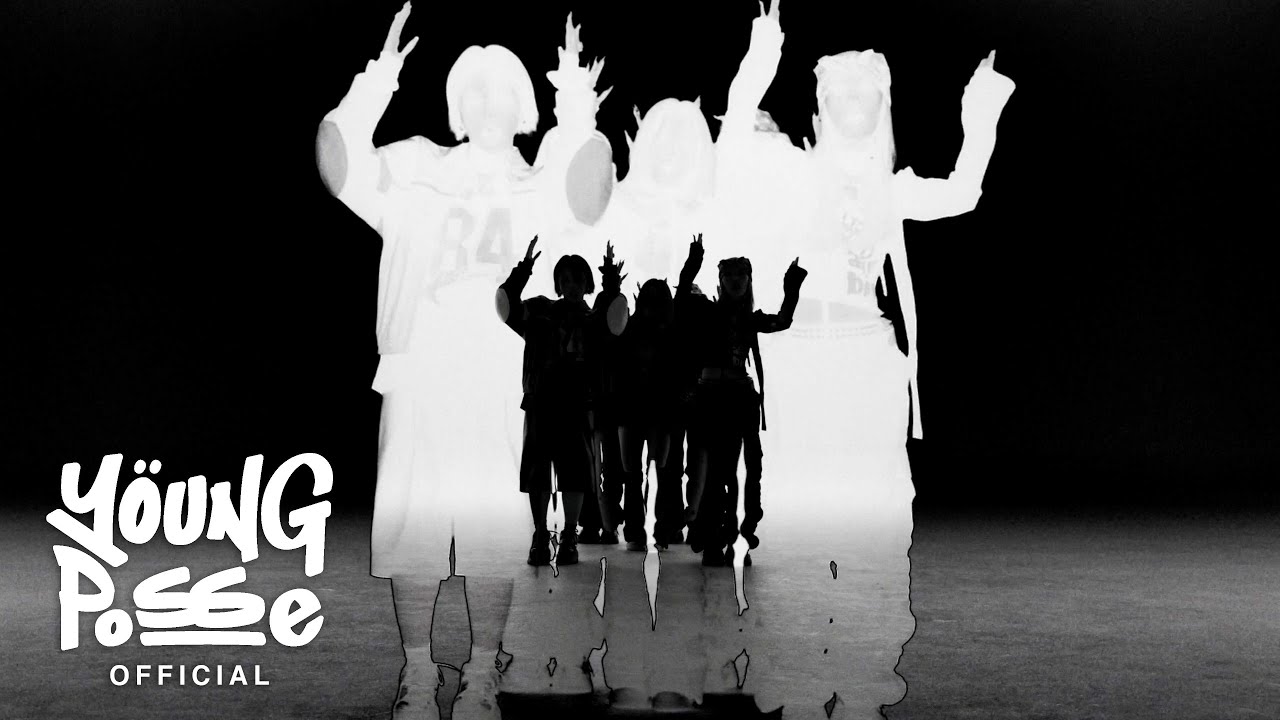
The black-and-white choreography video is the best proof that “XXL” has a performance idea underneath the giant-girl music video. Kiggen and Rick Bridges give the members a bending bass line, scratches and dry drums; the dancers answer with heavy knees, elastic shoulders and formation changes that keep enlarging and compressing the group.
Monochrome helps because nothing can win by color alone. The lighting carves five bodies out of a dark room, the camera moves close enough to catch personality and wide enough to preserve most group geometry. I wanted fewer cuts during the densest transitions, but this file understands scale as movement rather than a special effect.
What the whole thing means
The meaning of XXL survives without the city-sized joke: ambition keeps outgrowing the shape assigned to it. Every cluster that opens, every center that advances and every silhouette that refuses to shrink turns “extra large” into a physical decision instead of a slogan.
Release file
Released: March 22, 2024. This React is dated March 24 under the site’s one-to-three-day rule. Runtime: approximately 2:40. Exact upload: YouTube ID J_49eybaPJI.
Label / channel trail: DSP Media and Beats Entertainment through YOUNG POSSE’s official channel. File: “XXL” Choreography Video, Black-and-White version.
Performing lineup: Sunhye, Yeonjung, Jiana, Doeun and Jieun. Choreography credits: WeDemBoyz, MIN JUNG and YOUNG POSSE.
Song credits: Lyrics, composition and arrangement by Kiggen and Rick Bridges. Kiggen is credited for keyboards, piano, drums and scratching; Rick Bridges for keyboards and drums. Member songwriting elsewhere on the XXL EP does not become a title-track credit.
Sound: Old-school hip-hop with undulating low end, scratches, dry drums and an official musical and choreographic homage to Seo Taiji and Boys’ “Come Back Home.”
Sources: The exact official choreography file, Bugs personnel record and the group’s own explanation of the homage are linked below.
The bass bends and the bodies answer
The opening low end does not march in a straight line. The bass swells, crouches and changes pressure, so the choreography lives below the waist first. Knees remain soft. Hips shift after the main count. Shoulders finish phrases instead of beginning every one.
That sequence keeps “old-school” from becoming a costume label. YOUNG POSSE are listening to the pocket. When the scratch cuts across the beat, arms sharpen. When the bass stretches, torsos loosen. The arrangement is visible before any lyric gesture arrives.
Black and white is doing actual work
Monochrome can be the cheapest shortcut to “serious,” especially when a performance has no idea beyond mood. Here, the absence of color makes levels and silhouettes easier to read. Baggy clothing becomes moving geometry. Five sets of limbs separate cleanly against the room.
The lighting also gives the group scale without CGI. A bright edge makes one member feel larger when she advances; darkness compresses the others into a single backing shape. The visual concept supports the choreography instead of asking a filter to provide depth.
Sunhye owns the heaviest pocket
Sunhye lets the beat arrive through her center before she throws the accent outward. That fraction of patience gives her movement authority. She does not need to make every line large because the rhythm already says she controls the room.
Her rap delivery follows the same logic. Syllables stretch, strike and leave a gap for the bass. The camera likes her because she can hold attention while barely changing her face, then release a quick grin when the lyric turns ridiculous.
Yeonjung turns bounce into connective tissue
Yeonjung keeps movement alive between the obvious highlights. Watch her after another member takes center. She continues marking the swing through shoulders and knees, so the background never becomes five-second storage.
Her lighter rhythmic attack contrasts Sunhye’s weight. That difference matters in a song built around successive voices. A posse should feel connected without sounding or moving like copies.
Jiana gives the frame a clean vertical line
Jiana extends shapes farther and finishes them more cleanly. In monochrome, those lines become especially valuable. She can open a crowded cluster by lifting the eye upward, then return to the grounded group groove without looking detached from it.
Her brighter vocal color serves the same purpose. After dense rap phrasing and low production, Jiana lets air into the record. The choreography lets us see that tonal function instead of treating her section as a simple turn at center.
Doeun lands the jokes like statements
Doeun does not apologize for lyrics about giant shirts, impossible size and a rookie growth spurt. She plants the gesture, finishes the count and moves on. Comedy survives because she refuses to hover over the punch line asking whether we understood.
Her grounded attack also stabilizes transitions. When the group travels, Doeun’s weight makes the new formation feel deliberate instead of hurried.
Jieun turns youth into velocity
Jieun moves with quick recovery and bright facial timing. She can hit a compact accent, travel several steps and arrive at the next picture without showing the commute. That speed keeps the “growth spurt” joke connected to actual youthful energy.
The camera occasionally catches her waiting at the edge of a formation, and even there she remains inside the song. Her shoulders keep the groove alive. That is performance discipline, not filler.
The formation keeps changing size
The routine uses a smart visual grammar: tight cluster, sudden diagonal, one member advancing, then all five expanding across the width. “XXL” becomes something the formation does. The group repeatedly outgrows its previous shape.
Smaller gestures inside the cluster keep the members legible. A head angle, bent elbow or staggered level stops the five-person shape from becoming one dark blob. The choreography understands that scale needs detail or the image merely gets wider.
The camera helps until it gets excited
The moving lens adds force when a member advances and lets facial delivery matter more than it would in a distant practice room. A shallow push can make a lyric feel physically larger without pretending we are watching the MV again.
A few cuts arrive exactly when I want to inspect the floor pattern. That is the weakness. The choreography contains enough information to hold a wide frame longer. Editing should reveal the dance, not rescue us from having to watch it.
The Come Back Home receipt stays visible
YOUNG POSSE and DSP explicitly described “XXL” as an homage to Seo Taiji and Boys’ 1995 “Come Back Home.” The bass shape and selected movement references make that Korean route clear. This choreography file places the homage closer to the surface than the giant-city MV.
The receipt continues backward. “Come Back Home” drew from American hip-hop sounds connected to Black and Latino West Coast traditions, including the Cypress Hill comparison that has followed the song for decades. Korean pop history did not invent this movement vocabulary inside a sealed studio.
Credit is part of learning the dance
WeDemBoyz, MIN JUNG and YOUNG POSSE appear in the choreography credit trail. Naming them is better than treating choreography as a mist that settles over idols. The group’s participation also explains why several gestures feel closely attached to their personalities.
The broader hip-hop source culture still deserves names and context. These were young performers working inside an adult creative system. Their skill should be celebrated; management and creative leadership should teach the history attached to the style they sell.
What I would change
I would hold the widest formation through one complete phrase near the end. The repeated camera pushes make individual charisma easy to read, but the title promises scale. Give the five-member picture time to become enormous without optical help.
I would also simplify one busy center exchange. Extra footwork arrives after the musical point has landed. A slower walk with stronger pocket would say “XXL” more convincingly than another quick route to a mark.
What changed every time I replayed it
First replay, the monochrome silhouettes owned my attention. Second replay, Sunhye’s delayed weight made the bass visible. Third replay, Yeonjung’s background groove showed how much continuity happens outside center.
Fourth replay, Jiana’s long lines, Doeun’s grounded punctuation and Jieun’s fast recoveries separated the member functions. Fifth replay, the formation’s repeated expansion finally became the main idea. The video does not need a giant city. Five performers keep making the room too small.
RaeRae verdict
The official file is black and white because the choreography—not a replacement stock photo—is the subject. Here monochrome earns its keep: it exposes weight, spacing and formation scale. I would hold two transitions wider, but this is the cleanest proof that “XXL” has bones underneath the VFX.
The exact-file rule
This React covers YouTube ID J_49eybaPJI, the official black-and-white “XXL” choreography video released March 22, 2024. The official MV, album audio, other choreography files and later performances retain separate tracker records. Attachment 28315 belongs only to this upload and serves as hero, featured image, landing card and social image.