
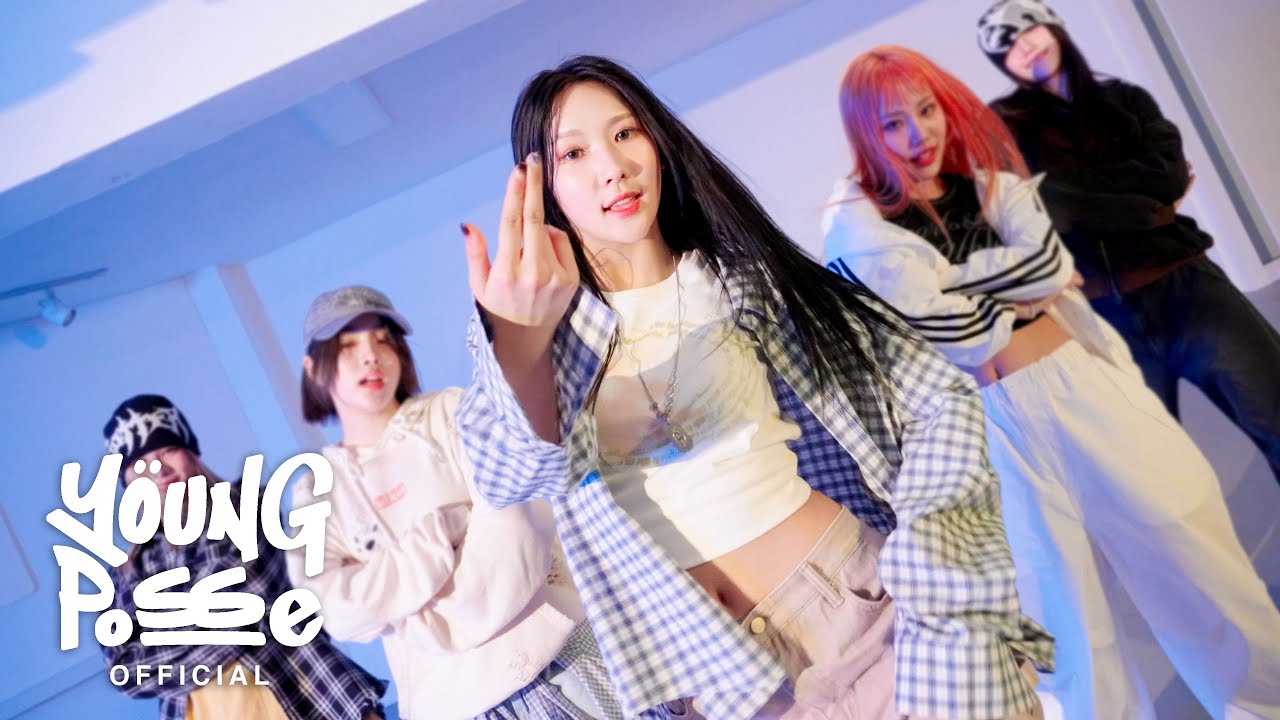
Scars Moving Cam: YOUNG POSSE Let the Hurt Keep Its Footwork
“Scars” is the moment YOUNG POSSE stop making appetite the loudest thing in the room. The camera keeps moving, but the bravado has bruises now.
Bottom line:
The “Scars” moving-camera practice works because vulnerability never becomes stillness. YELLA D’s arrangement carries a warmer, more reflective hip-hop pocket, while Sunhye, Yeonjung and Jiana put personal writing into a song about carrying marks forward. The choreography keeps the five members traveling, leaning on one another and breaking apart without turning pain into a slow-motion acting exercise.
The moving camera adds intimacy when a verse belongs to one member, then returns us to the group before the file becomes a string of close-ups. I would keep two transitions wider because the formation is telling part of the story. Still, this is one of YOUNG POSSE’s most persuasive performance files precisely because nobody asks us to confuse sadness with maturity.
What the whole thing means
The meaning sits in the gap between injury and identity. “Scars” does not ask the members to become perfectly healed inspirational posters. They carry the marks, keep the groove and decide the damage does not get sole authorship of the next step.
Release file
Released: April 17, 2024. This React is dated April 19 under the site’s one-to-three-day rule. Runtime: 3:21. Exact upload: YouTube ID hnUfgPXK-lQ.
Label / channel trail: DSP Media and Beats Entertainment through YOUNG POSSE’s official channel. File: “Scars” Dance Practice, Moving Cam version.
Performing lineup: Sunhye, Yeonjung, Jiana, Doeun and Jieun.
Song credits: Lyrics by Kiggen, YELLA D, Jiana, Yeonjung and Sunhye. Composed by Kiggen and YELLA D. Arranged by YELLA D.
Sound: Reflective hip-hop/R&B with restrained percussion, a warm low end, melodic rap handoffs and a chorus that opens emotionally without abandoning the group’s rhythmic identity.
Sources: The exact official moving-camera practice, the Bugs personnel trail and the XXL release record are linked below.
The beat does not ask for pity
YELLA D gives “Scars” room without draining the rhythm out of it. The drums remain present, the bass still carries forward motion and melodic details soften the edges rather than replacing the group’s hip-hop base with a generic ballad piano.
That choice matters. The song is about damage and persistence, not about sitting inside the damage forever. Every downbeat says the members are still moving. The choreography hears that instruction.
Three members wrote themselves into the record
Sunhye, Yeonjung and Jiana share lyric credit with Kiggen and YELLA D. I can hear why the language feels closer to the members’ age than a grand adult speech about overcoming adversity. The hurt is awkward, remembered and still being processed.
Member authorship does not mean every line is a diary confession. It does mean the song’s perspective was shaped with the performers rather than simply assigned to them. That distinction deserves a real credit line, not a vague claim that the group is “authentic.”
Sunhye makes restraint feel strong
Sunhye usually commands a beat through weight and timing. Here, she pulls some of that force inward. Her movement lands heavy, then releases with less swagger than “XXL” or “ATE THAT.” The change feels deliberate, not like her performance switch was turned down.
Her writing credit gives the quieter delivery extra context. She knows where the phrase needs air. The camera comes close, but she never performs pain as a demand for applause.
Yeonjung keeps emotion inside the pocket
Yeonjung has one of the clearest relationships between footwork and phrasing. Even when her face softens, her knees keep the groove. That balance saves the performance from the usual “sad song equals stop dancing” shortcut.
She also writes on the track, and her section feels built for the exact length of her breath. The moving camera follows without smothering the cadence in unnecessary dramatic zoom.
Jiana opens the melodic window
Jiana’s brighter tone gives the chorus and transitions a clean emotional edge. She does not make the song fragile. She makes it readable. Her extended lines in the choreography mirror the way her voice lifts above the lower production.
Her lyric credit matters here too. The melodic release does not feel disconnected from the rap verses because one of the people shaping the words also understands how the section must sing.
Doeun grounds what she did not write
Doeun does not have a listed lyric credit on “Scars,” and the review should not invent one. Her contribution is performance: a lower, direct quality that prevents the reflective material from floating away into softness.
She is especially useful at the edge of formations. A stable stance gives another member’s reach more meaning. Supporting the picture is not lesser work; this file lets us see how deliberately she does it.
Jieun refuses to disappear into “the maknae”
Jieun brings quick recovery and emotional clarity. Her youth does not require the review to erase her labor or pretend adults had no responsibility for the material. Both facts fit in the same sentence.
Her lighter movement quality is useful during the chorus. She gives the formation lift after the older members’ grounded verses, which makes the group look as if it is carrying weight together rather than sinking under it.
The moving camera behaves like a sixth performer
The lens approaches when a voice becomes personal, circles when the formation needs momentum and retreats before the chorus so five bodies can share the emotional release. Those choices create intimacy without pretending this is a solo confessional.
The best move is often a small lateral drift. It changes our relationship to the line while preserving footwork. The weakest moments are faster pushes that arrive because the vocal got louder. Volume is not a camera instruction by itself.
Weight and spacing tell the hurt story
The members repeatedly lean away, regroup and leave a gap where symmetry could have been easy. Negative space becomes a scar in the formation. Somebody is missing from the shape for a count, then the group closes around her again.
That is more effective than literal gestures toward hearts or tears. The routine trusts distance, balance and recovery to carry feeling. Pain changes how the five people occupy a room.
This is still hip-hop choreography
The softer mood does not erase groove, bounce and Black American movement foundations. “Scars” shows how narrow the industry’s visual shorthand can be: hip-hop is often sold as tough styling, then treated as absent the moment performers become vulnerable.
Hip-hop has always held testimony, grief, survival and self-definition alongside flexing. Naming that lineage matters more than congratulating the group for being “surprisingly emotional.” The surprise comes from marketing categories, not from the culture itself.
The song needed this room
On an EP led by the giant, funny “XXL,” a track called “Scars” could become the respectable B-side people praise and rarely replay. The practice gives the song bodies, member relationships and a reason to watch how the music travels.
I hear the record more clearly after seeing it. The percussion is not merely restrained. It is a pulse the dancers keep protecting. The chorus is not simply melodic. It is the moment the formation allows itself to expand.
What I would change
I would hold the camera wide through the second formation break. The members create an uneven shape and then repair it; cutting closer removes half the sentence. Let the choreography finish speaking before asking a face to translate.
I would also reduce one repeated reach gesture near the end. The song already communicates hurt through weight and spacing. A less literal final phrase would make the emotional control feel even more confident.
What changed every time I replayed it
First replay, the moving lens made Sunhye’s restraint the center. Second replay, Yeonjung’s feet proved the groove never left. Third replay, Jiana’s melodic lines showed how the formation opens with the chorus.
Fourth replay, Doeun’s stability and Jieun’s lift made the unwritten performance roles easier to see. Fifth replay, I stopped following faces and watched the empty spaces. The most convincing scar in the video is the gap the group keeps learning how to cross.
RaeRae verdict
This is the YOUNG POSSE file I would hand to anybody who thinks the group only knows how to make a loud joke. The camera occasionally crowds the formation, but the members never beg for sympathy. They let vulnerability keep its knees bent and its timing intact. That is why I replay it.
The exact-file rule
This React covers YouTube ID hnUfgPXK-lQ, the official moving-camera “Scars” dance practice released April 17, 2024. Album audio, fixed practices, “On My Scars,” stage files and other XXL tracks retain separate tracker records. Attachment 28312 belongs only to this upload and serves as hero, featured image, landing card and social image.