
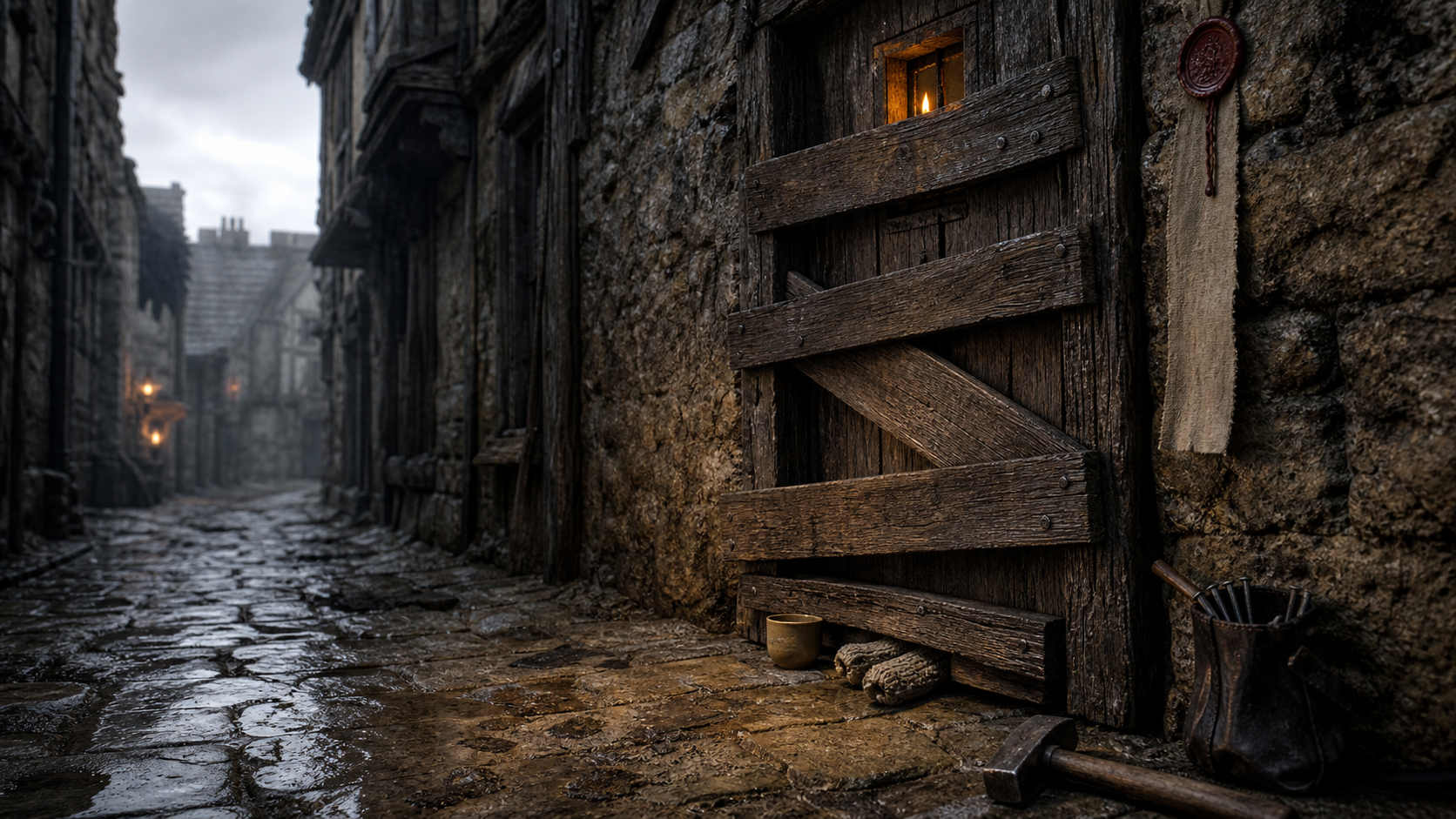
They Nailed the Sick Inside
The city calls it containment because “we sealed frightened people into their rooms and stopped treating them as neighbors” would sound exactly as monstrous as it is.
The thesis
A public-health response becomes punishment when care disappears
The Hayholt’s disease panic produces an image that should stop the story cold: doors nailed shut with sick people still inside. The official logic is containment. The material reality is imprisonment without meaningful consent, treatment, supply, appeal, or even the dignity of being seen as more than a source of danger.
Quarantine and abandonment are not synonyms. A community may need distance during disease, but distance creates obligations: food, water, medicine, communication, safe oversight, and a route out. Nailing the door solves none of those problems. It solves the comfort of everyone outside by converting suffering into a sealed room.
The receipts
The hammer tells us whose fear becomes policy
Somebody had wood, nails, authority, and enough healthy labor to close the building. Those resources could have supported care. Instead, they are used to make the boundary harder. The response protects the city’s preferred body by concentrating danger, thirst, terror, and helplessness inside the bodies it has already marked expendable.
The poor quarter matters. Powerful residents are rarely reduced to anonymous contagion with the same speed. Status buys interpretation: an important person is ill, while an unimportant household becomes “the sickness.” Once language merges people with threat, the plank can be presented as sanitation rather than violence.
RaeRae’s take
If your safety plan requires nobody to ask what happened behind the door, it is not care
The horror is not only that people may die inside. It is that the policy attempts to make their deaths administratively quiet. The seal turns neighbors into an invisible category and gives everyone walking past permission to believe the problem has been handled.
Book 1 keeps exposing systems that manage appearances instead of consequences: the feast while water disappears, the siege machine that hides replaceable bodies, the royal story that edits inconvenient witnesses. The nailed door belongs to the same government reflex. Close the image. Silence the receipt. Call the absence order. The people inside remain people whether the city can bear to hear them or not.
On the record
Full-spoiler reading receipt
Return to The Dragonbone Chair hub → · Open every Book 1 Rants → · Open the series hub →