
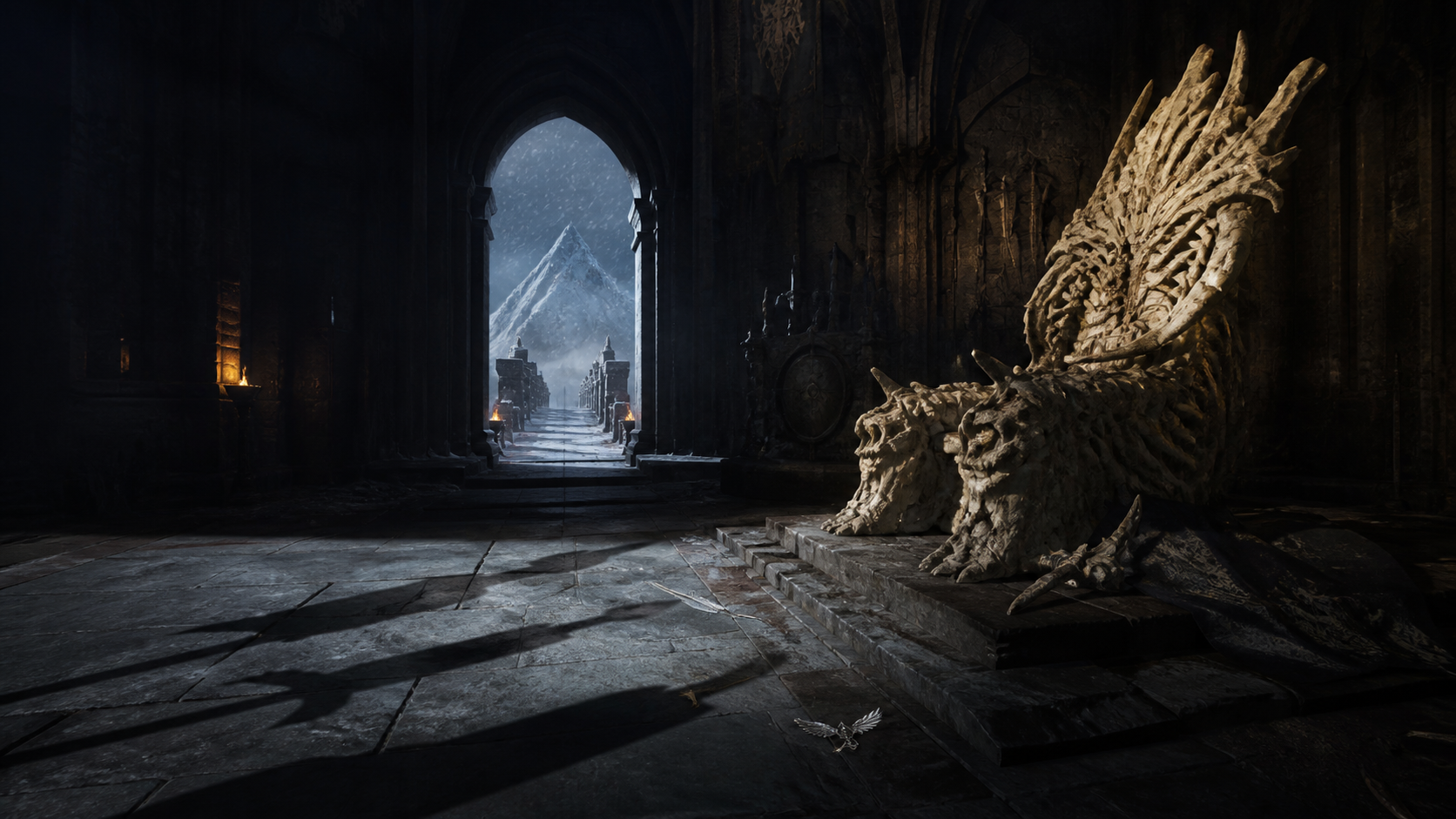
The Dragonbone Chair: What Actually Happens
Forty-four chapters, one kingdom breaking in public, and a scullion walking far enough north to discover the title is only the beginning of the trouble.
RaeRae’s reading
Chronology first. Rabbit holes attached where they belong.
This is the completed Book 1 plot, not a summary that sprints from inciting incident to dragon. The political collapse, supernatural machinery, and personal consequences are braided because the novel braids them. Later-volume knowledge is not used to steal a Book 1 reveal from the scene that earns it.
Complete Book 1 evidence
The rabbit-hole map
A mooncalf grows up inside somebody else’s conquest
Fourteen-year-old Simon knows the Hayholt as kitchens, roofs, forbidden corridors, and stories. Morgenes teaches him that the castle was Asu’a before humans took it, that history changes depending on who survived to name it, and that books are both magic and traps. King John’s failing body, Elias and Josua’s grief-soaked rivalry, Malachias’s secret movement, and the whisper promising “we will have it all back” make the ancient walls active before Simon understands why.
Receipt: Chs. 1–5, pp. 3–57.
Elias inherits the crown and begins spending the kingdom
John is buried at Swertclif with Bright-Nail, despite his private intention for Elias to receive it. Elias elevates Skali, sidelines Isgrimnur, binds Miriamele to a marriage plan she refuses, and lets pageantry outrun drought, plague, and hunger. Pryrates kills a puppy because Simon cannot stop him. Towser’s songs and frightened witnesses reveal the court’s truth sideways: Josua has vanished, the royal family’s old wounds are live weapons, and the official celebration is already a crisis machine.
Receipt: Chs. 6–11, pp. 58–141.
Simon rescues a prince and loses the only safe adulthood he knew
A gray cat breaks Pryrates’s pull and leads Simon through one of the Hayholt’s impossible passages to Josua, chained beneath the castle. Simon and Morgenes carry him out. Morgenes’s hidden network moves, six silver sparrows leave with pieces of unfinished work, and the doctor spends the very power he taught always has a cost. He dies buying Simon a road. At the Anger Stones, Pryrates turns Josua’s escape into a ritual emergency; Elias accepts Jingizu, vows to Ineluki, and makes the kingdom’s political collapse a supernatural covenant.
Receipt: Chs. 11–14, pp. 132–180.
The wilderness removes Simon’s fantasies one layer at a time
Simon flees with Morgenes’s ring and almost none of the heroic competence he once imagined. Hunger, cold, fear, and pursuit make survival collaborative. Binabik and Qantaqa rescue him without treating him as a chosen prince. Jiriki’s White Arrow becomes an obligation across peoples, while Malachias and the silent Leleth turn Simon’s instinct to protect into danger he cannot solve alone. Ingen Jegger’s white hounds make the North’s war physical long before its armies appear.
Receipt: Chs. 15–21, pp. 183–276.
Every kingdom discovers the weather is political
Rachel mourns the official version of Simon’s death. Eolair moves between Hernystir and Nabban while alliances, grain, marriage, faith, and old resentments become war material. Miriamele’s disguise is earned as identity rather than a twist; “Malachias” has been a princess refusing the future assigned to her. Simon’s group reaches Naglimund through loss and misrecognition, and the fortress’s iron history reveals that even the resistance’s refuge was built from another people’s fear.
Receipt: Chs. 22–30, pp. 277–408.
The Raed turns private testimony into a public cause
Josua convenes a council with shackles, witnesses, rumor, and political caution rather than a clean rebellion speech. Miriamele enters as herself, breaking Simon’s private story about Marya. The League’s manuscript, heretical counter-readings, scripture, Towser’s memory, and archival work identify the Three Swords as material objects with contested histories. Thorn lies north. Simon receives training, purpose, Miriamele’s scarf, and a mission that is dangerous partly because the adults still control what he knows.
Receipt: Chs. 31–35, pp. 409–493.
Naglimund runs out of bodies while Simon climbs toward a blade
The book divides its pressure between the fortress and Urmsheim. At Naglimund, Josua’s coalition improvises against a king able to spend soldiers “like apple peelings.” In the North, Jiriki returns the White Arrow as personal alliance rather than distant debt and joins the ascent. Simon, Binabik, Sludig, Jiriki, An’nai, and Grimmric cross a landscape where mortal and immortal histories touch. Elias rides beneath burning siege towers with Sorrow and orders the rain as though even weather should ratify his kingship.
Receipt: Chs. 36–41, pp. 494–592.
Naglimund falls; Simon refuses to disappear into a dragon
Jiriki shows Simon the remembered summer of Asu’a, then translates the wolves’ declaration: “I am; here I am.” Simon later claims that presence before Igjarjuk and brings Thorn down. Simultaneously, Elias’s human siege clears space for White Foxes, Hunën, Bukken, and the Red Hand. Naglimund’s defenses are bypassed from within and beyond ordinary war. Jarnauga dies protecting Strangyeard and the evidence route; Josua claims the crown over the burning refuge. On Mintahoq, Simon enters the dragon’s dying immensity and nearly loses the scale of one mortal life. He returns by remembering Rachel, Morgenes, Miriamele, and the name Simon.
Receipt: Chs. 42–44, pp. 593–635.
Why the chain matters
The plot does not begin when Simon leaves the castle
The most important structural decision in The Dragonbone Chair is its refusal to hurry the Hayholt. Simon’s chores, hiding places, crushes, punishments, stories, and lessons are not a long waiting room before the adventure. They establish what the political catastrophe will destroy and what Simon must later remember. When Igjarjuk’s consciousness offers him scale without limit, the way home is built from details the opening trained us not to dismiss: Rachel’s scolding, Morgenes’s rooms, particular friendships, embarrassment, hunger, and his own ordinary name.
The succession crisis also starts before Prester John dies. John’s victories have become sacred public memory while the violence, conquest, and political damage attached to them have been edited into glory. Elias and Josua inherit not only a crown but incompatible explanations of what strength looks like. Elias reads caution as humiliation because he has spent his life beneath a father whose legend rewards decisive force. Josua’s skepticism makes him look ambitious because court culture understands disagreement mainly as competition. Pryrates does not manufacture those wounds. He studies them and offers Elias a version of power that never has to tolerate uncertainty again.
Morgenes’s intervention joins the domestic and epic plots. Simon rescues Josua because curiosity, hidden-route knowledge, affection for the doctor, and inability to leave suffering alone finally point in the same direction. The rescue is brave and disastrously incomplete. It exposes Morgenes, forces the League’s work onto the road, and gives Pryrates the emergency needed to bring Sorrow openly into Elias’s reign. Heroic action does not fail; it succeeds at one moral task and creates consequences nobody involved can yet control.
The journey east and north then teaches Simon how little any one viewpoint can hold. Binabik knows survival, languages, Qanuc tradition, and fragments of the League’s problem; he does not know every court secret. Miriamele understands Elias as father and king but must disappear into Malachias and Marya to move outside his claim. Eolair reads alliances through Hernystir’s needs. Rachel sees the cost of power from kitchens and linen rooms. Towser remembers truths court history has filed under foolishness. Jarnauga carries older warnings. The plot advances when partial accounts touch, not when one wizard finally explains the universe.
The Raed is therefore the book’s real machine room. Plot, prophecy, archive, scripture, folklore, direct witness, and political motive are placed side by side. Thorn becomes findable because different classes of knowledge are permitted to argue. Even then, the council’s agreement cannot make the interpretation complete. “Find the swords” remains a dangerous sentence whose hidden assumptions the later series will prosecute.
Naglimund and Urmsheim operate as parallel answers to the same fantasy. A fortress and a magic sword both look like objects capable of solving vulnerability. Naglimund falls because its defenses answer an older threat model while Elias’s alliance combines human siege, creatures beneath the walls, Norn forces, and the Red Hand. Thorn is recovered, but the weapon’s presence brings no automatic understanding or safety. The book closes after granting the quest object and destroying the refuge, forcing the reader to separate acquisition from victory.
Simon’s dragon encounter completes the movement without pretending he is complete. He names himself, acts, survives, and returns altered. He also wakes dependent on companions and facing a world whose central systems remain unresolved. The plot earns a transformation while refusing the lie that one extraordinary moment finishes growing up.
The ending is a threshold, not a victory lap
Simon has Thorn, but he does not understand it. Josua has claimed a crown, but no fortress. Miriamele is at sea with Cadrach. Binabik faces an accusation waiting in Yiqanuc. Elias still has Sorrow, Pryrates, the Hayholt, and allies able to rewrite the rules of siege. Book 1 completes Simon’s first movement—from hidden castle child to visibly marked participant—while leaving every large conflict more dangerous because it is finally legible.
On the record
Read front-to-back, then reconciled
Return to The Dragonbone Chair hub → · Meet the complete Book 1 cast → · Open the series hub → · Meet Tad Williams →