
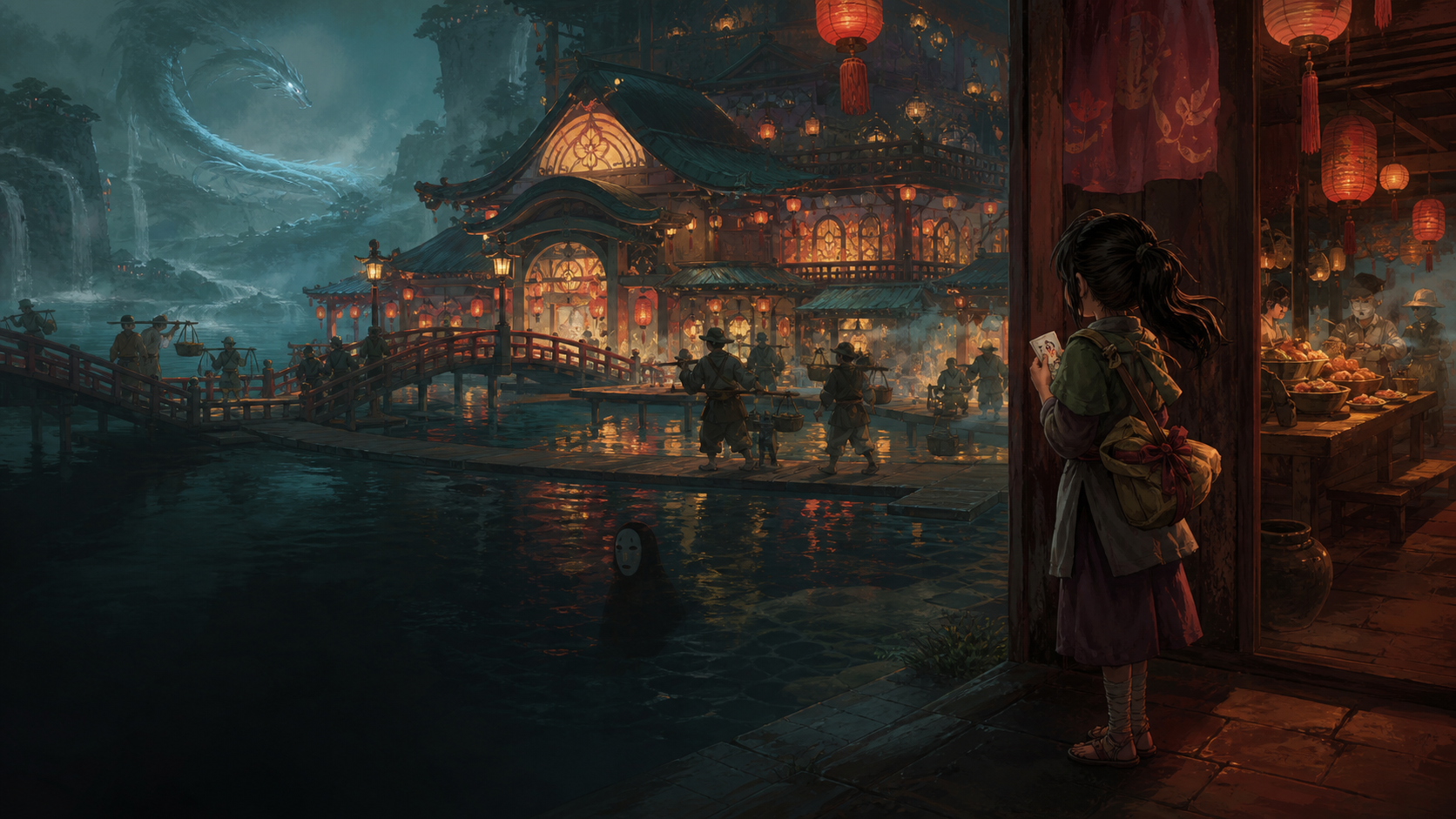
Spirited Away
Chihiro survives a magical workplace by remembering her name, doing the job, and refusing to confuse appetite with love. Her strength comes from attention, care, and the judgment to know what should never be bought.
Chihiro grows without becoming fearless
Chihiro begins frightened, sulky, and unhappy about moving. Those responses are reasonable. Her parents are driving toward a new life she did not choose, dismissing her caution, and treating confidence as proof of knowledge. The abandoned entrance looks wrong to her before any adult admits danger. The spirit world does not transform her into a fearless chosen one. Chihiro remains scared and learns to act while scared. She asks for work, scrubs floors, carries medicine, recognizes greed, remembers a river, and crosses a flooded world by train. Her growth does not require becoming louder or more violent. Attention becomes her heroic skill. She notices when food is not hers, when a guest carries hidden pain, when gold changes behavior, and when a stolen name remains worth recovering.
Food and names separate care from ownership
Food throughout Spirited Away can heal, sustain, welcome, corrupt, and reveal. Haku gives Chihiro food so her body will not disappear. Lin shares food after work. Zeniba offers hospitality. The parents’ transformation therefore cannot support a simple lesson against appetite. They enter an unattended restaurant, assume money will settle permission later, and consume a feast prepared for others. Confidence in cash replaces relationship. The pig bodies make consumption visible as identity. Their faces disappear into appetite because they treat the world as a service waiting for purchase. Chihiro does not rescue them by refusing every pleasure. She learns the difference between nourishment, gift, payment, temptation, and theft.
Chihiro signs a contract and becomes Sen. Yubaba removes characters from the written name, reducing identity through administrative action. A name links memory, family, history, and the ability to imagine life beyond employment. When Haku forgets his true name, the bathhouse becomes the only world he can navigate. The contract grants survival and creates control. Chihiro needs work because humans without purpose in the spirit world risk transformation or disappearance. Yubaba uses that need to define the terms. Remembering “Chihiro” does not make Sen unreal. Workplace competence, friendships, and courage develop under the shortened name. The danger comes from allowing an employer to claim that role as the whole person. Haku’s warning creates collective memory. People preserve one another by remembering names that institutions profit from erasing.
The bathhouse makes labor and management visible
The building contains boilers, elevators, kitchens, guest rooms, cleaning crews, clerks, managers, luxury suites, and enormous quantities of water. Gods receive restoration through labor performed mostly out of sight. Chihiro enters at the bottom. She must request employment repeatedly, learn routines, tolerate disgust, and accept correction. No training montage makes the work effortless. Lin’s irritation becomes mentorship. Kamaji claims Chihiro as a granddaughter to protect her, then provides help without demanding ownership. Coworker solidarity creates safety that formal management does not. The bathhouse rewards revenue and status. Staff adore No-Face when gold appears and recoil when his consumption becomes dangerous. Organizational values become visible through employee behavior. Miyazaki does not romanticize labor as automatic virtue. Work gives Chihiro structure, skill, and allies, while the workplace exploits names and rewards greed. Dignity comes through how people work together, not through employment alone.
Yubaba controls contracts, rooms, pay, discipline, and access. Her oversized office physically separates management from the floors where labor happens. She is perceptive enough to recognize Chihiro’s nerve and constrained enough by oath or rule to grant work after the girl persists. Authority operates through systems as well as mood. Her treatment of Boh reveals another kind of control. Protection becomes confinement. The enormous baby learns fear of germs and danger because his mother has made the outside world unimaginable. Yubaba values gold and reputation, yet maternal panic can override business judgment. She is not redeemed by love for Boh. The contradiction shows that private affection does not make a manager fair. Zeniba resembles Yubaba physically while organizing a different household economy through tea, craft, conversation, and shared work. Identical faces support opposing relations.
No-Face and Haku show how identity absorbs an environment
Chihiro allows No-Face inside through an ordinary act of courtesy. The spirit begins quiet, receptive, and undefined. Bathhouse workers teach him that gold commands attention. He produces what the institution rewards and consumes people who approach him through appetite. No-Face absorbs voices and traits from those he swallows. Identity becomes environmental. A lonely being takes the shape of surrounding desire. Chihiro refuses his gold because their first relationship was not a transaction. Her refusal interrupts the feedback loop. After vomiting the bathhouse excess, No-Face becomes quieter. Zeniba gives him a place inside a small household where work is connected to belonging rather than endless consumption.
Haku remembers Chihiro from childhood before he remembers himself. She once fell into a river and survived. That embodied memory preserves relationship after urban development removes the river from the visible landscape. His true name, Kohaku River, returns through Chihiro’s recognition. Environmental destruction becomes identity theft. A river can disappear beneath buildings while memory still carries the former geography. Yubaba controls Haku through name and ambition. He performs dangerous magic, steals Zeniba’s seal, and approaches death while serving a power structure that promises knowledge. Remembering does not recreate the river. The scene offers restoration of identity without pretending ecological restoration has already occurred. Their falling flight becomes joyful because recognition releases control. Chihiro saves Haku through attention rather than conquest.
The river spirit turns service into recognition
The bathhouse staff recoil when the filthy guest arrives. Chihiro receives the worst assignment because management considers her expendable. She notices a thorn in the spirit’s side. Workers pull together and discover a bicycle, refuse, and accumulated human waste lodged inside the body. The cleansing sequence turns pollution into labor rather than abstract guilt. Someone must enter the contaminated water, identify the obstruction, coordinate tools, and remove material. The recovered river god rewards Chihiro with medicine. More important, purification restores a being whose degraded condition had hidden identity. Miyazaki reportedly drew inspiration from river-cleaning experience. The scene connects spiritual pollution with recognizable environmental neglect without reducing ecology to a lecture.
Food reveals the difference between relationship and possession. Haku’s rice balls stabilize Chihiro and allow grief to surface. Lin’s food welcomes her after labor. Zeniba’s cake accompanies conversation. These meals become gifts because giver and receiver recognize each other. The parents consume food without permission. No-Face orders excess to command service. Boh has been overprotected and overfed inside confinement. Appetite becomes destructive when consumption replaces relation. The medicine from the river god has power because Chihiro chooses when and with whom to share. She gives portions to Haku and No-Face rather than hoarding a miracle for her parents. Her choice proves maturity through judgment. Scarcity does not force selfishness, and generosity does not mean giving everyone whatever they demand.
Kamaji’s boiler room is the hidden infrastructure beneath luxury. Guests encounter polished baths and attentive service. Beneath the floors, Kamaji and soot workers carry fuel, mix herbal water, and respond to endless orders. The boiler room visualizes labor that customers rarely see. Multiple arms make overwork look supernatural while preserving the exhaustion of one worker handling too many systems. The soot sprites receive food through labor and discover that Chihiro may carry loads for them. Kamaji warns that abandoned work threatens their role, revealing a workplace where usefulness protects existence. His rough manner softens through action. He lies that Chihiro is his granddaughter, provides train tickets, and supports Haku’s rescue. Solidarity appears before sentiment.
Lin teaches competence without pretending work is a family. Lin initially resents the burden of training a human child. Her frustration is credible because Chihiro’s mistakes could increase everyone else’s labor. Mentorship develops through instruction, defense, shared food, and pride. Lin helps Chihiro navigate rules without claiming the bathhouse deserves loyalty. She dreams about leaving for another town. The dream preserves a self beyond employment and counters Yubaba’s attempt to make work the entire world. Their relationship shows how coworkers can create humane conditions inside an exploitative institution without confusing solidarity with corporate culture.
Boh grows when protection stops functioning as imprisonment. Yubaba keeps Boh in an enormous nursery and teaches him that outside air will cause illness. Fear protects her emotional dependence as much as his health. Zeniba transforms him into a small creature, removing status and forcing contact with ordinary scale. He travels, carries weight, observes labor, and chooses movement. Growth occurs through manageable risk and relationship. Chihiro does not lecture him into independence. Shared experience makes the old room less convincing. When Boh refuses to support Yubaba’s threat, he demonstrates that love for a parent can survive disagreement.
Zeniba’s cottage offers another economy. The cottage contains tea, spinning, mending, conversation, and collaborative craft. Work remains present, but no customer hierarchy organizes the room. No-Face becomes helpful because the environment rewards attention rather than display. Boh participates without being worshiped. The transformed bird loses managerial surveillance and joins domestic labor. The hair tie made by friends carries protection through collective effort. Value comes from relationship rather than gold. Zeniba is not simply the good twin. She endangered Haku while pursuing the stolen seal and can wield frightening power. Her household shows another relation to power rather than pure innocence.
The train scene trusts a child to sit with melancholy
Chihiro boards a one-way train across flooded tracks. No chase interrupts the journey. Shadow passengers enter and leave. Stations suggest lives beyond the bathhouse that the film never explains. The sequence creates emotional distance after overwhelming appetite and noise. Chihiro has a task, but travel requires waiting. No-Face sits beside her without demanding performance. Quiet companionship becomes possible after consumption has been expelled. The flooded landscape resembles memory: familiar structures remain partly visible beneath changed conditions. The train moves forward without restoring the previous world. BFI criticism identifies the sequence as a tour de force of animation’s melancholy power. Movement, sound, spacing, and restraint produce meaning without exposition.
Chihiro’s courage develops through accuracy. She does not become fearless. Chihiro learns which fear deserves attention and which authority deserves challenge. At the tunnel, her fear is accurate while her parents dismiss danger. At the bathhouse, panic initially prevents action. Experience teaches her to convert observation into decisions. She recognizes the river god beneath filth, Haku beneath Yubaba’s control, and No-Face beneath the bathhouse’s appetite. Recognition becomes a form of rescue. Her final test depends on identifying that none of the displayed pigs are her parents. She succeeds because love no longer requires grabbing the first familiar shape.
The contract does not create work ethic. The contract weaponizes survival. Chihiro already shows persistence before signing. Yubaba’s contract captures that capacity and places a managerial claim over her name. The film distinguishes willingness to work from obedience to every workplace value. Chihiro completes difficult tasks and disobeys the bathhouse’s worship of gold. She also uses skills learned at work to challenge management. Competence gives her mobility, allies, and credibility. A labor reading should therefore avoid two extremes. Employment is neither pure exploitation nor automatic moral education. Conditions, relationships, ownership, and exit determine meaning.
Gold has value because everyone agrees to perform value. No-Face produces gold, and workers immediately reshape behavior around the promise. Service becomes flattery. Risk becomes acceptable. A mysterious guest becomes important. The gold later turns to dirt, exposing how collective belief sustained the frenzy. Material appearance was never enough. Chihiro’s refusal protects her because she wants something gold cannot purchase: her parents, Haku’s safety, and freedom from the contract. The film does not claim money has no practical value. The parents’ confidence in cash fails because currency cannot authorize theft or guarantee control across every social world.
The bathhouse sells purification while producing another kind of dirt. Gods arrive for cleansing. The building uses water, herbs, heat, towels, food, and labor to restore them. Behind the service, management exploits names, workers compete for tips, food becomes excess, and waste moves downward toward the boiler room. The polluted river god reveals literal contamination from the human world. No-Face reveals moral contamination amplified inside the business. Purification cannot remain a luxury service if the surrounding economy keeps creating pollution. Chihiro’s work succeeds because extraction and disposal stop long enough for the cause to be removed.
Why the parents remember nothing. After Chihiro wins their freedom, her parents return to human form without conscious memory of the spirit world. Their car carries dust and leaves, providing physical evidence that time passed. The memory gap protects no moral lesson for them. Chihiro alone carries the experience that changed her. Childhood often works that way. A child absorbs the emotional cost of adult decisions while adults continue believing the journey was uneventful. Her parents’ ignorance does not erase growth. Chihiro no longer needs them to validate what happened.
Chihiro and Haku do not need a conventional romance. Their bond includes childhood memory, rescue, loyalty, and recognition. Reducing every intimate connection between young characters to romance narrows the film. Haku helps Chihiro enter the spirit world safely. She later protects him, returns the seal, and restores his name. Reciprocity changes the relationship from guardian and dependent toward two people preserving each other’s identity. The promise to meet again can remain meaningful without specifying a future couple. Love has more than one form.
The tunnel marks a border that confidence cannot control. Chihiro’s father treats the entrance as another place available for exploration. His car, money, and adult certainty make trespass feel harmless. The family crosses without permission and ignores Chihiro’s objection. The spirit world punishes assumption rather than curiosity alone. On the return journey, Chihiro looks back only until Haku’s instruction takes hold. Crossing requires memory and forward movement together. The tunnel remains physically ordinary. Borders between social worlds often look ordinary until rules change.
Yubaba and Zeniba demonstrate that resemblance is not identity. The twins share a face, magical power, and voice, yet their households organize desire differently. Yubaba accumulates, contracts, surveils, and protects through control. Zeniba hosts, repairs, teaches, and makes through shared attention. The contrast repeats the film’s warning about surfaces. Pigs may not be parents. Gold may be dirt. A stink spirit may be a river. Identical faces may produce different ethics. Chihiro succeeds because she learns to interpret relationship and behavior instead of relying on appearance.
The ending: Chihiro remembers through behavior even if details fade
Chihiro identifies that her parents are absent from Yubaba’s pig lineup. The answer shows perception freed from panic and wishful thinking. Yubaba releases the contract, and Chihiro leaves without looking back. The instruction protects passage while testing trust. Outside, the parents resume ordinary conversation. Chihiro appears quieter and more prepared for the move she feared at the beginning. The hair tie glints, preserving material connection to friends who made the gift. Even if conscious memory changes, relationship has altered how she meets uncertainty. The family drives toward a new home. The original problem has not vanished. Chihiro has developed the capacity to enter an unfamiliar place without surrendering her name.
The test with the pigs is not a random fairy-tale trick. At the beginning, Chihiro sees danger correctly while her parents assume appetite and money will solve every uncertainty. She cannot stop them because fear overwhelms speech and adult confidence outweighs her judgment. At the end, Yubaba presents apparent evidence and expects Chihiro to guess under pressure. The girl refuses the premise. None of the pigs are her parents. Her answer demonstrates more than intuition. She has learned that authority can stage a false choice. Growing up includes recognizing when the available options were designed to make obedience look like decision.
Animation craft makes the spirit world feel employed
Movement communicates role. Workers hurry with trays, Kamaji’s arms manage simultaneous tasks, Yubaba’s body fills managerial space, and guests move according to appetite or ritual. Backgrounds contain pipes, drawers, tokens, food, vents, baths, corridors, and tools. Magic operates through infrastructure. Character transformation preserves behavioral continuity. The parents’ pig hunger extends their restaurant behavior. No-Face grows according to consumption. Boh’s smaller form exposes curiosity hidden by size. Digital techniques support complex camera movement and effects while hand-drawn performance remains central. Innovation serves the world’s density rather than announcing a technological break.
Joe Hisaishi gives transition a melody without explaining transition. The score carries wonder, anxiety, labor, grief, and forward movement. Piano and orchestra create emotional continuity through a world whose rules keep changing. The train sequence uses musical restraint to preserve silence and distance. Melancholy emerges without forcing sadness into one cause. The main themes can sound nostalgic even during a first viewing. That quality suits a story about remembering places and names before viewers possess their own memory of the film. Music supports Chihiro’s growth without converting courage into triumphal noise.
From Japanese box-office phenomenon to global animation landmark
The film became a record-breaking Japanese theatrical release and later won the Golden Bear and the Academy Award for Best Animated Feature. TIME’s industry history emphasizes how the Oscar mattered during the category’s early years and helped position Japanese animation as global cinema rather than niche import. International success did not depend on removing Japanese folklore, labor structures, food, architecture, or language from the core. Cultural specificity traveled because emotional and formal clarity did not require cultural flattening. The U.S. distribution campaign benefited from respected animation advocates and careful positioning. Awards are never pure measures of quality, but institutional visibility changed access for Ghibli and anime more broadly. The movie also expanded expectations for child protagonists. Chihiro confronts darkness without becoming a miniature action hero. Attention, labor, courtesy, and judgment carry the story.
Consumerism, the post-bubble economy, and bodies that cannot stop. Scholarship has connected the film’s eating, vomiting, waste, and excess with consumer capitalism in contemporary Japan. Bodies reveal what economic language hides. The parents consume until becoming livestock. No-Face consumes until losing shape. The bathhouse consumes labor while selling purification. Expulsion becomes necessary before relationship can resume. Chihiro’s alternative is not total abstinence. She eats what sustains, accepts what carries care, and refuses what tries to purchase her. The distinction offers a more useful critique than declaring consumption immoral. Life requires exchange. The question concerns whether exchange recognizes limits and other lives.
Honest criticism: abundance can make consequence feel selective
The bathhouse contains so many ideas that several workers and spirits remain functions rather than developed subjects. Lin receives vivid personality but little history beyond her dream of leaving. Yubaba’s contract system raises political questions that personal bravery cannot fully solve. Chihiro escapes, while the wider workforce remains. The parents receive transformation and rescue without memory or accountability. That choice supports Chihiro’s independent growth but leaves family dynamics largely unchanged. Cultural commentary can also become overconfident. Shinto, folklore, capitalism, labor, and environmentalism provide valuable contexts, but no single framework should claim every image. The ending’s resilience message may be used to celebrate children adapting to systems adults should repair. Chihiro’s competence does not excuse adult irresponsibility.
Easter eggs, language, and details worth noticing. The Japanese title includes kamikakushi, a concept associated with disappearance or being hidden by spirits. The title frames Chihiro’s absence through cultural memory rather than generic fantasy travel. Yubaba shortens Chihiro’s name to Sen using one character whose reading changes. Written language becomes visible power. Bath tokens, herbs, elevator rules, and worker signals make magic bureaucratic. Fantasy gains credibility through procedure. The river medicine resembles a bitter dumpling and causes violent expulsion. Healing can look unpleasant because contamination must leave the body. The hair tie embodies collective craft. Protection comes from several friends contributing labor rather than one powerful wizard granting a prize. The car’s dust provides quiet evidence. The human world has moved while the family was absent.
Where to watch Spirited Away legally in the U.S. As checked on August 13, 2026, JustWatch lists streaming through HBO Max, the HBO Max Amazon Channel, and YouTube TV. Amazon Video, Fandango at Home, and the Apple TV Store list rental or purchase options. Check current U.S. availability on JustWatch.
Chihiro’s first victory is asking for work while terrified. Kamaji tells her to leave. Lin objects. Yubaba tries to distract, threaten, and exhaust her. Chihiro keeps repeating the request. Persistence matters because the contract requires expressed intention. Yubaba can exploit a request but cannot fully manufacture one. The scene does not romanticize job seeking. Power sits entirely with the employer, and survival depends on acceptance. Chihiro’s courage develops inside unfair conditions. Her repeated sentence creates a boundary against manipulation. She does not debate every insult. She returns to the purpose that brought her into the office.
The bathhouse runs on emotional labor as much as soap and water. Workers must welcome guests, hide disgust, anticipate demands, perform respect, and protect the establishment’s reputation. Service includes managing feelings for sale. The polluted river god tests that requirement. Staff recoil, and Chihiro must approach someone whose condition produces overwhelming discomfort. No-Face exploits the same system. Gold purchases exaggerated attention, teaching him that desire can command smiles. Lin’s mentorship gives Chihiro a private space where honest frustration remains possible. Coworkers need places where performance can stop.
No-Face shows how loneliness copies the room. He begins without a stable voice or obvious appetite. The bathhouse supplies both through observation and ingestion. Loneliness alone does not make him violent. An environment organized around gold gives loneliness a script for obtaining attention. Chihiro’s refusal works because she does not reward the script. She addresses him as a being rather than customer, threat, or wallet. Zeniba’s cottage provides another room to copy. There, usefulness means spinning, listening, and sharing space. No-Face becomes calm because belonging no longer requires spectacle.
Yubaba’s surveillance is maternal and managerial. Her bird form monitors the grounds. Her smaller transformed servant observes Chihiro. Contracts preserve names as administrative property. Information supports control. She also monitors Boh through fear, keeping the baby close by teaching him that distance equals danger. Protection becomes a surveillance story told inside the nursery. When Boh travels, he discovers that the world contains manageable risks and relationships outside his mother. Experience weakens surveillance’s central claim: only the controller can keep you safe. Yubaba’s panic after discovering his absence shows genuine love entangled with possession.
The film’s spirits are customers without becoming cultural decorations. The bathhouse serves beings with varied bodies, ranks, habits, and needs. Some draw from recognizable Japanese spiritual and folkloric traditions, while others emerge through Miyazaki’s invention. A responsible international reading should resist assigning every creature one definitive mythological source. Visual resemblance may support context without proving direct identity. The film presents spiritual life as part of a changing society rather than a museum of pure tradition. Gods use elevators, demand service, pay, complain, and carry pollution from the human world. Modernity and tradition occupy the same bath rather than forming opposite universes.
The abandoned leisure complex is not empty history. Chihiro’s father interprets the site through economic explanation, suggesting a failed development from boom-era expansion. He sees abandoned property. Chihiro senses occupied space. The spirit world reclaims architecture left behind by human investment. Empty buildings become a border between financial ruin and another economy. The parents’ confidence reflects a consumer who believes closed businesses remain available for private use. Abandonment appears to cancel ownership only when they want access. The setting connects post-bubble anxiety with older stories of sacred disappearance. Economic failure does not erase cultural memory beneath development.
Why dirt behaves like hidden history. The river god’s filth contains objects discarded over time. Pollution appears as accumulation rather than one villain’s dramatic act. Bathhouse workers first identify the guest by smell and surface. Chihiro’s close attention reveals another history inside the body. Cleaning becomes historical recovery. Pulling the bicycle exposes evidence of ordinary behavior repeated until a river could no longer carry the burden. The spirit’s restored form does not remove responsibility from the human world. Purification creates a second chance, not innocence.
Remembering a river is a form of environmental testimony. Official maps and buildings may say that Kohaku River no longer exists. Chihiro’s childhood memory contradicts the developed landscape. Personal testimony preserves ecological history that planning systems can erase. A place remains meaningful after infrastructure hides the water. Haku’s name returns because another person witnessed his relationship to the land. Identity becomes communal memory. That recovery also asks what happens to countless rivers without a Chihiro. Development can erase names, habitats, and stories together.
Why Chihiro shares the medicine instead of saving every piece for her parents. The medicine represents scarce power. She originally hopes the gift may help restore her parents, which gives every portion emotional value. Haku faces immediate death from the stolen seal. No-Face faces an uncontrolled cycle of consumption. Chihiro responds to present need rather than hoarding for one private goal. Her generosity includes judgment. She does not give medicine to every hungry worker or powerful manager. Care becomes specific rather than self-erasing. Both recipients vomit what has harmed them. Healing removes foreign accumulation before restoring direction.
The film gives a ten-year-old responsibility without claiming children should raise adults. Chihiro rescues her parents because the plot follows her agency. Their recklessness created the crisis. The story can inspire resilience and still expose adult failure. Children often adapt because adults leave no alternative. Adaptation should not become evidence that the burden was appropriate. Kamaji, Lin, Haku, and Zeniba provide support at critical moments. Chihiro never survives through individual grit alone. Her growth depends on intergenerational and peer relationships that respect her attention. The movie’s lesson is collective care, not child self-sufficiency.
The bathhouse is a company town with better food. Workers appear to live where they work, depend on management for status, and organize daily life around guests. Housing, employment, and social identity occupy one structure. Leaving therefore requires more than quitting a shift. Lin’s dream of another town needs money, opportunity, and a self that Yubaba has not fully absorbed. Chihiro’s human identity makes her particularly vulnerable. She has no recognized place outside the contract and can be transformed if management decides she lacks use. Coworker solidarity reduces that control. Kamaji, Lin, and others share information and protection that formal policy withholds.
Why Yubaba cannot understand Chihiro’s final answer. Yubaba designs the pig test around attachment and visual uncertainty. She expects desire to make Chihiro choose incorrectly. Her worldview treats possession as love. Parents should be selected from available property because losing them feels unacceptable. Chihiro has learned that relationship is not guaranteed by appearance. No-Face copied voices. Haku lost a name. Zeniba shared Yubaba’s face. Pigs may resemble the transformed parents without being them. The correct answer rejects the inventory rather than selecting from the inventory.
Chihiro’s body changes less than everyone else’s for a reason. Parents become pigs, Haku becomes a dragon, No-Face expands and contracts, Boh becomes a small animal, birds become strange hybrids, and gods reveal alternate forms. Chihiro’s transformation happens through posture, expression, movement, and decision. Animation records psychological growth without replacing her body. The contrast protects ordinary childhood. Heroism does not require a magical body, hidden bloodline, or combat upgrade. By the end, the same girl moves through unfamiliar space with different attention.
The train ticket represents help saved for a future nobody could predict. Kamaji has held tickets for decades. The object survived without a known moment of use. Giving the tickets to Chihiro turns private reserve into collective possibility. He cannot accompany her, but earlier preparation extends her reach. The one-way route requires faith that another path home will emerge. Planning and uncertainty coexist. Support often works that way. Someone preserves a resource before knowing whose crisis will require the resource.
Zeniba’s hair tie is the opposite of Yubaba’s contract. The contract removes part of Chihiro’s name and binds labor to managerial control. The hair tie gathers work from friends and protects without claiming her. Both objects carry magic through collective or written action. Their ethics differ through consent and ownership. The tie travels with Chihiro beyond the spirit world. A good gift supports departure rather than requiring permanent dependence. The final glint gives friendship material presence after conscious memory becomes uncertain.
No-Face and the parents represent different stages of consumer identity. The parents begin with social confidence and become animals through unrestrained consumption. No-Face begins without clear identity and builds one from the consumption surrounding him. One case shows appetite erasing an established social self. The other shows appetite providing a substitute self where none feels secure. Both transformations depend on an environment offering abundance without relationship. Food and gold circulate faster than recognition. Chihiro reverses the cycle through limits, medicine, memory, and relocation.
The film’s feminism resides in ordinary competence. Chihiro, Lin, Yubaba, and Zeniba exercise different forms of authority. The story does not announce female strength through imitation of a male warrior arc. Chihiro negotiates, cleans, observes, travels, and refuses payment. Those activities carry narrative power because care and service remain politically meaningful. Yubaba demonstrates that a woman holding authority does not make hierarchy just. Zeniba demonstrates that domestic craft can organize power without becoming passive. The film respects work coded feminine while criticizing systems that exploit the workers performing that work.
Why the movie never explains every spirit. Unexplained beings protect the sense that the world exceeds Chihiro’s knowledge. A complete guidebook would turn relationship into classification. She survives by learning enough for the present encounter, not by mastering a mythology database. The approach also respects younger viewers. Children can navigate partial information and revise understanding through behavior. Mystery becomes an ethical limit: not everything encountered exists for the protagonist to name.
The final car ride changes the meaning of the first car ride. At the beginning, Chihiro sits passively while her father drives with confidence toward an unknown place. She clutches flowers and complains about loss. At the end, the same family continues toward the new home. The parents remain unaware, and the move remains real. Chihiro’s circumstances have not been rewritten to reward growth. Her relationship to uncertainty has changed. The film refuses the fantasy that inner development makes adults wiser or external problems disappear. Growth gives the child another way to meet what remains.
Why Spirited Away remains culturally specific and globally legible. International audiences do not need prior expertise in Japanese religion, labor history, or language to follow Chihiro’s fear and attention. Accessibility does not require removing bathhouse culture, written-name mechanics, food, architecture, or spirits. Emotional clarity carries viewers toward cultural questions. Localization can provide limited context while preserving strangeness. Over-explanation would flatten the experience into equivalents already familiar to another market. The film’s global impact demonstrates that specificity can create connection when distributors trust audiences to learn.
Resilience is not the same as gratitude for hardship. Chihiro becomes more capable because she responds well to danger. The danger was not a gift. Her parents’ recklessness, Yubaba’s coercion, and the bathhouse’s rules created unnecessary harm. Stories about resilient children can become excuses for adults who refuse responsibility. Admiring Chihiro should increase concern about the conditions she survived. Her strength also depends on help. Haku provides food and memory. Kamaji provides cover and tickets. Lin provides training. Zeniba provides another model of home. Resilience emerges through relationship, not through abandonment disguised as character building.
The spirit world recognizes work before recognizing humanity. Chihiro’s human smell marks her as contaminating or edible. Employment gives her a provisional social category that other beings must acknowledge. The rule exposes a harsh labor truth: institutions may recognize productivity before personhood. A worker receives space because someone can use the labor. Chihiro turns provisional access into relationships that exceed the contract. Lin, Kamaji, Haku, Boh, No-Face, and Zeniba learn her beyond assigned role. Leaving becomes possible because identity has spread through mutual recognition rather than remaining inside Yubaba’s records.
Apology matters more than magical innocence. Chihiro travels to Zeniba intending to apologize for Haku’s theft and return the seal. She cannot guarantee forgiveness. The journey distinguishes repair from victory. She takes responsibility for a relationship without claiming personal guilt for every decision Haku made. Zeniba reveals that the harmful curse has already been broken through Chihiro’s actions, but the apology remains meaningful because motive and consequence are separate. Magic does not eliminate the need to speak honestly about harm.
The movie’s deepest comfort comes from limits. Chihiro cannot save everyone, consume everything, remember everything, or stay everywhere. Those limits protect her from the forces overwhelming other characters. She gives medicine in portions. She refuses gold. She leaves No-Face with Zeniba. She accepts separation from Haku. She walks away from the bathhouse. Consumer fantasy promises fulfillment through more access and fewer limits. The film finds freedom through knowing what not to take. Her final confidence comes from boundaries practiced across the journey.
A scene-by-scene emotional map. The tunnel. A child’s accurate fear loses against adult certainty. The restaurant. Consumption without permission turns people into appetite. The contract. Survival enters paperwork, and management claims a name. The river cleansing. Attention discovers environmental history beneath disgust. No-Face’s feast. Loneliness performs the desire a workplace rewards. Haku’s fall. Ambition and stolen identity become bodily crisis. The train. Repair requires travel through quiet uncertainty. The pig test. Growth means rejecting a false choice rather than guessing better.
A final note on moving. Chihiro begins among wilted farewell flowers, angry that adults have relocated her life. The spirit journey never tells her that sadness about moving was childish. She learns that identity can survive relocation when names and relationships remain remembered. Home becomes more than one address without becoming meaningless. The new town may still feel lonely. Courage does not promise instant belonging. Chihiro now knows that unfamiliar systems can be studied, challenged, and entered without surrendering herself. That modest preparation gives the ending more emotional honesty than a promise that everything ahead will be easy.
Animation does not soften the adult world. Animation makes the adult world visible.
American marketing still trains many viewers to treat animation as a children’s shelf, even though the medium has always carried satire, politics, grief, sexuality, war, and social criticism. Spirited Away exposes the weakness of that habit. A live-action workplace drama could show unpaid labor, managerial coercion, customer worship, pollution, and identity loss, but Miyazaki can turn those pressures into bodies, buildings, weather, food, and magic. The parents become pigs because consumption has swallowed their social judgment. Yubaba steals written names because bureaucracy can reduce a person faster than a monster can. No-Face grows with every appetite the bathhouse rewards. Animation does not hide the argument from adults. Animation gives the argument a visual grammar children can also understand.
Japanese animation reaches audiences through industrial traditions that differ from American studio animation, but cultural difference should not become a lazy East-versus-West slogan. Japan also produces disposable entertainment, corporate franchises, and stories aimed narrowly at children. The United States also has a long history of adult animation and family films with serious ideas. The useful distinction concerns permission. Spirited Away assumes an animated feature can remain strange, quiet, culturally specific, commercially ambitious, and emotionally demanding without apologizing for the form. The film trusts viewers to hold comedy beside terror and wonder beside labor criticism. That trust helped international audiences expand their expectations of what a widely released animated movie could do.
The bathhouse also explains why global audiences recognize the film without sharing every cultural reference. Most people understand a workplace where revenue changes how staff behave, a manager controls information, senior workers protect newcomers, customers receive more respect than employees, and exhaustion becomes proof of commitment. Miyazaki builds those recognizable pressures inside a world of kami, bathhouse ritual, Japanese food, written names, and environmental memory. Cultural specificity becomes the route to universality rather than an obstacle. Viewers do not need every spirit identified because Chihiro does not need a field guide. She needs attention, manners, courage, and enough judgment to recognize when a rule serves survival and when a rule serves power.
That balance keeps the review from collapsing into a complaint about capitalism. The bathhouse offers genuine pleasures. Work allows Chihiro to develop skill, receive mentorship, contribute to a group, and discover courage through practice. The river-god sequence produces communal pride because difficult service work uncovers a buried environmental crime. Lin’s competence is admirable. Kamaji’s boiler room carries craft, rhythm, and responsibility. The problem begins when employment claims the worker’s name, when customer money determines moral value, and when management treats dependency as consent. A better workplace would preserve craft and solidarity while limiting managerial control, protecting rest, explaining contracts, and allowing workers to leave without losing identity or belonging.
Spirited Away therefore offers a journey rather than a motivational slogan. Chihiro does not learn that hard work fixes every problem or that courage earns permanent safety. She learns how to move through compromised systems without letting those systems define every relationship. She accepts help, refuses false gifts, apologizes where repair is needed, leaves No-Face with someone better equipped to host him, and walks away when the contract ends. The film’s hope rests in practiced judgment. Chihiro cannot rebuild the bathhouse during one visit, but her choices prove that another social order already exists in small acts of memory, hospitality, boundaries, and mutual care.
Final take. Spirited Away understands that growing up means entering systems built before you arrived and learning which rules protect people, which rules protect power, and which choices were designed to trap you. Chihiro survives through work without worshiping the workplace. She accepts food without becoming appetite. She cares for No-Face without becoming responsible for filling his emptiness. She remembers Haku when development has erased his river. The ending sends her toward another unfamiliar home. Courage does not remove uncertainty. Courage gives her a name she knows how to keep. Rating: Essential. A magnificent story about labor, appetite, memory, and the quiet intelligence of a child who notices what adults refuse to see.
Sources and further reading.
- Studio Ghibli: Spirited Away, official film record.
- BFI film record, critical overview and train-sequence context.
- BFI Sight and Sound film-of-the-month review, historical reception and thematic context.
- Oxford Academic: Excess and Abnegation in Spirited Away, consumer capitalism, food excess, and bodily expulsion.
- TIME: How Spirited Away Changed Animation Forever, box office, awards, distribution, and global industry impact.
- JustWatch U.S., current legal viewing checked August 14, 2026.