
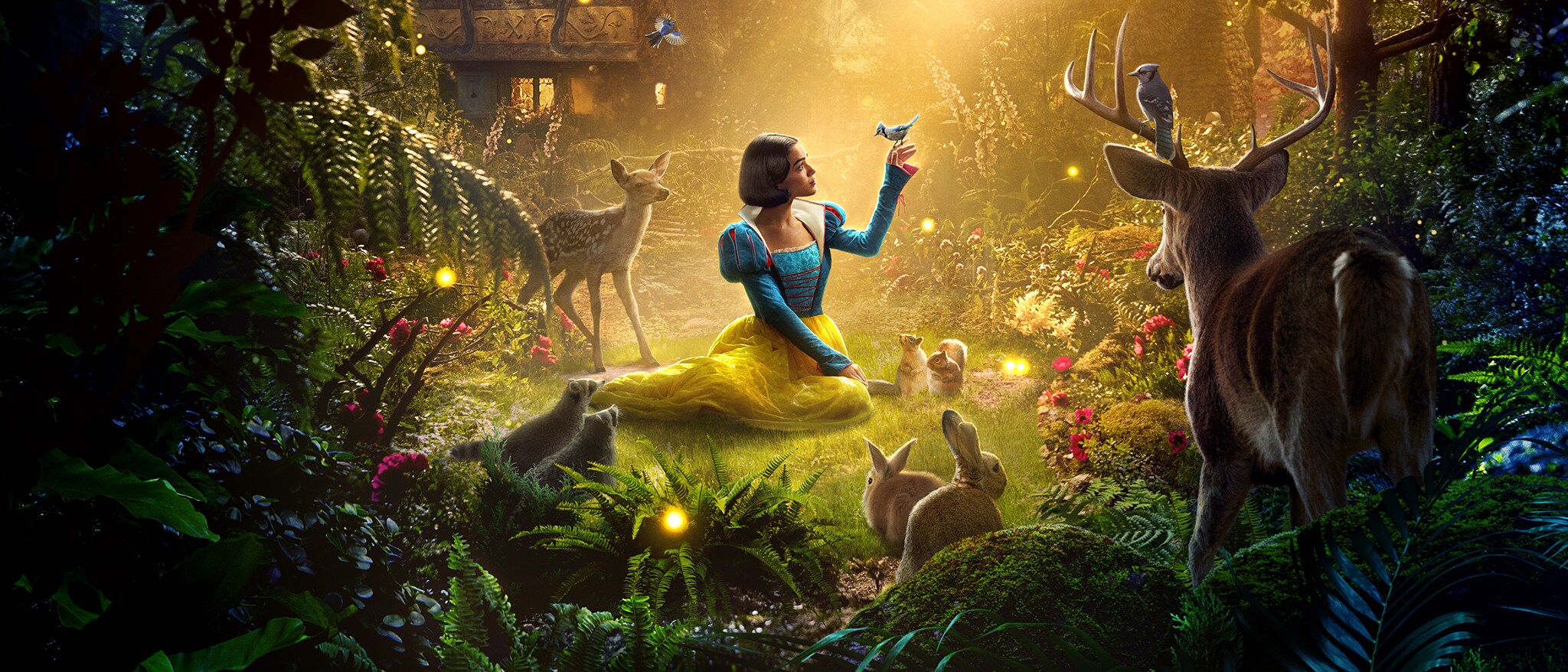
ICONIC BY MISTAKE · FULL MOVIE REVIEW · SNOW WHITE (2025) · SPOILERS AND RECEIPTS
Snow White (2025) Review: Rachel Zegler Survived a Movie That Never Stopped Defending Its Own Existence
Rachel Zegler brought a beating heart. The movie buried her beneath frightened updates, digital dwarfs, culture-war noise, and a villain performance from another zip code.
The verdict before the poisoned apple
Rachel Zegler is the reason this movie has a pulse, which makes the machinery surrounding her feel even more frustrating. And yes, I went back to Snow White confronting a kingdom that the screenplay describes more clearly than the camera ever makes tangible because I wanted to make sure I was not grading a memory instead of the movie sitting in front of me. Nope. The issue survived the replay. The remake wants political clarity, romantic revision, musical spectacle, visual familiarity, and corporate safety in the same two hours. Disney knew comparison came with the ticket. Nobody dragged the animated version into the room after the fact. The studio put the old songs, colors, names, poses, and emotional beats in every trailer because our memory was part of the marketing budget.
Here is where I start getting irritated. The result is not the disaster promised by people who decided to hate the casting before seeing a frame. The result is a nervous and frequently lifeless adaptation with one committed lead trapped inside the argument. That is not me insulting the crew. The crew clearly worked. Hair moved. Fabric moved. Digital light bounced off things that did not exist. Somebody probably spent three days fixing one ear. I respect that labor. I am judging the decision that all that labor was ordered to serve, because expensive and effective are not synonyms and Disney keeps acting surprised when we notice.
The receipt is Disney lists Marc Webb as director, Erin Cressida Wilson as screenwriter, and Pasek and Paul as writers of new songs. I am putting that right here because I am not doing the thing where a strong opinion floats three pages away from the evidence. The record tells us who made the choice and what the production said the choice was supposed to accomplish. Then Snow White confronting a kingdom that the screenplay describes more clearly than the camera ever makes tangible tells us whether the promise reached the screen. Sometimes yes. Sometimes absolutely not. Both answers can exist inside the same movie without me pretending the average is automatically good.
Watch the bodies in that sequence. Watch who gets to hesitate, who gets a reaction shot, who gets interrupted, and who only exists to confirm that the lead is correct. That is where Snow White (2025) quits talking about the update and accidentally shows what the update really values. A speech can say leadership all day. If nobody has a reason to follow, disagree, bargain, lose something, or change course, I am watching a slogan with costumes. Pretty costumes, probably. Still a slogan.
The sound gives away another problem. Disney knows exactly when the audience expects a melody, a swell, a joke, or the first three notes that will unlock somebody’s childhood. The easy move is pressing that button. The harder move is making the music belong to this performer in this version of this relationship. If the singer sounds scared of the score, if the arrangement does all the emoting, or if the camera cuts away from a face that should be carrying the number, I notice. I cannot unnotice.
I also refuse the fake choice between loving the original and allowing change. Change the whole thing if you have an idea. Move the point of view. Break the ending. Make the romance weirder. Let the villain be right about one uncomfortable fact. But do the work after the announcement. A modern line dropped into an old structure is not transformation. That is a sticky note. The story still has to absorb the idea until relationships and consequences look different.
Then we get to the image. Snow White confronting a kingdom that the screenplay describes more clearly than the camera ever makes tangible has to tell me where to look and what the character cannot say. Detail everywhere is not the same as meaning somewhere. A forest can have twelve thousand individually rendered leaves and still feel dead. A face can have perfect pores and no readable thought. A costume can be historically researched and emotionally wrong for the person wearing that costume. The camera is not a receipt by itself. The camera has to choose.
My little scorecard here is not complicated: did the character make a choice, did the choice cost anything, could the performer actually perform, did the song expose something, did the visual style help the emotion, and did the cultural material feel known instead of rented? Disney lists Marc Webb as director, Erin Cressida Wilson as screenwriter, and Pasek and Paul as writers of new songs Those facts answer the production side. Snow White (2025) still has to answer the human side, and brand recognition cannot take the exam for everybody.
Would this beat survive without the familiar title sitting above the poster? That is the rude question. Snow White confronting a kingdom that the screenplay describes more clearly than the camera ever makes tangible should create enough tension and personality to become somebody’s new memory. When the sequence only works because I remember how the drawing made me feel, the remake is charging itself for borrowed emotion and calling the loan revenue. I know the old movie. Disney made sure I knew. The new movie still has to show up.
So I landed where I landed: The result is not the disaster promised by people who decided to hate the casting before seeing a frame. Somebody else can love the scene. Fine. I am not raiding anybody’s Disney shelf. But “I liked the movie” cannot end a conversation that includes performance, culture, labor, technology, music, and a studio deliberately reselling its own history. I liked parts too. Then my ADHD kicked in, I opened the production notes, and now everybody has to look at the paperwork with me.
Rachel Zegler gives the movie a human center
Zegler sings with ease, listens in scenes, and gives Snow White an alertness that survives lines written to certify her modern credentials. I replayed the whole stretch to the early castle labor, the forest escape, and the moments when Snow White must decide whether fear changes how she treats another person because I wanted to make sure I was not grading a memory instead of the movie sitting in front of me. Her performance works because kindness arrives as behavior rather than a slogan.
Now I am annoyed. She is expressive enough to make the old fairy-tale emotions legible and grounded enough to resist the movie’s tendency to turn every value into a speech.
I checked the record, and the receipt is official production material identifies Zegler as Snow White and describes the character’s leadership arc. Then the early castle labor, the forest escape, and the moments when Snow White must decide whether fear changes how she treats another person tells us whether the promise reached the screen.
Look at who the camera allows to react.
My ears caught the next problem before my notes did.
Nobody needs to protect the original from change.
Now look at the actual frame. the early castle labor, the forest escape, and the moments when Snow White must decide whether fear changes how she treats another person has to tell me where to look and what the character cannot say.
I reduced the whole mess to six questions: did the character make a choice, did the choice cost anything, could the performer actually perform, did the song expose something, did the visual style help the emotion, and did the cultural material feel known instead of rented? official production material identifies Zegler as Snow White and describes the character’s leadership arc Those facts answer the production side.
Would anybody care about this beat without the logo? the early castle labor, the forest escape, and the moments when Snow White must decide whether fear changes how she treats another person should create enough tension and personality to become somebody’s new memory.
My answer after all that is She is expressive enough to make the old fairy-tale emotions legible and grounded enough to resist the movie’s tendency to turn every value into a speech.
A heroine should not need a corporate defense brief
The screenplay spends too much time proving that this Snow White is not waiting for a prince. Nobody asked the character to become passive, but agency becomes thin when every choice reads like a rebuttal to a press-cycle accusation. I paused and backed up to the repeated declarations about fairness and the late public uprising because I wanted to make sure I was not grading a memory instead of the movie sitting in front of me. A richer update would let leadership grow through relationships, error, labor, fear, and consequence.
This is the part that got on my nerves. The movie has the vocabulary of agency without always giving the heroine the messy dramatic process that makes agency feel earned.
Here is the named source for that claim: the studio synopsis explicitly foregrounds Snow White’s determination to liberate the kingdom. Then the repeated declarations about fairness and the late public uprising tells us whether the promise reached the screen.
Forget the press notes and watch the people.
Then the score starts doing emotional overtime.
I am not asking for a museum copy.
The picture has its own testimony. the repeated declarations about fairness and the late public uprising has to tell me where to look and what the character cannot say.
The test is embarrassingly simple: did the character make a choice, did the choice cost anything, could the performer actually perform, did the song expose something, did the visual style help the emotion, and did the cultural material feel known instead of rented? the studio synopsis explicitly foregrounds Snow White’s determination to liberate the kingdom Those facts answer the production side.
Take away the old song and what remains? the repeated declarations about fairness and the late public uprising should create enough tension and personality to become somebody’s new memory.
My notes end with the same blunt ruling: The movie has the vocabulary of agency without always giving the heroine the messy dramatic process that makes agency feel earned.
The dwarfs are a technology problem and a moral distraction
The seven digital companions look expensive, detailed, and fundamentally misplaced beside a flesh-and-blood lead. Their faces occupy the uncanny space between illustration and human mimicry. I watched that scene again to Snow White entering the cottage and sharing frames with seven photoreal fantasy bodies because I wanted to make sure I was not grading a memory instead of the movie sitting in front of me. The visual choice would already be distracting without the public argument about representation and employment that surrounded production.
And here comes the expensive nonsense. The movie wanted the brand recognition of the 1937 silhouettes and the legal distance of fantasy creatures. The compromise looks like a committee meeting rendered at enormous cost.
Before anybody calls that nostalgia, the record says official materials credit the familiar seven characters while contemporaneous reporting documented debate around their redesign. Then Snow White entering the cottage and sharing frames with seven photoreal fantasy bodies tells us whether the promise reached the screen.
Now watch who actually gets a decision.
The music tells on the movie.
Change was never the crime.
The visual argument is sitting right there. Snow White entering the cottage and sharing frames with seven photoreal fantasy bodies has to tell me where to look and what the character cannot say.
Here is my no-nonsense grading sheet: did the character make a choice, did the choice cost anything, could the performer actually perform, did the song expose something, did the visual style help the emotion, and did the cultural material feel known instead of rented? official materials credit the familiar seven characters while contemporaneous reporting documented debate around their redesign Those facts answer the production side.
If the childhood memory leaves the room, does the scene stand up? Snow White entering the cottage and sharing frames with seven photoreal fantasy bodies should create enough tension and personality to become somebody’s new memory.
So no, the polish did not change my mind: The movie wanted the brand recognition of the 1937 silhouettes and the legal distance of fantasy creatures.
Gal Gadot and the empty mirror
A fairy-tale villain can be heightened, theatrical, funny, terrifying, or all four. Gal Gadot plays the Queen with a rigid surface that rarely turns vanity into danger. I checked the sequence twice to the Queen addressing the mirror and later attempting to dominate the crowd because I wanted to make sure I was not grading a memory instead of the movie sitting in front of me. The mirror scenes need hunger and private panic because the Queen’s public power is built on terror of replacement.
This is where the pretty surface stops helping. The performance and direction keep presenting the outline of menace. Rachel Zegler reacts to a threat that the movie keeps promising rather than fully delivering.
The production trail gives us Disney identifies Gadot as the Evil Queen while the film frames her as both sorcerer and political ruler. Then the Queen addressing the mirror and later attempting to dominate the crowd tells us whether the promise reached the screen.
Look past the dialogue and follow the reactions.
Now listen to what the arrangement is covering.
Please change the story if somebody has an actual idea.
Now the expensive pixels enter the chat. the Queen addressing the mirror and later attempting to dominate the crowd has to tell me where to look and what the character cannot say.
I am not grading this on childhood loyalty: did the character make a choice, did the choice cost anything, could the performer actually perform, did the song expose something, did the visual style help the emotion, and did the cultural material feel known instead of rented? Disney identifies Gadot as the Evil Queen while the film frames her as both sorcerer and political ruler Those facts answer the production side.
Can this moment breathe without borrowing the animated version’s oxygen? the Queen addressing the mirror and later attempting to dominate the crowd should create enough tension and personality to become somebody’s new memory.
My final reaction is not complicated: The performance and direction keep presenting the outline of menace.
The new songs keep announcing the assignment
Pasek and Paul understand musical propulsion, yet several songs feel written to explain what the screenplay already underlined. I went back with the nostalgia turned down to Waiting on a Wish, Good Things Grow, and the Queen’s musical material because I wanted to make sure I was not grading a memory instead of the movie sitting in front of me. A musical number should reveal pressure, contradiction, or desire that ordinary speech cannot contain.
Now the remake starts testing my patience. Zegler can carry the melodies. The problem is dramatic placement. Too often the lyrics arrive wearing a name tag that says Theme.
The paper trail matters here: Disney’s production notes credit Benj Pasek and Justin Paul with original songs while preserving material from the 1937 film. Then Waiting on a Wish, Good Things Grow, and the Queen’s musical material tells us whether the promise reached the screen.
Pay attention to who owns the silence.
The vocal track creates a separate argument.
The old version is not holy scripture.
The camera cannot hide behind detail. Waiting on a Wish, Good Things Grow, and the Queen’s musical material has to tell me where to look and what the character cannot say.
My checklist fits on one sticky note: did the character make a choice, did the choice cost anything, could the performer actually perform, did the song expose something, did the visual style help the emotion, and did the cultural material feel known instead of rented? Disney’s production notes credit Benj Pasek and Justin Paul with original songs while preserving material from the 1937 film Those facts answer the production side.
Would this scene create a memory from scratch? Waiting on a Wish, Good Things Grow, and the Queen’s musical material should create enough tension and personality to become somebody’s new memory.
After the replay and the receipts, I am here: Zegler can carry the melodies.
The forest has animals but no danger
The 1937 forest sequence turns panic into expressionist horror before the animals restore scale and tenderness. The remake supplies realistic creatures and polished environments without matching that psychological transition. I ran the scene one more time to Snow White’s flight from the huntsman and first contact with the woodland animals because I wanted to make sure I was not grading a memory instead of the movie sitting in front of me. Photoreal surfaces are not automatically immersive when composition has stopped taking emotional risks.
Here is the part Disney cannot decorate away. The scene is readable, pleasant, and strangely weightless. The old hand-painted nightmare had more contact with terror than the new forest built from superior tools.
I did not pull that from fandom air. The record is Disney promotional art foregrounds the forest animals as a bridge to the animated iconography. Then Snow White’s flight from the huntsman and first contact with the woodland animals tells us whether the promise reached the screen.
Watch who moves and who merely agrees.
The song is where the remake has nowhere to hide.
I did not come here demanding the same movie twice.
The frame starts answering questions nobody asked aloud. Snow White’s flight from the huntsman and first contact with the woodland animals has to tell me where to look and what the character cannot say.
The movie has six jobs here: did the character make a choice, did the choice cost anything, could the performer actually perform, did the song expose something, did the visual style help the emotion, and did the cultural material feel known instead of rented? Disney promotional art foregrounds the forest animals as a bridge to the animated iconography Those facts answer the production side.
Remove the recognition. Does the drama still work? Snow White’s flight from the huntsman and first contact with the woodland animals should create enough tension and personality to become somebody’s new memory.
The verdict survived every rewatch: The scene is readable, pleasant, and strangely weightless.
Jonathan is not a prince and still feels underwritten
Replacing the prince with Jonathan avoids repeating an old courtship structure, but subtraction does not create chemistry by itself. I looked again because the first reaction was loud to Jonathan’s first clashes with Snow White and their later alliance because I wanted to make sure I was not grading a memory instead of the movie sitting in front of me. Romance needs specific curiosity, friction, pleasure, and vulnerability between two people.
This choice bothered me more on replay. The pair are likable. The relationship often feels scheduled, though, because the political plot and legacy beats take priority whenever the two might become genuinely strange or intimate.
The credit and intent check gives us official cast listings identify Andrew Burnap as Jonathan, a new character rather than the 1937 Prince. Then Jonathan’s first clashes with Snow White and their later alliance tells us whether the promise reached the screen.
Look at the scene without the inspirational sentence.
Then the familiar melody walks in carrying everybody’s childhood.
A remake is allowed to break things.
The image either carries the feeling or drops the feeling. Jonathan’s first clashes with Snow White and their later alliance has to tell me where to look and what the character cannot say.
I kept the standard basic on purpose: did the character make a choice, did the choice cost anything, could the performer actually perform, did the song expose something, did the visual style help the emotion, and did the cultural material feel known instead of rented? official cast listings identify Andrew Burnap as Jonathan, a new character rather than the 1937 Prince Those facts answer the production side.
If the poster had a new title, would the sequence still matter? Jonathan’s first clashes with Snow White and their later alliance should create enough tension and personality to become somebody’s new memory.
I kept trying to argue myself out of this conclusion: The pair are likable.
The production design cannot decide whether to breathe
Costumes and sets repeatedly quote the animated palette, yet the frame often looks flattened by digital finishing. I gave the scene another chance to the castle courtyard, forest cottage, mine, and final confrontation because I wanted to make sure I was not grading a memory instead of the movie sitting in front of me. A fairy tale does not require realism. A fairy tale requires a visual law that the audience can feel.
Now we need to stop pretending the budget is an answer. The film keeps the colors because audiences recognize them, then drains away the graphic confidence that made those colors powerful.
The official version of events is official production coverage describes deliberate reuse of design and musical history from the 1937 feature. Then the castle courtyard, forest cottage, mine, and final confrontation tells us whether the promise reached the screen.
Follow the power inside the blocking.
The soundtrack starts pressing the nostalgia button.
Nostalgia does not get veto power.
Now I need everybody to look at the composition. the castle courtyard, forest cottage, mine, and final confrontation has to tell me where to look and what the character cannot say.
My rubric is less complicated than Disney’s publicity tour: did the character make a choice, did the choice cost anything, could the performer actually perform, did the song expose something, did the visual style help the emotion, and did the cultural material feel known instead of rented? official production coverage describes deliberate reuse of design and musical history from the 1937 feature Those facts answer the production side.
Does the beat earn emotion or withdraw emotion from our old account? the castle courtyard, forest cottage, mine, and final confrontation should create enough tension and personality to become somebody’s new memory.
The movie had every chance to change my mind: The film keeps the colors because audiences recognize them, then drains away the graphic confidence that made those colors powerful.
A backlash is not a film review
The public campaign around Snow White swallowed the movie before release. Racist abuse aimed at Zegler, arguments about the dwarfs, political outrage, interview clips, and studio nervousness became a parallel production. I replayed the beat without the trailer in my head to the gap between the film on screen and the film imagined by online combatants because I wanted to make sure I was not grading a memory instead of the movie sitting in front of me. Critics still have to separate valid analysis from punishment campaigns that target a performer for existing in a role.
This is where my notes got rude. The movie has real problems. Rachel Zegler’s ethnicity is not one of them. A serious review can reject racist framing and still explain why the adaptation fails.
Here is what the production record actually gives us: AP and Variety documented the controversy, security concerns, release, reviews, and weak opening. Then the gap between the film on screen and the film imagined by online combatants tells us whether the promise reached the screen.
Watch whose face receives time.
The number sounds prettier than the scene feels.
I am fine with a new ending, new politics, and new rules.
The design choice becomes impossible to ignore. the gap between the film on screen and the film imagined by online combatants has to tell me where to look and what the character cannot say.
I asked six blunt questions: did the character make a choice, did the choice cost anything, could the performer actually perform, did the song expose something, did the visual style help the emotion, and did the cultural material feel known instead of rented? AP and Variety documented the controversy, security concerns, release, reviews, and weak opening Those facts answer the production side.
Can the scene survive without the audience finishing the feeling? the gap between the film on screen and the film imagined by online combatants should create enough tension and personality to become somebody’s new memory.
This is the ruling at the bottom of the page: The movie has real problems.
The ending mistakes declaration for transformation
The uprising gives Snow White visible political purpose, but the kingdom remains an abstraction populated when the finale needs witnesses. I checked whether I was being unfair to Snow White rallying the people and confronting the Queen because I wanted to make sure I was not grading a memory instead of the movie sitting in front of me. Political storytelling requires institutions, material conditions, alliances, and consequences, even inside a fairy tale.
Here is where the movie loses me. The ending tells us that leadership happened. Cinderella (2015) understood that a heroine’s moral clarity becomes meaningful through repeated tests. Snow White hands the same idea a microphone.
The claim has a source: the official synopsis frames the story around restoring the kingdom. Then Snow White rallying the people and confronting the Queen tells us whether the promise reached the screen.
Look at who is allowed to be complicated.
Music exposes the gap fast.
The source can handle criticism.
The visual system tells the truth. Snow White rallying the people and confronting the Queen has to tell me where to look and what the character cannot say.
The scorecard does not care how much the shot cost: did the character make a choice, did the choice cost anything, could the performer actually perform, did the song expose something, did the visual style help the emotion, and did the cultural material feel known instead of rented? the official synopsis frames the story around restoring the kingdom Those facts answer the production side.
What happens when nostalgia stops spotting the movie twenty points? Snow White rallying the people and confronting the Queen should create enough tension and personality to become somebody’s new memory.
I can like pieces and still say this: The ending tells us that leadership happened.
The box office is context, not a verdict
The movie’s reported cost and weak theatrical return matter because they reveal the scale of Disney’s bet and the damage created by uncertainty. I returned after reading the production notes to the contrast between detailed effects work and the cautious final whole because I wanted to make sure I was not grading a memory instead of the movie sitting in front of me. Money cannot prove whether a performance is good, but budgets can expose a production model that spends lavishly while sanding away conviction.
And now the corporate polish starts showing. The failure belongs to strategy, development, and execution. Treating one young actress as the face of a corporate misfire is cowardly accounting.
I brought the receipt because this part is factual: AP reported an opening around forty-three million dollars against a budget reported above two hundred fifty million. Then the contrast between detailed effects work and the cautious final whole tells us whether the promise reached the screen.
Now count the choices instead of the speeches.
Then the orchestra tries to do the acting.
I want the filmmakers to argue with the original.
The frame is where the sales pitch gets tested. the contrast between detailed effects work and the cautious final whole has to tell me where to look and what the character cannot say.
I am using the same test for every remake: did the character make a choice, did the choice cost anything, could the performer actually perform, did the song expose something, did the visual style help the emotion, and did the cultural material feel known instead of rented? AP reported an opening around forty-three million dollars against a budget reported above two hundred fifty million Those facts answer the production side.
Would a first-time viewer receive the whole emotional equation? the contrast between detailed effects work and the cautious final whole should create enough tension and personality to become somebody’s new memory.
The receipts brought me back to one answer: The failure belongs to strategy, development, and execution.
What Snow White should have trusted
The old story can support a modern reading of labor, beauty, authoritarian vanity, mutual care, and leadership without apologizing for being a fairy tale. I watched again with the old movie out of reach to Snow White cleaning alongside the dwarfs, sharing food, singing, grieving, organizing, and choosing how to govern because I wanted to make sure I was not grading a memory instead of the movie sitting in front of me. The strongest path was deeper specificity rather than louder correction.
This is where I stopped being generous. Keep Zegler. Keep the songs that expose private longing. Give the Queen psychological danger, give Jonathan a life, let the dwarfs occupy one visual world, and let kindness become costly enough to mean something.
The file behind the opinion is the 1937 film remains the explicit source named across Disney’s own materials. Then Snow White cleaning alongside the dwarfs, sharing food, singing, grieving, organizing, and choosing how to govern tells us whether the promise reached the screen.
Watch where the camera places sympathy.
The vocal choices deserve their own side-eye.
A remake should make dangerous choices.
Now the lighting and faces have to do their jobs. Snow White cleaning alongside the dwarfs, sharing food, singing, grieving, organizing, and choosing how to govern has to tell me where to look and what the character cannot say.
Here is the test I refuse to soften: did the character make a choice, did the choice cost anything, could the performer actually perform, did the song expose something, did the visual style help the emotion, and did the cultural material feel known instead of rented? the 1937 film remains the explicit source named across Disney’s own materials Those facts answer the production side.
Does the new version own this moment yet? Snow White cleaning alongside the dwarfs, sharing food, singing, grieving, organizing, and choosing how to govern should create enough tension and personality to become somebody’s new memory.
My patience, nostalgia, and research all ended here: Keep Zegler.
Receipt ledger
- Comparison rule: recognition is part of Disney’s sales pitch, so the animated source belongs in the review.
- Craft rule: criticism of a finished movie does not erase the labor of performers, animators, designers, technicians, musicians, or crew.
- Evidence rule: production claims are linked to studio or trade reporting; interpretation is labeled as CVM Sekai analysis.
- Spoiler rule: the full film is discussed because endings, omissions, and rearranged relationships are central to the argument.
Sources and production credits
Release, cast, filmmaker, music, production, and distribution facts were checked against the linked official Disney pages, filmmaker interviews, guild or studio craft materials, and contemporaneous reporting. Box-office figures are contextual evidence rather than a substitute for criticism. All scene readings, comparisons, judgments, and conclusions are original CVM Sekai editorial analysis.
Keep exploring
Return to the Animation Library hub for characters, animation, franchise branches, reviews, rants, and guides.