
The Spinning Wheel
Aurora did not fail a test. Every adult kept the study guide from her.
The room is not inviting Aurora because it is beautiful
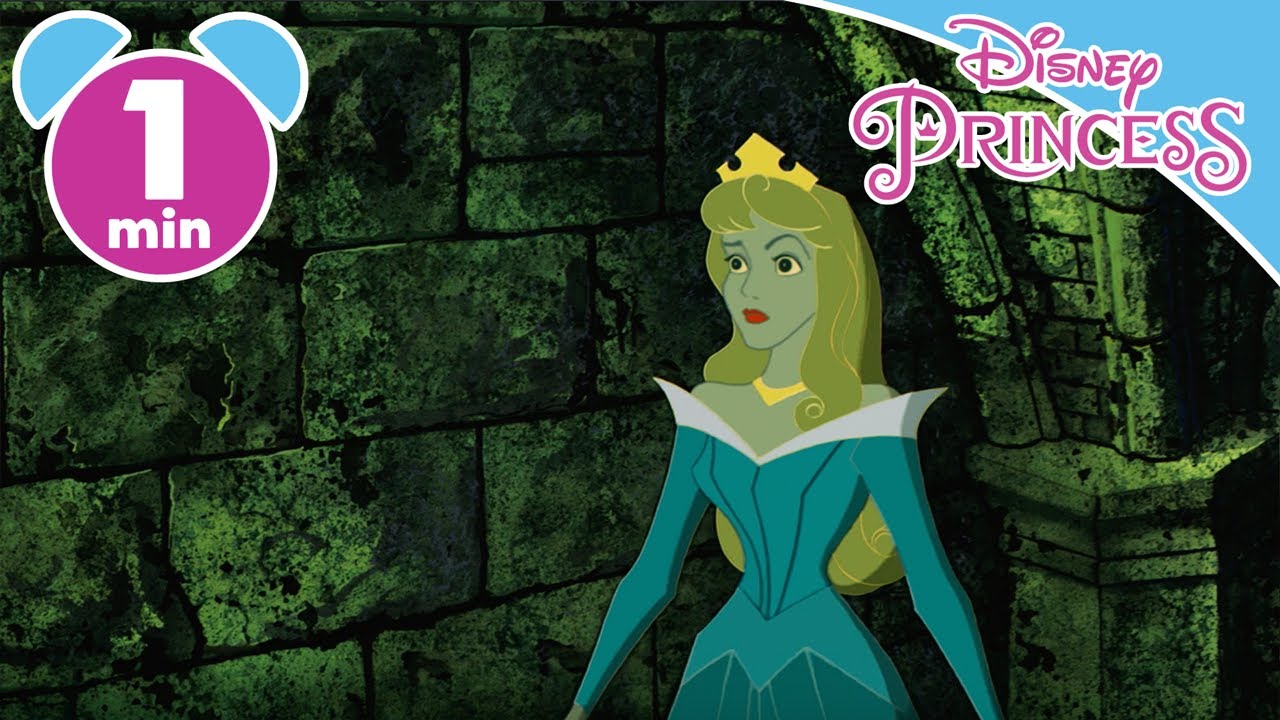
The tower is stripped of ordinary comfort. It is narrow, shadowed, and reached through a route that separates Aurora from every person trying to protect her. The spinning wheel sits there like the only clear object in a nightmare. Aurora does not enter because she suddenly wants to sew. Maleficent has taken control of her attention and movement. The scene is frightening because the body continues while the self appears locked somewhere behind it. That distinction matters. Curiosity did not cause this. Disobedience did not cause this. A powerful adult targeted a child and removed her ability to refuse.
The green light is coercion made visible
Maleficent rarely needs to grab Aurora with her hands. The sick green glow travels through the corridor, fills Aurora’s eyes, and turns command into atmosphere. Violence becomes something the entire room is breathing. The color makes mind control legible without requiring Aurora to explain an experience she cannot interrupt. Her blank expression is not consent or fascination. It is evidence that her will has been displaced. Disney gives the sequence very little dialogue because the image already tells us the central fact: Aurora is present, but she is not free.
Aurora has already been emotionally shattered before the spell takes her
Minutes earlier, she learned that Briar Rose was an invented identity, her guardians were fairies, her parents were alive, and the man she chose could not be part of her future. She arrives at the castle carrying grief and disorientation. Maleficent exploits a person whose entire understanding of home has just collapsed. The spell is supernatural, but the targeting follows a painfully recognizable pattern. Control becomes easier when someone has been isolated from trusted voices and denied time to process. The film never blames Aurora for that vulnerability. It shows how adults created it, then lets another adult weaponize it.
Sixteen years of secrecy fail in one private room
The fairies built an elaborate protection plan around geography, false names, banned magic, and social isolation. They focused on keeping Maleficent from locating Aurora and gave much less attention to preparing Aurora to recognize manipulation. A safety plan that depends on permanent ignorance becomes fragile the moment the protected person must act alone. Aurora cannot understand the curse, the spindle, or the political danger because all three were deliberately hidden from her. The tragedy is not that the fairies cared too little. They cared deeply. The tragedy is that love organized entirely around concealment did not build informed resistance.
Maleficent turns the prophecy into theater
She could treat the curse like a remote mechanism, but she stages the fulfillment. There is a procession through the castle, a forbidden tower, a single wheel, a glowing spindle, and an audience of horrified fairies arriving too late. The spectacle is part of the punishment. Maleficent wants the guardians to see that their sixteen years of labor end at the exact moment she named. She is not only harming Aurora. She is forcing everyone else to witness her authorship. That appetite for recognition links the curse to the original insult. Maleficent was excluded from a ceremony, so she makes herself impossible to exclude from the story that follows.
The spindle is ordinary labor turned into a weapon
A spinning wheel belongs to textile work, domestic production, and the long history of women turning fiber into usable cloth. The curse converts that tool into a threat so dangerous that the kingdom destroys every wheel it can find. The object becomes uncanny because it should be useful. Its danger is not in its natural function but in the power imposed upon it. That makes the sequence more unsettling than a random magical blade would be. An everyday instrument carries the violence, while the person who designed the violence can remain physically absent until she claims victory.
The kingdom’s first response was mass destruction, not education
King Stefan orders the spinning wheels burned. The bonfire looks decisive, but it treats objects as the problem and leaves the underlying aggressor untouched. Nobody appears to tell Aurora what a wheel looks like or why one surviving spindle matters. Removing hazards can be necessary. It is not the same as giving a person knowledge, language, and a plan for the moment removal fails. The kingdom chooses a visible display of control because it feels more reassuring than admitting control is incomplete. Maleficent only needs one hidden wheel to expose the weakness in that strategy.
The fairies arrive with information Aurora needed earlier
Flora, Fauna, and Merryweather finally shout for Aurora to stop, but the warning reaches a person already captured by magic. Their panic reveals how much they understand and how little of that understanding they shared with her. The sequence is brutal because the audience can imagine a different version. Aurora could have known about the curse, recognized the wheel, and had language for the green light before Maleficent isolated her. Magic might still have won, but secrecy would not have been doing part of its work. Protection without explanation has left the target responsible for a danger she was never allowed to name.
Aurora’s hand becomes the last battlefield
The scene narrows from castle corridors to a finger moving toward one sharp point. That compression makes the curse feel both enormous and intimate. A political grievance, a royal celebration, and sixteen years of fear all converge on a tiny physical contact. Aurora’s hand hesitates just enough to remind us that a person remains inside the trance. The pause creates hope without turning the final motion into her choice. When the finger touches the spindle, the film is not showing temptation rewarded. It is showing coercion reaching its designed endpoint.
Maleficent speaks through absence until the reveal
Her voice guides Aurora before her full figure dominates the room. That separation makes her power feel less like one body and more like an invasive system. She can occupy the castle without walking openly through its halls. Once the curse is fulfilled, she appears to savor the fairies’ failure. The reveal is not necessary for the spell. It is necessary for her ego. The villain who began from exclusion still needs witnesses. Triumph without recognition would not satisfy the wound she has converted into ideology.
Aurora’s silence should not erase her from the analysis
The film gives the fairies the rescue work, Phillip the battle, and Maleficent the active threat. Aurora spends the central crisis unable to speak or move freely. It is easy for commentary to discuss everyone around her and forget the violated person at the center. Her limited agency is a legitimate criticism of the narrative. It should not become a second disappearance where viewers treat her as furniture because the spell does. The scene asks us to hold both truths: Aurora has been underwritten, and what happens to her is still emotionally and ethically important.
The curse punishes a daughter for a father’s guest list
Aurora did not organize the christening. She did not exclude Maleficent, insult her, challenge her, or even exist as a conscious participant in the dispute. The curse chooses her precisely because hurting a child will hurt the adults who possess political power. That is the logic of retaliatory violence. The vulnerable person becomes a message delivered to people who are harder to attack directly. Maleficent dresses the message in elegant language and ritual certainty, but elegance does not make the target selection less monstrous.
The fairies change death to sleep and still leave a consent problem
Merryweather cannot erase the curse, so she changes its ending. Aurora will sleep rather than die, and true love’s kiss can wake her. This is an act of care inside terrible constraints. It also transfers the final condition of Aurora’s recovery to another person’s action while she is unconscious. The fairy-tale mechanism predates modern discussions of consent, but modern viewers do not have to pretend the discomfort is invisible. A rescue can be narratively benevolent and still expose how rarely the story lets Aurora control what happens to her body.
Putting the kingdom to sleep spreads the consequence
After Aurora falls, the fairies place the castle under sleep so she will not awaken alone in a world that moved past her. The choice is tender and wildly authoritarian at the same time. Nobody else gets consulted. The spell turns private harm into collective suspension. Servants, guests, guards, and family lose time because the royal household cannot bear the emotional consequences of remaining awake. Fairy tales make power look kind by giving it comforting motives. The scale of the act deserves to remain visible even when the motive is compassion.
The visual design refuses cozy darkness
Eyvind Earle’s angular architecture and vertical forms make the tower feel like a trap drawn with a ruler. The shadows do not soften edges. They sharpen routes, isolate Aurora’s silhouette, and make each stair seem predetermined. The color palette also protects the film from becoming a pastel princess postcard. Acid green, black, stone gray, and flashes of violet tell us this world contains beauty without safety. The sequence is one reason Sleeping Beauty’s design remains more psychologically interesting than Aurora’s small amount of dialogue might suggest.
The music removes ordinary time
As Aurora walks toward the spindle, the score stretches the moment instead of racing through it. Repetition and sustained tones make the corridor feel detached from clocks, conversation, and human pace. That altered rhythm resembles dissociation. The world continues, but normal sequence and choice no longer feel available to the person moving through it. Music does not merely announce that something scary is happening. It places the viewer inside a pattern that seems impossible to interrupt.
The fairies’ small size makes their panic hurt more
They rush behind Aurora with all the urgency they can summon, yet the architecture dwarfs them. The same guardians who managed an entire hidden childhood suddenly look physically unable to close the distance. Their helplessness is partly Maleficent’s power and partly the result of arriving after information can still help. The film makes both facts visible without stopping to explain them. Love is running up the stairs. Love is also late.
The scene is about grooming without pretending every detail is realistic
Maleficent isolates Aurora, uses a soothing command, controls the environment, narrows available attention, and leads her toward harm while presenting obedience as inevitable. The mechanism is magic, but the pattern is recognizable. Calling the pattern recognizable does not mean reducing real abuse to a fairy tale. It means noticing why the sequence unsettles viewers beyond fear of a sharp object. The horror comes from watching someone’s trust in her own perception get replaced by the instructions of a person who intends harm.
Aurora cannot fail a test she was never allowed to study for
Some readings treat the spindle as a forbidden-object lesson, as if the princess loses because she touches what she should avoid. That interpretation requires information the character does not possess and freedom the scene explicitly removes. There is no moral victory available through better manners. Aurora is entranced. The wheel was hidden. The adults built the danger around her before she could speak. The correct question is not why she touched it. The correct question is why everyone with power accepted a plan that kept her uninformed.
The curse fulfilling itself does not prove fate is neutral
Prophecy stories can make outcomes feel natural because viewers know them in advance. Yet this outcome was authored by Maleficent, modified by Merryweather, and enabled by a chain of adult decisions. Calling it destiny can launder responsibility. Specific people made choices that shaped the route to the tower. The scene is stronger when we resist fatalism and keep asking who benefited from secrecy, who imposed the condition, and who paid for it.
Aurora’s collapse is not the end of her emotional story
The image of the sleeping princess can turn Aurora into a completed object, as though the curse has frozen everything she felt before entering the tower. It has not. The betrayal, the forest romance, the shock of meeting her parents, and the loss of Briar Rose are all waiting with her. Waking her body cannot automatically organize those experiences. A genuine happy ending would require time, truthful conversation, grief, and the freedom to decide which parts of both identities she wants to keep. The film moves from awakening to celebration because fairy tales love restored order. Aurora deserves restoration that belongs to her, not only to the kingdom.
RaeRae’s final reaction
The spindle scene makes me furious because Aurora is blamed by the shape of the fairy tale for a choice she never makes. She is heartbroken, isolated, hypnotized, and led toward an object nobody bothered to explain. Then the story lets one tiny touch stand in for sixteen years of adult mistakes. Maleficent is serving theater, I will give her that. The corridor, the green light, the creepy wheel waiting in the dark, and the reveal after the fairies arrive are villain production design at an unreasonable level. She still cursed a baby over an invitation, so the cape is not getting her acquitted. What stays with me is the fairies running behind Aurora and realizing love cannot outrun withheld truth forever. They protected her body for sixteen years. They did not prepare her mind for the day the secret ended. That is the tragedy hiding underneath the magic.